Category Archives: Comics

Omnireviewer (week of Jun. 26, 2016)

23 reviews. Again!

Literature, etc.

Matt Fraction & Chip Zdarsky: Sex Criminals, Volume 3 “Three The Hard Way” — I love this comic so, so much. I love how it manages to be deeply insightful about modern sexuality and relationships, while also being hilariously immature. There’s an issue in this collection that pretty much offers a microcosm of the whole comic. The story intercuts a lecture, given in a lecture hall, about feminism and the suppression of female sexuality with a scene where the protagonists fight a character that is honest to god actually referred to as a “semen demon.” It is exactly as head-spinning as it means to be. Also, Jon and Suzie continue to have possibly the most believable relationship in current serialized fiction. The supporting cast is really getting fleshed out now as well. If I have one complaint, it’s that in two subsequent issues, Fraction avoids writing a difficult scene by going meta. The first time it happens, it’s brilliant and contains some top-notch Zdarskyana, but when it happens again one issue later, you can’t help but think that Fraction’s using the jokey tone of the book to avoid specific writing challenges. It’s a minor quibble, though. I love this comic so, so much.

Music

SebastiAn: Total — Having spent a fair bit of time with Justice at this point, I was exceedingly happy to listen to some dance music with less shitty mastering. Which is only halfway a dig — I still love both of those albums. I love this, too. M.I.A.’s guest vocal was always going to be a high point, but I also love “Jack Wire,” “Love in Motion” and of course “Tetra,” because I love anything vaguely Baroque-sounding. There will be more listens in the future.

Yes: Relayer — Another old friend. I spent many years liking this more than Close to the Edge, but I can’t say I did this time. It’s really wonderful, no question. But Jon Anderson’s lyrics on “Gates of Delirium” are, if anything, a little too comprehensible. Almost trite, in places. I love him best at his most obtuse, and his most indifferent to grammar. Which is not to say there’s not great stuff in there: “burn their children’s laughter on to hell” is a compelling line, for instance. And the entire outro — “Soon,” as it’s called in its single edit — is one of the most beautiful moments in the Yes discography. “Gates of Delirium” in its entirety is possibly the farthest point out on the thin peninsula of post-60s Flower Power. Anderson apparently wrote the bulk of it at a piano, but you can imagine most of it strummed on an acoustic guitar, sung to an audience of Vietnam war protesters. I do think Relayer has a better side two than Close to the Edge, though. Patrick Moraz’s playing on “Sound Chaser” might be the best keyboard performance on any Yes recording. And “To Be Over” is pure catharsis. Speaking of catharses, I saw Jon Anderson on a solo tour shortly after he’d been booted out of Yes. He’d been in the hospital the previous night for a resurgence of his respiratory ailment. It was October in Edmonton: not really the best place for a person in delicate health to travel to. But he sang beautifully. He even managed to pull off “Long Distance Runaround” transposed up a couple semitones, because he’d forgotten to take his capo off. He could only last about half an hour, but when the audience gave him an ovation, he came back out and sang “Soon,” which he said is the song he’d written that had been the most helpful to him throughout his life when he needed to heal from something. It was a hell of a moment. I think of it every time I listen to this.

Fiori-Séguin: Deux cents nuits à l’heure — I can’t speak to how this record is remembered in French Canada, but in my neck of the woods, this collaborative record by Harmonium’s Serge Fiori and the songwriter Richard Séguin is entirely forgotten. Which is a shame, because, it’s probably the best Canadian prog album I’ve heard that isn’t by Harmonium or Rush. The pair of them both have great voices: Fiori’s being more strident and Séguin’s being a bit more fragile. And their songwriting style is entirely complementary, and lent cohesiveness by the arrangements, written by Harmonium’s road band. Every track on this is great. It bears a certain resemblance to Harmonium’s L’Heptade, but it’s lighter. I’d highly recommend this to anybody who likes the more pastoral side of prog — early Genesis, Fairport Convention, the Pentangle, or even the Canterbury scene. This is the definition of a buried gem.

Games

The Walking Dead: Michonne: Episodes 2 & 3 — This has everything that the previous seasons of the Walking Dead game has: great characters, fantastic writing, a gripping story and somewhat superfluous combat. Yet it isn’t as successful as it predecessors. The weakest part of this mini-season is the addition of a psychological horror element. Normally, I’d be all for that. And it does illustrate the effects of Michonne’s emotional trauma. But the actual deployment of the psychological horror is the same as in pretty well every game ever, which is that the camera shakes and changes colour to differentiate a hallucination from reality. In its most effective moments, Michonne jumps between reality and somewhat fanciful flashbacks by hard cuts. Whenever other devices are used, it gets a little clichéd. I’d still recommend it if you like the series and can find it on sale.

Jazz Jackrabbit — There are shreds of my childhood that I can’t quite get ahold of as an adult, because they fall outside the narrative of my life that I’ve spun for myself. I recall that as a child, I was not allowed to play games like Jazz Jackrabbit: a PC platformer that shamelessly rips off both Sonic the Hedgehog and Super Mario Brothers in equal measure. And yet, I clearly did play it. When I was a kid, computer games were a matter of what my mother deemed edifying and what my father deemed affordable. On my mother’s authority, I played mostly Learning Company edutainment games. They ranged from unimaginative (Treasure Cove) to pretty compelling (Gizmos and Gadgets) to treasures of the PC gaming canon (Where in Time is Carmen Sandiego?). An honourable mention ought to go out to Sierra’s The Incredible Machine 3, which remains a game I wish I could find a way to play again. These occasionally limp but well meaning programs are the video gaming experience that I have chosen to define my childhood. Together, they represent a substantial moment in the origin story of the persnickety infosponge that I’ve grown into. But on my father’s side of the equation, there was an entirely different and equally prevalent experience: games like Hugo’s House of Horrors, Heroes: The Tantalizing Trio, and Skunny: Return to the Forest. These were shareware titles, often made by tiny DIY studios, that my dad had no idea were moderately to substantially subversive. What mattered is that they were cheap. They came 50 to a disc, and those discs couldn’t have cost more than a few bucks apiece. Jazz Jackrabbit was one of the better executed and more conventional of those games. Revisiting it now on the Internet Archive brought back a wave of the best kind of nostalgia — nostalgia for something you’d nearly forgotten. Something you’d intentionally forgotten, wrongly. 

Television, etc.

Don’t Hug Me I’m Scared — Oh jeez. Pretty much at a loss, here. This is thoroughly unsettling and mysterious, and I am not likely to put it all together in the near future.

Last Week Tonight: June 26, 2016 — The Brexit debrief outshines the doping scandals feature, but I’m not complaining.

Game of Thrones: “The Winds of Winter” — If not for the first few minutes this would be a typically un-‘splody Game of Thrones finale. But that opening sequence, I tell ‘ya. It unfolds with all the clockwork inexorability of its Philip Glass-inspired score (the reprise of which at Cersei’s coronation is ingenious). The fallout of that opening sequence (pun intended) is brilliantly portrayed. And from there, this episode contents itself with watching the dust settle. And that’s a mode that I especially love in Game of Thrones: people examining the consequences of things. That scene with Daenerys and Tyrion is just a shimmering gem. It feels like the flipside of the famous trial scene from season four, and it can join that scene among Peter Dinklage’s best moments. Taken in combination with the previous scene with Dario, it’s one of Emilia Clarke’s best as well. And Lena Headey, my perpetual favourite cast member, finally gets to revert to evil mode. How gratifying. This is a great finale to a season that turned out shockingly well, considering its weak start and the low calibre of the season that preceded it. Game of Thrones is over for another year (or whatever), yet I’m starting to feel like it’s back.

Orange is the New Black: Season 4, episodes 5-13 — Boy does this season ever hold its cards close to its chest. Nearly everything that happens in the first ten episodes is part of a huge invisible clockwork machine that’s setting up the events of the last three. Like every season of this show, there’s plenty here to shock and appall and move you. There’s an almost unfair number of excellent performances in it. But what sets it apart is the way that the various seemingly unrelated components of its story are all set up to lead inexorably to a conclusion. The way that this season examines consequences of decisions that are made on an institutional level — the macro story feeding into the micro story — reminds me of nothing more than The Wire. That’s maybe most obvious in Sophia’s storyline, which is remarkably the most dramatic that character has ever had, even though Laverne Cox gets substantially less screen time than in any prior season. Having a central character’s season-long arc occur nearly entirely offscreen is a masterstroke, and it’s only one of many. I’m trying to decide whether I like this better than season two. I have rosy memories of that season, but thinking back, it’s mostly just Suzanne’s arc that I’m attached to. Every strand of season four is extraordinary. I’m really happy we’re getting at least a few more seasons of this, because it seems far from tired out. Pick of the week.

Podcasts

WTF with Marc Maron: “Neil Young” — Neil’s in an obliging mood for this one, which is good. Because on an ornery day, he would have eaten Maron alive. As a Neil Young fan, there are a lot of moments where I felt like a great question was staring Maron in the face and he didn’t ask it. But for the most part, this is an engaging conversation that even touches on some of the less well-regarded stuff in Neil Young’s catalogue (Trans, Everybody’s Rockin’). It also made me halfway think I should probably listen to his new album. It sounds ambitious, if nothing else.

Pop Culture Happy Hour: “Small Batch” The Outs with Adam Goldman” — The Outs sounds great, but I will likely not get around to watching it. On the other hand, hearing Glen Weldon interview somebody is fun.

The Gist: “Billboard Hits From 1964” — I’m really getting into this show. This episode is a lot of fun, focussing as it does on the British Invasion in the week of the Brexit. I have an infinite capacity for Beatlemania chart statistics, but I do suspect that many people who don’t might also enjoy this. Also, in Pesca’s post-Brexit breakdown, he makes the single most gratuitous Yes reference I’ve ever heard. (Actually, to be specific, it’s not even a Yes reference — it’s an Anderson Bruford Wakeman Howe reference, which is way geekier.) That makes me wonder what references in the other episodes I’ve heard flew past me.

Theory of Everything: “sudculture (part II of II)” — It’s ToE at its most straightforward, but sometimes that’s a good thing. This nicely problematizes elements of the craft beer revolution, like the herd mentality beer bros who will follow delivery trucks from one liquor store to the next so they can stockpile small batch sours and IPAs. The most interesting moment comes near the end when a pair of craft brewers talk about the time their art professor asked them if brewing was art. Which, firstly, fuck anybody who thinks that’s even a worthwhile question. That professor sounds like an insufferable professor. But their response that producing a good flavour can’t be an art because it’s supposed to be straightforwardly pleasant is compelling. And I’m inclined to agree, if only because they’re right to place the power to answer that question in the hands of the audience (the beer drinker) rather than the artist (the brewer). The production of beer may be as subtle and complex as painting or sculpting, but the optimal response is different. And while that prof is still an asshole for bringing it up, at least it gave Benjamen Walker an opportunity to end the episode on a really ToE note.

99% Invisible: “Home on Lagrange” — This is one of the best episodes they’ve done in ages. It’s about Gerry O’Neill, the scientist who made actual designs for human settlements in space. And rather than straightforwardly tell his story, the 99pi crew offers up a kaleidoscopic vision of all of the inspirations and implications of his work, including his intellectual offspring in the modern world. Fascinating.

Code Switch: “I Don’t Know If I Like This, But I Want It To Win” — I hope we get more of Gene Demby and Kat Chow co-hosting this show. I know them both from Pop Culture Happy Hour, and to some extent, this is just that with PCHH’s three regulars excised. It’s good to know that there will be pop culturey episodes of Code Switch, because this is really good. And the thing that sets it apart from other pop culture shows is that it’s a story. Kat Chow takes us through this crazy saga of Asian-American television, wherein an Asian-American critic, Jeff Yang, writes a review that’s credited with the cancellation of All-American Girl, a not-very-good sitcom about an Asian-American family. In the risk-averse television industry, an event like that can have terrible consequences. Namely, there were no more network television shows starring predominantly Asian casts for 20 years. The next one to be greenlit was the currently-running Fresh off the Boat, which in a drastic twist of fate, stars Jeff Yang’s 12-year-old son Hudson. You couldn’t make that up. The interviews with both Yangs are totally compelling and raise interesting questions about how a critic should deal with television that reflects a possible positive change in the industry, but just isn’t very good.

Song Exploder: “CHVRCHES – Clearest Blue” — This isn’t one of the most interesting episodes I’ve heard, but this is a great song, and it was fun to hear CHVRCHES talk about the rules they established for themselves when they were writing this — it should be laid back, and have only two chords — which they swiftly broke.

All Songs Considered: “New Mix: Bellows, Cornelius, Keaton Henson, A-WA, The Wild Reeds, More” — This contains a lot of music that I don’t especially care to hear again, but I’m glad I heard once. I think I may have written this exact review before…

In Our Time: “Songs of Innocence and Experience” — I’ve decided I love this show. I’ve decided that because I’ve realized that it’s the only podcast I’ve ever listened to that never condescends to me. Jad Abumrad, Ira Glass, and even more idiosyncratic hosts like Benjamen Walker and the Reply All guys all present stories in a way that assumes limited knowledge in the audience. But in lots of areas, my knowledge is not especially limited. Melvyn Bragg is the opposite of everything that North American media types think of as a good radio host — he interrupts his guests, he opines, he’s not afraid to show off his own knowledge, and he mumbles. In short, he’s an intelligent person first, a radio personality second. (Probably the closest thing to Melvyn Bragg in American media is Mike Pesca, and even he feels the need to throw in dodgy jokes and a dumb signoff phrase.) In Our Time is uncompromisingly smart, and probably really alienating to a lot of people. It’s pretty much my ideal for what public broadcasting should be like. This episode on William Blake demonstrates everything that I find enthralling in this show. It tackles ideas head-on without sugar coating them, and takes for granted that its subject matter is interesting, which of course it is. I hope the BBC recognizes what it has here. This sort of thing is what makes it the best public broadcaster in the world. Pick of the week.

Love and Radio: “The Neighborhood” — I love hearing non-standard, non-narrative approaches to audio production. This collage is the sort of impressionistic thing that I can only take in small doses, but it’s pretty brilliant, actually. Scott Carrier has a great ear for interesting tape, and that’s enough to carry this short piece about the neighborhood where he lives. Maybe I need to start listening to Home of the Brave. Grumble. Another one. Great.

StartUp: “Up in Flames” — This season has picked up rather dramatically. This story is told in a very NPR fashion — interviews, narration, music and basically no field tape — but the story is incredible. It’s about a man whose business decisions drove him out of his mind, so he burned down his yogurt factory. You should listen to this.

Pop Culture Happy Hour: “Finding Dory and Great Voice Acting” — Stephen Thompson’s 11-year-old daughter is one my favourite minor characters on this show (along with Glen Weldon’s husband Faust, and producer Jessica Reedy). At the start of this episode Thompson refers to her as a “sullen crank,” which is a hilariously aggressive descriptor for one’s own daughter. It’s the little things that make this podcast.

Invisibilia: “The Personality Myth” — This is an hour of radio about how people don’t have fully fixed personalities and how it’s all actually very much more complicated than that. I was unaware of the specifics, but I think that when you listen to a lot of podcasts and just generally consume a lot of media, at some point you become inured to the idea that things are more complicated than they seem. So, when somebody tells you that, you just sort of say “oh, of course,” and get on with your day. I reached that point about seventeen Radiolabs ago. So, unless a given commonly-held belief is oversimplified in a really interesting way, I kind of don’t see why I should listen. And this episode explores the notion of fundamental human change in the most predictable way possible: through the lens of incarcerated criminals. Maybe I’m just Orange is the New Blacked out, but that seems facile to me.
Omnireviewer (week of Jun. 12, 2016)

29 reviews. A week of awesome music. Mostly.

Music

The Punch Brothers: The Phosphorescent Blues — Come to think of it, I listened to this when it first came out, loved it, and never listened to it again. Well, now I’ve listened to it again. It’s more ambitious and more polished than Who’s Feeling Young Now? but it’s also a bit slicker than anything they’ve done before. Drums make their first appearance, and there’s a general sense that when they’re not doing ten-minute prog tracks, they’re trying to be bluegrass Coldplay. Maybe that sounds like a dig, but bluegrass Coldplay sounds like a more appealing proposition to me than regular Coldplay. The lyrics’ obsession with smartphones, and whether or not we’re still capable of connecting, or living in the moment is a bit cliched, and the Punch Brothers don’t really have anything meaningful to add to the discussion (nobody does), but that’s not what anybody wants from any band, or shouldn’t be, at least. I don’t like this as much as Who’s Feeling Young Now? but “Familiarity” and the midsection of “Julep” are selling points for this band in themselves.

IQ: The Seventh House — It’s been a long time since I listened to anything like this. I really only ever listened to neo-prog when I was at my most prog-obsessed, maybe ten years ago. These days, I tend to think of prog as a moment — a moment that lasted from about 1969 to 1977 — and my exploration of it tends to go deep into that time period, rather than broadly across others. It’s not that I think nothing of value has been done in prog since then. But there’s a point where it became a “genre,” with tropes of its own to be imitated, rather than a dispersed music that takes cues from elsewhere. And that point was around the beginning of IQ’s career. Still, I really enjoyed The Seventh House. I remember hearing “The Wrong Side of Weird” on ProgArchives years ago, and loving it, and it totally holds up. Prog may have been a moment, but neo-prog of IQ’s vintage was too. Bands like IQ and Marillion come very much from the same context as new wave, and it’s fun to hear a take on prog that shares that characteristic directness with the Smiths or Joy Division. Yes, I know The Seventh House was made in 2000, but it’s quantifiably different from the nostalgic symphonic prog that younger bands were making at that time. Given the choice between IQ and a band like the Tangent, whose music is far more similar to classic 70s prog, I’ll take this.

Big Big Train: Folklore — Speaking of. Big Big Train is very much on the Tangent side of that line. I won’t say there weren’t parts of Folklore that I liked. I’ll probably listen to parts of it again. (I know there are prog fans out there who’ll tell you that you can’t get a handle on a prog album on the first listen, and I think that’s true for the really good stuff. Certainly, I’m still finding new angles in Relayer hundreds of listens in. But this is not Relayer.) It’s got some great playing, nice orchestrations that aren’t overbearing, good singing, the whole bit. But part of the reason that I like prog better than lots of other kinds of music is that I want to form relationships with the musical personalities involved in the records I listen to. I don’t love Steve Howe for his technical facility; I love him because his playing is weird and singular. I love how he can evoke Wes Montgomery and Carl Perkins within the same phrase, and how he uses the lap steel for symphonic effects with no reference to the country music it’s normally found in. I couldn’t give you that kind of description of any of the instrumentalists in Big Big Train. It mostly feels like prog by numbers to me.

Let’s Eat Grandma: I, Gemini — Holy shit. This is so weird. So, so weird. It’s also one of the best albums I’ve heard this year. If you’d told me last year that the best psychedelic record in years would be made by a pair of teenagers… well, I’d likely have believed you because I’m credulous. But I would have been mighty taken aback. There are parts of this that remind me of early Pink Floyd, other parts that bring Captain Beefheart to mind, a bit of Tom Waitsy sinister calliope music. But for the most part, there are very few reference points that make any sense for this music. It is very much it’s own thing, and the fact that the people who made it are so young is astonishing. Odd that two of my favourite albums of 2016, this and the John Congleton record, should be explicitly tied to horror. Just having that kind of year, I guess. But while Congleton’s horror is thought through and intellectual, Let’s Eat Grandma traffics in a more liminal sort of horror — you can almost tell what it’s about, but the fact that you can’t quite makes it more distressing. This album meanders, and winds and strolls along. It makes no compromises to anything as glum as “focus.” I love it. I can’t even adequately describe it because I can’t really process it fully. Anyway. Pick of the week.  

Justice: Cross — It’s loud and lo-fi, but it’s pretty rock and roll. And I like my dance music to be at least a little bit rock and roll. “DVNO” is irresistible; Uffie is insufferable. I suspect I may prefer their less acclaimed second album, but I enjoyed this. We shall see.

The Beatles: Abbey Road — When it comes down to it, I’m a White Album man. But I think Abbey Road is probably objectively the strongest Beatles album. Also, it is possible that I am the only Beatles fan who thinks that “Octopus’s Garden” is the best track on side one. The combination of that childlike vulnerability and that staggeringly good guitar solo gets me every time.

Television

And Then There Were None: episodes 2 & 3 — I wish I’d seen trailers for this, if only to know if they contained Miranda Richardson saying “Trust in God. But perhaps also we should lock our doors.” This is fabulous in a Lord-of-the-Flies-for-grownass-Brits sort of way. Even small details like watching these characters go from eating elaborately prepared lobster hors d’oeuvre to eating tinned meat are somehow satisfying. I had absolutely no idea how this was going to turn out, but there’s a lovely poetry to it. This will end up being one of those bits of television that not a lot of people in this part of the world actually watch, but that is regarded as a treasure by those who do. I don’t know how faithful it is to Agatha Christie’s original, but if it does follow the story at least approximately, I 100% understand why she’s so revered. This is beautiful narrative clockwork. Also, I wasn’t hugely convinced of Burn Gorman’s performance in Torchwood, but I sure love him here. At some point, he emerges as a real standout among the cast. Which is a real trick in this cast. Watch this. It is astonishing in every single scene.

Full Frontal with Samantha Bee: June 13, 2016 — I’ve been meaning to watch Samantha Bee’s show since the beginning, but I only just got around to it. I always liked her on The Daily Show because in the face of insane injustices, you could count on her to be a vessel for righteous anger. John Oliver will never be that. And after the senseless, ludicrous tragedy in Orlando, that is exactly the comedic sensibility that is required. Bee’s merciless attack on Florida’s asshat governor Rick Scott is the most meaningful thing in comedy this week, and I urge everybody to watch it by whatever means necessary.

Last Week Tonight: June 12, 2016 — Oliver may not be capable of the level of sheer rage necessary to properly address the shootings at the Pulse nightclub in Orlando, but he is capable of generating pathos, and he did so reasonably well in his opening segment. Still, he loses the week in comedy, because Sam Bee was willing to tackle it head-on (albeit with an extra day to prepare). Which is not to say this isn’t a great episode of Last Week Tonight. They all are. But a show like this has to tap into the national mood, and that mood was basically just being sad and angry about a horrible tragedy. And they kind of missed. To be fair, they owned up to that fact. But it still feels weird.  

Game of Thrones: “No One” — Plenty of needless brutality in this one, and not just one but two military strategies that don’t make a lick of sense. Other than that, it’s perfectly fine. I’d put it at about average for the season, which is shaping up to be quite good.  

Literature, etc.

John Herrman: The Content Wars — In Herrman’s post of predictions for 2015, he wrote that “in 2015, notable (choose your definition) publications will declare their intentions to go fully distributed — or some other term that means the same thing — effectively abandoning their websites and becoming content channels within Facebook or Twitter or Pinterest or Vine or Instagram.” Mercifully, that hasn’t happened as of 2016. But it still feels like something that could be in the future and, mark me, it will be the end. On the other hand, there’s also this quite canny prediction: “GamerGate will return under different names in multiple venues. Its agents will not be GamerGaters or even necessarily know what GamerGate is, but they will behave almost indistinguishably.” Hello from the recent past, Hugo fascists! Also, this entire blog features an incredibly amusing selection of robot gifs that become weirdly threatening in context. Also: “There will be a backlash not against podcasts but against the podcasting voice, which is really an extension of Ira Glass voice [30 seconds of post-rock] which is a mutation of NPR voice.” I love Ira and a lot of the other people Herrman’s probably talking about (Alex Blumberg), but that backlash would actually be really nice to see. A bit more idiosyncrasy in public radio-mode podcasting would be great. I nominate P.J. Vogt and Benjamen Walker as potential ways into a new approach. Here is another quote that I like, from a different post: “A new generation of artists and creative people ceding the still-fresh dream of direct compensation and independence to mediated advertising arrangements with accidentally enormous middlemen apps that have no special interest in publishing beyond value extraction through advertising is the early internet utopian’s worst-case scenario.” And yet, it has come to pass. When I get to the end of this blog, I’ll do something more than just copy quotes. But again, if you happen to be an editor of a substantial web content enterprise who is reading my blog for some reason, go read Herrman’s instead.

Matt Fraction/Gabriel Bá: Casanova, Volume 3 “Avaritia” — I feel like I could have used a refresher before I started reading this third volume. But I totally enjoyed it, insofar as I had a clue what was happening. Gabriel Bá’s art is absolutely astounding. Every so often in this book, somebody experiences a time paradox and starts… fluctuating? I don’t even know how to describe it. God knows how Fraction expresses it in his scripts. But the way that Bá devises to illustrate it, a sort of psychedelic cubist freakout where giant lips and eyes protrude from a haze that envelops the character, is genius. Casanova is great fun. And the final chapter of this volume has a fantastic payoff to a story arc that’s been going since the beginning. I’ve got the next volume sitting right here, still in the shrinkwrap. I was going to read more Ligotti before I get going on that, but I hear volume four is sort of a soft reboot of the story and that sounds like something I could really enjoy right now, so…

Matt Fraction, Michael Chabon, Fábio Moon & Gabriel Bá: Casanova: Acedia Volume 1 — This is very much the new Matt Fraction we know from Sex Criminals going back to his old property. Acedia is far and away the most straightforward arc of Casanova, and I would highly recommend it as a starting point for anybody wanting to get into this — certainly moreso than Luxuria, which is both the least satisfying and most confusing arc. It’s called “volume 1” rather than “volume 4” for a reason. The key difference between this and previous arcs is that the story in Acedia takes place entirely in one timeline, which simplifies things immensely. It’s nice to see that this is something that’s possible with Casanova, but I can’t help but miss the craziness of realities converging, like it was in Avaritia. Also, Michael Chabon’s backup stories to each issue are quite perfunctory, and one feels that they were only included in this trade collection for the potential sales value of having his name on the cover. Backup stories don’t belong in trades. I’m with Kieron Gillen on that. Still, this is a good story, and a compelling new direction for the comic. I’m looking forward to the continuation of this arc.

Podcasts

The Heart: “Salt in the Wound” — A quiet denouement to the “Silent Evidence” season. It’s just Tennesee Williams talking over the events of the series with Kaitlin Prest — a format we don’t normally hear in The Heart. It serves its purpose, which is just to unpack the last three episodes, but it also reveals new information about yet another traumatic experience Williams suffered while she was making the story. It’s appalling, as many elements of this series have been. But it never loses that ray of hope, either. Again, I can’t recommend this series highly enough.

Reply All: “On the Inside, Part IV” — I’ve been effusively positive about this series for its entire run thus far but I have to say, while I was listening to this part, I couldn’t help but think… why this story? When Sarah Koenig decided to relitigate Adnan Syed’s case on Serial, that was because there were innumerable serious problems with his trial and and a relatively convincing counternarrative to be unearthed. I don’t know that the same thing applies here. Where in Serial, you heard Koenig become more and more doubtful of Syed’s guilt (if not exactly convinced of his innocence), in this series Sruthi Pinnamaneni seems to become more and more convinced that Paul Modrowski did in fact murder somebody, and thus that justice was carried out properly. So… what’s the story? The farther we’ve gotten from the standard Reply All internet story of an inmate who writes a blog, the more I’ve been forced to wonder what the point even is. I’m looking forward to a new story next week.

StartUp: “Happy Ending” — Winning the Gimlet sweepstakes for the first time in months, StartUp introduces us to a drug dealer every bit as enterprising as the fictional ones in The Wire. This fellow, who is now running a company that means to hire ex-cons as personal trainers, is charisma personified. The story doesn’t brush away the fact that he was involved in an illegal trade that materially hurts a lot of people, but it also doesn’t paint him as a villain. This is far and away the best story of this season, provided next week’s conclusion doesn’t let me down.

Pop Culture Happy Hour: “Popstar: Never Stop Never Stopping and Making Music Funny” — I will likely not see Popstar. But I think it’s about time I watched Spinal Tap.

On the Media: “Sad!” — Bob Garfield’s essay from a few weeks ago on how the press tacitly legitimizes Trump was a masterpiece of media criticism, but I’m not sure I totally agree with him that the press needs to become actively partisan where Trump is concerned. On the other hand, I’m not totally convinced by Paul Waldman’s claim that traditional, old-fashioned shoe leather reporting and fact checking is the best way of dealing with Trump. Trump, as we know, exists outside the concept of truth. But here’s the thing: I don’t think it’s necessarily partisan for a journalist to behave in the way that Garfield suggests they should: by calling Trump out for racism and misogyny. We do possess reasonably stable definitions of those two behaviours, and I believe that people in general think that they are Bad Things (even as many of them fail to acknowledge those behaviours in themselves). So, it ought to be possible to make a factual statement that “Donald Trump is racist,” and to hold him accountable for that. Partisanship need not enter into the conversation. That small semantic quibble aside, Bob Garfield continues to be the public personality with whom I find the most common ground on Trump. Gone are the days when I thought him to be merely an equal horror to Ted Cruz’s theocratic raving. This hour of radio (edited by Brooke Gladstone, but featuring Garfield as the sole host — a canny decision in this instance) demonstrates why.

Code Switch: “Re-Remembering Muhammad Ali” — This is a discussion of what was missing in the coverage of Ali’s death. In being that, it is also an excellent remembrance of Ali.

Pop Culture Happy Hour: “Small Batch: 2016 Tony Awards” — God, I wish I’d watched the Tonys. Glen Weldon’s right that we may well see a Hamilton backlash soon, but when it happens it’ll be empty hipsterism, because there’s nothing in the text to justify a backlash. Hamilton remains the most unimpeachable work of art since Abbey Road.

More Perfect: “The Political Thicket” — I am loving this. I dare say it’s my favourite political journalism anybody’s doing right now — insofar as On The Media is a media show rather than a politics show. This second episode is better than the first one. It tells this incredible story of how the Supreme Court completely changed because of one decision, which Jad Abumrad illustrates brilliantly with archival tape. Seriously, it contains his best sound design moment in years, probably. This is the best argument for long-view journalism that I’ve heard in a long time. The world today will make more sense once you listen to this, even though it tells a story that happened decades ago. Magnificent. Pick of the week.

All Songs Considered: “A Conversation With Paul McCartney” — This is fun, but it also illustrates a problem that I have with arts journalism in general, which is that the people who do it lose track of their opinions when an actual artist is present. I’ve toyed with the idea in the past that we should just stop interviewing artists altogether. Anybody who wants to get into arts writing probably knows enough about it to write compellingly without having to ask an artist what their work means. Bob Boilen and Robin Hilton just take for granted that the listener to this won’t think twice when they imply that McCartney’s career has been wholly worthwhile for six decades. But everybody would think twice when faced with that. Why are interviewers forced to ignore orthodoxies like “Paul McCartney’s solo work is patchy” when they ask their questions?

Reply All: “Friendship Village” — 120984957918379 19345734579171 39847896823151 168038645120 6857906565452210 6874121968595 9874848 649521062128 976218 0954021089510 951098500736587654 0687052180321084052 9945256889 0968408155094 987304267 0987450854098521220842 9765385659765764 0968740524 0987524210845240 7656 098732109842109684510 654524 09875135578952197970 741741455 0865118518410 984189748951984 0984984954954 9849809849512 98409 984984984984

99% Invisible: “The Blazer Experiment” — This is a great example of how a design angle can be used to tell a really huge story. This is basically the story of the British and American police forces and their respective relationships to the citizens they police. That story naturally includes a lot of branding. It’s not the most direct, incisive journalism about the police that we’ve seen in the past couple of years, but it adds context to the current controversies over policing.

All Songs Considered: “The Tallest Man On Earth, Lisa Hannigan, LP, More” — Nothing leapt out, musically and Bob and Robin are spouting platitudes this week. Oh, well. Sometimes you miss. On the other hand, I’d have never heard Let’s Eat Grandma’s album from this week without this podcast to point me there.

Code Switch: “How LGBTQ People of Color Are Dealing With Orlando” — Well, they had to address it somehow. And it happens that these producers/hosts are tapped into the best American writers about race, so they have plenty of people to call up. More than anything, this emphasizes the extent to which Code Switch is a welcome addition to the NPR podcast offering. They’ve had to deal with both this and Ali, right at the start of their podcast’s run. I do hope that they can double back to doing episodes that aren’t so explicitly news-hooked, but it’s great to see right at the beginning that they’re capable of responding thoughtfully to current events. (I mean, of course they are; they’re NPR journalists. But the show is still demonstrating what it can do, and impressively so.)

Reply All: “Vampire Rules” — Exactly what we all needed after “On the Inside.” A Super Tech Support about a suspicious Tinder photo, followed by a Yes, Yes, No about Hillary Clinton. I love Reply All. I love it as much for this dumb stuff as I do for Sruthi Pinnamaneni’s awesome investigative stuff.

Imaginary Worlds: “The Year Without a Summer” — I’ve heard the story of how Mary Shelley got the idea for Frankenstein over and over, but I hadn’t realized how the climate (literally) of that time links Frankenstein’s ideas to our current early-stage eco-apocalypse. Interesting.

More Perfect: “Adoptive Couple v. Baby Girl” — I had heard this story before on Radiolab, and I think it’s one of their better political stories. It sits at that uncomfortable crossroads between a law that’s been really effective on the macro level, and one personal injustice that threatens to overturn the whole thing. I still think that the work this team has been doing on new episodes of More Perfect is better. There’s nothing like processing contemporary issues through the lens of history.

Omnireviewer (week of Jun. 5, 2016)

Every week, I tag my Omnireviewer posts with the relevant categories: movies, TV, comedy, books, comics, classical music, popular music, video games and podcasts. This week marks a new milestone: the first time I’ve got all the categories in one post.

*party favour noise*

Here are this week’s 28 reviews.

Movies

Captain America: Civil War — I LOVED this movie. But before I praise it to the high heavens, I need to puke up the obligatory caveat that cinematic universes are a bad idea and I want there to be small, self-contained movies again. The trailer for Rogue One at the start of this actually cast a shadow over the opening scenes of the movie. The idea that there are just going to be a million Star Wars movies now appalls me. Back when there were just two trilogies, the batting average may have been low, but at least there wasn’t a saturation problem. That seems inevitable now. On the other hand, Civil War gets maximum mileage out of the advantages that a sprawling canon affords. Every major MCU character save for Thor, Bruce Banner and Nick Fury are here, along with the bulk of their supporting cast. And when they all fight (spoiler: they all fight), their previously established relationships inform the way that fight plays out. The character dynamics in this remind me of two very different movies, both of which are far better than this one, but the fact that I’m even thinking about them speaks highly of Civil War. One of those movies is Mad Max: Fury Road. I wrote about the fight scene between Max and Furiosa in my year-end wrap up for 2015. The huge fight scene that serves as Civil War’s central set piece is far less focussed and less high-concept, but it is similar in the sense that the characters are not just trying to mow each other down and emerge victorious. There are more complicated dynamics at play for everybody here, from Black Widow and Hawkeye not wanting to hit each other too hard to Spider-Man being an obvious newbie and eager to impress. And, just a side note before I continue this line of thought: it looks like the third time’s going to be the charm where Spider-Man movies are concerned. The Tobey Maguire ones have aged very badly and the Andrew Garfield iteration was DOA. But this Tom Holland kid (says the guy who’s five years older than him, but spiritually, forty) has got the goods. If the writing for Peter Parker in the next Spider-Man movie is as sharp as it is here, we’re saved. This is the wisecracking, verbose, overenthusiastic character that I remember from the cartoons of my youth. I am similarly excited for Black Panther, though I don’t actually know the character. Anyway. The other movie that came to mind while I was watching this was, stay with me here, The Rules of the Game. Like I said a couple weeks ago, that’s a movie where everybody does what they think is right, and there are terrible consequences anyway. There’s no bad guy. There is a bad guy in Civil War, obviously. This is a Marvel movie; not a French drama from 1939. But, the villain here is essentially a MacGuffin. He even almost conceives of himself as a MacGuffin: he’s just trying to start a process that he himself will not have much to do with. This is the closest thing I’ve seen to a juggernaut franchise blockbuster that doesn’t have time for the idea of evil. Even Mr. MacGuffin doesn’t turn out to be evil, necessarily, though it takes a certain amount of ruthlessness to respond to his circumstances the way that he does. The point is: it’s almost immaterial whether you align yourself with “Team Cap” or “Team Stark”: the important thing is that they both think they’re doing what’s right, and violence ensues regardless. That is almost unprecedented in this kind of movie. But, this movie is trying to be a subtly different kind of franchise movie in a few different ways. Let’s return to Mr. MacGuffin for a moment. The big reveal about his character near the end of the movie is the exact opposite of the trick that Star Trek: Into Darkness played with Benedict Cumberbatch’s character, where they reveal some time into the movie that he’s actually been a huge iconic villain from the canon all along. Mr. MacGuffin’s big reveal is that he’s nobody. At this point, that’s more legitimately surprising in the MCU than, say, revealing that he’s the Green Goblin. It’s a willful subversion of a trope that has been established — largely by Marvel — only in the age of cinematic universes. Also, the fact that he’s a previously inconsequential victim of the carnage in Age of Ultron is an apt response to the appalling body count of many of these types of movies. The character Vision is one of the least interesting in the movie, but he has one interesting thing to say. He suggests that the presence of superheroes in the world leads to the inevitable presence of super-threats. What he’s really saying is that the Avengers need to be careful how they act, because their very existence proves that they’re in the kind of story where cities get levelled by monologuing AIs. Tony Stark is ready to not be in that story anymore. So, he tries to turn the story into a political drama. Stark has little to lose, narratively speaking. He can function just fine as a quippy guy in a boardroom. Cap’s not having it, though, because he can only function as a superhero. The fact that all of these themes are demonstrably present in this movie without it ever descending into explicit metafiction (not a given from a pair of directors who worked on Community) marks it as something special. The fact that I’ve written this much about a Marvel movie without saying anything outright negative marks it as something approaching a miracle. Pick of the week.

Television

Last Week Tonight: June 5, 2016 — I never have anything substantial to say about this show, because I feel like it leaves everything pretty much said for itself. This was a fantastic episode that completely transcends its headline-grabbing gimmick of forgiving $15 million dollars of real-world debt. I was thinking as I watched this, I think part of why it’s so good isn’t necessarily because it’s funny from top to bottom. Take note of where the audience laughs versus where they applaud. Part of why this feels so good is that it’s skilful rhetoric. That word has taken on a bit of a ghostly pall these days, and deservedly so. Rhetoric is used by politicians to peddle talking points, and in that service it need not necessarily be reasoned. But John Oliver has a standup comedian’s ability to take you gradually from point A to point B to point C, until you reach clarity. I can’t name a moment where I’ve actually disagreed with John Oliver, and while that might be partially because we are approximately the same species of liberal, I think part of it is simply because of the power of his argumentation. That’s not scary in this instance; it’s laudable. I lump him in as much with people like Bob Garfield and Brooke Gladstone as with Jon Stewart and Stephen Colbert. I haven’t given this show pick of the week very often, and I’m not going to this week either. But as a sustained thing that I check in with each week, it’s absolutely one of my favourite things being made right now.

Archer: “Deadly Velvet, Part 2” — Well, shit. Now I’m definitely watching the next season. This was really funny, and brought the story full-circle in a way that made some jokes pay off after an entire season of waiting. Archer is still capable of intense cleverness, even if it is starting to feel a bit thin in places.

Game of Thrones: “The Broken Man” — Ian McShane! The Hound! Jon and Sansa are building an army! Arya got stabbed! Oh, so much for Ian McShane.

Lost: “Confidence Man” — There are so many characters that don’t work in this first season. Sayid is almost one of them, just due to Naveen Andrews’s atrocious fake accent. But mostly I’m talking about Sawyer because he is noxious. And frankly, even a sympathetic origin story and the considerable writing talents of Damon Lindelof himself cannot paper over that.

And Then There Were None: Episode 1 — If I’m not mistaken, not only have I never read anything by Agatha Christie, but I also have never seen an adaptation of her work. The closest I’ve come is that silly Doctor Who story where she gets attacked by a giant bee. This unfamiliarity makes it interesting to watch a series that perceives itself to be telling a familiar story. And Then There Were None, elegantly retitled from Christie’s original very racist title, introduces its characters with great ceremony, as if they’re all James Bond or Sherlock Holmes. Presumably, they are better known to the average BBC viewer than they are to me — Christie is a nearly unparalleled British cultural touchstone, of course, and I am a mere hayseed from the colonies. But once you get over the feeling that you’re being presented with the phenomenon of Agatha Christie: familiar thing, the story rockets along in this miniseries premiere. The acting is the most obviously phenomenal thing, and the show gets a lot of mileage out of just letting Miranda Richardson be charismatically horrible, Burn Gorman be charismatically skittish, and the rest of them be charismatic variants on other unsavoury traits. But it’s also wonderfully written, shot, paced, etc., and the sets are fantastic. I’m loving this so far, but I’ll leave it there for now because I suspect things are going to go bonkers in the next instalment.

Comedy

Mitch Hedberg: Comedy Central Presents Mitch Hedberg — This is amazing. It’s like a battle between a man, his sense of self, and an audience that he wrongly perceives as hostile. Actually, listening to the audience only sort of get the jokes is half the fun. There are so many quotable one-liners packed into these 37 minutes, that it’s hard to fathom how long it must have taken him to put together all that material. His whole career, I assume. This is messy and weird and probably still one of the best specials I’ve seen.

Literature, etc.

Thomas Ligotti: “The Red Tower” — This seemed to me to be the most hyped story in Teatro Grottesco, and I certainly understand why. It is exceedingly unorthodox not just in its subject matter, which is a given for Ligotti, but in its approach. Aside from the narrator, about whom the reader never learns any details, there are no characters in this story. It is simply a description of how an incredibly unsettling supernatural factory operates. It left my skin crawling, because I’m certain that it’s a metaphor for something but I’m not sure what. The operation described in this story has the shape of a vaguely familiar thing, but twisted into a grotesque parody. That feeling of not quite being able to put your finger on the reason you’re upset is, I’m learning, a hallmark of Ligotti’s writing. I’m not sure this is my favourite story in Teatro Grottesco so far — I’m still quite fond of “The Town Manager” — but I suspect it’s objectively the best one.

Alex Clifton: One Week // One Band, Punch Brothers — Having grazed through bits and pieces of this group blog’s back catalogue, I’ve found that there are some weeks that feature solid critical theory worth revisiting long after the fact, and others that take a more companionable approach something like a really smart radio host. This is the first week that I’ve followed as it goes along, and Clifton tends towards the second approach — but boy does it work better when delivered in real time. Every so often, you’ll get another dose, and by the end of the week, you feel like you’ve got a handle on the band. The Punch Brothers are a band I’ve meant to get into for ages, having seen a bunch of Chris Thile related stuff on YouTube. Now I’ve got a bunch of context and I’ve seen a bunch of live stuff that I might not have if I’d just dove in with an album from the start. I think this is what Tumblr is for. This made me not hate social media for a while, which is a real trick in a week where I also read…

John Herrman: The Content Wars — I dunno about you, but I’m feeling more and more like Facebook is leading us all to the brink of an intellectual apocalypse. And I’m starting to feel the backlash coming on. The first inkling of it that I observed outside of my own head was Vox co-founder Joshua Topolsky’s post on Medium a few weeks back. Then, I heard my favourite fellow tech sceptic Benjamen Walker bring it up on Theory of Everything. And that episode led me to John Herrman’s column The Content Wars that ran on the Awl throughout 2014-15. Being me, I decided to read every column, straight from the top. I’ve got a ways to go yet, but so far it is excellent and frightening. The upshot is that social platforms, Facebook in particular, are interested in promoting content (Herrman always stylises it as CONTENT) that makes people use those platforms more. Whether anybody clicks on or engages with a publisher’s CONTENT is essentially irrelevant. Thus (and Herrman doesn’t argue this didactically though he clearly feels it very acutely), publishers who produce content in the hopes of taking advantage of Facebook’s algorithm are not only cheapening their respective brands. They are also helping Facebook cement its monopoly on the sharing of information. Which, in turn will force more publishers to cater to Facebook’s algorithm, and we’re suddenly in a big dumb feedback loop of fail videos, listicles and inane hot takes. Some of Herrman’s posts are newsy and of their time, but the best ones are the most abstracted, and they’re still very relevant a year later. It ought to be required reading for anybody working in any media company because the impact of social media on editorial CONTENT is bad and it is real and it will either end soon and take us all with it or it will lead to the utter nadir of human thought. Unless we stop it. Read this series to know what I’m talking about.

Matt Fraction/Gabriel Bá: Casanova, Volume 3 “Avaritia” — Man, this comic is really hard to follow. I can’t imagine what it’s like to actually follow on an issue-by-issue basis. I can barely keep track of everything when I’m reading the trade collections. But the penny does usually drop at some point, and that moment was pretty awesome in the second volume, so I will hold out hope. Also, Fraction is the only writer who composes an SF story this intricate and still fills it with recurring sight gags.

Music

John Storgårds, Helsinki Philharmonic Orchestra, Gerald Finley, Mika Pohjonen et. al: Works by Rautavaara — Einojuhani Rautavaara is one of the best living composers, and probably one of the most revered by people who are inclined to revere people like him. But his name hasn’t quite punctured through into the mainstream classical consciousness in the way that, say, Steve Reich or Arvo Pärt have. I wish it would. Rautavaara’s music sits exactly on that perfect line between Romantic familiarity and postmodernist novelty. Storgårds and his Finnish orchestra are no strangers to this music, and perform it wonderfully. Gerald Finley’s performance on the first work on the disc is typical of his dramatic, unforced approach to concert material and reminded me why he’s one of my favourite baritones — not only can he really, really sing, but he’s also a great champion of new work. (This song cycle was commissioned for Finley specifically by Wigmore Hall.) Tenor Mika Pohjonen is new to me, and honestly not my kind of singer. He’s got that paint thinner vibrato; you know the kind. But he’s tolerable in the fairly small tenor part of the cantata Balada. And the Helsinki Music Centre Choir gets their time in the sun during Four Songs from the Opera Rasputin, an opera which I am now determined to see.  Anybody looking for a way into Rautavaara’s music should check this out. (Then high-tail ‘er straight for the Latvian Radio Choir’s amazing recording of his sacred music. That’s also incredible.)

Punch Brothers: Who’s Feeling Young Now? — Alex Clifton’s recommended starting point did not disappoint. The music on this album seems generally more straightforward than some of the stuff on their first two, though that doesn’t stop Chris Thile from pulling out an inscrutable polyrhythm on “Movement and Location.” There are no bad songs on this, and it’s so much more than the novelty you might expect from a bluegrass group fronted by a mandolin virtuoso that does Radiohead covers.

Games

Super Meat Boy — I confess, I played this for a few minutes this week just so that I could finally sweep all of my Omnireviewer categories. But since I’m here, I may as well talk about how this sort of game is the kind of thing that I can appreciate, but never really enjoy. I bought it out of curiosity after watching Indie Game: The Movie, and the beauty of the mechanics was obvious from the start. Still, it is much too “video game” for me, in general. I like my games to be books. This is very much not a book. I will say, though: I beat a few levels I’d been struggling with, and man did it feel good. Mark this down as a potential danger to my health.

Podcasts

More Perfect: “Cruel and Unusual” — This story of the way that lethal injections enter the United States, the first in a miniseries from Radiolab about the SCOTUS, is the best Radiolab-related story I’ve heard in some time. And that’s coming from a staunch Robert Krulwich devotee, and he’s not in this. It contains the most amusing bit of tape I’ve heard in awhile, where a dogged but pathologically good-natured British reporter presses a cartoon villain of a pharma reseller with questions he absolutely does not want to answer. It’s glorious. The whole thing is. Jad’s theme song is the dumbest thing I’ve heard in my damn life, though. Pick of the week.

Pop Culture Happy Hour: “X-Men: Apocalypse and Supervillains” — On one hand, I’m not sure why they decided to do this, since none of them seemed to have strong feelings about the movie one way or another, but having Chris Klimek and Daoud Tyler-Ameen in lieu of Glen Weldon’s usual brand of comic book geekdom is refreshing in a topic like this. And I admire Linda Holmes’s tenacity in constantly referring to Apocalypse as “Oscar Isaac Blue God Man.”

On The Media: “When to Believe” — Worth it for the story of a New York Times reporter who changed the way the media covered AIDS. It’s hugely moving, in a way you don’t normally expect from this show.

The Heart: “Hands on the Wheel” — I can’t make it pick of the week every week, but I’m tempted to. The Heart has already found its way into my top podcasts of the year, on account of this series alone. Which is not to say that The Heart isn’t always good — it is. But this series is gut-wrenching and well-made and if you’re not listening to it right now you’re doing podcasts wrong. Or, you don’t want to hear a long, detailed story about a woman grappling with her childhood sexual abuse, which is totally fair. But if you’re open to hearing that kind of story, get on this.

The Bugle: “VIB – Very Important Bugle” — I saw that title and thought, oh, John Oliver must be leaving The Bugle. And I was right. The Bugle is great, but I’ve only been listening for a short time, and even then only occasionally. I can’t help but feel that its best days were prior to my having found it. Maybe the upcoming soft reboot, with a rotating panel of second chairs (Wyatt Cenac! Helen Zaltzman!) will reinvigorate it into a show I feel compelled to listen to when the title isn’t “Very Important Bugle.”

The Memory Palace: “Family Snapshot” — A lovely, slight little thing, but when it comes to moon landing-related episodes of The Memory Palace, there’s only one for me. You know how it is.

All Songs Considered: “Sean Lennon’s Surreal Ode to Michael Jackson’s Pet Chimp, Bubbles” — This is an odd, odd song. I feel somewhat tempted to check out the album, just on account of how odd this song is. Sean Lennon is a strange bird, but can you blame him?

Radiolab: “The Buried Bodies Case” — This is quite basic in its approach, but it’s a super compelling story. It starts with an account of a manhunt that’s totally absorbing, and then it moves into a discussion of the criminal defence lawyers in the case, and the unusual position they found themselves in where they had to disobey their consciences to be good lawyers. Really interesting.

Theory of Everything: “Not Soon Enough” — I had to go back and listen to this whole episode after Roman Mars played the opening on 99pi and Nate DiMeo cited it as his favourite on The Memory Palace. The middle portion didn’t make a lot of sense, I’ll admit, probably because I hadn’t heard the episode where this character (a real person, maybe?) was introduced. See below. But the beginning and end, featuring a pair of monologues from Benjamen Walker about trying to jump into a painting, are glorious. This is that magical thing: a combination of fiction and nonfiction with a bit of art criticism thrown in for good measure. This show is unlike anything else and I love it so much that I’m going to listen to two more episodes now.

Theory of Everything: “Admissions of Defeat” — I listened to this in the hopes that the middle section of “Not Soon Enough” would make more sense. It does, but I’m still not sure how much of it isn’t real. It shouldn’t matter, but today it did for some reason. The rest of this episode is amazing, though. Walker attends (well, no he doesn’t; he just says he does) a post-gentrification, tech bubble psychic, and a correspondent explains an NSA plot to put backdoors in podcasts. This is the only show tied to a major podcast ring that’s got the guts to go this far out. I love it so much.

Theory of Everything: “sudculture (part I of II)” — Okay, this is a bit earnest. I love craft beer, and I am all for any anti-corporate attitude that results in a more flavourful brew. Actually, I am pretty much for any anti-corporate attitude. But this is the first time that Walker’s statement-making felt like rote hipsterism to me. I suspect that the second part, which he’s suggested has something to do with craft beer opposing one corporate monoculture only to impose another, will be more interesting.

Pop Culture Happy Hour: “Small Batch: The Black Film Canon” — A useful summary of a Slate piece I’ll likely skim fairly soon.

99% Invisible: “H-Day” — There’s a feeling you sometimes get as a radio producer where you find a piece of tape that is so absurd, so wonderful, and so unexpected that you know it will make everything around it more memorable just by proximity. This episode has a song, funded by the government of Sweden, intended to remind people to drive on the right side of the road. The key lyric, approximately translated: “Keep to the right, Svensson.” That song is going to make this a 99pi I will remember. But it’s also just pretty fantastic in general. Other revelations include the fact that the Swedish government instituted a sweeping infrastructure change in spite of a referendum that showed over 80% of the population opposed it, and that there’s a phone number you can call to be connected to a random Swede.

Code Switch: “Made for You and Me” — This podcast is proving to be a massive reintroduction to the extent of my own whiteness. This is an entire episode about the stereotype that people of colour don’t do outdoorsy things. I didn’t even know that stereotype was a thing.

Omnireviewer (week of May 15)

Ah man, I came so close to a clean sweep of my categories, this week. If I’d only listened to some classical music and played a video game. In any case, 26 reviews, many of which contain multiple items within them. Good week.

Events

Vancouver Art Gallery: MashUp — I went to this exhibition on the last day before it ends, and left completely fried. All four floors of the VAG were devoted to this century-spanning show, with a different period on each, in reverse order. For two floors, I read more or less all of the curators’ text and stopped to look at everything on display. But at some point on floor three, amidst the Warhols and the Rauschenbergs, I got overwhelmed and couldn’t take it in anymore. This is a show I wish I’d been to see at least twice. The three hours I spent were not nearly enough to process everything on display. But I’m really happy to have seen it at all. It leant context to some figures that I’m particularly fascinated by, like John Cage, Luigi Russolo, Marcel Duchamp, Guy Debord and Brian Eno. Predictably, I was especially fascinated by the room devoted to My Life in the Bush of Ghosts, in which the videos for “America is Waiting” and “Mea Culpa” were playing on repeat, alongside a display of works that were influential to Eno and Byrne as they were producing the album. The curators admirably didn’t shy away from pointing out the culturally imperialistic elements of the album, but also presented it as a key text in the history of mashup, which it definitely is.

Music

Kanye West: The Life of Pablo — Okay, it’s growing on me. (It has also changed substantially since last I heard it, and the mix doesn’t sound like amateur hour anymore, so there’s that.) I am still bothered by the sheer extent of the asshat that Kanye’s willing to be here: that Taylor Swift line is unforgivable. Kanye’s verses on Pablo are even more mean-spirited than Yeezus, but they’re also more frequently stupid. However, a lot of the beats are nearly Dark Fantasy calibre. “Famous,” in spite of the aforementioned unforgivable line, is one of the best beats in Kanye’s catalogue, and “Ultralight Beam” is one of his best songs, full stop. Chance’s verse is the best on the album by a country mile. I’m reminded of Nicki Minaj on Dark Fantasy. “Waves” is a solid pop tune with something interesting to say about the permanence of great art. Now that Pablo is something resembling finished, it has the makings of a decent Kanye album. But there are still enough head-shaking moments (the outro of “30 Hours?”) that I think it’ll ultimately be regarded as one of his lesser works.

Jack White: Blunderbuss & Lazaretto — I loved Jack White’s bit on Lemonade so much that I needed more. These solo albums are maybe a bit less idiosyncratic than the best White Stripes albums, but they’re no less good. It’s interesting to hear what White does backed by a band of musicians as capable as he is. (That’s not a knock on Meg White — she shaped the White Stripes as much as Jack did, even if only by forcing Jack into a corner.) You might expect White to get lazy when provisioned with the relative freedom of working with ace session musicians and playing a bunch of instruments himself. (Giving an artist total freedom is castrating them, Peter Gabriel once said. Maybe he learned that from Eno.) But White maintains his discipline, writing great songs and only reaching for the studio magic juice when it will serve the track. Blunderbuss is the one that feels more familiar to me as a White Stripes fan, but it still goes madly off in many more directions than any other Jack White project I’ve heard. “Sixteen Saltines” is practically vintage, while the almost barrelhouse piano that starts “Hypocritical Kiss” sounds like nothing I’ve heard from White before. “Take Me With You When You Go” is as good as anything on a White Stripes album. Lazaretto is solid modern blues rock — from possibly the only living artist who can honestly claim that label. “Alone In My Home” is so unexpectedly joyous that I almost didn’t finish my first listen through, in favour of just hitting repeat on that one. And I don’t even think it’s the best track on the album. I love both of these, and I feel like they fill a hole — just as I suspect I’m nearing my lifetime saturation point for Led Zeppelin, I have another rootsy rock and roller to obsess over. And one with a more modern sensibility.

The White Stripes: full catalogue — Hey, I had some spare time and a trial period on Tidal. (I’m becoming less hostile to Tidal, but when I inevitably sign up for the cheap version and don’t get this glorious hi-def sound, I’ll be pissed.) There were a few first listens here. In fact, it’s possible that White Blood Cells and Elephant were the only ones I’d heard before. I thought I’d heard Icky Thump all the way through, but not much of it sounded familiar. In any case, this is a serious body of work. The debut is a tad too punky for my liking, but the basics are in place. If nothing else, it features a very interesting selection of covers, marking the Whites as people with good taste from the start. De Stijl is a huge leap forward, and an album I can see myself returning to frequently. “Truth Doesn’t Make A Noise” is maybe the first great White Stripes song. White Blood Cells is the album that converted me, and still my pick for their best. I’ve always thought of Elephant as more of the same but not as good. Which is to say, still pretty good. Get Behind Me Satan was one of the biggest surprises here. It is certainly a larger, more elaborate-sounding album than the ones before it, but it’s a needed change of pace, and I think I may prefer it to Elephant. And finally, Icky Thump. If I had heard this all the way through I would damn well have remembered. It’s the most elaborate White Stripes album by a fair margin, and a sort of stepping stone to the sort of music Jack White would do on his solo albums. But there’s not a hint of dilution, here. The raw energy in tracks like “Icky Thump” and “Conquest,” and the Jimmy Page by way of Adrian Belew guitar squalls on “300 MPH Torrential Outpour Blues” are not the sorts of things you hear on an album by a band that’s past their prime. It’s a hell of a swansong, and probably my second-favourite of their releases. This is a really fun discography to mainline. I highly recommend gulping it all down in a week. You’ll have so much energy. I can’t wait to check out the lives and B-sides.

Television

Last Week Tonight: May 15, 2016 — Not among his funniest, but the standing invitation to Donald Trump’s alter-ego is a lovely little throw of the gauntlet.

Game of Thrones: “Book of the Stranger” — Okay, I asked for Daenerys to be allowed to do something, and as “doing things” goes, that is a fairly substantial thing. Actually, all of my complaints about the season thus far were at least partially rectified this time around, with Tyrion getting some actual story and a bit of decent writing, and the Wall finally getting interesting thanks to Jon and Sansa being reunited. Brienne continues to be the best thing in any given scene — my two favourite parts of this big, eventful episode are her confrontation with Melisandre and her lustful (I think?) glance across the table at Tormund. I’ll say this though:, killing off Ramsey Bolton won’t be enough. I’ll only forgive Game of Thrones when he gets retconned out of the universe.

Archer: Season 7, episodes 7 & 8 — “What are you all doing here?” “Lunch?” “It’s 5:30!” “Dunch?” I laughed very hard at most of these episodes. Archer in ordinary mode is still a very funny thing.

Comedy

Zach Galifianakis: Live at the Purple Onion — I think it’s good, but I didn’t actually laugh that much. Galifianakis is a really good joke writer who doesn’t seem interested in thinking in a straight line. The piano plunking, the characters and the crowd work are a deliberate structural choice that allows him to string together unrelated jokes. The jokes are good, but I can’t decide if the whole is greater or less than the sum of its parts.

Movies

Primer — Oh good god. If it weren’t for YouTuber LondonCityGirl’s illustrated explanation, I would be 70% clueless. This is an outstanding movie for those of us who like movies to be puzzles, and I do. That’s one of the reasons that time travel is my favourite SF trope. But I’m not sure I’ve ever seen anything quite as intentionally obscure as this movie. Having basically figured it out, with YouTube’s help, I now think this is one of the most ingenious hard(ish) science fictions I’ve ever seen. Without spoiling anything crucial, the key here is that the time travel mechanic enables an unprecedented amount of duplicity. The things that go wrong go wrong not because the machine doesn’t work as expected, but because people trick each other. Also, I love that this story clearly originated with the time travel mechanic. You don’t see that very much. Most people who write genre fiction use particular tropes because they already have a basic story and some themes in mind. This is obviously a story derived from the set of rules that its time machine imposes. If Brian Eno wrote a sci-fi movie, it might well be much like Primer.

Captain America: The Winter Soldier — Figured I’d catch up before Civil War. I hate cinematic universes because I want my stories to have endings. But as they go, Marvel’s universe is pretty good. This is far better than its pedestrian predecessor, and I’m actually hard-pressed to think of an MCU movie that I prefer to this. Maybe the first Avengers. The secret is the incursion of spy movie tropes into a blockbuster superhero movie, which is becoming a genre unto itself. The more that directors can play with genre to offset expectations, the better these movies will be. The Russos seem to be doing that best, at this point.

Literature, etc.

Kurt Vonnegut: Hocus Pocus — One of only two Vonnegut novels out of the ten I’ve read that I haven’t enjoyed. (The other is Player Piano, which is practically juvenalia.) There are occasional great lines, but so many of Vonnegut’s attempts at aphorism fall flat in this that I started to wonder if it might be intentional. One of the book’s key themes is that rhetoric (“verbal hocus pocus”) can be used to make people think illogically. So, when Vonnegut makes a statement that takes the basic form of a dark joke, but doesn’t seem to be based on anything true, it’s tempting to read redemptively and assume that he’s just offering concrete examples of the sort of fallacy he’s critiquing. But I’ve never seen Vonnegut go in for that particular kind of subtlety before, so I don’t honestly think that’s what’s happening here. Not good. But hey, they can’t all be masterpieces.

Elizabeth Alsop: “The Future Is Almost Now” — This Atlantic piece posits that science fiction is becoming more and more interested in the near future rather than the far future. It’s worth a look for anybody interested in the genre, or anybody just generally paranoid.

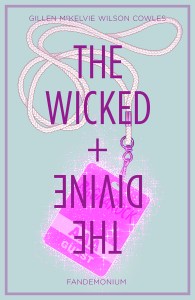
Kieron Gillen/Jamie McKelvie: Phonogram vol. 3 “The Immaterial Girl” — Absolutely marvellous. Gillen and McKelvie’s music fantasies are among the best contemporary literature, in or out of comics. Nobody has reckoned with the material effects of music and pop culture on people’s lives more incisively than they have in Phonogram and The Wicked and the Divine. And while the latter of those remains the easier one to recommend, this concluding arc of Phonogram is the best expression of their general thesis that music is never just music, but rather one of the forces that most powerfully animates human society. These are broad generalities, but to describe what they do here in any detail would likely make it seem trite. So instead, I’ll just urge you to read Gillen and McKelvie’s work. Start by catching up with WicDiv, then read the three collected editions of Phonogram in this order: 2, 1, 3. If you have ever been a superfan of anything, you will appreciate every panel in these volumes. If the thing you are a superfan of is music, you will have a new favourite comic. Possibly two. Pick of the week.

Thomas Ligotti: “Purity” — This is the first story in his collection Teatro Grottesco, which I managed to find at Pulpfiction, my absolute favourite bookstore in Vancouver, when I could not find it anywhere else, in physical or digital form. I needed to be shook up a bit, and I had heard that Ligotti was the man for the job. He has already begun. This story is properly creepy, with bits of mundane imagery taking on a grotesquerie that they simply ought not to have. Much is left unsaid, but it is all totally clear. And to boot, the story strongly reminded me of one of the creepiest things I’ve ever read, Michael Lutz’s Twine story “My Father’s Long, Long Legs.” A very promising start.

Podcasts

Now that my Podquest submission has had cold water poured on it gently, Radiotopia reviews will resume as usual.

On The Media: “Trending Topics” — It’s nice to hear a treatment of the Facebook trending topics scandal that actually gets to the root of the problem, which is that today’s tech giants have far too much control over the dissemination of information. Whether stories get traction by way of algorithms or human intervention, the kind of thing that’s likely to get huge on Facebook is not necessarily the kind of thing that people most need in their media diets. It’s also incredible to hear about the conservative economist who advocated for government intervention in monopolies (which may be a term that meaningfully applies to Facebook) in order to repair the free market. This episode also features a discussion with the New York Times public editor Margaret Sullivan that is interesting for its frankness about the Times’s shortcomings, but also interesting for the extent to which Bob Garfield allows it to be a straightforward valediction. I suppose not everyone needs to be afraid of him. But if he’s in softball mode during that segment, he roars back into righteous indignation mode in his final essay about the media’s sudden elevation of Donald Trump to legitimacy. To Garfield, talking to Trump about tax policy is “like asking Charles Manson about his driving record.” It is one of the best things that has been written about Trump since this whole boondoggle began, and I can’t recommend it enough. Even if you skip the rest of the episode to get to those last three or four minutes it’s worth your time. Pick of the week.

All Songs Considered: “The 1975, SOAK Covers Led Zeppelin, A Home Demo From My Morning Jacket” — A consistently interesting episode, but not one with a lot of songs I feel likely to return to — with the notable exception of Gaelynn Lea’s studio recording of the song she won the Tiny Desk Concert with. That is a remarkable piece of music.

On The Media: “How the ‘Fake News’ Gets Made” — Oh good, journalists can make funny things. This is Brooke Gladstone interviewing a bunch of satire writers and producers, all of whom came from journalism. So basically, you get Bob Garfield at his best in the main episode and Gladstone close to her best in this podcast extra.

This American Life: “Promised Land” — This episode of This American Life begins with Ira Glass singing an “I wish” song, and continues with pieces by Starlee Kine and the late David Rakoff. It is what public radio is for. Kine’s story about how her overprotective mother wouldn’t let her kids go to Disneyland (in spite of them living in L.A.) but would take them to the Disneyland Hotel twice a year is exactly the kind of story you want to hear from Starlee Kine, and Rakoff’s piece about fasting and not finding enlightenment is exactly the kind of story you want to hear from David Rakoff. Then it ends with a story from Hillary Frank from The Longest Shortest Time, a parenting podcast that I do not intend to listen to. But this story is absolutely riveting. You know when your friend says, “I heard the craziest conversation on the bus,” and then tells the best story you’ve heard all day? This is that story, except the best one ever. This is light on reporting for TAL, but it’s mercilessly consistent.

Sampler: “Mother Podcast” — This is Sarah Koenig on Sampler, which is a reason to listen to Sampler. It’s awkward at the start, because Brittany Luse insists on saying a bunch of the gushy stuff that should have been consigned to the intro while Koenig is actually in the room, which puts Koenig in the uncomfortable position of having to react to fervent praise in public. It gets better from there, but not by much. The concept for the episode must have seemed solid: here are a bunch of podcasts that have been born in the post-Serial world — “Look what thou hast wrought, Koenig!” But Koenig doesn’t seem much more than bemused at the clips Luse subjects her to. For all her staggering success, Koenig doesn’t belong to the crazy world of podcasting that virtually all of the Gimlet staff does — even those who had prominent public radio careers previously. She’s a reporter. Playing her clips from Hello From the Magic Tavern is pretty counterintuitive, improv background or no. Not good.

Bullseye: “Maria Bamford & Wanda Sykes” — That’s a hell of a double bill. These are the kinds of interviews with comics that you want to hear. Bamford is charming and has an uncanny ability to find the humour in terrible, uncommon things that have happened to her. Sykes is super sharp and a great storyteller. The best talk radio I’ve heard in awhile.

99% Invisible: “Separation Anxiety” — And, we’re back! During my Radiotopia reviewing hiatus, 99pi continued to interest me casually but not blow me away. This episode is about trash disposal in Taipei, and also San Francisco. I recently listened to a bonus interview with Roman Mars for Radiotopia supporters, and one thing he mentioned that I was happy to hear him mention is the fact that many episodes of 99pi don’t really have stories — they just explore an idea for a while in a logical fashion. That’s kind of what this episode does, and I so appreciate that there’s a show that has the guts to do that. I’m all for storytelling, but it’s also a dogma among media producers. There are other ways to impart information in an entertaining fashion.

Imaginary Worlds: “The Robot Uprising” — There are apparently people, or at least one person, who advocates for robot’s rights on the basis that the same justifications are used to deny the humanity of black people are being used to deny the humanity of robots. Eric Molinsky is rightly confused by this idea — surely, robots actually aren’t human? But he doesn’t push quite hard enough. There are times on this show where I feel like Molinsky is offering a sort of menagerie of strange worldviews without taking any of them to task. Still fun, though.

Invisibilia: Season 2 trailer — I think it’ll be good, but this show can be awfully cloying at times. They don’t even totally avoid it in this three-minute trailer.

The Memory Palace: “Open Road” — I’m so glad to get to review The Memory Palace again. I love this show so goddamn much. Anyway, this is about the Green Book, the guide for black motorists in pre-Civil Rights America. It is the second Radiotopia treatment of this topic in just a few months, after 99pi’s, but I think I prefer this approach. Just a gorgeous, semi-imaginary story with beautifully-drawn imagery. Really nice.

On The Media: “Ghosts” — Collectively, the episodes of On The Media I listened to this week did me more good than anything else this week. This special episode on the uses and misuses of collective memory demonstrates just how thoughtful this show can be. It isn’t hemmed in by the news cycle; there’s so much more it can do.

Pop Culture Happy Hour: “Money Monster and Eurovision” — I’m really shocked at how little they trashed Money Monster. I mean, I know it’s called Pop Culture HAPPY Hour, but that movie does not look okay. Also, Glen Weldon’s enthusiasm for Eurovision is one of the few moments where he can honestly be described as “adorable.”

Omnireviewer (week of Feb. 7, 2016)

19 reviews, many good things:

Movies

Hail, Caesar! — I think this is the least good Coen brothers movie I’ve seen. I haven’t seen any outright bad ones, but Hail, Caesar! is hugely inconsistent. There are scenes that are totally brilliant — one near the beginning where Josh Brolin’s gregarious Hollywood producer talks theology with leaders from four religions is primo Coen. But for every scene like that, there’s an unfunny joke that goes on for ages. One of the problems here is that the Coens commit so wholeheartedly to every single one of the fragmented bits and plotlines they threw in. So, if one of them isn’t doing it for you, tough. You’re stuck in it for seven minutes, probably. I will say this: the Coens are the most politically inscrutable filmmakers working. This film’s attitude towards Communism is almost impossible to make out. To take that line of thought further would head into spoiler territory, so would somebody I know please go see this movie and have that conversation with me? Thanks.

The Big Short — This is possibly the saddest movie I’ve ever seen. Civilization is broken and we’re all hopelessly fucked. (To be less emotional about it, this is a big swing of a movie with an aesthetic all its own and lots of unlikely choices. Most of those choices are the right ones, but some of the jokes early on don’t land because of problems with the delivery or editing or something. I have problems with the infamous “Margot Robbie in a bubble bath” scene — how much irony does it take to offset decades of cinematic sexism? But on the other hand, I love that this movie begins as a big broad comedy that revels in its own excess like The Wolf Of Wall Street — to which Robbie is an obvious and intentional connection — only to do what The Wolf failed to do in the end: namely, to condemn the entire financial system in a miasma of sudden bleakness. The Big Short is messy and ambitious and mostly really good and everybody should go see it.)

Television

Doctor Who: “Paradise Towers,” episodes 2-4 — One of the biggest problems with the classic series is that every episode save for the last in a serial needs a cliffhanger. And, while the cliffhangers themselves are often delightful, their resolutions tend to be trite. The Doctor just kind of clevers his way out of a situation so that he can get on with the rest of the story. But when it’s Sylvester McCoy doing the clevering, it makes it easy to ignore the seams in the storytelling. Seriously, this guy is the most underrated of the Doctors by a mile. And everything else about this story is delightful as well. The cannibalistic grandmas are obviously the best part, but the main villain’s wonderful overacting comes in a close second. This is the period in the show’s history where they realized that the budgets aren’t going to increase, and neither is the audience, so they may as well do what they like. It’s all approached with a heavy dollop of irony, which manages not to overpower the actual brilliance of the story. There are actually worse places to start with classic Doctor Who than this, I’d expect.

Lost: “House of the Rising Sun” — There are problems with Sun and Jin’s storyline in early Lost, but they’re papered over by a pair of totally wonderful performances by Yunjin Kim and Daniel Dae Kim. Also, one of the real pleasures of these early episodes is seeing various cast members share scenes for the first time. This episode, it’s Charlie and Locke’s scenes that really pop.

Music

Kanye West: My Beautiful Dark Twisted Fantasy — This is the album that got me into hip hop, and it’s still probably my favourite album of the past decade. (Run the Jewels 2 might be its only competition.) It’s basically psychedelic rap: a giant Dionysian pastiche of colours and lights and hazes and paranoia and regrets. (According to my taxonomy of psychedelia, Fantasy qualifies as a “Pepper.”) It’s a bit bloated, maybe. I’d lose “So Appalled,” cut a bit off “Devil in a New Dress,” and excise Chris Rock from “Blame Game.” But, better to have too much. And if Kanye’s ego makes him insufferable at times, it also gives him intense self-knowledge, which he calls up in every verse on this. It’s amazing to hear such a complex psychology reflecting on itself.

Literature, etc.

Alejandro Jodorowsky/Moebius: The Incal — I enjoyed this a lot, but I don’t know if I’d actually recommend it. I’m fascinated by Jodorowsky’s esotericism as it pertains to the Kabbalah and Tarot. But here, his belief system seems to mostly revolve around the idea that “there’s light and there’s darkness and you can’t have one without the other,” which is such a drug cliché of an observation that I can only roll my eyes. Much of the dialogue is terrible, and a lot of the sex in this seems to have been shoehorned in, just to ensure that we all know this is an “adult” comic, and only ends up making it seem adolescent. Also, in terms of sequential art technique, there are a lot of moments where it kind of seems like there are key story beats or transitions missing between panels — in a way that doesn’t seem intentional. Plus, there are instances on nearly every page where it’s unclear in what order to read the speech balloons. This all stems from bad decisions and inexperience on Jodorowsky’s part. Fortunately, he’s only half of the team. Moebius is a nearly peerless illustrator, and it’s almost worth picking up The Incal just to bask in the colours and details of the world he draws. Almost. If you have a relatively high threshold for sci-fi bullshit and new-agey nonsense, this is something you should probably check out.

Jorge Luis Borges: “Blindness” — I have a wonderful book called The Art of the Personal Essay that I’ve read just over half of. It is much better than its bland title would suggest: it is a selection of wonderful personal writing by some of the greatest authors in history — people like George Orwell and Virginia Woolf — edited by Phillip Lopate. I go back to it very occasionally and read a few of the essays I haven’t read before. This one is a wonderfully companionable account by Borges of being appointed director of a national library, ironically just as he’d gone blind. I had never read any Borges, having been slightly scared of him, but I think I may have been missing out and will add Ficciones to my already unmanageable reading list.

Hubert Butler: “Beside the Nore” — Another personal essay, this one by an Irish writer that more people should probably know. This is a short, simple account of several elements of old, rural life in a riverside town in Kilkenny. It is presented unpretentiously, without a framing device or thesis statement. It’s just some lovely writing about a charismatic place. At the very end, Butler appends a few extra sentences, to say that he believes local history to be far more important than national history, which has no impact on the vast majority of people — thereby justifying his entire enterprise. Really nice.

E.M. Cioran: “Some Blind Alleys: A Letter” — This is an essay about how insufferable writers are and how meaningless the international community of people of letters is. It’s about how only an incredibly egocentric person would dare take on a career as a writer, and about how narcissistic it is to assume that other people want to read about what you think. Hi there. You reading this? Good, then we’re fine.

Kieron Gillen/Jamie McKelvie: The Wicked and the Divine, vol. 3 — Now for some actual smart comics. I was wary of the idea that this entire trade volume would diverge from the main WicDiv story, but these issues featuring the supporting cast of the main story add such depth to the world of this comic. Each one is probably among the best stand-alone stories that Gillen and McKelvie have ever done. The issue featuring Woden (the jerk-ass Daft Punk god) is particularly impressive, being a sort of remix issue, made up of scenes from prior issues of WicDiv. Also, there is a cat goddess in this who looks like Rihanna but acts exactly like an actual housecat: getting distracted by laser pointers and such. A comic that does complex formal experiments and also has Rihanna getting distracted by laser pointers can only be a straightforwardly good thing. Pick of the week.

David Day: Alice’s Adventures in Wonderland Decoded — I read the introduction to this a while ago and got sidetracked. I’m still kind of sidetracked, honestly. But this is what I’m reading, now. The tiny bit of this I just read was fascinating — the politics of Christ Church College at Oxford is more compelling than you’d think.

Podcasts

Fresh Air: “‘Mad Max’ Director George Miller’” — Listening to this guy talk makes a bunch of connections become immediately clear. If it seemed incongruous that Mad Max and Babe were made by the same guy, consider the extent to which Babe is a conventionally Campbellian hero’s journey. If it seemed like The Road Warrior and Fury Road have no precedents in action movies, look beyond that to Buster Keaton’s The General. I’m disappointed that Terry Gross wasn’t around to do the actual interview. I’m sure she would have probed into his feminism more deeply. Still, Dave Davies acquits himself admirably. Anybody who likes Miller should check this out.

Serial: “Adnan Syed’s Hearing,” days 1-3 — I’m glad Sarah Koenig was there to report on Syed’s hearing, because she’s probably the most knowledgeable person about his case. But what this is actually going to do is remind everybody how much more invested they were in season one of Serial than season two. In any case, these three mini-episodes are great, and feature Koenig and Dana Chivvis speaking extemporaneously for longer than I think they ever have on the show — which is great, considering that they both know the case inside out. I’m still unconvinced of Syed’s innocence, but convincing people one way or the other has never been the goal of Serial, in spite of what certain critics might say.

All Songs Considered: “Andrew Bird Gets Personal” — This sounds like a great record, but wow, this is an awkward conversation. Bird does NOT want to talk about these songs. I’m excited to hear more of this considering Blake Mills is on guitar, and his guest spot with Vulfpeck last year was one of my favourite performances I’ve heard on a record in a while.

Pop Culture Happy Hour: “Small Batch Super Bowl 50” — All due respect to Beyoncé, but was I the only person who thought Bruno Mars stole the halftime show?

The Heart: “Ghost: Bobby” — A totally mundane breakup story that’s told well enough to be worthwhile. The sort of thing that only The Heart can do.

WTF With Marc Maron: “Danny Boyle” — Still catching up on episodes from December, apparently. But this is great. I like Maron with filmmakers. He’s such an insightful film geek that it’s easy for people like Boyle and Todd Haynes to talk to him.

Fresh Air: “Filmmakers Charlie Kaufman & Duke Johnson on ‘Anomalisa’” — “I have a tendency to read about syndromes,” says Charlie Kaufman near the beginning of this interview, to nobody’s surprise. I need to see Anomalisa.

WTF With Marc Maron: “Charlie Kaufman & Duke Johnson” — It’s interesting to hear Terry Gross and Marc Maron interview the same people about the same things. Since hearing that wonderful episode where Maron interviewed Gross, I’ve looked at them as two sides of the same coin. On one side, you get the bare-bones story of a thing from Gross, and on the other side you get self-psychoanalysis by proxy from Maron. It shouldn’t be about picking a winner, but in this case Maron wins. Apparently Kaufman was scared to go on this show because he was uncomfortable with how deep Maron probes. But Maron keeps this one relatively light, and just gives Kaufman the opportunity to be funny. It was also a really good decision to do a segment with Kaufman alone before bringing in Duke Johnson to talk about Anomalisa, which I really need to see. (Also, how weird to hear an ad for Blackstar that was clearly recorded before Bowie’s death but released after.) Pick of the week.

Omnireviewer (week of Jan. 31, 2016)

First off, I forgot something crucial last week:

Live events

Roomful of Teeth: live at the Fox Cabaret — There aren’t a lot of opportunities to hear operatic vocals, jazz singing, tuvan throat singing, yodelling and oktavism on the same program. This was one of the most incredible displays of virtuosity I’ve seen in concert. I knew it would be impressive, having heard their CDs, but what I hadn’t anticipated was how loose and comfortable it would feel. A lot of times, when ensembles perform music that’s this hard, it comes off sounding metronomic, like they’re struggling with all their might to keep together. But Roomful of Teeth owns this music completely. Caroline Shaw’s Partita was the obvious highlight, and totally lived up to the recording I’ve come to know so well. My only complaint is that, at 90 minutes and no encore, the performance was too short. Honourary pick of last week.

Now, on to this week’s reviews proper — just eight of them:

Movies

Spotlight — I don’t have much to say about this that I didn’t already say in my best of 2015 post. Suffice it to say that I’m still preoccupied with it a week later.

Room — This would have probably made the list if I’d seen it earlier. Very few movies have induced such anxiety in me, and not just in the sequences where you might think. There’s a scene near the start of the movie where Brie Larson’s character has to tell her son, who has lived for five years in a garden shed that he’s never been outside, that there is such a thing as outside. Watching her struggle to explain the concept of an entire world outside the realm of her son’s experience made me want to tear my beard out. The really great thing about this is how well it grapples with the way a child might respond to that revelation. It works similarly to some hard SF: it asks “what if…” and the story is the answer to that question. Unlike most hard SF, though, it’s got gut-wrenching amounts of emotional honesty. Pick of the week.

Literature, etc.

Alejandro Jodorowsky/Moebius: The Incal — This is proving to be more entertaining than it is good. Considering the extent to which Brian Michael Bendis says this changed his life in the intro, the writing here is soooper dodgy. The characters speak as if somebody’s summarizing what they said after the fact: “I don’t want to suffer! I don’t want to die!” Or, “Wait. There’s a thought coming to my mind… ‘The Black Incal!’” Also, there are these “tell, don’t show” moments where a caption explains what’s happening in the art, which is odd. There are elements of this that are a bit boneheaded. The climax is clichéd, hippy-dippy “union of opposites” nonsense. But Moebius’s art is stunning, and the universe where this takes place is convincing and fun. I’m enjoying this. Also, since I’ve seen Jodorowsky’s Dune, I can’t help but hear all of the dialogue in Jodorowsky’s voice.

Games

Journey — It’s nice to have friends with gaming consoles. Journey is a really successful example of non-verbal storytelling. Not a word is seen or spoken, yet it makes sense in an open-ended sort of way. But the real pleasure of this game is similar to the pleasures of a game like Super Mario 64, a longtime favourite of mine: moving your character around just feels good. Jumping, sliding, and running just works. I’d like to play it again, now that I know the controls a bit better.

Podcasts

Pop Culture Happy Hour: “Making a Murderer, True Crime, and Remembering Alan Rickman” — Look, I love Alan Rickman, but why in god’s name does everybody love Die Hard?

Pop Culture Happy Hour: “Fred Armisen and Welcome to Night Vale” — Armisen’s a bit of a bore, but Joseph Fink and Jeffrey Cranor are, predictably, great fun in conversation. Linda Holmes is, as ever, a person I would like to hear do more interviews.

Love and Radio: “The Fix” — An older episode, with the characteristically overbearing audio production of Love and Radio’s earlier episodes. That’s not a dig. This era of this show is one of the most aesthetically distinctive bodies of work in radio. And the story uses Nick van der Kolk’s cleverest device, where it starts in one place, then zooms back to another, and the suspense comes from the fact that it seems totally implausible for the two points to ever meet. So clever. I love this show. Pick of the week.

Serial: “Meanwhile, in Tampa” — There’s some really good writing in this, but this story is getting to the point where it requires more attention than I can offer a lot of the time. I have no idea what I’ll feel like when this season of Serial ends.

Things I loved in 2015: The rest of them

Well that’s that, then.

Except, I have a whole bunch of genre-specific lists of things I loved sitting in a Google doc, and I can’t resist posting them here, so the honourable mentions get their honourable mention. These are “top x” lists: just however many entries I could think of that I liked, ranked. The ones that made the top 25 are in bold.

Movies

  1. Mad Max: Fury Road
  2. Carol
  3. Inside Out
  4. The Hateful Eight
  5. Spotlight
  6. The Revenant
  7. It Follows
  8. What Happened, Miss Simone?
  9. The Lobster (saw it at VIFF; look out for the upcoming wide release)
  10. The Martian
  11. Star Wars: The Force Awakens
  12. Amy
  13. A Most Violent Year

Television

  1. Mad Men
  2. Unbreakable Kimmy Schmidt
  3. Better Call Saul
  4. BoJack Horseman
  5. Doctor Who
  6. Last Week Tonight
  7. Hannibal
  8. The Jinx
  9. Parks and Recreation
  10. Louie

Music

  1. Lin-Manuel Miranda: Hamilton: An American Musical
  2. Vulfpeck: Thrill of the Arts
  3. Björk: Vulnicura
  4. Africa Express: In C Mali
  5. CHVRCHES: Every Open Eye
  6. Kendrick Lamar: To Pimp a Butterfly
  7. Roomful of Teeth: Render
  8. Afiara Quartet and Skratch Bastid: Spin Cycle
  9. Max Richter: From Sleep
  10. Bryce Dessner: Music for Wood and Strings

Podcasts

  1. The Memory Palace
  2. Reply All
  3. Mystery Show
  4. Love and Radio
  5. Pop Culture Happy Hour
  6. Benjamen Walker’s Theory of Everything
  7. StartUp
  8. Radiolab

Books/Comics

  1. David Cavanagh: Good Night and Good Riddance: How Thirty-Five Years of John Peel Helped Shape Modern Life
  2. China Miéville: Three Moments of an Explosion
  3. Kieron Gillen/Jamie McKelvie: The Wicked and the Divine, vol. 2
  4. Kelly Sue DeConnick/Valentine De Landro: Bitch Planet, vol. 1
  5. Matt Fraction/Chip Zdarsky: Sex Criminals, vol. 2

Games

  1. Sunless Sea
  2. Undertale

(I played a couple of others but did not enjoy them.)

There you go. 48 wonderful things. A good year, by any standard.


Things I loved in 2015: Nos. 15-11

How do you follow up prison planets, drunk horses, West African minimalism, Jonathan Banks in a tollbooth, and BIG WIDE 70MM SUPER CINEMASCOPE? Like this:

No. 15 — Mystery Show

The twin notions that everything is connected and that there must be a conspiracy are classic engines for genre fiction, from Lovecraft to From Hell to Welcome to Night Vale. But I’m not sure that it’s ever been taken up in non-fiction with such total aplomb as on this podcast.

Mystery Show is ostensibly about actual, real-world mysteries with actual real-world solutions. But each story is told according to the semi-ironic non-logic of real-world Dirk Gently, Starlee Kine. So, the plotline of Must Love Dogs becomes crucially important to finding a forgotten video store. The life story of a guy who works for Ticketmaster customer service could yield crucial clues to discovering Britney Spears’ reading habits. And the members of the Phoenix Culinary Association could (and do) prove invaluable in the quest to find the owner of long-discarded belt buckle.

Mystery Show is funny, sure. And it’s presented with one eyebrow at least halfway raised. But, it also makes you feel like we all live in a world where there are amazing stories beneath every rock — as long as you take for granted that it’s the most important rock in the universe.

No. 14 — Unbreakable Kimmy Schmidt 

If you’re not completely sold on this show on the basis of its theme song, we cannot be friends.

Unbreakable Kimmy Schmidt is on this list primarily because it made me laugh and laugh like a big dumb idiot. It’s like Tina Fey and Robert Carlock decided that 30 Rock just wasn’t quite packed-full-o’jokes enough, and they’d have to do better next time.

But what I really remember most fondly about my embarrassingly fast binge of Unbreakable Kimmy Schmidt is the first two minutes. I don’t think I’ve ever seen a show establish its premise and characterize its lead quite so efficiently before. That theme song certainly does a lot of the heavy lifting, but really watch Ellie Kemper’s performance as she emerges from the bunker where Kimmy’s been kept for 15 years. There’s not a shred of anger or resentment about what she’s missed out on — just overwhelming joy that the world outside still exists.

I’m not saying it’s psychologically realistic, but in that moment you realize that this is a character you want to spend a lot of time with.

Even if Unbreakable Kimmy Schmidt hadn’t given us the profound gift that is “Peeno Noir,” it would still be my favourite new comedy in ages.

No. 13 — Kieron Gillen/Jamie McKelvie: The Wicked and the Divine, vol. 2

WicDiv2

Do you ever get the feeling that the intended audience for a thing is specifically you, and nobody else? It probably happens to me more than a lot of people, to be fair. But I’m not sure there has ever been a narrative premise that is such obvious Parsonsbait as “a pantheon of gods from various mythologies are periodically incarnated as rock stars.”

The first volume of The Wicked and the Divine bowled me over, but this second one, “Fandemonium,” is where things really seem to be picking up. We learn more about the history of the pantheon, our protagonist’s story takes some completely unexpected twists and turns, and — best of all — we meet a genderfluid incarnation of the Sumerian love god(dess) Inanna who dresses like Prince.

Also people trip out at a rave hosted by Dionysus.

This comic is bonkers and beautiful and I’m more invested in it than almost any other ongoing serial narrative. I’m picking up the third trade collection later this week, and will devour it immediately.

No. 12 — Inside Out

I tend not to watch kids’ movies — not out of a lack of respect for them, or out of self-consciousness; it’s just that my reaction is usually something like “Boy, I wish I could have seen this when I was ten.”

Not Inside Out. This movie hit me straight in the 25-year-old feels. First off, the premise of exploring the changing psyche of a young girl by way of personified emotions is brilliant. And the casting is spot-on. But it’s specifically the exploration of sadness’s role in maturity that makes Inside Out one of the most thoughtful children’s movies I’ve ever seen.

No. 11 — Björk: Vulnicura

Björk’s creative peak is lasting a ludicrously long time. Vulnicura is, to my ears, as good an album as she’s ever made. It’s certainly a mode we haven’t seen her in before. And with an artist like Björk, the best you can possibly hope for is yet another new direction.

Sonically, Vulnicura could be seen as a retreat to the barren, strings-and-drum-machines-only timbres of her acclaimed Homogenic. But this time, that timbre doesn’t make her seem tough: it leaves her exposed. Which is apropos, since this is Björk’s breakup album. I think it’s destined to become both a classic of that minor genre and of her discography.

“Stonemilker” is pure catharsis, and one of my favourite songs of the year.

More whiplash tomorrow, as we enter the top ten with a beautiful movie, a beloved show, a kaleidoscopic podcast, a disappointingly overlooked album, and the list’s first non-comic book.

Things I loved in 2015: Nos. 20-15

So far, we’ve celebrated gigantic-sounding candy pop, long takes of bear attacks, space eyebrows, journalistic integrity, and the quality of empathy as expressed through radio. We soldier on. Here’s more excellence in sound and screen, and also this list’s first instance of excellence in panels:

No. 20 — Kelly Sue DeConnick/Valentine De Landro: Bitch Planet, vol. 1

bitch-planet-1-deconnick-de-landro-image-cover-628x968

This comic is badass feminism 101. If I could force everybody I know to read it, I would, because for most of them it would be validating and triumphant, and for the rest it might disavow them of some dodgy notions.

Kelly Sue DeConnick’s brand of dystopian satire is a wonderfully blunt instrument. Aside from the literal existence of a prison planet where non-compliant women are sent for various crimes against the patriarchy, the world of Bitch Planet is essentially no different from our own. Its power comes from the fact that most of its characters’ struggles are stories you might actually have heard somebody tell from personal experience.

But aside from being merely (ha) progressive, Bitch Planet is also exquisitely crafted and detailed, right down to the zine-inspired design and 90s comics-style joke classifieds in every issue. As a trade-waiter on principle, the wait for the next volume is going to drive me insane.

No. 19 — BoJack Horseman

https://www.youtube.com/watch?v=5sGsBoX6vUo

Has there ever been a more compelling unsympathetic loser on television than BoJack Horseman? In its far-superior second season, BoJack becomes the cartoon animal version of Don Draper: attaining his dreams, alienating everybody he loves, gradually self-destructing, and trying and failing and trying and failing to put himself back together. And everybody around him seems to be coming apart at the seams for their own particular reasons, as well.

But the fact that these plotlines are embedded in a show that’s this joke-dense and whimsical allows BoJack Horseman to do what lots of these trendy shows full of terrible people fail at: it can take for granted that people are often horrible and don’t deserve their good fortune, while still being compulsively watchable.

And on top of everything, this season gave us “Hank After Dark,” one of the most visually dense, funniest and also most chilling episodes of television of the year. As a response to the Cosby spectacle, it’s as powerful as anything. If the season has one weakness, it’s that “Hank After Dark” thoroughly eclipses even the second-best episode.

No. 18 — Africa Express: In C Mali

Even as a confirmed minimalism devotee, I couldn’t get into Terry Riley’s classic In C until I heard it performed by West African musicians.

Africa Express is a project started by the distinctly non-African Damon Albarn, with the participation of a couple other notably non-African people including Brian Eno, who is required by British law to be involved in everything.

The idea behind Africa Express was to forge meaningful connections between European and African musicians. Given that, you may well wonder whether it’s a tad suspect that Albarn’s second recording with these musicians is entirely focussed on a piece of Western classical music. But, just listen to the record.

The thing that’s immediately clear is that In C Mali is more than just another recording of In C. The music on this recording does not belong to Terry Riley nearly as much as it belongs to Africa Express. In C is freely structured to the point where every performance is slightly different, but this performance is entirely its own thing. The musicians own this music. Riley fades into the background.

I doubt I’ll listen to any other recordings of this piece for several years, at least.

No. 17 — Better Call Saul

Sometimes you see critics say things like “it was better than it needed to be” when a show or movie has a built-in audience from a beloved related property.

Better Call Saul was massively better than it needed to be.

The important thing that Vince Gilligan and Peter Gould realized is that they couldn’t, shouldn’t, and were under no obligation to replicate the successes of Breaking Bad. So, they made a show that fans of Breaking Bad would be sure to enjoy — it’s got that signature dialogue and all the stunning sights of Albuquerque, N.M. — but that is a fundamentally different show in terms of content and pacing.

Better Call Saul lacks its predecessor’s explosive plotline, allowing it to luxuriate in its characters and themes the way that Mad Men does, and the way that Breaking Bad didn’t. The greatest side effect of this is that it gives Bob Odenkirk and Jonathan Banks more space for multifaceted performances as Jimmy McGill and Mike Ehrmantraut, respectively.

This show didn’t just overcame the impossible expectations associated with being a Breaking Bad spinoff: it also staked out its own territory immediately. I suspect it’ll only get better.

No. 16 — The Hateful Eight

https://www.youtube.com/watch?v=gnRbXn4-Yis

To some extent, Quentin Tarantino is a substance. Each of his movies is an additional quantity of that substance to be consumed. If you didn’t enjoy the last jar of Tarantino you ate, you’re not likely to enjoy any other ones either.

That said, there are things he does that I love, and things he does that I don’t. I could take or leave his action scenes and the more conspicuous exploitation movie tropes (I have zero time for Death Proof or Kill Bill: Vol. 1). But when he’s in talky mode, there’s nobody I like better.

The Hateful Eight is an entire movie’s worth of the Mexican standoff in Pulp Fiction, the barroom scene in Inglorious Basterds, or the final confrontation in Kill Bill: Vol. 2. It has an amazing cast full of people who clearly delight in saying the sorts of things that people say in Tarantino scripts. And, if you live in an opportune place, you can see it (as I did) in glorious 70mm projection, complete with the novelty of an overture and an intermission.

At this moment, it is my second-favourite jar of Tarantino.

Tomorrow, we’ll pick up from no. 15, with our most whiplash-inducing set of five yet: an album, a movie, a comic, a show and a podcast. 

Omnireviewer (week of Dec. 6)

A week full of lovely things, really. 22 lovely things.

Music

The year-end lists are coming out, so I was going to spend the week going through the stuff I missed. But then I got waaay more obsessed with this first one than I’d anticipated. It’s nearly embarrassing, but actually no it isn’t at all.

Lin-Manuel Miranda: Hamilton, An American Musical — They made a hip hop musical about the establishment of America’s national bank. Just when you thought Broadway was all superfluous Disney adaptations. This is incredible for so many reasons. It shifts seamlessly from convincing hip hop to straight-ahead showtunes about arcane political processes. And that’s not the only tonal shift it manoeuvres: it’s incredible how this flits back and forth between funny and tragic, arch and sincere, and from straight-ahead storytelling to meta-commentary. It is totally self-aware about its own unlikely subject matter, but it doesn’t let that self-awareness get in the way of its story, which you can get lost in to an extent that you seldom see in works of musical narrative. Unlike most cast albums, this works brilliantly as a bespoke object. As a concept album, it has a narrative thrust that keeps you listening to the words, even when the music threatens to beguile you away from the piece’s themes. And it’s bewilderingly allusive: it’s well worth listening to this with the Genius annotations (some of which come straight from Lin-Manuel Miranda himself) within arm’s reach. Miranda has everything. It’s not just that he can rap and sing and write a catchy hook and verses that lodge in your head, he also has something interesting to say about Alexander Hamilton as a historical figure and about how who tells the stories from history affects how we think about it. There are nothing but good things to say about this. I don’t care if you like musicals or not, listen to Hamilton. Pick of the week.

Kendrick Lamar: To Pimp a Butterfly — If it seems perverse to give pick of the week to a musical rather than what looks increasingly like the consensus best album of 2015, know that it’s only because I’m totally obsessed with Hamilton right now. To Pimp a Butterfly is as good as everybody says it is, and I would imagine that out of the two, it’s what I’ll be coming back to more frequently in 2016. If only to figure out what he’s on about. This is some seriously challenging stuff.

Africa Express/Terry Riley: In C Mali — I’m a huge fan of California minimalism in general, and Terry Riley specifically. But, his most famous piece, In C, was never one that I found myself listening to very much. Until I heard it played on African instruments when this thing came out earlier this year. Then I listened and I listened and I listened. Nice to revisit again after a few months.

CHVRCHES: Every Open Eye — Here’s something I’m not seeing on nearly enough year-end lists. CHVRCHES’ music is pure catharsis and people who don’t like it hate joy. This album is significantly better (or at least more consistent) than their first, which critics were all about. What gives? “Make Them Gold” is a clunker of a single, if we’re being honest, but the rest of the album is perfect pop.

Television

Deadwood: “Reconnoitering the Rim” — I don’t know where this show is going, but damn, Ian McShane can act.

QI: “Marriage and Mating” — Why am I reviewing an episode of QI? Tell you what, I’m not.

BoJack Horseman: “Hank After Dark” — According to my own rules, I’m not technically obligated to review this, since it’s my second time watching it in the course of this blog — and, in fact, in a fairly short span of time. I just felt obligated to pop back in and reiterate that this is one of the best episodes of comedy television I’ve ever seen. Okay? Okay.

Lost: “White Rabbit” — Reasons I don’t understand people who like the first season of Lost best: (1) Shannon and Boone are unwatchable; (2) Sawyer is a prick — and not in a way that any reasonable person should find charming, although the show sure seems to sell him like that; (3) it’s galling to see Jack take such a large role in the story when you know he was supposed to die in the first episode in what would have been the most brilliant bait-and-switch in television history, had the writers followed through. Jack’s story has more “it’s so hard to be a handsome rich hero dude” than I’d like. We wouldn’t have had to sit through that if they’d just done the right thing and killed the handsome rich hero dude. And that cliff dangle is ridiculous. I still basically like this, though. The hallucinatory manifestation of Jack’s daddy issues is properly creepy.

Literature, etc.

Alejandro Jodorowsky/Moebius: The Incal — A very thoughtful birthday present from some wonderful friends. I think I’m going to enjoy this. So far, Moebius is impressing more than Jodorowsky, whose writing has a lot of sci-fi clichés, and the juxtaposition of text and image sometimes seems arbitrary and lacks clarity. But this is a good yarn with some damn pretty pictures.

China Miéville: “Dreaded Outcome” — Here’s a narrator that Miéville can really sink into: a jargon-dropping therapist. I put this story down right at the point where a massive twist happens, then when I picked it back up, I didn’t even recognize it. This is good.

Lucas Adams: “An Illustrated Account of the Great Maple Syrup Heist” — This short comic about a thing that honest to god actually happened will make you very excited about the Jason Segal movie that Sony Pictures is honest to god going to make about it.

Podcasts

Pop Culture Happy Hour: “A Conversation with Trevor Noah” — I haven’t gotten around to watching any of Trevor Noah’s Daily Show, but I think I will now. In this interview with Linda Holmes (who should really do more hour-long podcast interviews; she’s fantastic) he proves to be refreshingly circumspect. There’s an awkward moment near the end when he’s talking about “things you’re not supposed to say,” but at least he’s willing to own up to his mistakes and learn as he goes.

Imaginary Worlds: “Origin Stories” — The superhero origin story imagined as a psychological necessity. Excellent.

Song Exploder: “Wilco – Magnetized” — This is my favourite song on the new Wilco album by a fair margin, so it’s great to hear it exploded. I love that Glenn Kotche’s drum part was inspired by Jeff Tweedy’s son’s drumming. But I still kind of think he’s just imitating Ringo.

On The Media: “Lies, Lies, Lies” — No tragedy this time, except for Donald Trump’s presidential candidacy. On The Media is a really dark show, sometimes. Throughout this episode, you realize gradually that the demonstrable truthfulness of a statement doesn’t really have that much to do with whether or not people are swayed by it. Let us all collectively shudder.

Serial: “DUSTWUN” — Back into the weeds we go. Look, I love Serial, and I love Sarah Koenig’s journalism. But this is one of those situations where it can be difficult to keep the thing itself separate from the phenomenon of the thing. The response to season one of Serial was huge and weird and bad. I remember it being compared to True Detective which is just wrong. Serial is not a fictional detective show; it’s real journalism about people who exist out in the world. The widespread disappointment in the ending of the season was naive and ruthless — you can’t just end a true story however you want. And while I’m a devoted listener to a great many non-fiction podcasts, some of which tell serialized stories, it’s distressing to me that the story of Adnan Syed ended up being fetishized by people in the same way that I fetishize, say, Doctor Who. So, Serial: the breakout podcast phenomenon is a thing I have very mixed feelings about. BUT, Serial: the longform non-fiction storytelling project is a thing I really love. So, this new season is properly exciting — especially given that it’s about a story that got international TV news coverage, and now we’ll get a totally new lens on it. Instead of people filing stories in a day, we’ll get one of the most ruthlessly detail-oriented journalists in the world, plus her team of producers, PLUS screenwriter Mark Boal (of Hurt Locker fame and Zero Dark Thirty infamy) all on the case and making no compromises to time. And if that last line is any indication, the next episode is going to be a corker. Let’s all keep our heads, though. This is actually happening. Pick of the week.

Reply All: “I Love You, I Loathe You” — Reply All is that rare podcast that focuses on fussy, meticulous, reported stories but can also pull off just having its hosts banter with each other for a whole episode. In that sense, it may be the “most podcast” of all podcasts: it combines the pre-taped public radio approach of shows like This American Life and On The Media (where both hosts once worked) with the podcast-native approach of people talking to each other into microphones with little adornment (à la Stop Podcasting Yourself, etc). There’s no reported story in this episode of Reply All, but it was still fantastic and still Reply All. This is Gimlet’s best podcast and it would take something staggering for them to top it. (Jonathan Goldstein, perhaps.)

Pop Culture Happy Hour: “Creed, Men Crying At Movies, and Visceral Responses” — I find I seldom have much to say about regular episodes of PCHH, but don’t be fooled: I love this show. It will likely take a slot on my year-end roundup of best podcasts for its sheer reliability in delivering insight and joy. And Gene Demby sounds so happy to be back.

The Moth: “Amir Baghdadchi & Dameon Wilburn: StorySLAM Favourites” — Two outstanding, riotously funny stories about travel, both distinguished more for the quality of the telling than by the story itself.

99% Invisible: “Pagodas and Dragon Gates” — These days, there are good episodes of 99pi, and “fine” episodes of 99pi. This is one of the good ones. It’s about why San Francisco’s Chinatown looks like it does architecturally, in spite of the fact that pagodas and dragon gates were long out of fashion in China when those structures were built in Chinatown. It’s more of a story than you might anticipate.

StartUp: “Pitch Perfect 2” — Alex Blumberg is absolutely pathological about playing that tape of him bombing a pitch over and over. This is super interesting, and I’m so happy that Gimlet has a new partner who shares Blumberg and Matt Lieber’s vision. I can’t wait to hear their new shows — especially Jonathan Goldstein’s. That guy is a master.

Fresh Air: “Historian Mary Beard Tackles Myths about Ancient Rome” — Research about antiquity is catnip to me. This interview (with Dave Davies, filling in ably for Terry Gross) contains such wonderful tidbits as Caligula hating being called Caligula, because it was a diminutive nickname from his childhood — “Bootikins,” essentially.