Category Archives: Books

A Dark Tower Travelogue

If you’re one of the three people wondering why I still haven’t finished Moby-Dick, here is part of the answer: I’ve been extremely busy reading Stephen King. It started in 2017, when King became suddenly more zeitgeisty than he’d been since probably the ‘80s. This was the year of the first recent It movie, and the second season of Stranger Things. It was also the year of the derided film adaptation of King’s most ambitious work: the Dark Tower series. The movie’s release might have been the first I heard of the Dark Tower. And its reception among reviewers who’d read the novel was my first indication that maybe I should finally read something by King. 

I don’t remember any one review in particular. But I remember getting the sense that this by-the-numbers Hollywood blockbuster (allegedly; I haven’t seen it) was working to adapt something beyond cinema’s capacity: something closer to outsider art than to the eminently adaptable novels that made King into the multimedia sensation he is. A tantalizing prospect – a resolutely personal seven-volume drafts folder, written by the most successful popular novelist alive with no eye towards mass appeal, or even coherence. This is my shit. This is what I live for. This is why I’ve now read the whole Dark Tower series and several King obscurities, and I still haven’t read The Shining

If this is somehow your first point of contact with the Dark Tower series altogether, the basic premise is this: Roland Deschain is the last of a long line of wild west gunslingers who are literally descended from King Arthur, and who once served as defenders of the natural order in a high-fantasy setting that has since deteriorated into wastes. Roland feels that this damage might be reversible if only he can make it to the Dark Tower, the nature of which is initially unclear. In his travels, he makes many unsettling discoveries, chief among them that his world is porous, and contains many passages into other realities altogether, which allows his story to intersect wantonly with stories from other, initially unrelated books by Stephen King. 

There are many (too many) knowledgeable guides to the Dark Tower on the internet, detailing what you should read when, and piecing together the connections between the officially demarcated Dark Tower novels and the many many other books in King’s canon that intersect with them. This is my idiosyncratic and personal version of that. It is less complete than many (I haven’t read anything co-written by Peter Straub, and I’m not touching The Regulators, thanks) but hopefully by not pretending to total authority I can help somebody have their own specific and personal reading experience. 

Before I read the Dark Tower series, it always seemed like gatekeeping to me when somebody said that you need to read a half-dozen other books to have a Truly Complete Experience. I admired the writers who boldly claimed that all you need to read if you want to read the Dark Tower series is… the Dark Tower series. But I’m afraid I don’t agree. As Cameron Kunzelman observed on the fantastic Just King Things podcast, the series’ controversial final instalments are simply more interesting if you have a sense of King’s development over the long gestation of the series. I’d put it this way: you need an almost personal relationship with Stephen King if you’re ever going to enjoy Song of Susannah. And, contrary to popular opinion, that book can in fact be enjoyed. 


Here’s how this will work. The second part of this post will be a ranking of the eight official Dark Tower books (including The Wind Through the Keyhole). Tedious, I know. But frankly, all of the Dark Tower novel rankings I read before I started gave me a very different sense of what the good shit is than I actually experienced myself. If I can counterbalance a bit of conventional wisdom here, great. I’d love for you to start reading these books with absolutely no preconceptions about which ones you’ll like best. 

But first, I’m going to go through every Tower-related book I read, in the order that I read them. Why should you care what order I read them in? What authority do I have? Only this: I loved reading the Dark Tower series, and I feel like the order in which I read the various related materials has something to do with how much I loved it. If you were to replicate it exactly, who knows whether it would work as well for you. But here it is all the same. In an effort to offer a more concrete service, I have rated every book out of ten for both its excellence and its Tower-relevance. Let these metrics guide your choices. 

A final note before we begin: the only King novel I’ve read that has essentially nothing to do with the Dark Tower in my opinion is Carrie. But if you’re interested in cultivating that personal relationship with the writer, I really think Carrie is worth reading around the same time you read ‘Salem’s Lot. They’re the first two books of King’s career, and they are the reason why he became the writer he did. All the same, this is a fringe argument, so I’m not putting Carrie on the reading list proper. 

Oh also, I’m going to try really hard not to spoil anything. If you’re deeply spoiler sensitive you probably shouldn’t read this, but let’s all be reasonable. I’m writing this assuming that you’ve read none of these books. In my opinion nothing discussed here should affect your experience of the story. 

Here goes. 

Part One: Related Reading

On Writing: A Memoir of the Craft

Placement: After The Gunslinger (book 1)
Excellence: 9
Tower-relevance: 7

We might as well begin with the weirdest inclusion on the list. I really think that if you want to get the most out of the Dark Tower (the last two books in particular), you need to read On Writing. It is a work of nonfiction, so how related could it possibly be? Honestly: pretty related. Reality is famously porous in the Dark Tower series, so it stands to reason that some events from our world might become relevant at some point. 

This modest autobiography/creativity self-help manual is one of my favourite things King has ever written. Rather than attempt to chart a reliable course towards literary success, King uses his own life as an example of one way it’s been done. His story is defined more by tenacity and good fortune than by the vague notion of “talent,” and perhaps the single most useful thing anybody has written about writing is King’s assertion that you learn it by doing a lot of it.

I encourage you to read this early in your Dark Tower experience. I read it around the same time I wolfed down The Gunslinger and The Drawing of the Three (my first two King novels, perhaps bizarrely). Even before the content of On Writing became surprisingly germane to the Dark Tower’s story, I felt more attached to everything I subsequently read from knowing a bit about King’s life and process. King will be your travelling companion for a good, long time. Let him introduce himself. 

It

Placement: After The Waste Lands (book 3)
Excellence: 10
Tower-relevance: 4

It is genuinely optional reading from a Dark Tower-focussed perspective. But: it’s fucking good. It is famously messy, arguably overlong, and contains some truly problematic shit. I don’t care. It’s one of the best genre novels I’ve ever read. 

In a sense, It embodies the same tendency as the whole Dark Tower series: undisciplined maximalism that’s brimming with ideas and light on actual story. The difference is that It has been successfully adapted not just once but twice, both times focussing on the iconic central image of Pennywise the Dancing Clown. From the adaptations, and the way they’ve woven their way into the public imagination (full disclosure: of these, I’ve only seen It: Chapter One from 2017), you’d think the whole book was about some kids and a scary clown. It isn’t. 

It’s connection to the Dark Tower is limited to a brief moment near the end. But: it’s got a spiritual sequel that is significantly more Tower-related, which we’ll be discussing later. More to the point: if you find that the Tower has cultivated your taste for King at his most sprawling, It is essential. Read it at any time; just make sure you get to it before Insomnia

The Stand

After The Waste Lands (book 3)
Excellence: 6
Tower-relevance: 8

If there are any Constant Readers in the audience, maybe this is where I lose them. Go then, there are other opinions than these. 

The Stand is the most acclaimed book Stephen King has ever written. I cannot imagine why. The Stand is a huge slog, especially in its definitive Complete and Uncut Edition. It has a lot of good stuff distributed throughout its 1,152 pages, but it also has even thinner characters than King normally writes and makes us spend more time with them than ever. My vague dislike might have something to do with my particular experience of reading it: I started it shortly before COVID, had no desire to resume reading a pandemic apocalypse story during an actual pandemic, and eventually got through the second half several years after I started. I am seemingly in the minority of people who actually prefer the book’s second half – though I agree with the larger contingent of readers who find the ending idiotic. 

Listen. You should probably read The Stand. Chances are, you’ll like it better than I do. It is also the book that introduces Randall Flagg, King’s most iconic villain. Flagg is a significant presence in the Dark Tower novels, though less significant than some would have it. (The Man in Black who makes his first appearance in sentence one of The Gunslinger was originally intended to be a separate character, only to be retconned into Flagg later on.) And the setting and story of The Stand are relevant to the frame narrative of the fourth Dark Tower novel, Wizard and Glass. The somewhat self-contained nature of both Wizard and Glass and Flagg himself in the series makes me inclined to believe The Stand is skippable. But if you’re already planning to read thousands and thousands of pages of Dark Tower-related King novels, not reading The Stand is probably perverse. Just before Wizard and Glass is the only appropriate place for it. 

The Eyes of the Dragon

Placement: After The Waste Lands (book 3)
Excellence: 7
Tower-relevance: 7

Some general advice: I think it’s a good idea to focus your additional Tower reading in two big chunks. I personally read On Writing and It concurrently with the first few novels in the series, and you can feel free to do the same. But overall, I think the best places to lump in all of these other books are just before Wizard and Glass, and just after. These are the points where King took a good long break from the series. This is also where the Dark Tower begins to tick upward in its intertextual tendencies. In a moment, I’m going to argue there are four books you should try to read during the second of these breaks, just before you pick up Wolves of the Calla. In the first break, before Wizard and Glass, there are only two: The Stand and The Eyes of the Dragon

The Eyes of the Dragon is mainly relevant to the Dark Tower for the same reason as The Stand: Flagg. The version of Flagg that surfaces here is markedly different from the one who shows up in that earlier novel, or in the Dark Tower: almost an emanation of The Stand’s Flagg, rather than a concretely related character. There are other connections between this novel and the Tower, but overall the reason I recommend it is because it’s a rollicking good read, and totally different from anything else on the list. The first half in particular is finely-wrought palace intrigue that’s completely unexpected from King. 

It is also fairly short. If my distaste for The Stand has dissuaded you, just read this instead.

Insomnia

Placement: After Wizard and Glass (book 4)
Excellence: 7
Tower-relevance: 8

We’ve hit a crucial point, now. All the rest of the books on this related reading list are the ones I packed in between Wizard and Glass and Wolves of the Calla. Famously, King was hit by a van and nearly killed during this period of his career. His first order of business upon recovery was to finally finish the series he’d been putting off for years. The last three Dark Tower novels are a trilogy in themselves. Even more than their predecessors, they bring together threads and characters from throughout King’s body of work. It’s worth doing a little extra homework before taking them on. And you should probably start with Insomnia

Insomnia is not a well-regarded book. Fair enough: it’s slow and inscrutable, and finds King attempting to grapple with abortion. (This does not go as badly as you might expect, but the sheer tension of reading a book from the ‘90s by a famous man on this topic might decrease your enjoyment.) But personally, I find it pleasantly bonkers. By this time you may be growing weary of King’s stock characters: the self-involved quippy dude, the tenacious boy, the idiot savant, The Woman, etc. Here, King circumvents that tendency by writing a story almost entirely about elderly people. It also contains simply the strangest depiction of supernatural abilities in King’s whole corpus. It wasn’t always fun to read, but I kind of love it in retrospect. It’s definitely better than The Stand

Tower-wise, Insomnia is hard to pin down. By the end of the novel, it is practically a Dark Tower story in itself. It has a significant connection to the last book in the series. In fact, King explicitly calls attention to Insomnia as a major part of the Dark Tower mythos in the final volume, only to dismiss it mere pages later. It’s a moment so weird that it will probably make you want to read Insomnia regardless when you get there. It also takes place in Derry, Maine. So: if you’re a Dark Tower fan and an It fan, Insomnia is absolutely essential. 

Hearts in Atlantis

Placement: After Wizard and Glass (book 4)
Excellence: 9
Tower-relevance: 10

Listen: I believe that all of the books I’m listing here will significantly improve your experience reading the later Dark Tower novels. But there are two that are absolutely critical. Hearts in Atlantis is one of them. You should rejoice at this, because aside from being essential Dark Tower prep, it is also one of the most glorious books in King’s whole catalogue. It is a collection of novellas, some better than others. My personal favourite is the titular novella (Tower-relevance: 0), but the main event for our purposes is “Low Men in Yellow Coats,” also one of King’s finest stories. 

“Low Men” is neither fish nor fowl: a literary story that’s self-contained for much of its duration, until it becomes so inextricably tied to the Dark Tower that it couldn’t possibly resonate for readers who aren’t caught up. The good news is, as a Tower reader, you are perfectly positioned to experience one of the most beautiful endings ever written by a guy who’s bad at endings. 

Hearts in Atlantis as a whole reckons with the legacy of the 1960s: the broken dreams and self-importance of King’s generation. It is the great boomer novelist tackling the great boomer subject. That in itself is relevant to the Dark Tower, whose characters come from throughout time, and whose values reflect the times they come from, ‘60s counterculture included. More concretely, the events of “Low Men in Yellow Coats” are directly important to the final Dark Tower novel. 

Everything’s Eventual

Placement: After Wizard and Glass (book 4)
Excellence: 5
Tower-relevance: 6

I’m going to do you a favour here. You don’t need to read all of this one. It is perhaps King’s least acclaimed short story collection, though it’s also the only one I’ve read. The only story in it that I truly loved was “Lunch at the Gotham Café” (Tower-relevance: 0), and there are only two stories in it that pertain to the Dark Tower at all. 

One, “The Little Sisters of Eluria” is a straight-up Dark Tower story, featuring the series’ protagonist Roland of Gilead shortly before the events of The Gunslinger. The other, the title story, deals with a character who will unexpectedly reappear in a Dark Tower Extended Universe supergroup of sorts, about midway through the final Dark Tower novel. (Hardly a spoiler – what could he possibly be doing there?) 

My advice is simply to read those two stories (and “Gotham,” just for fun) and leave the others aside. They’re only worth your time if you’re “in for a penny” and you’re a pretty fast reader. 

‘Salem’s Lot

Placement: After Wizard and Glass (book 4)
Excellence: 8
Tower-relevance: 10

The two most essential Dark Tower-related books are Hearts in Atlantis and ‘Salem’s Lot. In particular, reading Wolves of the Calla without having read ‘Salem would be like skipping a book in the series. Good news, though: ‘Salem’s Lot is really good. It’s arguably the novel where King becomes King, jettisoning the tight focus of Carrie in favour of a massive, town-spanning cast and a powerful sense of place. 

Here is a spoiler that you’d also encounter on the book jacket of any of the last three Dark Tower novels: ‘Salem’s breakout character Father Callahan is a central character in the Tower saga, from Wolves of the Calla onward. Wolves is as much a sequel to ‘Salem’s Lot as it is to the previous Dark Tower books. It is almost comically essential. There should be a warning sticker on every copy of Wolves, warning readers off unless they’ve got the pre-requisites. At least this one. 

And that’s it! Having read all of these books (or at the very least: Hearts in Atlantis, ‘Salem’s Lot, and the relevant stories in Everything’s Eventual), you’re totally prepared to barrel forward through the last three books in the Dark Tower series, and love them as much as I do. To that point: 

Part Two: The Dark Tower, ranked

8. The Wind Through the Keyhole (Book 8, or 4.5)

King’s return to the world of the Dark Tower seven years after it had officially finished is a perfectly entertaining book. But of the three stories here, nested inside each other like Russian dolls, only the innermost one feels totally committed. It’s a sort of fairytale that’s told as a bedtime story within the fiction of the Dark Tower, but the suggestion is that it’s also something that definitely actually happened. 

The story’s outer layers deal explicitly with the story of Roland and his various sidekicks throughout his long life, but they’re really mostly interesting to bring out resonances in the inner story, which has nothing explicit to do with that set of characters. 

Some people recommend reading this book after Wizard and Glass, which is where its events take place within the series’ continuity. Don’t do that. This book is an afterthought, and should be read accordingly. 

7. Wizard and Glass (Book 4)

Easily the most contentious book in the series, some consider it the best of all and one of the best things King ever wrote, and others see it as a needless diversion from the main thrust of the story. To be clear, it’s my least favourite of the main series by a wide margin, but I don’t really understand what’s to hate about diverging from the main story as such – if you’re looking for ruthless narrative efficiency, you’re reading the wrong series. You’re reading the wrong author

Still, Wizard and Glass is a huge slog. Like The Wind Through the Keyhole, it is presented mainly in flashback. The flashback that makes up the bulk of the novel is primarily a love story, one that establishes the causes of certain tendencies in our hero. The best thing about it is its setting: a town whose geography and characters become familiar by the end. (King has done this before, more successfully, outside of this series – and he’ll do it again within the series, to much stronger results.) 

The worst thing about it is the love story. Roland’s love interest, Susan, is an extremely central point-of-view character, with an extremely underdeveloped point of view. Many readers disagree. Fair enough. I didn’t hate Wizard and Glass, but hearing that it’s some people’s favourite makes me feel like I read a different book. 

6. The Drawing of the Three (Book 2)

To be clear: everything from here on is aces, in my opinion. I say that, because this is one of the most acclaimed books in the series, and I’m placing it lower than some less beloved installments. The Drawing of the Three is in many ways where the story of the Dark Tower really begins, where Roland meets the supporting cast that will define the rest of the series. It’s also where the multiverse spins up, such that the book is almost more like three novellas than like a single novel, each in its own time and place.

These novellas are of dramatically different quality. The first and best of them is a crime thriller that’s as much of a page turner as anything King has ever written. The others are more mixed, and the introduction of a Black character named Odetta Holmes – overall, one of the best characters in the series – rankles. King is… let’s call him a problematic boomer antiracist. He’s really trying here, and he almost gets to something interesting about stereotypes of Black people in fiction. It doesn’t really land. 

Drawing still rips. The frame narrative connecting the three novellas is one of the best drivers of tension King’s ever devised. 

5. Song of Susannah (Book 6)

This is the one that’s supposed to be at the bottom. And here I am debating whether I should maybe put it one slot closer to the top. Granted, it isn’t perfect. The last three books of the Dark Tower series are a trilogy in themselves, and Song of Susannah has some traits of the neglected middle child. The main characters are split up between plotlines. Some of them are absent for nearly four hundred pages. Where most of the other books in the series have a distinct story of their own, a lot of this one is table setting for the final volume. 

But as table setting goes, it’s pretty enthralling. It is the book where the series’ intertextual tendencies finally pays off. And it is a wild ride for its title character, who endures one of the most imaginative horrors King has ever devised. 

Again, no spoilers: but there is one thing that happens in this book that makes some readers specifically angry: a metafictional turn reminiscent of Breakfast of Champions, Adaptation, and stories by Borges and Calvino. I’m not sure that this thing I’m talking about works as well here as in those other examples. But if you’ve spent thousands of pages in this writer’s company and when this thing happens you aren’t at least interested to see how he handles it, I dunno what’s wrong with you.

4. The Waste Lands (Book 3)

The closest the series has to a consensus masterpiece, The Waste Lands is our first opportunity to spend time with our whole supporting cast, together. It’s also the book where Roland travels through the largest swathe of his fictional world. Many of the other books move frequently from one reality to another, or else simply focus on one key location. The Waste Lands is unique in that it takes place mostly in Roland’s own reality, and it’s a travel-heavy story. There’s no better book in the series for delivering a sense of the vastness of this world. 

It’s also where the best supporting character in these books, Jake Chambers, becomes a series regular. 

And it’s got an evil pink monorail who speaks in all caps. It’s really no wonder people love this one. 

3. The Gunslinger (Book 1)

If you take as long as I did to read the Dark Tower series and its various related novels, you might forget by the end of the process how wildly different the first novel is in tone from anything that came after. (This is easily rectified by re-reading it immediately after you finish book seven, which I highly recommend.) King started writing The Gunslinger in his early twenties, and it reads like a book written by an author with Very Serious Literary Aspirations. In particular, it reads like Blood Meridian, but if Blood Meridian were kind of dumb (complimentary). 

King revised the book after finishing the series, in a fashion now frowned upon in a world blighted by George Lucas’ “special editions.” The revised book now contains references to elements of Dark Tower continuity that King hadn’t devised at the time of the novel’s original composition, and even alters the text to suggest the story’s ultimate ending in a way that the original version did not. It also contains occasional incursions of in-universe colloquial speech like “tell ya sorry” that don’t become prominent until much later. Reading the revised Gunslinger first, then proceeding throughout the rest of the series causes the disorienting experience of these linguistic tics existing, vanishing for three whole books, then returning suddenly for their actual invention in Wolves of the Calla

Still, King wisely left some of The Gunslinger’s most unresolvable questions open. The novel’s most beguiling ambiguities remain unreconciled to such an extent that if you choose to reread it (even its revised version) after completing the series, you may well find it more baffling than before, not less. Neither of The Gunslinger’s two texts is ideal (I have sampled the original text by way of an old audiobook you might find floating around). But their inconsistencies speak to King’s process in a way that, to me, enriches it. The Gunslinger was, and remains, a bizarre outlier. It’s a great novel, whether its author knows it or not.

2. The Dark Tower (Book 7)

The final book in the series is gargantuan and reluctant. At least the first three quarters of it have the sense of a chain of dominoes falling: everything you knew had to happen does, usually in a wonderfully unexpected way. Then, it suddenly slows down dramatically, as if King is unwilling to face the actual end of a story he’s been struggling to tell for thirty years. 

The story ends in, to me, the only way it possibly could. I’m aware some readers dislike it. I simply don’t understand that. Forgive my vagueness, reader who in theory hasn’t read this book yet, but the final ending of the Dark Tower series is not the sort of thing you can call “good” or “bad.” It’s simply necessary that it is exactly what it is. 

All of this is entirely beside the point: The Dark Tower is over 1000 pages of incredible shit that brings thousands and thousands more pages of King’s writing to a head. It’s as good as King gets. 

1. Wolves of the Calla (Book 5)

A lot of what happens in the Dark Tower series has an air of inevitability. King goes on about the concept of “ka,” which essentially means “destiny.” The prevalence of that idea in these books makes for a lot of moments when a wild plot contrivance is simply deemed inevitable. It also means that things frequently happen exactly as you would expect, without any attempt at a last-minute plot twist or reversal of fortune. 

Nothing feels more inevitable than the moment when this wild west-inspired intertextual epic simply turns into The Magnificent Seven. It was bound to happen. 

The thing that’s great about The Magnificent Seven – and even better in its source material, Seven Samurai – is how it takes its sweet time getting to the fireworks factory. Both movies spend the bulk of their running time establishing the texture of their settings, making you care about the towns where they take place and establishing the stakes of the final action sequence. Even putting iconography aside, this is extremely compatible with the whole sensibility of the Dark Tower. I can think of no other story that’s more committed to atmosphere over plot, and I’m sure Akira Kurosawa would approve of King’s love for a melancholy anticlimax. 

The town where Wolves of the Calla takes place is the most compelling single location in this whole series, filled with believable characters and weird little rituals. Overall, quite a lot happens in Wolves of the Calla, but not in the same way that a lot happens in The Drawing of the Three. A lot happens in the same way that a lot might happen in a year of your actual life. It’s a wild genre fiction with the texture and pace of lived experience: a theme park in book form. I’m not sure I’ll ever read the full Dark Tower series again, but I am quite certain I want to revisit Wolves of the Calla, which is maybe second only to It – another masterpiece of small-town atmosphere – in my overall ranking of King’s books. 

And, I mean, it’s also got a vampire-slaying, multidimensional priest from a book King wrote almost thirty years before. How anybody couldn’t love this is beyond me.

Things I loved in 2024

I try to format this list a little differently every year. Nevertheless, they all have one thing in common: they are always incredibly long. Let’s try something really new. This year, I present a tight seven, appraised briefly with a minimum of honourable mentioning. Here goes. 

Best Television: Culinary Class Wars

For the second year running, not a single scripted television program I watched could compete with the rapturous gloss, detail and complexity of a Korean competition show. Culinary Class Wars is, beyond a shadow of doubt, the best cooking show I’ve ever seen. Before its premiere, my partner and I had been watching a lot of Masterchef. We can never go back. We have been spoiled by the brilliance of this. Culinary Class Wars features both traditional comfort food and haute cuisine, but at no point does anybody refer to the need to “elevate” a dish. We witness the tension of skilled chefs working under unrealistic deadlines, but the editing never suggests that something may go horribly wrong that ultimately doesn’t. And the judges, while almost comically exacting, are never rude. In particular, they are never performatively rude for the camera’s benefit.

To say too much more would be to ruin the sense of discovery you’ll get from going in cold: not just the discovery of who wins and who cooks what, but the discovery of what kinds of characters even show up on a show like this. I will say two final things to pique interest. Firstly, the specific events that the competitors are obliged to take part in are enormously more taxing than anything I’ve ever seen on an American cooking show. In some jurisdictions, they would surely run afoul of labour laws. And secondly, in the semifinals, one particular chef does perhaps five or six of the most astonishing things I’ve ever seen anybody do with food, within the span of only three real-world hours. 

I’ve largely lost my appetite for television in this era of Mid TV. This year, even some of the shows I was genuinely excited for left me feeling like they’d wasted my time (not to mention Cate Blanchett’s). But a couple of scripted shows stood out. The Curse is a miracle of behavioural comedy, featuring maybe Emma Stone’s best performance and a finale worthy of Twin Peaks. And Ripley is a genuinely cinematic adaptation of a classic story, in a medium that is quickly transforming into radio with pictures. 

Best Movie: Perfect Days

I missed this at TIFF 2023, so it’s a 2024 film to me. 

The logline of Wim Wenders’ gorgeous film might make it sound like a stunt or a provocation in the vein of the Nicholas Cage movie Pig. It might go something like, “a film about cleaning toilets, except the film is life-affirming.” This summary, while accurate, suggests that the disparity between the film’s subject matter and its incredible beauty might be meant to create some sort of cognitive dissonance: that Perfect Days is somehow perverse. It is absolutely not perverse. It is an utterly sincere and almost innocent film about a man who has learned how to be happy most of the time, dirty toilets or no. 

Kōji Yakusho is nearly silent in the lead role, so we leave the cinema largely ignorant of his insights. Perfect Days regrettably does not function as a self-help manual. But it does something better, a Wim Wenders speciality (he does it in Wings of Desire as well): it persuades you that Humanity Is Good.

I saw fewer new movies this year than any other year since lockdown, and only a handful really floored me. Notably, Dune: Part Two is the first version of that story that I have found completely satisfying. Its oddness and spectacle have essentially overwritten my memories of the novel that is its source, David Lynch’s creative nadir, Alejandro Jodorowsky’s spectral recollections, and even this new film’s own predecessor. Anora is a surprisingly frothy film for most of its duration, while also building a wonderful portrait of a marginalised character and illustrating how capitalism poisons everything. The other film I truly loved this year, Rebel Ridge, made me a confirmed devotee of Jeremy Saulnier. He’s one of vanishingly few filmmakers dedicated to making realistic thrillers, all the more realistic since his villains–neo-Nazis and abusive, corrupt cops–are people you could see on the news. 

Best Album: Sparagmos, Spectral Voice

By most reckonings, Spectral Voice is a side project of the massively successful prog metal project Blood Incantation. So, Sparagmos isn’t even this approximate collection of musicians’ highest profile release of the year. Blood Incantation’s Absolute Elsewhere is almost certainly the most acclaimed metal album of 2024. But I spent much more time with this release by their shadowy mirror twin, which is eviler by far. The fact that “sparagmos” is an ancient Dionysian ritual makes the metaphor almost too obvious. Where Absolute Elsewhere is striving, Apollonian music of transcendence through knowledge, Sparagmos is intuitive, dark and impulse driven. It is murky and doomed. 

It is the only top choice on this essentially optimistic and affirmational list that strikes that mood. Maybe I needed it this year, to help maintain perspective. 

And now: new music from an old favourite, a new favourite, and a favourite that’s newish to me. Godspeed You! Black Emperor’s comeback hasn’t been entirely consistent, but No Title as of 13 February 2024, 28,340 Dead is a career highlight–as stark and strident as its non-title. The existence of Geordie Greep’s solo career is distressing in itself, since it implies the end of his old band Black Midi, before I even got to see them. But The New Sound is a small miracle, blending some Thumpasaurusy meme funk tendencies with a genuine gift for extended form. And Four Tet’s Three was the ideal workout companion for several months, touching on nearly every mood in his kaleidoscopic catalogue. 

Best Game: 1000xRESIST

It’s absurdly easy for me to choose my favourite video game of all time, much easier than the same choice in any other medium. It’s Kentucky Route Zero. I love that specific game more than I love video games. I’ve played more than a handful of games that are clearly going after what KRZ did so well. Some of them are great. But none of them have KRZ’s lightning in a bottle originality. 1000xRESIST does. 

This is a game that, like KRZ, deals with the fallout of recent history: in this case the 2019 Hong Kong protests and the pandemic. Like KRZ, it is suffused with real-world melancholy over the way that social forces have shaped its characters’ lives. Like KRZ, its presentation changes in novel ways from moment to moment. But the atmosphere and preoccupations of 1000xRESIST are entirely its own. Its story and aesthetic are built from scraps of anime, Kojima games and Final Fantasy. Ultimately, I think the main thing the two games have in common is that they were both made by teams with more experience in other media than in games, experience that helps bring originality to their approach, and enables them to sidestep every cliché.

Bizarrely, I interviewed this game’s director, Remy Siu, many years ago in an almost entirely different context. I’d just seen the premiere of a musical performance piece of his called Foxconn Frequency (no. 2) — for one visibly Chinese pianist. The gist is that the performer has to play incredibly difficult exercises on an electric keyboard, amidst a clamorous multimedia stage environment, and can’t move on until they get it right. Different as it is, I’m pretty sure everything Siu told me about that piece is in 1000xRESIST somewhere as well. I should have seen it coming. 

This was the most contentious category. I considered two others for the top spot: Lorelei and the Laser Eyes and Balatro. But I’ll be giving plenty of attention to Lorelei soon enough, and I’ve played Balatro so compulsively this year that it’s starting to feel like I ate too much Halloween candy. Both games are ingenious, but neither got under my skin like 1000xRESIST. The other runners-up are Judero, a handmade stop motion adventure game whose somewhat tedious combat doesn’t at all detract from its atmosphere or the wonderful oddness of its NPCs, and 20 Small Mazes, which actually is just 20 small mazes. But they’re very good mazes. 

Best Book: The Work of Art, Adam Moss

While I read more than usual this year, I’m afraid this one wins its category by default. Turns out, when I don’t have half my mind turned towards a year-end blog post that a tiny handful of people will even see, I don’t read new books. But the one new book I did read this year is a truly stunning object. Moss was the longtime editor-in-chief of New York magazine, among others. His first book as an author rather than an editor is, and I mean this as a compliment, a huge magazine. It contains 43 features on notable artists and their processes, lavishly illustrated with sketches, scraps, outlines and notes-to-self. The artists featured are always a delight to read, and Moss is a wonderful tour guide through their minds. But it’s this documentary evidence that steals the show: process in still life. 

Moss shows us Twyla Tharp’s studio-spanning scroll, on which she details her choreography in a language that’s only legible to her. He shows us the multiple versions considered of two specific jokes in Veep. He shows us studies and sketches by artists that may in their rough emptiness be more poignant than the finished product. It’s an avalanche of fragments, a fragmalanche, and it reinvigorated my urge to make things, over and over and over. 

I had considered the notion of “curation” as a focus for this list. Had I gone through with it, this might have served as a sort of sequel to last year’s list, wherein curation becomes my latest alternative to frustrating, modern narrative experiences: instead of telling a linear story, you can simply place things next to each other. I decided against it in the end, possibly because I lived through the halcyon days of clickbait, and I’m not sure the word “curation” will ever be purged of that era’s evil associations. Also, the theme probably wouldn’t have applied to much aside from this book and a handful of games: Lorelei and the Laser Eyes, The Story of Llamasoft, and the latter’s fictional counterpart UFO 50 (which I didn’t even play). This paragraph is as much as I can muster on the topic. 

Best Podcast: Benjamen Walker’s Theory of Everything

Benjamen Walker is a podcasting OG with essentially no competitors. We’re a decade into the era of narrative podcast oversaturation, and there still isn’t anybody else who really does what Walker does: a blend of fiction and non-fiction, essays and interviews, often built around ideas that some would consider simply too abstract for radio. This year, the main event on the Theory of Everything feed was Walker’s series Not All Propaganda Is Art, a nine-part group biography of three 20th-century writers with ties to the CIA: Richard Wright, Kenneth Tynan and Dwight Macdonald. It is a titanic work, not only in its architecture but in the research that obviously undergirds it–Walker located not just one but two films that were previously considered lost in the course of making this series. It is one of the vanishingly rare history podcasts that tells you things you couldn’t have previously learned by Googling them. 

It is also a proof-of-concept for the whole idea of a podcast group biography. Should anybody else take up the torch, I hope they’ll follow Walker’s lead in thinking as a radio producer first, a writer second. By necessity, he tells most of his story through a written script. But the show is built around documentary evidence: recordings of lectures, film clips, television interviews, etc. that are present here not just for colour, but as the central pillar of Walker’s argument. In a just world, this would be the moment when Walker finally acquired imitators. But I doubt anyone has the energy. 

Most of my listening this year was to the same handful of chat podcasts that have made the list over the last several years, but I’ve added some new ones to the stable. Unexpectedly, the best of them comes from one of the godfathers of narrative podcasting: Roman Mars. The 99% Invisible breakdown of The Power Broker by Robert Caro is the platonic ideal of a chat podcast, featuring an smart host who’s also surprisingly funny (Mars), and a funny co-host who’s also surprisingly smart (Elliot Kalan). I did not read along with them, but if I ever pick up that brick of a tome, I’ll listen again. Finally, In the Dark maintains its crown as the best and most virtuous investigative podcast around. Its third season revolves around the infamous mass killing of civilians in Haditha by American marines during the Iraq war. Like its predecessors, the smaller story serves to illustrate a broader systemic reality–one that in this case will only become more troubling throughout the second Trump administration. 

Bonus: Jon Bois

If I were following the format, this would be an endorsement of Secret Base, the freewheeling sports-focussed YouTube channel associated with SB Nation. But really, I’ve only been following their creative director, Jon Bois, who created two extraordinary works this year that have nothing to do with sports. One is a data driven (all of Bois’ work is data driven but nobody ever phrases it that way because you don’t say that about funny people) history of America’s essentially defunct Reform Party. It’s one of the most entertaining works of non-fiction I’ve ever seen about American politics. 

Unfortunately, Bois’s recent video essay about how many people slip on banana peels is even better. 

Tally ‘em up and that’s 21 things I loved. You want an even 25? Fine. Llamasoft: The Jeff Minter Story, Corb Lund’s El Viejo, M. Night Shamalan’s Trap, and The London Review of Books. Are we done here?  

Notes on Moby-Dick (five years later and still having fun): Part 5

“How many things have I left unfinished? How many times have I pulled the brakes on a train of thought before arriving at a troubling certainty? And how long will it take me to finish reading this book?”

Matthew Parsons, September 2018

There are two ways to read Moby-Dick. “Quickly” is not one of them. No: if you make it from cover to cover in a sane and reasonable amount of time, your experience has been somehow wanting. I dare say the two ways to read Moby-Dick are better characterized as two viable defenses for why it is taking you so long to read it. I will call them the Ahab defense, and the Ishmael defense. 

The Ahab defense asserts that the book is an obstacle to overcome. It is the defense mounted by those for whom the book has become their own “white whale.” Those who plead the Ahab defense may not even particularly enjoy reading Moby-Dick, but persist nonetheless because they feel they have to read it. The book has become a meaningless and insane compulsion: a task to be undertaken at the cost of their own time, mental health, and personal relationships. 

This is not the defense I plan to assert. I will take the Ishmael defense. The Ishmael defense holds that nothing good ever comes from reaching an ending. Ishmael is the patron saint of amorphous and unpredictable middleness, only happy when he is literally and figuratively “out to sea.” From the moment I met him, I found this argument persuasive. And here we are five years later. 

Fortunately, we still have a ways to go before we’ll have to contend with Moby-Dick’s ending. So let’s continue. Welcome back. 

Chapter 42: The Whiteness of the Whale

This is one of Moby-Dick’s most famous chapters: something I anticipated the way you anticipate “to be, or not to be” in every new production of Hamlet. But “The Whiteness of the Whale” finds Ishmael in a very different mood from his other iconic digressions. This is the chapter where we watch his usual way of making an argument–marshaling an impossibly diverse and detailed range of examples–completely break down. 

He begins by anticipating H.P. Lovecraft yet again, while trying to explain what specifically unsettles him about the whale: 

“…there was another thought, or rather vague, nameless horror concerning him, which at times by its intensity completely overpowered all the rest; and yet so mystical and well nigh ineffable was it, that I almost despair of putting it in a comprehensible form. It was the whiteness of the whale that above all things appalled me.”

JUMPSCARE!!!

In his long-winded efforts to explain himself, Ishmael returns to the vein of horror fiction repeatedly, noting the whiteness in the visages of the dead, the matching colour of the shrouds in which they are traditionally wrapped, the whiteness of ghosts in the popular imagination, and the pale horse upon which Death proverbially rides.

He also touches somewhat awkwardly on race, noting that the global pre-eminence of the colour white “applies to the human race itself, giving the white man ideal mastership over every dusky tribe.” Neither Ishmael nor Melville actually subscribes to this sentiment, as pointed out throughout the rest of the book, and by Dr. Parker in the footnotes. Ishmael later invokes white colonialism in North America as a kind of fall from grace, implicitly filing white people alongside the polar bear, the great white shark, and all the other various bloodthirsty pale creatures he finds so uncanny. Perhaps this is too modern a reading for a book published in 1851, but I don’t really think so.

In any case, all of this quickly becomes unimportant. As you read this chapter you can actually feel Ishmael gradually giving up on his argument, nearly raising the “white flag” of surrender to an idea he can’t reckon with. But then he hits on something, almost by accident: as if a voice in his head has suddenly whispered a line from a half-forgotten nightmare. 

Ishmael recalls the idea that colour itself is a trick of the eye: that nothing is implicitly colourful and that colour only applies to a thing when it is observed. So, perhaps the universe is fundamentally colourless and blank, and light itself if not filtered through the subjectivity of human vision would render the whole world with the uncanny, impassive whiteness of the dead.

The terror of the white whale is simple, then. Its whiteness is a confession of some deeper, suspected truth about the universe: that all of its vibrancy and color is a lie, constructed by humans as a way to cope with the fundamental blankness of the world before them. This is the most insidious way that Ahab has gotten into Ishmael’s head. A few chapters ago, Ahab asserted that the whole world is a “pasteboard mask” obscuring the true nature of things, and that the white whale is an emissary from the bleak reality beyond. 

Ishmael doesn’t invoke Ahab directly here. In fact, he comes closer to invoking Ahab’s opposite: his first mate, Starbuck. He refers to the blind instinct of a young colt, a “dumb brute”: the exact same words Starbuck used to refer to the whale. Starbuck would absolve the white whale of its violent tendencies because it acts on instinct: it lacks the willpower to act with real malice. But Ahab has recognized that “blindest instinct” is what the whole world is constructed from. And he cannot bear this. So he makes himself a golem of pure willpower, pure intention, and he lashes out at the universe’s indifferent violence. 

Ishmael could never do the same: he’s a man of ideas, not a man of action. But something in Ahab’s philosophy has taken hold of him. Ahab introduced Ishmael to the prospect of a blank and colourless world. It’s an idea that can’t be unthought. That is the true horror of the whiteness of the whale. 

Chapter 43: Hark!

It feels like ages since we’ve heard from the Pequod’s crew. Five years, at least. Actually it’s only been two chapters, which is not bad by Ishmael’s standards. 

This brief scene is an exercise in suspense. Two sailors hear something odd at night–a cough, perhaps, from below decks. Previously, we heard from the prophet Elijah that Ahab had secreted something, or someone, aboard the ship under cover of darkness. Now it comes to mind again. 

This is the kind of writing that subsidizes chapters like the previous one. Melville can afford to let Ishmael go on about his theories and anxieties, because he knows he can hook you into the story again in half a page or less. 

Chapter 44: The Chart

I expect there are readers who would prefer if all of Moby-Dick were written like this chapter, with Ishmael’s erudition folded neatly into the character drama. Most of the chapter concerns the surprising precision with which sperm whales travel, migrating predictably alongside their food sources. This makes their hunting easy for those who are willing to adequately obsess over their patterns. 

But rather than frame this knowledge as a pure digression, Ishmael presents it as the sort of thing that a compulsive personality like Ahab would know. Ahab’s perverse rationality here reminds me of the insane narrator from “The Tell-Tale Heart”: “You should have seen how wisely I proceeded — with what caution — with what foresight — with what dissimulation I went to work!” Likewise, Ahab plots and plans, and mathematically adjusts his well-worn charts. But by night, we’re given the striking image of him sleeping with clenched fists, fingernails driving into his palms hard enough to draw blood.  

This chart is from a generation later than Ahab, but I like to think Ahab’s was more detailed even so.

Ishmael envisions Ahab split into two parts: the rational, thinking Ahab of the daytime–and the haunted willpower golem of the night. He returns to his grim realization from two chapters ago, describing this nocturnal Ahab as “a ray of living light… without an object to colour, and therefore a blankness in itself.” Neither Ishmael nor Melville are trying to be subtle in their analogies between Ahab and his quarry. What’s interesting is that Ahab conceives of himself as the opposing force to the white whale’s impartial violence, all the while animated by precisely the same sub-rational blind impulses. Is he indeed a creature of pure will, or a “dumb brute” himself? At this point I’m not sure, and neither is he, and neither is Ishmael, and probably neither is Melville. 

Chapter 45: The Affidavit 

Once again, Ishmael spends this whole chapter trying to lend credibility to his story. There’s something poignant about his outright insistence that he can once again simply make his point by citing examples. Only three chapters ago in “The Whiteness of the Whale,” we saw him try to do this very same thing, only to fail dismally and spiral into madness. Three chapters is how long it took for him to suppress this madness once again. I imagine he hopes we’ve forgotten. Probably he has. 

In any case, the point he’s driving at here is that it isn’t so unlikely that a specific whaler could encounter a specific whale twice in one lifetime. Ishmael has seemingly witnessed this several times. Also, he’s asking us to believe that a whale is capable of acting with genuine vengeance, as opposed to simply self-defense. As part of his evidence, he cites the wreck of the Essex in 1820, the subject of the film The Heart of the Sea. The Essex was wrecked by a whale whose attacks “were calculated to do us the most injury,” and whose aspect “indicated resentment and fury.”

This is all part of Ishmael’s constant attempt to make us see the white whale from Ahab’s perspective. But he’s got another explicit goal as well: that we shouldn’t consider his story “a monstrous fable, or still worse and more detestable, a hideous and intolerable allegory.” I love this. It should be paraphrased in the comments of every YouTube video with “ENDING EXPLAINED” in the thumbnail. 

Also, this may be the first time in the novel that Ishmael’s been funny on purpose: “…the Commodore set sail in this impregnable craft… But he was stopped on the way by a portly sperm whale, that begged a few moments’ confidential business with him.” 

A FEW MOMENTS’ CONFIDENTIAL BUSINESS

Chapter 46: Surmises

Here we have a whole short chapter dedicated to explaining that, however intent Ahab was on killing the white whale, he still had to placate his sailors’ need for money and diversion by operating a genuine whaling operation along the way. It finishes with the promise that soon we may actually witness some action. Maybe so, but we’ve been fooled before. 

Chapter 47: The Mat-Maker

Fooled before, indeed, but not this time! From the moment this chapter starts, it’s clear there’s action coming. A placid reverie has taken over the ship, allowing Ishmael a few moments to reflect on the relationship between fate and free will–but only a few. This type of calm is clearly a storytelling device. It’s “the calm before the storm.” You can tell something’s about to happen just by the way that Melville situates Ishmael’s reflections at an actual point in time. If he intended to go on like this for a while, he’d just be talking to the reader about fate and free will directly, but here he’s reflecting on this while sitting beside Queequeg and weaving. While the story is happening. 

And when it happens, it happens. Tashtego sees a whale, and the Pequod jumpstarts into action. Moby-Dick the Long Essay is finally giving way to Moby-Dick the Adventure Story. And the suspense over the Mysterious Secret Below Decks is about to be relieved. 

Chapter 48: The First Lowering

There’s a moment halfway through this chapter that feels like a fulcrum point: standing aboard a boat pursuing a whale through the sea, the harpooner Tashtego spies a flicker of movement below: “Down, down all, and give way!–there they are!” It took nearly eighty-five thousand words to get here, but WE’RE HUNTING WHALES, BABY

The devil fetch ye, ye ragamuffin rapscallions; ye are all asleep. Stop snoring, ye sleepers, and pull. Pull, will ye? pull, can’t ye? pull, won’t ye? Why in the name of gudgeons and ginger-cakes don’t ye pull?

This is the first truly action-packed chapter in the book. Even so, the thrill of it lies mainly in watching these characters we’ve come to know so well behaving exactly as you’d expect them to behave under pressure. Stubb is loud and garrulous, Starbuck quiet and a little scary. And Flask, when we catch a glimpse of him, is careless–risking life and limb in pursuit of his ambition. He stands on his massive harpooneer’s shoulders to see across the water: action comedy worthy of George Miller. 

As for the Mysterious Secret Below Decks, the rattling, coughing shadows seen and heard at various points throughout the story are five expert whalers from Manila. Suddenly, we see them released from their quarters to join Captain Ahab himself on one of the smaller boats lowered from the ship for the hunt. 

The crew and officers regard these men with total shock and astonishment. Perhaps we can even understand their racism towards the newcomers, given what a betrayal of trust this is on Ahab’s part. To the crew, the new arrivals could have simply arrived on the Pequod suddenly from hell. Even Ahab’s first mate Starbuck is taken by surprise. Leave it to second mate Stubb to find a way to rouse his men to action in this challenging moment:  “Never mind the brimstone–devils are good fellows enough.”

Ahab speeds toward his destiny as if on rails, propelled by his team of sudden demons. We’ve heard a sample from each of Ahab’s mates, indicating how they speak to their men. But Ishmael declines to reproduce the words Ahab speaks at this moment. No doubt they are devilish words, unhearable by delicate landsmen and good Christians. 

By this point, the reader may well feel like they’ve picked up another book entirely from the one they’ve been reading all these years. It’s as if a painting turned into a movie. Appropriately, Melville caps off his first chapter of genuine action by zooming out his camera from the character details we’ve seen so far: 

“It was a sight full of quick wonder and awe! The vast swells of the omnipotent sea; the surging, hollow roar they made, as they rolled along the eight gunwales, like gigantic bowls in a boundless bowling-green; the brief suspended agony of the boat, as it would tip for an instant on the knife-like edge of the sharper waves, that almost seemed threatening to cut it in two; the sudden profound dip into the watery glens and hollows; the keen spurrings and goadings to gain the top of the opposite hill; the headlong, sled-like slide down its other side;—all these, with the cries of the headsmen and harpooneers, and the shuddering gasps of the oarsmen, with the wondrous sight of the ivory Pequod bearing down upon her boats with outstretched sails, like a wild hen after her screaming brood;—all this was thrilling.”

Pure kino. 

Anyway, Ishmael finds himself on the unlucky boat at the end of this. He and Starbuck are separated from the others by a squall, and a whale surfaces directly underneath their boat. YOU WANTED WHALES, WELL BUDDY YOU GOT ‘EM

Chapter 49: The Hyena

Rockwell Kent’s illustration of Ishmael’s first brush with death

Surely we can afford our narrator a few moments of light philosophy, given how much action he just managed to get through. We know it’s hard for him. Give the man a break. Certain experiences, Ishmael tells us, are so hilariously grim that they can cause a person to stop taking his misfortunes so seriously. He must simply join the cosmic hyena in its laughter. This hyena doesn’t appear in Ishmael’s narration. It’s only implied by the chapter title. But I expect this hyena will be laughing throughout the rest of the book. 

Anyway. Once he gets back to the ship, Ishmael’s colleagues reassure him that this harrowing misadventure he’s been through is just par for the course in the whaling industry. No reason to get worked up about it. You only nearly died. Ishmael recruits Queequeg as the executor of his will, and suddenly feels much more at ease.

Chapter 50, Ahab’s Boat and Crew–Fedallah

This chapter concludes with a racist passage implying that Fedallah, the newly-arrived Filipino harpooneer, is some sort of devil-spawn. Reading against the grain, these troublesome moments are the points when Moby-Dick truly earns its reputation as the Great American Novel. Elsewhere, it’s just a Great Novel. 

It’s been two chapters since the shock reveal of five hitherto unseen crew members aboard the Pequod. Now we learn why they’re here: it’s unusual for a captain to actually participate in the whale hunt himself, especially not a disabled one. The Pequod’s owners would have never allowed this, so Ahab secretly arranged for his own boat crew to be shepherded on board by night and kept below decks until the moment of truth. 

Flask argues that Ahab ought to quit while he’s ahead. At least he’s got one knee left. Stubb counters: “I don’t know that, my little man; I never yet saw him kneel.” I wonder if we ever will. 

To be continued. 

Notes on Moby-Dick (still not finished): Part 4

LET US SET SAIL ONCE AGAIN.

(Edit, 2022: These notes are essentially just me recapping Moby-Dick as I read it very slowly and deliberately over the course of what has turned out to be several years. I’m writing it primarily for my own benefit and posting it for the interest of about five people who might care. Lightly edited out of sheer embarrassment.)

Chapter 33: The Specksynder

Having just finished with a massive digression on the taxonomy of whales, Ishmael now moves on to… another digression. This one is about the role of the specksynder (or more properly, as Dr. Parker informs me, the “speksnijder”): the chief harpooneer of certain whaling cultures that stood in equal esteem to the captain of the ship. Ishmael examines the ways that people acquire power and how they wield it: specifically, how Ahab wields it. He proceeds without any unnecessary majesty or pomp but he occasionally lapses into tyranny. (Just ask poor Stubb, who just before all of these digressions was recovering from being kicked.)

But the really interesting thing, at least for somebody with my particular obsessions, lives in this chapter’s short final paragraph:

“But Ahab, my Captain, still moves before me in all his Nantucket grimness and shagginess; and in this episode touching Emperors and Kings, I must not conceal that I have only to do with a poor old whale-hunter like him; and, therefore, all outward majestical trappings and housings are denied me. Oh, Ahab! what shall be grand in thee, it must needs be plucked at from the skies, and dived for in the deep, and featured in the unbodied air!”

I’ve gone on at possibly tiresome length in these notes about Ishmael being an unreliable narrator. I’ll largely put that topic aside after this instalment, but it does become pretty central in these next few chapters. The paragraph above is the closest thing we’ve had so far to Ishmael addressing this head on. He feels compelled to tell a grand story in the vein of Shakespeare’s Henriad. But both Ishmael and Melville are compelled to draw from their own life experience, which doesn’t touch on emperors and kings. So, to tell the kind of story that he’s compelled towards, Ishmael must pluck Ahab’s grandness from the skies — from his own fathomless imagination.

jorge_luis_borges_28crop29

One of Melville’s biggest fans.

Whether you regard it as a central element of the novel or not, Melville is definitely concerned with whether or not his fictional narrator is telling a true story. Obviously, it’s not a true story. But the fact that it might not even be fully true for Ishmael is certainly part of what makes this such a rich book for me. I imagine it’s also what made Jorge Luis Borges so enamoured of it.

A quick aside: the poem I linked just now is a big part of why I decided to read Moby-Dick in the first place. Any book revered by Borges is good enough for me. That said, there’s a line in there that I disagree with: the bit about “the pleasure… of spying Ithaca.” Ithaca is Odysseus’s much sought-for home in The Odyssey, which is a story about travelling by sea to find your way home. It’s a bizarre story to evoke in this context, given that Moby-Dick is almost its complete opposite in this way. As we’ve discussed previously, in Moby-Dick home is death for the soul. Maybe Borges knew this and just couldn’t resist a classical reference. Still, he ties his poem up with another Odyssey reference, when he describes Moby-Dick as “azul Proteo” — “blue Proteus,” referring to the ever-transforming water god. Fair enough; perhaps if Proteus were a book, he’d be this one.

Chapter 34: The Cabin-Table

The reason I’ve leapt right back into the question of Ishmael’s authenticity is that the perspective from which this book is told is about to shatter completely. That process begins in this chapter, where Ishmael tells us in great detail about things that happened in a room where he wasn’t present. Either he’s a John Le Carré-level superspy, or he’s making all of this up. 

I’ve heard it said that Ishmael has a tendency to “disappear,” as if he narrates only some of the book and that chapters like this are clearly written in a different narratorial voice altogether. I don’t buy that, mainly because this chapter still reads like Ishmael. Who else would refer to Belshazzar and the German emperor’s seven imperial electors during a description of a simple dinner scene? Who else would remark, after Flask lacks the courage to help himself to butter at the silent, tense table: “Flask, alas! was a butterless man!” Chalk these details up alongside Ishmael’s name as things we can’t be certain of. 

Also, as an avid home cook, I love this: “Who has but once dined his friends, has tasted what it is to be Caesar.”

Chapter 35: The Mast-Head

And now, A BRIEF HISTORY OF PEOPLE STANDING ON TALL THINGS. I’m not joking. At the start of this chapter, Ishmael is summoned for his first lookout shift on the masthead. And before telling us anything about what that experience was like for him, he decides to let us in on his research about WHO WERE THE FIRST PEOPLE TO STAND ON VERY TALL THINGS. It’s not the builders of the Tower of Babel, clearly, since that got blown over by God before it was finished. So it must be the Egyptian astrologers with their pyramids (again with the pyramids). Ishmael enumerates the various historical personages looking out over great modern cities from atop towers: Napoleon, Washington, Nelson.

pun dog

This was stupid when I first posted it, but editing this now in 2022 it feels like something from 75 years ago.

Either Ishmael, or Melville, or both have a tendency to weaponize the reader’s exasperation for comic effect. And while I’m fully immune to feeling exasperated by this book, I feel like that’s what’s going on in this line of argument: according to Ishmael, the masthead aboard a ship is an evolution of mastheads that were once posted onshore at Nantucket and New Zealand, where a lookout would call to the manned boats in the harbour when a whale came near the shore. Surely, these onshore mastheads are just evolutions of the same principle that led the Egyptians to build the pyramids. It all comes back to the pyramids.

Later, as he explains what it’s actually like on the masthead (uncomfortable), Ishmael makes a metaphor where a coat is your house, but then makes sure that we all know it’s just a metaphor and that a coat isn’t literally a house. “You cannot put a shelf or chest of drawers in your body, and no more can you make a convenient closet of your watch-coat.” So: you can, in a sense, bring your house with you to the masthead in the form of a coat — except that a coat is not a house, so you cannot actually bring your house with you to the masthead. Great, good to know.

Unsurprisingly, Ishmael is a terrible lookout. He’s got too much to think about to worry himself with something so mundane as doing his job.

This is one of the best chapters in the book. 

Chapter 36: The Quarter-Deck 

In a lesser, saner novel, this would be chapter one. Our crew is assembled. And at last, the captain calls them to the quarter-deck to tell them why they are aboard this ship — to tell us why we are reading this novel. It took Ishmael sixteen chapters to invoke the name of Ahab. Here we are in chapter thirty-six, and only now does Ishmael allow a character to speak the dreaded name: Moby Dick.

vlcsnap-2014-11-12-10h23m56s149

From Christophe Chabouté’s comic adaptation, which I’ll read someday. In English.

Turns out, the crew of the Pequod are not primarily seeking sperm whale oil, but a more abstract commodity: vengeance. As we already know, Ahab lost his leg to a whale on a previous voyage. We now learn that the whale responsible for his disfigurement was itself a disfigured brute: a gigantic albino sperm whale “with a wrinkled brow and a crooked jaw.”

Aside from finally telling us what every contemporary reader already knows, this remarkably straightforward and non-insane chapter also provides us with the first substantial bit of verbiage from Captain Ahab. His language reminds me of two vastly different literary figures. The obvious and intentional one of these is Shakespeare. Like the great characters of Shakespearean tragedy — Hamlet, the Macbeths, Othello, Iago, Lear, etc. — Ahab is capable of expressing complex, abstract thought through inventive language. Ishmael’s even good enough to signal this particular reference point to us by including one of his increasingly frequent stage directions at the start of the chapter, and by allowing Ahab to speak directly to the reader in a passage marked “(aside).

cthulhu_by_dnatemjin

Worse things happen at sea…

The other literary figure I’m reminded of is H.P. Lovecraft. Lovecraft wrote his sea monster classic “The Call of Cthulhu” in 1926. Ahab’s got him beat by 73 years. But the similarity between Ahab’s description of Moby Dick and the entire milieu that’s come to be known as “Lovecraftian horror” is undeniable. In the previous chapter, Ishmael self-identified as a Platonist — a person primarily occupied with the world of ideas, rather than the physical realm. Here, Ahab joins the ranks of those who see past the world of the senses, but he is something more akin to a Gnostic.

For Ahab, the physical world around us is nothing more than a “pasteboard mask,” obscuring the true nature of the forces that lurk just beyond our perception. “Hark ye yet again the little lower layer,” he tells Starbuck. The white whale is no mere animal upon which Ahab desires revenge. It is his portal out of the Matrix. It’s his red pill. (Please can we pretend that very useful phrase hasn’t been appropriated by shitheads?) It is the serpent of Eden, which some of the ancient Gnostics worshipped.

The white whale is a vast and incomprehensible manifestation of the unknowable evil power that governs the universe. It is Cthulhu, three quarters of a century ahead of schedule.

Starbuck is the only person onboard with the strength of character to resist Ahab’s rhetoric. It’s Starbuck’s religion that leads him to condemn Ahab’s thirst for vengeance, but it’s his sense of reason talking when he comes to his final conclusion: the white whale is a dumb brute upon whom vengeance would be wasted. And yet, at the one moment when Starbuck stood a chance at preventing Ahab’s mania from fully spreading among the crew, he demurs. This is the fall of valor that was foretold to us.

We’re in Ahab’s story now. The captain has taken up residence in Ishmael’s mind. And even if our narrator is making nearly all of this up, Ahab is as real to Ishmael as Ishmael is to himself, because Ahab is a part of him. 

Starbuck never stood a chance.

Chapter 37: Sunset 

If Ahab has indeed taken up residence in Ishmael’s mind, perhaps Moby-Dick is Ishmael’s attempt to exorcise him. The events of this story have been rattling around in his brain for who knows how many years (“never mind how long precisely”), gradually becoming more sensational as they recede into memory. Perhaps the white lies he inserts into his narrative are a way of defending himself against lingering trauma.

mv5bnwzhmte0owqtoda2zc00yjq2lwfjzgytnzcxymexzgnlogjhxkeyxkfqcgdeqxvynjq2nda2odm-_v1_

This is not Moby-Dick.

But the central question of Moby-Dick is not simply whether anything that happens is real. Moby-Dick is not Life of Pi. The story and characters are beguiling in themselves, regardless of their factuality within the fiction. So I’m going to put the question of what’s real and what’s fake aside for a while now, and just start looking at what’s actually happening in the words on the page. 

This monologue by Ahab is well worth reading aloud. I’ve read most of Moby-Dick aloud at this point and I highly recommend it, especially as more characters begin to enter the narrative. Reading aloud helps to drive home the impressive variety in how these characters express themselves. It also makes it clear that Moby-Dick is one of the most theatrical novels ever written.

Robert McKee has written that the strength of theatre is in showing the ways that people communicate with each other, whereas the strength of novels is in painting intimate pictures of the lives people lead within their own minds. In a sense, Moby-Dick demonstrates exactly what McKee means, since it is a detailed illustration of somebody else’s innermost preoccupation. But in another sense it isn’t novelistic at all, because Ishmael isn’t talking to himself: he’s always talking to you. Moby-Dick is like a transcript of a massive one-man show, or the world’s longest TED talk.

These next few chapters are ostentatiously theatrical in the sense that they’re actual soliloquies. But the fact that Melville’s riffing on the tradition of Shakespeare specifically, the champion of hyperverbal interiority, gives us the best of both worlds: novelistic and theatrical. We learn who these people are and how they think, but we learn it by way of language that’s crafted for an audience. 

Chapter 38: Dusk

eaf3b44dd281c7d23fb44fa5421dda98

This is Moby-Dick.

Oh, Starbuck. Your death is going to hurt the most.

Every character in this book is fun to spend time with, but there’s only one severe old Quaker aboard the Pequod who I’d describe as “admirable.” In his first appearance since his “fall of valor” at the quarter-deck, it’s tragic to see that he’s already berating himself. How could he allow Ahab to overwhelm him like this, and put the crew’s lives and livelihoods in danger?

Also, it’s odd that this book keeps accidentally referencing major horror franchises that don’t exist yet, but Starbuck does refer to the white whale as a “demogorgon.”

Chapter 39: First Night-Watch

We’ve had soliloquies from Ahab and Starbuck now, so let’s continue down the line to Stubb.

Stubb is really smart in a very dumb way, like the drunk porter in Macbeth, except we get to hang out with him for more than one scene. “Wise Stubb,” he calls himself here, and while he isn’t exactly right about that, he’s correct that this entire enterprise will lead the whole crew to madness. It’s good to have a Shakespearean fool around, they have great impulses.

Interestingly, Dr. Parker’s notes inform me that the rhyme Stubb recites in this chapter was written by a friend of Melville’s, Charles Fenno Hoffman, who was interned in a madhouse when Melville was writing this. Hoo boy.

Chapter 40: Midnight, Forecastle

6119401d1003892d4b556bfefd7bfc3c

Daggoo, as imagined by Rockwell Kent.

Evidently Flask’s soliloquy was cut for time, because we’ve moved straight on to the harpooners and sailors, in dialogue this time. Maybe the most remarkable thing about this chapter, which is basically just drunken cavorting, is how plainly Melville is trying to convey the multiculturalism of the crew. The sailors who speak in this chapter come from scores of places both general and specific. We’ve got two black characters in Daggoo and Pip, a young boy who sweeps up. We’ve got Tashtego of the Wampanoag. We’ve got the expected handful of Nantucketers. But we’ve also got sailors from Denmark, France, Iceland, Malta, Sicily, Long Island, the Azores, China, the Isle of Man, India, Tahiti, Portugal, England, Spain, São Tiago and Belfast. If Moby-Dick is “the great American novel,” then this is why. There’s even a drunk racist dude to put an even finer point on it.

Chapter 41: Moby Dick

One thing that will continue to drive me nuts throughout this book is the maddeningly inconsistent hyphenation of the white whale’s name. In the title, it’s hyphenated. Throughout the book it isn’t, EXCEPT for one time in chapter 133. (Try Command-F to confirm.) It’s making me crazy. Anyway.

If anybody still has doubts about how bugnuts this book is, in this chapter Ishmael suggests that sperm whales can teleport. He’s not entirely convinced by this, but he won’t dismiss the possibility out of hand. And since Moby Dick himself is such a storied, possibly supernatural beast, Ishmael is more willing to accept that maybe he can be in two places at once.

(Also, we learn that among Moby Dick’s deformities is a “pyramidical hump.” Pyramids everywhere.)

gcebn

Art from Mastodon’s Leviathan. Trust a metal band to nail the tone of this book.

Ishmael’s got two main orders of business in this chapter. One is a retread of the chapel scene, where he called attention to how many people die at sea. This chapter is about the dangers of the sperm whale, and of Moby Dick in particular. Many thought it suicide to give chase to even an ordinary sperm whale, let alone a fantastical giant brute.

His other order of business is to give us a more detail on exactly how Ahab lost his leg. After the white whale had “reaped away Ahab’s leg as a mower a blade of grass in the field,” Ahab was confined to his bed for weeks, laced into a strait-jacket to prevent him from lashing out with all the remarkable strength that was left in him. His madness came on thick and fast, and then apparently subsided. But, as Ishmael says in one of the book’s best lines so far: “Human madness is oftentimes a cunning and most feline thing. When you think it fled, it may have but become transfigured into some still subtler form.”

Thusly maddened, Ahab sets to sea with the three mates most likely to see him to his purpose: the mediocre Flask, the reckless Stubb, and poor Starbuck, who almost but didn’t quite manage to conjure up the willpower to protest.

More than ever, it feels as though the story’s about to get underway. Naturally, it isn’t.

To be continued.  

Notes on Moby-Dick (which one day I will finish): Part 3

LET’S REVIEW. Ishmael has set sail at last aboard the whaling vessel Pequod, captained by the mysterious Ahab, about whom much has been implied and little has been actually established.

(Edit, 2022: These notes are essentially just me recapping Moby-Dick as I read it very slowly and deliberately over the course of what has turned out to be several years. I’m writing it primarily for my own benefit and posting it for the interest of about five people who might care. Lightly edited out of sheer embarrassment.)

Chapter 24: The Advocate

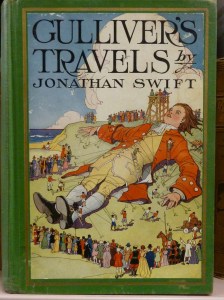
Having just delivered his most generous volley of actual story thus far, Ishmael now stops in his tracks to mount a defense of the whaling industry. I don’t quite know what to make of this. It’s easy to look at this novel as an environmentalist story of humanity’s attempt to dominate nature, with catastrophic consequences. There are those who believe Melville actually intended the story to be read this way. If that’s true, then this chapter is the first serious case of Melville, our author, disagreeing with Ishmael, our narrator. Ishmael steps an inch closer to Lemuel Gulliver, a narrator that Jonathan Swift transparently thought was an idiot.

8640345343_3dfb127a86_b

Not Ishmael.

The most outlandish claim that Ishmael makes in this chapter is that whaling helped to end colonialism in South America. He actually credits whaling with the emergence of “eternal democracy” in Peru, Chile and Bolivia. This is patently absurd, and Dr. Parker’s footnotes tell me that Melville was well aware of its absurdity. If we’re taking Ishmael at his word, this idiocy is the most Gulliver-esque that he ever gets.

The thing I’m struggling with here is that I’d like to be able to read Moby-Dick as an environmental story, but I’m not sure that’s more important to me than being able to uncomplicatedly sympathize with Ishmael. Maybe we can square the circle. Allow me a moment to follow Ishmael’s example, and play advocate for him.

Ishmael’s Get Out Of Jail Free card is his earlier statement that he is “quick to perceive a horror, and could still be social with it.” The process of telling this story is a deep dive into old traumas: experiences that would certainly be enough to clue Ishmael in to the horrors of whaling. Perhaps in this chapter Ishmael is simply extending his customary social niceties to the horror that defines his whole life: the entire edifice of the whaling industry. This serves a story purpose as well: this rose-tinted outlook will enable us to more easily sympathize with the slew of experienced and enthusiastic whalers that Ishmael is about to introduce.

If you’re not entirely convinced by this, well neither am I. But I’m not sure this argument is any weaker or less committed than Ishmael’s.

Chapter 25: Postscript

elizabeth_ii_greets_nasa_gsfc_employees2c_may_82c_2007_edit

She NEVER smelled like fish.

This tiny chapter wasn’t included in the original British printing, which is a shame because the U.K. is certainly where it would have caused the most amusement. Ishmael continues his argument from the previous chapter by pointing out that every British monarch is consecrated with sperm oil at their coronation, doubtless lending the newly-crowned royals an unbecoming maritime aroma. I would have appreciated some guidance from Dr. Parker on whether or not this is true but he nipped out for a cig at the end of this chapter, so Google will have to do. 

The oil used in coronations starting in the 17th century is a perfume that includes orange blossom, cinnamon and jasmine among other things. The one used to anoint Elizabeth II wasn’t far off from that same formula. So, Ishmael’s claim that the royals smell like sperm whales, while amusing enough to cause censorship in England, is seemingly false. 

Chapter 26: Knights and Squires

The next three chapters consist of tell-don’t-show character sketches of the six men we haven’t met yet who are crucial to the story to come. Starbuck, for example is “A staid, steadfast man, whose life for the most part was a telling pantomime of action, and not a tame chapter of sounds.” Ironically, “a tame chapter of sounds” is precisely what we’re reading right now. It feels like Ishmael is admitting to us that he’s baffled by Starbuck: that his own tendency to describe and pontificate renders Ishmael unable to depict such a man of action with the necessary vigor.

He’s too modest; for me anyway, Ishmael’s characterization of Starbuck rings true. There were never any whalers in my family, but there were plenty of fishermen. The most successful of them shared Starbuck’s conscientiousness and wariness of the sea. They had no patience for anybody with a cavalier attitude towards a dangerous job. They, too, knew “that an utterly fearless man is a far more dangerous comrade than a coward.”

Chief mate Starbuck is severe and humourless, but he’s the sort of person you want on your team. So it’s troubling when Ishmael implies that this story will bring about a “fall of valour” in Starbuck. Brace yourself.

Chapter 27: Knights and Squires

Bizarrely enough, this chapter has the same title as the previous one. It feels as if Ishmael has only broken up the chapters up because he got a little too excited at the end of that last one and needed a moment to collect himself. What’s the easiest way to get from the prayerful ecstacy of “bear me out in it, O God!” to the banality of “Stubb was the second mate?” Chapter break. 

Stubb, incidentally, is the second mate. He’s a man so unconcerned by the dangers in the world around him that he hums while he hunts sea monsters. Ishmael ascribes his cheerfulness to his constant habit of pipe smoking — a pipe containing only tobacco, we’re told. We’re treated to another of Ishmael’s dubious cosmic notions, which is that all the world’s air is polluted by the misery of every person who’s died here. Stubb’s pipe, we’re told, filters all that out. It’s a beautiful flight of fancy, and an elegant way to avoid calling this man an idiot outright.

The third mate is Flask, and you’d think he’s the last person Starbuck would want to be working with. “I will have no man on my boat who is not afraid of a whale,” Starbuck said in the last chapter. Yet here we are. Flask strikes me as even more of a liability than Stubb aboard the Pequod. Stubb is a buffoon, but Flask is impetuous and I feel like that’s worse.

2000px-chess_board_blank-svg

How to set up a chessboard.

Finally we meet the harpooneers, starting with our beloved Queequeg who we already know. Next, there’s Tashtego: an Indigenous harpooneer from Martha’s Vineyard. The Indigenous people from the region Tashtego hails from are the Wampanoag, though he isn’t identified as such in the text (so far). One gets the sense from Ishmael’s description of him as the descendent of brilliant archers that he is a good deal swifter than his boss, second mate Stubb. Finally, the diminutive Flask commands a harpooneer named Daggoo: an enormous black man that Ishmael describes somewhat condescendingly. Nevertheless, he takes this as an occasion to mention that in whaling, while officers are almost always “American” (he means white), the industry’s workforce is truly multicultural. And in spite of his condescension, this workforce is where Ishmael’s sympathies mainly lie. Remember, he told us in his first chapter how “the commonalty lead their leaders,” and only one chapter ago he waxed poetic about how brightly God’s dignity shines “in the arm that wields a pick or drives a spike.”

Moby-Dick can’t totally escape the racist attitudes of its time. But the whaling vessel where it takes place is a multicultural society. That’s one of the most important things Ishmael communicates to us as he sets up his chessboard.

Chapter 28: Ahab

Ahab might be the most recognizable character name in Moby-Dick, in spite of the fact that its most famous sentence is “Call me Ishmael.” Adaptations of the novel have a tendency to shunt Ishmael to the side in favour of the Pequod‘s one-legged captain. It’s not hard to see why. Ishmael is a novelistic conceit: a distinctive, multidimensional character who nonetheless has very little to do with the actual story. The story belongs to Ahab. And as a storyteller, Ishmael knows that Ahab is his ace in the hole.

511vwieztwl-_sx303_bo1204203200_

This is the cover of my beloved Norton Critical. I like this illustration by Oleg Dobrovolskiy, but I can’t imagine picturing Ahab like this.

Witness the difference between how he introduces Ahab and how he introduced his slew of inferiors in the last two chapters. Ishmael was willing enough to sum up Stubb, Flask, and even Starbuck in a few declarative sentences, the way an undergraduate might in an exam. But with Ahab, after teasing the reader with suggestions and premonitions and dropping his name with little context like “Bad Wolf” in Doctor Who, Ishmael permits us to get to know the mysterious captain the way he did: through observation. First, we take careful note of his absence. Then, we experience the crew’s shock at his sudden presence. Finally, we take stock of the man from his appearance and way of moving about the ship.

But Ishmael can’t keep the high-flying language at bay for long. He is fully committed to elevating Ahab into tragic heroism: “moody stricken Ahab stood before them with a crucifixion in his face; in all the nameless regal overbearing dignity of some mighty woe.” The poor man can’t help but render himself the second most memorable character in his own story. Poor guy.

Chapter 29: Enter Ahab; to him, Stubb

He speaks! As he descends into his cabin, Ahab mumbles, “It feels like going down into one’s tomb.” His first words in Moby-Dick: another portent of death.

Also worth noting: the title of this chapter is a stage direction. Ishmael will play with this more in later chapters, but for now it’s just one more indication of how much he’s puppetmastering his story into a dramatic shape, rather than laying it out genuinely according to his memory. And indeed, this chapter finds Ishmael penning a soliloquy for the second mate, Stubb, who’s starting to feel something like a Shakespearean fool: a hapless, much abused dogsbody who stumbles upon nuggets of wisdom in his rambling speeches to nobody.

(c) National Galleries of Scotland; Supplied by The Public Catalogue Foundation

King Lear and the Fool in the Storm by William Dyce. A cool thing about making blog posts is finding dodgy old paintings to illustrate them with.

First comes the episode that the chapter title alludes to, in which Stubb and Ahab interact for the first time. Ahab abuses Stubb with Shakespearean overzealousness (“I will not tamely be called a dog, sir,” says Stubb; “Then be called ten times a donkey, and a mule, and an ass, and begone, or I’ll clear the world of thee!” replies Ahab, measuredly) and possibly kicks him so hard he instantly forgets it happened. Then, Ishmael quotes Stubb directly in a speech that goes on for a whole page, during which there is nobody else around. Note that one of the people who isn’t around is Ishmael himself, unless we conjecture that he is very good at inconspicuously listening to people talk to themselves and remembering it word for word.

The Shakespearean nature of Ahab is much remarked upon, but the most Shakespearean moment in this chapter (and the best) belongs to Stubb, who could simply say “time to go to bed,” but instead says this:

“Here goes for a snooze. Damn me, it’s worth a fellow’s while to be born into the world, if only to fall right asleep. And now that I think of it, that’s about the first thing babies do, and that’s a sort of queer, too. Damn me, but all things are queer, come to think of ‘em. But that’s against my principles. Think not, is my eleventh commandment; and sleep when you can, is my twelfth — So here goes again.”.

Chapter 30: The Pipe

If Ahab and Stubb ever had anything in common, it would have been their mutual love of pipe tobacco. And as if to drive home the fact that Ahab has nothing at all in common with Stubb, Ishmael devotes an entire little chapter to the act of Ahab throwing his pipe overboard: “What business have I with this pipe? This thing that is meant for sereneness, to send up mild white vapors among mild white hairs, not among torn iron-grey locks like mine. I’ll smoke no more.”

Chapter 31: Queen Mab

320px-110_queen_mab2c_who_rules_in_the_gardens

“Gotta find the queen of all my dreams…”

At last, Shakespeare finds his way into a chapter title: Mab being the queen of dreams, most famously described in Romeo and Juliet. This chapter brings us even more primo Stubbiana. And this time Ishmael actually gives him an audience for his ramblings: the thoroughly disinterested third mate Flask. Stubb, preoccupied by the kick that may or may not have happened the previous night, has had a weird dream that he simply must share.

In Stubb’s dream, Ahab kicks him and Stubb attempts to kick back, only for Ahab to suddenly turn into a pyramid. Pyramids are of course the subject of many whack-a-doo conspiracy theories. They are ancient, mysterious and inscrutable. Possibly extraterrestrial. Much like whales, if you subscribe to that sort of thing. And like Ahab lost his leg at battle with the white whale, in his dream Stubb loses his leg in a kicking battle with a pyramid. Stubb has ceased to be a Shakespearean fool and has taken on the role of holy fool — the hapless idiot you pay attention to because he has visions of the truth in his madness. Unbeknownst to him, Stubb has dreamed a reenactment of how Ahab lost his leg. Except in this version, Ahab himself has become the monster.

Stubb finishes recounting his dream just as Ahab calls out for the crew to keep an eye out for white whales. Stubb once again demonstrates that though his wits may be dim, his intuition is second to none: “A white whale — did ya mark that, man? Look ye — there’s something special in the wind. Stand by for it, Flask. Ahab has that that’s bloody on his mind. But, mum; he comes this way.”

Aaaaaaannnnd CLIFFHANGER.

Chapter 32: Cetology

At last we’ve made it to the most infamous chapter in Moby-Dick. Just as we’ve started getting to know our captain and his retinue of old salts, Ishmael once again draws the story to a screeching halt to enumerate and categorize the different kinds of whales.

These are the bits of Melville’s novel that might compel some to label it “bloated” or “indisciplined.” I dunno. I wasn’t remotely interested in reading Moby-Dick when I was under the impression that it was primarily a seafaring adventure story — the sort of story it’s sometimes adapted into by readers who prioritize Ahab over Ishmael. It wasn’t until I cracked it open to “Loomings” and met our maddeningly discursive narrator that the book called out to me. Adam Gopnik put it better than I possibly could in a New Yorker piece about an abridged version of the novel in 2007:

“When you come to the end of the compact Moby-Dick you don’t think, What a betrayal; you think, nice job — what were the missing bits again? And when you go back to find them you remember why the book isn’t just a thrilling adventure with unforgettable characters but a great book. The subtraction does not turn good work into hackwork; it turns a hysterical, half-mad masterpiece into a sound, sane book. It still has its phallic reach and point, but lacks its flaccid, anxious self-consciousness: it is all Dick and no Moby.”

You won’t be surprised to hear that “Cetology” is my third-favourite chapter of Moby-Dick up to this point, next to “Loomings” and “The Lee Shore.” And how could it not be? This is the chapter in which the most bookish man to ever sail the seven seas categorizes the whales using terminology taken from bookbinding.

This choice on Ishmael’s part is not arbitrary. He is intentionally thumbing his nose to science. As far as Ishmael is concerned, a whale is not a mammal; it is a giant fish. Because of course it is. Just look at it. Read the story of Jonah, or any of the sources that Moby-Dick’s eighty epigraphs came from, and you’re sure to find it referred to as such. Reason may have it that a whale is not a fish, but the popular imagination says otherwise. For Ishmael, that’s more important.

image-4

Duodecimo is even littler.

And so, we have whales categorized in “books.” The big ones are “folio whales,” named for the largest size of book, the middle-sized ones are “octavo whales,” named for one of the middle sizes, and porpoises are classed as “duodecimo whales,” after one of the smaller sizes of books. Ishmael guides us through several examples of each, pausing to offer folksy sailor’s wisdom on many of them. He also offers a list of probably fictional whales that amusingly includes the blue whale, which was thought to be either extinct or altogether legendary when Moby-Dick was written.

But the real reason to love this chapter comes at the end of it, when all the taxonomy is done and dusted. Ishmael takes pains to inform us that his system of categorizing the whales is incomplete and inadequate, and hopes for some enterprising soul to make amendments to it someday. It’s not that Ishmael couldn’t finish writing Whaleipedia on his own: it’s that he’s built his entire aesthetic around incompleteness. That’s what he was getting at back in “The Lee Shore,” when he wrote that “in landlessness alone resides the highest truth,” landlessness being the state you’re in on an unfinished voyage. It also ties in with Ishmael’s perpetual unwillingness to just get on with the story the way that Gopnik’s abridgers would have him do. That would be anathema to him, because the end of the story is death. All of these sorts of things — endings, destinations, homecomings, logical conclusions and states of certainty — are anathema to Ishmael. Home is death for the soul. Better to die at sea than live on land, as Milton might phrase it.

Ishmael savours the journey and rues the destination. Very soon we’ll learn that Ahab is the other way around. The white whale must die. Everything that happens between now and that teleological event is a mere inconvenience.

“God keep me from ever completing anything,” Ishmael proclaims in an aphorism that defines him and this novel better than maybe any other single sentence. Maybe it defines me, too. How many things have I left unfinished? How many times have I pulled the brakes on a train of thought before arriving at a troubling certainty? And how long will it take me to finish reading this book? Do I also prefer to remain adrift in the seas of incomprehension, frightened at the prospect of arriving anywhere?

We may never find out.

To be continued.

The Final Omnibus

“As we all know, there is a kind of lazy pleasure in useless and out-of-the-way erudition.” — Jorge Luis Borges

Some years ago — never mind how long precisely — having no steady job, and nothing particular to interest me in empirical reality, I thought I would begin writing reviews of everything I watched, read and listened to. It is a decision I have lived by relentlessly ever since.

Now it’s time to stop.

To the dozen or so of you who constitute my core audience, thank you. And don’t fret — there will be plenty more nonsense for you to read here on matthewjrparsons.com in the future. But the exhaustive reviewing project that’s currently called Omnibus (still known to its friends primarily as Omnireviewer) is over, as of this post.

But as longtime readers will attest, if Omnibus is to vanish it is only appropriate that it should vanish up its own ass. And so, I present the last missive of the Omnireviewer. Strap in. In all my years of blogging I have never been as self-indulgent as this.

One review.

Literature, etc.

Matthew Parsons: Omnireviewer/Omnibus — Some things are so self-explanatory that you can review them just by describing what they are. “A prog rock album with only one 44-minute long song,” for example. Or, “a graphic novel that intertwines a gay coming-of-age memoir with a character study of the author’s father by way of the literature that fascinates them both.” Some readers will look at these descriptions and say “yes, please,” and others are philistines. Regardless, the point is that these particular works are so obviously the thing that they are, which nothing else is, that to say more would be almost superfluous. Surely there has never been a clearer example of this than the present one: “A blogger writes reviews of everything he watches, reads, and listens to for nearly three years.” You’re no philistine if that premise makes you run for the hills. But even if it doesn’t, if you’ve spent any amount of time at all on the internet — better still, any amount of time at all around me — you know precisely what you are getting into. To say more would be pointless. STILL, I PERSIST.

Before we go any further, let’s dispense with the no-paragraph-breaks schtick. That’s a policy I instituted early on to prevent myself from writing too much. It never really worked.

So. Was Omnireviewer any good? No, not really. I believe it’s the home of some of my worst writing, in terms of the actual quality and readability of the prose. But assessing the quality of things was never quite the point of the enterprise, nor should it necessarily be the point of reviewing in general — except in cases so superlatively brilliant or awful that there’s little else to say. Generally, I prefer a more rhapsodic approach — drawing connections, parsing out meaning, converting subtext to text. And if in my explorations I should happen to touch on the success of a given thing, fine. Quality vs. success is a subtle but useful distinction. To me, the former implies that there’s an objective standard to which everything can be held. And while I do half-heartedly believe that, I don’t trust myself to be the arbiter of such things. Neither does anybody else.

But success is different. Success, to paraphrase the great British avant-gardist Cornelius Cardew, exists in relation to goals. To determine the success of a venture, you need to know something of the intention of the venturer.

So, if we’re going to establish whether Omnireviewer has been a success, we need to explore why I started writing it in the first place.

***

Of all the various magical accoutrements in the Harry Potter books, my favourite one as a kid was the Pensieve — Albus Dumbledore’s magical basin full of thoughts. “One simply siphons the excess thoughts from one’s mind, pours them into the basin, and examines them at one’s leisure,” Dumbledore explains in my nostalgic fave, Harry Potter and the Goblet of Fire. “It becomes easier to spot patterns and links, you understand, when they are in this form.” I have often described Omnireviewer as my Pensieve: the technique I use to evacuate my brain of all the swirling observations and analyses of trifling pop culture matters that threaten to crowd out what’s actually important. It’s an easily avoidable place where those observations and analyses can live permanently, so I don’t feel compelled to annoy my friends with them in bars. At least, not when they don’t ask me to.

All of this is true, and it is a large reason why I’ve continued to write Omnireviewer for nearly three years. But it isn’t the whole story. And the Pensieve isn’t the only valid pop culture analogue for this weird project. For a more honest one, we’ll have to look back a whole generation to another totemic childhood text:

Lucy_Blanket

Omnireviewer entered the world on November 1, 2015, but the context for it dates back more than a year prior to that. The circumstances that enabled this blog emerged in the summer of 2014. That summer, two extremely ordinary things happened. Firstly, I finished grad school, marking the end of twenty consecutive cycles of school/summer/school/summer etc. Suddenly, I was all too aware that my life was now FREE JAZZ — structure be damned. Exacerbating this anxiety was the small matter that I had graduated with a masters degree in journalism, and the universe was laughing at me. ONE SINGLE DAY after I turned in my thesis — in the form of a radio documentary — the Canadian Broadcasting Company cut 600 jobs. “Screw you, Parsons,” said the universe, “and everybody who shares your ludicrous ideas about how to make a living.” Just as all this was going on, a relationship I’d been in for seven years came to an end as well. Like every breakup, it seems inevitable in retrospect. But at the time it seemed impossible.

Unemployment; breakup. I bring up these two extremely ordinary things only because they are the first two misfortunes in my life that I couldn’t just smile my way through. I’m not sure why. Unemployment and a breakup are empirically no worse than things I’d been through previously. Maybe there just comes a time in a person’s life when the emotional warp drive has to give out and you’ve got to rely on just a regular engine. I dunno. But prior to 2014, I always prided myself on my ability to be happy in spite of things. Losing that was like falling out of the sky.

What helped me was work. In the uncomfortable grey zone between graduation and the start of my first contract, some friends of mine tried to start a magazine. They brought me into the fold as a writer, and even though it wasn’t really my project, I contributed as much writing to its embryonic form as anybody. What else was I going to do with my time? The magazine never properly launched. But if nothing else, it kept me from going off the deep end during the worst few weeks of my life.

And since the experience of writing for that vapourizing magazine was such a lifesaver, I proceeded to try that method ONE HUNDRED MORE TIMES. Even when my work situation started to pick up, I had to be constantly doing things to distract myself from the swirly void. A friend proposed an epistolary project where we assigned each other albums to listen to. I eagerly accepted. I took up cooking with the vigor of Hannibal Lecter. I started running. At work, I built a huge interactive story about dead composers, cheerfully spending twice as many hours on it as I got paid for. (It has since vanished into the digital wastes, mourned by no one, least of all me.)

Over the next three years, I would start, and swiftly abandon, a history of progressive rock. I would write 20,000 words about Jethro Tull in a single week. I would put together, and never submit, a book proposal. I would take a class about writing for comics. I would begin and struggle to complete a set of annotations for Moby-Dick. I would make two comedy podcasts with one of the guys who started the vapourizing magazine. I would make podcasts on my own, which reside on my hard drive to this day, waiting for their moment.

Yeah, I’ve been busy.

But as of November, 2015, I was not busy enough. So I filled my time the way we all do. I watched TV. I went to movies. And since I’m me, I also read voraciously, listened attentively to my favourite records dozens of times in a row, and listened to 30 or 40 podcast episodes per week. And the more time I spent on that, the more aware I had to become of how little time I was spending in gainful employment or meaningful social exchange. So I made up a game to put it out of my mind. The game was Omnireviewer. Every Sunday since then, I have released a report on the game, with the week’s score tallied up at the top of the post. 17 reviews. 23 reviews. 35 reviews. Here was a game I could win.

linus

***

Since keeping score was always such a big part of what this blog has been about, let’s look at some final statistics:

Total instalments of Omnireviewer/Omnibus: 143

Total reviews: 2,822
Average reviews per week: 20
Largest number of reviews in a single week: 38

Total words: 441,637
Average words per week: 3,088
Highest word count in a single week: 8,493

A few notes on these numbers:

  • Bear in mind that I sometimes clumped together whole seasons of television in one review. A large number of the reviews I have written on this blog have been for more than one episode of a show or podcast. So, as impressive as the number 2,822 may look, it is still deflated somewhat.
  • A cursory Google indicated that novels tend to range from 60,000 to 100,000 words, on average. If we split the difference and go with 80,000, my reviewing habit has stretched to the length of five-and-a-half novels in less than three years’ time.
  • In spite of everything I’ve written here so far, I am intensely proud of both of these stats.

Speaking of pride, shall we move on to the set of statistics that make me the proudest of all?

Total page views: 2,146
Average page views per week: 15
Highest page views for a single post: 117
Lowest page views for a single post: 3

They say that if you do any one thing on the internet for long enough, you’ll eventually find an audience. I am just pleased as punch to have disproved that rule. The post that got 117 views — still paltry, by any reasonable standard — accidentally demonstrated the real way to find an audience on the internet. It only received such a substantially above average number of readers because I got retweeted by one of the post’s subjects, the food scientist and cookbook author J. Kenji Lopez-Alt.

By the way, the post that got only three views was 3,000 words long. That’s one reader per thousand words.

“Really don’t mind if you sit this one out.” — Jethro Tull

When I started this project, I started it for myself. I made it public only for the sake of accountability. The thing that makes me proudest of all is that I kept writing Omnireviewer for as long as I did in spite of the fact that nobody read it. The human mind is a cobweb ball of rationalizations and suppressed motives. I’ve never felt like I can be entirely sure when I’m just looking for attention. But surely, here is numerical proof that this project stayed true to its roots.

One final note on the statistics, that only slightly undercuts what I’ve said above: these numbers don’t account for the people who saw my reviews on the associated Tumblr account. In some cases, this was substantially more, but mostly it was not. The numbers also don’t account for the homepage, which got a significant bump on weeks when my site’s URL was read on the radio. In the interest of transparency, my homepage has been visited 7,163 times since I started Omnireviewer. What a pathetic number. I love it.

***

On the topic of the radio: the best thing to come out of this blog was a column that I’ve been doing on CBC Radio 1’s North by Northwest since June of last year. I pitched it as a recurring summer feature on the show, and it just never stopped. Since the beginning, that column has distilled the best of this blog into purposeful nuggets of meaning and connection. It is Omnireviewer at its most Pensieve-like.

In the written edition of Omnireviewer, anything might prompt a veiled exegesis on the disappointments and regrets of my life. The Beatles’ Help. Olivia Liang’s deeply relatable work of memoir-through-art-criticism The Lonely City. The death of Anthony Bourdain. Chris Gethard. Maria Bamford. In the written edition, the music of Brian Eno is not only ingenious, but kind and restorative. In the written edition, Alison Bechdel is a saint, because she confirms the value in reading your own life as literature, like I do — drawing connections, parsing out meaning, converting subtext to text.

But on the radio, it isn’t about me. It can’t be. A public radio audience requires you to put aside your self-indulgence in a way that a blog with 15 readers just doesn’t. And that made for a far superior version of this project. Many paragraphs ago, I asserted that Omnireviewer wasn’t very good. That’s true, at least of its original form. But its radio form is one of the things I’m proudest of in my entire career so far.

In my last radio column of 2017, I flirted more dangerously than usual with the masked confessional approach of the blog. But I’m glad I did. I finished it with a segment on Margo Price’s “Learning to Lose,” a heartbreaking duet with Willie Nelson that struck a chord with me immediately. I closed out my year in radio with the sentiment: “Maybe next year we’ll learn to win.” Three months later I got a job as the associate producer of North by Northwest. I ran around, waving my arms in the air and laughing like a maniac. The context for this blog collapsed in a heap.

***

To me, Charlie Brown is not the hero of the Peanuts comics. It’s Linus — the would-be philosopher who stays positive in spite of his insecurities, which are made manifest in the blanket he cannot be parted from. Omnireviewer was a security blanket I wove to shield myself from the emptiness of my life. But unlike Linus, I’m not stuck in time. I can outgrow my compulsions. I don’t need my blanket anymore. Life is good. More to the point — life is good in spite of the fact that lots of specific things about it are not. At last, we’re back to where we started.

“God keep me from ever completing anything.” — Herman Melville

In the months to come, I’ll work on other things in my spare time. But not because I need to for my sanity — because there are things I want to make that I think people might enjoy. I’ll keep posting fun nonsense to this blog. Notes on Moby-Dick will return. I’m thinking about writing more short fiction. Maybe I’ll rank all the tracks on ABBA Gold. And I’m going to make some tweaks to those podcasts I alluded to earlier, and hopefully get them out in the world before too long. That’s what I’m going to do with the time I would have spent on Omnibus. I’m not convinced I could bring myself to do any of it if not for this blog. I’ve learned so much from doing this. I’ve made connections I never would have made. I’ve learned about the conditions under which I do my best and worst work. I got a job that I probably wouldn’t have gotten if not for this blog and the radio spots it inspired. And I have kept my head above water. I have nothing but warm feelings for this weird-ass thing I’ve been doing these past few years.

And so it comes to this. Omnireviewer has fulfilled its purpose, and fulfilled it better than I could ever have foreseen. Time now to set it adrift in the obscure internet sea where it has always resided and always will.

Pick of the week.

toaster.gif

Omnibus (week of June 24, 2018)

This contains one of my longest reviews ever, though a bunch of it is just a list of paintings, sculptures, woodcuts, lithographs, cathedral facades and interiors, ornate candlesticks etc. It also contains some of my shortest reviews ever because reviewing podcasts can be tedious. It also contains a lot of Belle and Sebastian. Enjoy.

25 reviews.

Music

Belle and Sebastian: Dear Catastrophe Waitress — In the past few weeks I’ve stumbled upon a couple things with unexpected connections to Yes’s unexpected commercial breakthrough 90125. It is not a particularly good album, so I’ll likely not heed the signs that are telling me to revisit it. But the two Trevors who made that album into a Yes album like no other (Rabin, a.k.a. the composer of the Hot Rod score, and Horn, a.k.a. half of the Buggles and the producer of this Belle and Sebastian album) are admirable people in their own right. This is my first listen through the full album, but I’d heard “I’m a Cuckoo” before. Trevor Horn’s influence on it was less obvious to me when I’d only heard The Life Pursuit. But now that I know what this band sounded like before they committed to actually sounding good, I get it. This is far from the high-gloss production we identify with Horn, i.e. 90125 and the first Frankie Goes to Hollywood album. But by B&S standards, it’s basically Purple Rain. It’s a great record. My favourites are probably “Step Into My Office, Baby” and “Lord Anthony,” but this will doubtless be subject to much reassessment.

Belle and Sebastian: The Boy With the Arab Strap — I’ll continue my odd habit of referencing Yes in Belle and Sebastian reviews, because this reminds me of Fragile in a very specific way. For Yes, that album was undeniably a step forward — the first to feature their classic lineup, and the home of several of their most accomplished tracks. It also contained five tracks designed to feature the band’s individual members, which are slight by design and hold the album back from unqualified masterpiece status. The album that had preceded it, The Yes Album, was a huge step forward in itself: the first album to consist entirely of originals, and the one that cemented them as critical favourites. Looking back on the two albums, the earlier one is the more consistent of the two. But nothing on it quite has the sublime confidence of “Roundabout” or “Heart of the Sunrise” from Fragile. I think this comparison is roughly analogous to If You’re Feeling Sinister and The Boy With The Arab Strap. The latter demonstrates a real advancement over the former in terms of the band’s performance and willingness to try out new instrumentation. “Sleep the Clock Around” is an album highlight for that reason: its synths and horns lend it the euphoric feel of much later Belle and Sebastian songs, like “We Are the Sleepyheads.” Even the Rhodes piano of the title track (which I only now realize the Decemberists totally ripped off in “Days of Elaine”) is a nice touch. But is anybody really going to think back on an album with tracks like “Chickfactor” and “A Space Boy Dream” as an unmitigated classic? Basically, I like this album a lot and its best songs are classics. But its restless need to try things makes it patchy in a way that its esteemed predecessor is not.

Belle and Sebastian: Tigermilk — Last week I expressed that I was slightly underwhelmed by If You’re Feeling Sinister, but I did think it was more than just nostalgia that made that album so revered. Now I’m reconsidering the role nostalgia might play. Because Tigermilk — Belle and Sebastian’s debut, made the same year as Sinister, first pressed on only 1,000 vinyl records, containing the first few recordings of songs from Stuart Murdoch’s massive songwriting backlog from his years with chronic fatigue, and presumably the ones in which he was most confident — is outstanding. It’s confident, it has hooks all over, Murdoch’s voice is strong, and it’s even fairly well recorded, which is not something anybody’s likely to say about If You’re Feeling Sinister, whatever its virtues. But only one thousand people at maximum heard it when it was released. Most people didn’t hear it until it was reissued in 1999, post-Arab Strap, at which point If You’re Feeling Sinister had already been enshrined as, if not a classic, then at least the Moment Of Revelation for the first wave of Belle and Sebastian fans. It strikes me that this album is similar enough to Sinister, and good enough on its own merits, that had it received wider distribution on its first release it might have had the same impact its successor did. That calculus reduces Sinister slightly, suggesting that the biggest thing it has going for it is the fact that it was the indie community’s first contact with the band. Don’t get me wrong, I really like If You’re Feeling Sinister, and it’s grown on me the couple more times I’ve listened to it since last week. But I love Tigermilk. “We Rule the School” is the most beautiful and delicate thing I’ve heard of theirs from before “Dress Up In You.” There are hints of the sonic variety I had assumed were first introduced on The Boy With the Arab Strap. The synth lead on “I Could Be Dreaming” is irresistable. And “The State I’m In” is delightfully funny and vulnerable at once. The Life Pursuit is still my favourite. After all, that was my first point of contact. But this is a close second.

Belle and Sebastian: How to Solve Our Human Problems — The last phase in my cramming for the concert. This is a compiled version of their three EPs released a few months back. It’s fine. There are some standouts, like the single “We Were Beautiful,” the leadoff to the first record, “Sweet Dew Lee,” and the Sarah Martin feature “Poor Boy.” But there’s a fair bit of chaff alongside it. Worth a listen, but only a few moments are worth returning to.

Live events

Belle and Sebastian live at the Vogue — What you don’t expect from a Belle and Sebastian concert, if you’ve never been to one and you’ve been marinating in their lo-fi early work for a week, is relentless energy. But you get it. This band, and particularly Stuart Murdoch, has mastered the fine balance of spreading catharsis without forcing it. There is no desperation in Belle and Sebastian — they aren’t Arcade Fire. Murdoch’s magnetism comes from the sense that he’s proven all he needs to prove to himself, and that it was a hard-won victory. It’s a confidence that radiates outwards to the rest of the band, with the effect that you can’t help but love them all. This was a great show. Musically, the band has the tightness of their post-Catastrophe Waitress records, and none of the sloppiness of their early ones. Excellent as those early records are, at least conceptually, nobody should mistake this for a loss. Many fans appreciate the sincerity of B&S’s lo-fi era — but they’re mistaking sincerity for an aesthetic. Nothing puts the lie to this notion like hearing the far more experienced modern iteration of the band play the snot out of “Judy and the Dream of Horses.” Songs from that era struck me as being better live — but only because they’re a better band now. Many of the highlights were early songs: a delicate reading of “We Rule the School,” a rollicking “Boy with the Arab Strap,” and “Me and the Major” transformed into a rousing encore. All of these hit harder in the room than on record. That’s less true of the later material, but a live performance only solidifies the brilliance of “I’m a Cuckoo,” “Sukie in the Graveyard” and especially “I Didn’t See It Coming.” Music aside, Murdoch also dispensed relationship advice and love hearts (one package of which he tossed cleanly into the balcony, which shouldn’t have been impressive but kind of was). Stevie Jackson wore a suit and was the spitting image of a British Invasion lead guitarist. Sarah Martin played a dozen instruments. A huge screen played wistful black and white video, which in the haze of the coloured lights became an animated rendition of the band’s album covers. The crowd was all about it. I am notoriously unmoved by most rock shows. But I left this show liking Belle and Sebastian a lot more than when I went in. Pick of the week.

KNOWER live at the Imperial — This concert preceded Belle and Sebastian in my week, but I’m reviewing it after. The contrast between these two concerts in a single week is not lost on me. The fellow nerd I saw both shows with summed it up rather well by pointing out that Louis Cole and Genevieve Artadi make music that is as counterintuitive as Stuart Murdoch’s is natural. Their melodies go off in every direction at once, they use complicated jazz school chords I don’t even understand, and they can change tempos on a dime. And yet it still all holds together. This was one of the few concerts I’ve been to by a group of professional musicians where it genuinely felt like anything could happen. This is the line that jazz fans use to explain the appeal of that music, and indeed this was a Vancouver Jazz Festival event. But this isn’t that. (Indeed, it’s not jazz — I’ll spare you my explication of the emerging genre of “meme funk” for now, but expect it in the medium-near future.) This is ludicrous dancing and drumstick throwing and lyrics about pizza. And I highly doubt that anybody else at Jazz Fest will be dressed as poorly. Cole was sporting a black t-shirt tucked into tiger-striped pajama pants and dark shades. It’s a look. Point is, KNOWER’s show is definitely not anybody else’s show. They are compulsively unpredictable. The most illustrative moment in the show came when Louis Cole called out to the audience to see if his cousin was still around (he’s got family here, shout out to the Coles). Turns out, Cole’s cousin is also an excellent drummer. When he joined the band onstage, the band started playing a song he hadn’t heard before. The premise of this song is that the band only plays for a few bars at a time before the drummer takes a solo. He goes wildly off in a direction that has nothing to do with the song itself, then counts the band back in and we’re back to where we started. So it would have presumably continued for several iterations, but in this case, the two Coles switched out on the drum stool every time the band started up again. And it worked. This kind of logistical fast-and-looseness only works for groups of supremely confident musicians. And they all are — the three touring band members included. Fun shit.

Literature, etc.

E.H. Gombrich: The Story of Art — Two flights and a quiet evening later, I know 99% more about art than before. As a person with very little visual imagination, who tends not to pay much attention to what’s happening in front of my eyes, this book made me see differently. Now I feel like I can go to a gallery and just enjoy the pictures, rather than spend 90% of my time reading the curatorial text. I’ve even started to look at photographs differently, making careful note of the compositions in news photos, and the expressions on people’s faces. (Check out the sneer on the woman near the centre of this story’s top photo. Or the play of light in this one.) This in turn has given me a greater appreciation of the work of painters who conceive of and craft scenes like this from scratch, or nearly. It seems to me that the biggest barrier to entry for appreciating works by painters like Vermeer and Rembrandt is how accustomed we are to seeing similar images in photographs. At the time, it must have seemed like magic for a painter to conceive of a scene like this one, with all of its personalities and reactions conveyed as if they’re of a piece with each other. Nowadays it takes a jolt of realization to fully recognize that a painting like this is the construction of a single mind. The Story of Art’s greatest asset is providing that jolt, without ever resorting to didacticism. This isn’t a book about arguments and value judgements. It is what it says it is: a story. Specifically, it’s the story of dozens of generations of artists trying to solve particular problems, like how best to represent nature in art, or how to convey depth in two dimensions. Gombrich’s central contention is that every artist, whether they know it or not, works inside a set of parameters that pose problems that need to be overcome. And if the artist is a great artist, we admire the resulting work of art for its beauty without even thinking about the reasons the artist had for making the choices they did. If Brian Eno could be bothered to write a survey of the history of art, it might not be so unlike this. Some of the problems solved are things you wouldn’t even think of as problems until you try to imagine a world where they hadn’t been solved. Here’s a crazy insight: think of an Egyptian relief carving. You know the ones I’m talking about — the ones where the head is in profile but the body is front on. You know why they look like that? It’s because the Egyptians hadn’t yet thought through the idea of conveying things as they saw them. Instead, they conveyed them as they thought about them. You can show more of a thing if you show it from different angles simultaneously. These images even have two left feet for this same reason. This is by no means a value judgement. In fact, the 20th century found Picasso doing much the same thing deliberately. One more example: think about what it would have been like to see a painting in perspective for the first time. You’ve never seen depth represented on a flat surface before, and suddenly there it is. Must have been like seeing Avatar. If you’re thinking about reading this book but wondering whether you might be better served by reading something more recent — I kind of can’t help you, because I don’t know any more recent books. But I can counsel you thus: Gombrich was clear-headed and sceptical enough to distrust certain fashions of his age that have come and gone, i.e. that creativity and madness are somehow intertwined. Even if this scepticism also made him discount Warhol, Rauschenberg and the other pop artists whose works still seem penetrating to us today, it seems to me a fair tradeoff. Gombrich’s outlook makes this book far less of its time than it might be. Of course, it is parochial in the way that all mainstream histories of creative endeavour have been until quite recently: people of colour are underrepresented save for the chapters on prehistoric art, which to Gombrich’s credit he clearly admires. And women are almost entirely absent — though even a critic writing in 1950 couldn’t ignore the stunning works of Käthe Kollwitz. The histories of these artists are something I’ll need to supplement my reading to learn. Gombrich saves his best writing for last. The final chapter of his original book (which, in my 16th edition is followed by an additional chapter on developments since then) sums up Gombrich’s idea that art tends to form around a central core of requirement, either from a patron or a flummoxing artistic problem: “We know that in the more distant past all works of art gained shape round such a vital core. It was the community which set the artists their tasks — be it the making of ritual masks or the building of cathedrals, the painting of portraits or the illustration of books. It matters comparatively little whether we happen to be in sympathy with all these tasks or not; one need not approve of bison hunting by magic, or the glorification of criminal wars or the ostentation of wealth and power to admire the works of art which were once created to serve such ends. The pearl completely covers the core.” Gombrich, circa 1950 is concerned about the fact that artists now exist for the sole purpose of creating “art with a capital A.” Maybe it’s our fault we don’t understand modern art: “If we do not ask them to do anything in particular, what right have we to blame them if their work appears to be obscure and aimless?” The point is: critics are important. Now that we no longer live in a world that accepts portraiture of the wealthy as great art for our times, there need to be people in the public who hold artists to specific standards. Today, this is a more resonant point than ever. Alex Ross wrote about it in the New Yorker only last year. So, read The Story of Art. You will enjoy yourself, and you will not necessarily even feel that you’re living in the past. A postscript: this is a dense book, and I feel the need to look through it again. So here, for your Googling pleasure, is a list of some of my favourite works featured in Gombrich’s book, upon a quick skim through. I can’t be bothered to link them. There’s only so much work I’m willing to do for y’all. Firstly, I love all of Gombrich’s tailpieces to his chapters, which are all images of artists at work that Gombrich does not comment on at all. It’s a nice touch. Here are more favourites, in order of appearance, with occasional notes: Caravaggio, Saint Matthew (both versions); Pablo Picasso, Cockerel; 19th century Haida chieftain’s house; Inuit dance mask from Alaska; Tutankhamun and his wife (c. 1330 BC); Hagesandros, Athenodoros and Polydoros of Rhodes, Laocoön and his sons (a favourite among favourites; enormously powerful; I desperately want to see it in person); Trojan’s Column (Google close-ups of this; crazily detailed); Court of Lions, Grenada; Mu Yüan, Landscape in moonlight; Liu Ts’ai, Three fishes; Saint Matthew (830 AD; artist unknown, but oh my god it’s practically Van Gogh 100 years early); the Gloucester Candlestick; Amiens Cathedral; Giotto, The Mourning of Christ; Virgin and Child (silver gilt statue, 1339); Paul and Jean de Limbourg, May; Masaccio, Holy Trinity with the Virgin, St. John and donors (the origin point of perspective); Donatello, The Feast of Herod; Jan van Eyck, The Ghent altarpiece; Jan van Eyck, The betrothal of the Arnolfini (there’s a mirror at the back of the painting, in which the painter paints himself painting; this is one of those decisions that seems almost unbearably clever when you think that he’d never seen a photograph); Benozzo Gozzoli, The Journey of the Magi to Bethlehem (one thing I didn’t expect is how colourful pre-Renaissance art can be); Leonardo da Vinci, anatomical studies (not so much for their aesthetic virtues as for their insight into one of the most obsessively probing minds of all time); Leonardo da Vinci, The Last Supper (it holds up); Leonardo da Vinci, Mona Lisa (so does this); Michelangelo, Sistine Chapel ceiling (quite possibly the greatest work of art ever made; there is much to be said for the intersection of skill and spectacle); Correggio, The Holy Night (the most convincing faces in the book); Correggio, The Assumption of the Virgin; Albrecht Dürer, St. Michael’s fight against the dragon (some of these figures could come straight from comics); Grünewald, The Resurrection (Blake before Blake); Albrecht Altdorfer, Landscape (better than landscapes from the heyday of landscapes); Hieronymus Bosch, Paradise and Hell; Federico Zuccaro, window of the Palazzo Zuccari (this one I will link because it’s bonkers for 1592); Giambologna, Mercury; El Greco, The opening of the Fifth Seal of the Apocalypse (the most shockingly modern thing from before the 19th century); Pieter Bruegel the Elder, Peasant Wedding; Anthony van Dyck, Charles I of England (so dashing); Diego Valázquez, Las Meninas (so meta; so Borges); Frans Hals, Pieter van den Broecke (maybe my favourite portrait in the book; very loveable); Rembrandt van Rijn, Self-portrait (c. 1655-8; probably objectively better than the previous portrait, but I still like it a little less); Jan Steen, The christening feast; Jan Vermeer, The kitchen maid; Gian Lorenzo Bernini, The Ecstasy of St. Teresa; Melk monastery; Francisco Goya, The giant; William Blake, The ancient of days; Joseph Mallord William Turner, Steamer in a snowstorm (basically impressionism); John Constable, The haywain; Claude Monet, Gare St-Lazare; Katsushika Hokusai, Mount Fuji seen behind a cistern; Victor Horta, Hotel Tassel; Vincent van Gogh, Cornfield with cypresses; Ferdinand Hodler, Lake Thun; Frank Lloyd Wright, 540 Fairoaks Avenue; Käthe Kollwitz, Need; Paul Klee, A tiny tale of a tiny dwarf; Piet Mondrian, Composition with red, black, blue, yellow and grey; Marc Chagall, The cellist; Grant Wood, Spring turning; René Magritte, Attempting the impossible; Salvador Dali, Apparition of face and fruit-bowl on a beach; Jackson Pollock, One (number 31, 1950); Zoltan Kemeny, Fluctuations; Giorgio Morandi, Still life (1960); Henri Cartier-Bresson, Aquila degli Abruzzi; David Hockney, My mother, Bradford, Yorkshire, 4th May, 1982, terracotta army.

Stephen Rodrick: “The Trouble with Johnny Depp” — A showbiz tale for the ages. This story of how Hollywood’s most bankable star went broke is worth a read even if you’re not interested in him. Rodrick at one point compares Depp to Elvis, which is very apt. Johnny Depp, circa 2017, comes off here like a man child with access to vast riches and no sense of personal responsibility. This piece also casts Depp’s domestic abuse allegations in a larger context of increasingly troubling behaviour.

Podcasts

On the Media: “Chaos Agents,” “Polite Oppression” & “The Worst Thing We’ve Ever Done” — The first two are standard episodes, and good ones. But “The Worst Thing We’ve Ever Done” is a feature episode with no specific time hook, and those are often the best episodes of this show. This one is about America’s insistence on rewriting history and not confronting the reality and aftermath of slavery. The comparison between this problem and Germany’s total acknowledgement of the Holocaust has been made before, but maybe never as deeply as here. For one thing, this episode brings up the fact that the Allies dictated the narrative for Germany going forward — an example of history being written correctly by the winners. But the rest of the episode points out that this is a coincidence of history, and it isn’t always like that.

Reply All: “An Ad for the Worst Day of Your Life” — Alex Goldman helps a guy whose wife died tragically take down the clickbaity ads that take advantage of his story. In the process, he elucidates the shady (but very profitable) world of those ad boxes with terrible stories in them. It’s good.

Decoder Ring: “Clown Panic” — Willa Paskin is a welcome addition to the pop culture podcast world. This show is turning out to be as much about analysis as storytelling, and that is good. This is the story of how scary clowns became more ubiquitous than happy clowns and what that says about us.

Song by Song: “Wire Stripped Special” & “Straight to the Top” — Sometimes this show is a bit dumb and I wonder why I listen to it. The idea that anybody could ever listen to “Straight to the Top” and see it as anything other than a complete piss take is ludicrous to me. Oh well.

Theory of Everything: “It is happening again” — More stories of fictional artists from Benjamen Walker. No complaints.

99% Invisible: “Post-Narco Urbanism” & “Right to Roam” — Two stories from two continents that aren’t North America. Nice. The Latino USA collaboration “Post-Narco Urbanism” is especially good, outlining how urban planning played a role in rehabilitating a Colombian neighborhood after the fall of Pablo Escobar’s cartel.

In the Dark: “Discovery” — This season of In the Dark has something that the first season of Serial had that no true crime podcast I’ve heard since (including Serial season two and In the Dark season one) has had, which is the occasional incursion of innocuous but surreal investigative side streets. In this episode, the team speaks to more than six different men named Willie James Hemphill, searching for one person with that name who might be connected with the case. It’s like something Peter Greenaway would write. I’m not sure if this or Caliphate is my favourite podcast of the year so far, but it’s a two-show race.

Ear Hustle: “So Long” — Stories of people getting out of prison. It takes a lot of planning. Imagine dating. This is really good.

Slow Burn: “What If Nixon Had Been Good At Football?” & “Live in New York” — The first is a crossover with Mike Pesca’s new sports podcast Upon Further Review, which sounds good but not good enough to impel me to listen to multiple episodes of a sports podcast. The live episode doesn’t really add much to the series. I am looking forward to season two, though. My lack of enthusiasm for these specific episodes notwithstanding, Slate’s killing it these days. This has been followed by Decoder Ring and Lend Me Your Ears, both of which I love. Good work, Slate.

Code Switch: “Immigration Nation” — This is a long-term look back on the times when anti-immigration fervor reached similar heights as it has in America today. History. It’s useful.

The Truth: “The Jesse Eisenberg Effect” — Starring the real Jesse Eisenberg! As the fake Jesse Eisenberg. This is the best episode of The Truth I’ve ever heard, and it’s basically an episode of Upon Further Review. It’s the fully dramatized, and hugely exaggerated, story of how Jesse Eisenberg’s letter to his favourite basketball player ruined the world. I love it. Pick of the week.

We Came to Win: “How Soccer Made It in America” — Another underdog story, and a perfectly good one. But I think I’m done with this show now.

Pop Culture Happy Hour: “The Songs of Summer” — An NPR Music takeover featuring a great many songs that I cannot rightly say I care about. I dunno. Some years I’m in new music mode. Some years I’m not. 2018 isn’t a new music year.

Home of the Brave: “Lick the Crickets by Larry Massett,” “Rumble Strip: It’s a Podcast” & “End of Season One: A Walk On the Beach” — “Lick the Crickets” is bonkers and I don’t understand it, nor do I feel the need to. I need more of this Larry Massett fellow in my life. Rumble Strip isn’t for me. But the story Scott Carrier replays to finish off his “first season” of Home of the Brave is beautiful. Just a conversation with an old friend as they walk along the beach. Simple. It’s the sort of thing people should do more of.

Trump Con Law: “Taking the Fifth” — This ties the Hollywood blacklist to the Russia campaign — but only conceptually! Though, I really would like to hear that conspiracy theory. Anyway, it’s really good.

Bullseye: “Special: The Wire!” — I don’t know if I’ve ever heard an interview with Wendell Pierce before, but that man is interesting. This whole episode is great and made me want to watch The Wire again. Wherever will I find the time.

StartUp: “Arlan Hamilton” episodes 1 & 2 — I’ll always give a new season of StartUp a shot. But as interesting as Arlan Hamilton is, this show has become Gimlet’s “business podcast.” It’s no longer about the real-time tribulations of startup founders who may or may not succeed, like it was in its epochal first season and its hugely underrated second. For now, I’m out.

Omnibus (weeks of Apr. 22 & 29)

I’ve been away for a week, and that always throws off my schedule here. So, we’ve got two weeks worth of reviews, and they are ALL OVER THE PLACE.

I think I’m actually proud of this particular Omnibus. There’s a lot going on here. There’s opera and paintings and other hoity-toity shit like that. There’s the new Avengers. There’s a pair of films about rock and roll, and a pair of albums by a band I’m currently obsessed with. There’s stuff that made me laugh. There’s a weird game. And there are not so many podcasts as to tip the balance away from the other stuff. I think this may be good. Anyway, it was fun.

I will also take this opportunity to direct you to the Tumblr associated with this blog, in case you would like a more media-rich experience that also includes paragraph breaks. Paragraph breaks are good, but we have a house style here and some rules are not made to be broken. Even when the paragraphs clearly are. I think the Tumblr may be particularly advisable in the case of the Vancouver Art Gallery entry, because pictures. Regardless of your choice, enjoy.

Does three picks of the week sound reasonable? I think that sounds reasonable.

20 reviews.

Events

Gaetano Donizetti: Anna Bolena (Canadian Opera Company) — I only had time to take in one show while I was in Toronto. It might have been a hard choice if Sondra Radvanovsky hadn’t been singing at the COC. That made it damn easy. I’ll be honest: I don’t like Donizetti. I don’t find his music memorable, and the librettos in these Tudor operas make me cringe. But in this case, that didn’t matter at all, because I was in this for Radvanovsky specifically, and she was magnificent. She’s a singing actor who puts intensity front and centre, in the tradition of Maria Callas — except, in my opinion, with a more innately attractive voice than Callas. And intensity is what you need for Bolena, a role that encompasses imperiousness, regret, madness, spite, and maybe love. Radvanovsky’s Bolena seems ready to spit in the king’s eye at any moment — a dramatic task made easier by baritone Christian Van Horn, who plays Enrico (Henry) VIII as a louche slimeball with no sense of his own hypocrisy. Van Horn and Radvanovsky have that delicious dynamic of intense loathing that’s hard to come by outside of the Lannisters on Game of Thrones. Remarkably, soprano Keri Alkema holds her own alongside Radvanovsky. The role of Giovanna Seymour is intrinsically less interesting than the role of Bolena, even if she does get some nice coloratura stuff to sing. Seymour is merely a lover — and a tediously sincere one at that, who knows Enrico is objectively horrible and loves him anyway. Bolena’s concerns are more complex: she wants power, and she’s concerned about her legacy. There’s a great love in her past, but when she looks back on it fondly, you get the sense that she’s really just regretting the pickle she’s gotten herself into by marrying such a terrible man. But it’s precisely this contrast between the two characters that makes Radvanovsky and Alkema so effective together. They understand that relationship completely. Of the smaller roles, Allyson McHardy stands out in the pants role of Smeton, a character whose only narrative purpose is to drive the tiresome intrigues that are a mandatory part of all bel canto opera. What the character lacks in narrative interest, McHardy compensates for with wonderful singing. If I haven’t made it clear already, this is a very well-directed production. Even though the libretto (or at least its translation) is made up exclusively of things that nobody would ever say, the actors commit. And their understanding of the relationships that underpin the drama goes some distance to papering over the weakness of the text. The set is spectacular without being overbearing. It is essentially a Jacob’s ladder of connected, tall wood panels that can slide back and forth across the stage to produce the impression of intimate spaces when they’re close to the audience and grand spaces when they’re far back. They can become corridors and gates. It’s nifty. It also aids the drama: Bolena’s chambers seem tiny and claustrophobic, while Enrico seems particularly frightening slouched on a throne in the middle of a huge, empty stage. Director Stephen Lawless and set designer Benoit Durgardyn have done well, here. I enormously enjoyed this. I still think it’s a dumb opera, but it hardly seems to matter. (Okay, fine, “Al dolce guidami” is gorgeous.)

A visit to the Vancouver Art Gallery (April 24, 2018) — As I’m writing this, it has been nearly two weeks since the visit in question, and the network of connections and ideas that formed in my head as I traversed the five exhibitions present at the time has largely disintegrated. But I did see a bunch of art that’s stuck with me and will continue to. So I’m just going to rattle some of it off. The reason I was at the gallery was that it was my last chance to see Takashi Murakami’s retrospective exhibition “The Octopus Eats Its Own Leg.” Given what a hit it’s been, I figured I’d see it last, so as not to be completely underwhelmed by the rest of the art in the gallery. In practice, I think the opposite happened. I was at the VAG for more than four hours. By the end of that, I was completely overstimulated and my brain was having trouble processing images. That’s not the state you want to be in when you walk into a whole floor of brightly coloured, enormously detailed, narratively complicated art with influences ranging from ancient Japanese painting to Instagram. I’ve never seen Picasso’s Guernica or Bosch’s Garden of Earthly Delights in person, but I imagine that some of Murakami’s most gigantic paintings rival those works for sheer impact of spectacle. Seeing Tan Tan Bo Puking on a screen or an advertisement makes it look like a comics splash page or a Roger Dean album cover: you may be drawn in by its whimsy and impressed by its minute detail, but you’re unlikely to be overwhelmed. Seeing it in person is overwhelming because it is seven metres long. I have no idea what, if anything, it is meant to convey. But it doesn’t seem to matter because the spectacle is so effective. That’s a reasonable summary of my whole experience with the Murakami exhibit. I wish I could see pieces like 100 Arhats or Dragon in Clouds again while not being quite so spent, because they require a lot of energy. Knowing that I would need at least a fragment of my energy left for Murakami, I breezed through the small exhibition on the fourth floor somewhat inattentively. In addition to the traditional selection of Emily Carr paintings (which I never tire of), the VAG was showing some prints of photographs by Mattie Gunterman, a photographer born in 1872 who walked six hundred miles with her husband to get to B.C. to mine for silver. Seeing her photographs alongside Carr’s famous forest pictures made perfect sense, prompting me to go “ah” as I slingshotted around this floor and headed for Murakami. This brings us to “Bombhead,” maybe my favourite exhibition I saw on this visit. It’s a selection of art and artefacts focussed around the idea of nuclear disaster, curated by John O’Brian. It’s accompanied by a nifty little booklet designed in the style of Canadian nuclear survival guides that were published in the 50s and 60s. The exhibition takes its title from a Bruce Conner picture that sets the tone for the whole thing: the nuclear age is a void too dark to stare into, so we resort to whimsy. Accordingly, the exhibition is exhausting and marvellous. I spent more time than I needed to in an alcove, watching an old Cold War era documentary called The Atomic Cafe, while a Globe and Mail story about Donald Trump and Kim Jong Un loomed over me. I stared at a wall lined with photographs from Robert del Tredici’s epochal book At Work in the Fields of the Bomb. I surveyed unexpected images of nuclear detonations in popular culture. And I nearly barfed at the power of Nancy Spero’s bomb paintings. It’s a bonkers experience that feels terrifyingly relevant. The fallout from “Bombhead” seems to be drifting downwards to the lower floors of the VAG. Murakami’s exhibition is also concerned with the literal and figurative flattening of Japan by a nuclear bomb. And World War II looms large in the focus of “Living, Building, Thinking,” an exhibition of expressionist art building from the collection of McMaster University. I love expressionism. I do not know art, but this is where I live. This exhibition shuffles the entire history of expressionism and its influence around so that the expected wartime Germans rub shoulders with contemporary Canadians and others. Walking in, you’re greeted by Yggdrasil: an oppressive, overwhelming painting by the German painter Anselm Kiefer, who was born just as WWII ended. That sets the tone nicely. Shortly thereafter, we see Canadian painter Tony Sherman’s Poseidon, which stares bleakly at us from a sea of drab dribbles. At that point, we’re well prepared for an intensely German freakout by Jörg Immendorff and a moving work by the Montreal-based painter Leopold Plotek called Master of the Genre of Silence, depicting the Soviet journalist Isaac Babel being interrogated. But the real heart of the exhibition is a whole room full of wartime lithographs and etchings by Nazi-persecuted artists like Max Beckmann, Hermann Max Pechstein and Frans Masereel. Pechstein’s multi-part illustration of the Lord’s Prayer is the absolute highlight of the exhibit, and even more modest works like Beckmann’s The Draughtsman in Society and Masereel’s wordless graphic novel Passionate Journey have incredible power in their simplicity and expressiveness. I’ll explore all three of these artists in greater depth. We’ve been working backwards through my visit to the VAG, so we’ve now finally arrived at the beginning. The expressionism exhibition shares a floor with another one taken from the collection at McMaster, this one containing art that was donated by the private collector Herman Levy. With all due respect, I do not care about Mr. Levy, no matter how hard the annotations in this exhibition try to make me. However, he doubtless had excellent taste in art, and I totally enjoyed seeing some great works by Monet and Pissarro in the comfort of my own city. I enjoyed noticing for the first time that painters sometimes convey the motion of water by actually thickening the layers of paint on the ripples. And I definitely enjoyed being introduced to the work of George Braque and Roderic O’Conor, who I was previously unfamiliar with. You know what, I like art. Art is good. This was a fun afternoon. Also, during the course of my visit, two different people stopped to look at a fire extinguisher and jokingly said “so beautiful” to their friends. I wonder if that joke happens every day. Pick of the week.

Movies

Avengers: Infinity War — It is without a doubt the mostest movie I’ve seen this year. Avengers: Infinity War is a big fun spectacle that I had a great time watching. And it embodies all the best and worst tendencies of the Marvel Cinematic Universe in one movie. Weirdly, I think a useful way to look at this movie is in comparison with Game of Thrones. I’ll tell you why, and I’ll do so with no spoilers. Relax. The key question for me going into Infinity War is how the hell they’d be able to juggle all of these characters and still maintain a semblance of a cohesive story. The answer turns out to be that they structure it like an episode of GoT, which famously encompasses a vast range of characters and settings. Your standard episode of GoT pushes several independent stories forward at once, each of them linked to the others only in the sense that viewers are aware of the complex web of familial relationships and power dynamics that relates them. Tune into a random episode, and it might feel like you’re watching five different medieval soaps. Infinity War is structured much the same way, with characters from various bits of the MCU grouped off and pursuing stories independently of the others. But unlike GoT, this movie’s characters are pulled from separate franchises, some of which have drastically different tones than the rest. It’s great fun to see a Spider-Man school bus scene that could come straight out of Homecoming bump up against big silly Guardians of the Galaxy space opera scenes and climactic battles in Wakanda. If Infinity War operated along the same lines as the first two Avengers movies, with its cast largely concentrated on one threat in one area, it would be impossible. But the GoT approach makes it surprisingly fleet-footed. You can quibble with the underrepresentation of certain favourite characters (for many, Black Panther; for me, Hulk). But in a movie with a gazillion superheroes, this is inevitable. Infinity War strikes that balance more deftly than anybody could have hoped. (But seriously, though: when are we going to get a Mark Ruffalo-starring Hulk movie? That’s maybe my favourite performance in the whole MCU, and he’s only ever been a side-character.) The other way in which Game of Thrones can help inform a viewing of Infinity War is less flattering to the latter. GoT is famous for killing off major characters at the drop of a hat. So as not to spoil too much, I will only say that Infinity War also has a body count. But the funding models of these respective franchises prevent us from looking at them the same way. GoT can kill off characters and twist the plot around in crazy ways because its viewers are invested in a brand called “Game of Thrones” which will endure regardless until the story’s done. This is how television works. Infinity War, on the other hand, can’t easily kill anybody important off permanently because the MCU is a blockbuster movie generator buoyed by big, bankable characters. There is no end in sight to the overarching storyline of the MCU, and the brands that draw audiences in are “Spider-Man,” “Iron Man,” “Captain America,” and so forth. You can’t kill these characters because the characters themselves are brands. The brands need to stay alive if they can make money. In GoT, Tyrion Lannister is not a brand. He’s arguably a selling point for the show, but nobody’s tuning into a show called Tyrion. They’re watching Game of Thrones. These cold hard facts of capitalism are impossible to ignore while watching Infinity War, and they seriously undercut what would otherwise be some deeply affecting moments. Basically, I liked Infinity War. It’s a big, silly action movie. The villain is undercooked, and some of it is boring because of underdeveloped relationships. But it’s fun, and I don’t mind that it made a billion dollars.

Deconstructing the Beatles: The White Album — I went to this screening at the Rio expecting something else. This is a film of a multimedia lecture given by the Beatles scholar Scott Freimann. Freimann himself was in attendance, so I thought we’d actually be getting a live rendition of the multimedia lecture captured on the film. Still, the film was worth seeing, and it was fun to be able to ask Freimann questions after the fact. He’s been doing this whole series of lecture films on the Beatles, including ones on Sgt. Pepper, Rubber Soul, and Revolver. This particular film on the White Album covers the usual beats associated with that album — the move away from psychedelia, the trip to India, Yoko, George Martin getting fed up and leaving, Ringo getting fed up and leaving — but it also highlights the musical consequences of those events in a way that taught me a lot. I’m always worried going into a Beatles-related thing that I won’t learn anything. Martin Scorsese’s George Harrison documentary fell into that category. But this didn’t. It’s worth seeing for Freimann’s breakdowns of the multi-track recordings alone. Who knew the vibrato on Clapton’s “While My Guitar Gently Weeps” solo was done by manipulating the tape machine? Sounds like a whammy bar, but it isn’t. There are gems o’plenty along those lines in this. I’m curious to see the others, and may well do.

The Fearless Freaks — I’ve seen a ton of rock documentaries, and I’m not sure that any of them capture the spirit of the band they document quite as well as this one. Director Bradley Beesley had known and worked with the Flaming Lips for years by the time this was finished, and it allowed him to get footage of them that feels like genuine fly-on-the-wall material, rather than just relying on talking heads like most rock docs do. It also helps that Beesley directed a bunch of Flaming Lips music videos, so he’s a person who actually contributed to their iconic visual aesthetic, which is represented here in spades — it’s a hectic, fast-edited movie full of overwhelming colour. Except for when it’s in black and white. Honestly, the black and white footage is nutty because watching it is almost exactly the same as watching black and white footage of the early Pink Floyd. Without the beard, Wayne Coyne even looks a bit like Syd Barrett. A lot changed between the late 60s and the early 90s. But the appeal of getting high and making loud noises on guitars evidently did not. What I did not expect was that Coyne is not the highlight of the film. He’s a compelling live performer, no doubt. But this movie makes it entirely clear that his key virtue is being incredibly hardworking. That’s admirable, but not super interesting. The hero of this movie is Steven Drozd, the band’s once-heroin-addicted drummer/guitarist/keyboardist/pantomath. Drozd is a naturally lucid talker, to the point where Beesley can even have a frank conversation with him while he shoots up. This scene is the cornerstone of the film, but it doesn’t feel voyeuristic at all, given the obvious trust that exists between the two people. The key tension in the movie comes from the fact that Drozd is the most talented musician in the Flaming Lips, and Wayne Coyne is well aware that the band’s sound depends on a guy who could die at any moment. I don’t know the Flaming Lips’ music very well, but this is a great primer on their story.

Music

The Flaming Lips: Yoshimi Battles the Pink Robots — The first time I listened to this I was really distracted. My review at the time said that “I generally find myself wishing that the fun spacey sounds and weird beats would occasionally also yield to a nice melody or a good lyric.” Did I just flat out fall asleep during “In the Morning of the Magicians?” That is a serious melody. Where was I right at the top of “Fight Test?” That’s a melody so good it’s actually by Cat Stevens. And as for lyrics, you can’t beat “you realize the sun don’t go down, it’s just an illusion caused by the world spinning round.” This is every bit the album I didn’t used to think it was.

The Flaming Lips: The Soft Bulletin — My second foray into the Lips discography, and the one that’s going to end up cementing me as a fan. This album is gorgeous. It has just enough of the archness I know from Yoshimi and the smattering of earlier Flaming Lips stuff I’ve heard to keep it from being tedious. But Wayne Coyne and co. seem much more concerned here with producing a thing of beauty rather than a thing that’s just fun. “A Spoonful Weighs a Ton” strikes the perfect balance between preening Broadway balladry and cheap, janky indie rock. The song itself is grandiose and cathartic, but it’s clothed in bad orchestral synths and Wayne Coyne’s detuned bleat. It’s perfect. I love every song on this. The ones I keep going back to are “Buggin’,” which is a very unexpected summer jam about mosquitoes, “The Spark That Bled,” which goes off madly in every direction, “The Gash,” which is psychedelic gospel music, and “Waiting for a Superman,” which is one of those songs that made me regret not being close to a piano right when I first heard it. I don’t know why it took me so long to get to this, but it’s one of my favourite musical discoveries I’ve had recently. Pick of the week.

Literature, etc.

E.H. Gombrich: The Story of Art — What book should I take on the plane, I asked myself. Maybe Moby-Dick, so it won’t take you a whole year to get through it? Or possibly something light, both physically and figuratively? You know, airplane reading? No, I said to myself. What you need to take on the plane is this hardback brick of a book about the history of visual art from prehistoric times through the 20th century. That is what you will enjoy. And you know what? I DID. I have only gotten up to the Renaissance so far, but this book is 100 percent living up to its reputation as a clear and lucid introduction to art with a layout that encourages you to look at the pictures discussed with a fresh eye. I’m learning so much — like, I didn’t realize that the reason Ancient Egyptian art looks like that is because they were trying, Picasso style, to show the whole of a thing from one angle. Nor did I realize how long it took for painters to devise a way to show an image from a perspective that makes it look lifelike. These are things I just took for granted. Thank you, Dr. Gombrich. I look forward to learning more.

Chris Onstad: Achewood — My plan for Achewood reading going forward is to read a year’s worth of the comics followed by a year’s worth of the affiliated blogs until I’m done. It’s too tedious to keep up with the blogs as I’m reading the comic, but I’ve realized that they are an essential part of the Achewood experience. If you’re unfamiliar, Chris Onstad wrote a series of in-character blogs for the various personages that populate his webcomic. Together, they expand the universe by a fair margin. And more than that, they provide Onstad with a more flexible platform to explore the language of his characters. Everybody in Achewood talks in their own particular way, and the blogs reflect that. Given that, some of them are virtually unreadable. Lyle’s blog is a tragically garbled account of life as an unrepentant blackout drunk. Little Nephew’s is an admirably committed performance of teenage affectation. Both are nearly as challenging as some chapters of Ulysses, or at least A Clockwork Orange. Molly’s is problematic for a different reason, namely that her entire identity revolves around her boyfriend. But aside from these, the blogs are a pleasure, and they add layers upon layers to the comic. If you noticed that Cornelius had been absent from the strip for a while, you might well take to his blog to see where he’s been. Sure enough, he’s in Russia, attempting to seduce an Olympian. (Cornelius’s blog contains my absolute favourite post I’ve read so far, which is this.) The other standout is Nice Pete’s blog, which contains a serialized novel of such derangement that your laughter is almost defensive. A sample: “Eustace ducked into the bathroom six seconds later. Six seconds is the amount of time it takes a man to really get into a good pee. He knew that Dimitri would be focused on the pleasure of his peeing sensation, and that he could have his way.”

Comedy

John Mulaney: Kid Gorgeous at Radio City — Mulaney remains the comic with the highest batting average. His two previous specials are both brilliant and this one keeps the pace. It’s a bigger venue (it’s Radio goddamn City Music Hall), and Mulaney is accordingly more physical. But his jokes are still things of immense precision. I’ve been off learning about how to write better for the radio for the last week. Radio producers would do well to listen to Mulaney’s writing. It is everything that is good in writing. If you are a radio producer and you are reading this, I specifically recommend the bit about Stranger Danger. It is a well-oiled machine of perfect construction. Also, this has a live appearance by Jon Brion playing Radio City’s weird old organ. He closes Mulaney’s set with Nirvana’s “Lithium,” which he’s talked about at length in interviews. That’s fun.

Games

OFF — I was listening to a recent episode of the podcast No Cartridge and this weird French indie game came up as a point of contrast with EarthBound, which I love. So, I downloaded it — for free; it is a non-commercial release. And I could not run it without it freezing constantly. But I was compelled enough by it to want to see it in some form anyway, so I watched a three-hour playthrough on YouTube. I wish I could have played it myself, because watching somebody else play a turn-based RPG isn’t the best experience. Still, I think I got a sense of the story and feel of OFF, and it is a hell of a thing. Firstly, it came out in 2008, before the recent pileup of recursive, meta indie games (The Stanley Parable, Device 6, Stories Untold, Pony Island, etc., etc., etc.). Nowadays, it’s par for the course for an indie game to put forth a Borgesian transgression of the boundary between fiction and reality, but it doesn’t seem to me that this was the case in 2008. Given all the praise that was quite deservedly heaped upon Undertale, which is also a deeply meta game with a fairly explicit debt to EarthBound, you could be forgiven for thinking that it was the first game to really question the mechanics of a video game in that particular way. But OFF did something remarkably similar, long before. That doesn’t lessen Undertale’s accomplishment — it is, execution-wise, by far the better game. But it does demonstrate how ahead of its time OFF was. In this game, you control a character known only as the Batter (seemingly a reference to Ness’s weapon of choice in EarthBound, though apparently the creator of the game denies this). The Batter is aware that he is being controlled by a puppeteer he cannot see — the player; you. At least one of the other characters in the game, a grotesque cat called the Judge, is aware of this as well and often addresses the player directly. This one idea — that the player character of OFF is aware of the player — completely changes the dynamic of the game, relative to your standard old-school game. Where a character like Ness or Link looks like a hero moving actively through the world and overcoming obstacles, the Batter comes off as a ruthless inquisitor. He kills because it is inevitable that he must kill, because that is why we are playing the game. Again, this is expressed more subtly in Undertale, but OFF has more going on that just that theme. Its final stage is a creepy masterpiece of bizarre reiterations and echoes. At one point, you have to navigate several different versions of a room by using a fake version of the menu screen. That’s very nearly an Undertale idea. I enjoyed this a lot. I only wish I could have actually played it.

Podcasts

On The Media: “Moving Beyond the Norm” & “Dog Whistle” — Two good episodes with some great segments between them. Highlights include a Ken Kesey retrospective, a piece on the history of self-immolation, and two bits of metacriticism on Roseanne and The Simpsons — the latter featuring Hari Kondabolu. So yeah, it’s On the Media.

The Daily: “Friday, Apr. 20, 2018,” “Tuesday April 24, 2018” & “Friday, April, 27, 2018” — Wow, I’ve been away from this blog a while. The first of these is Michael Barbaro’s excellent interview with James Comey, which is the best of the many Comey-related things I listened to during Comey Week. Remember Comey Week? The media declared Comey Week, a couple weeks ago. It was all really interesting. But Barbaro’s interview is the best one because he focussed specifically on the idea of ego, and whether that character trait might have a lot to do with the decisions Comey made during the 2016 presidential election campaign. He denies this, and argues persuasively against it, but it’s interesting to hear how hard he has to work at it. The second is a fascinating look at a story that had nothing to do with the news cycle we’re constantly bombarded by: a Hong Kong bookseller suddenly disappeared and all hell broke loose. It’s an incredible story. The third is the Cosby episode. It’s also good.

No Cartridge: “Videogames’ Citizen Kane w/David ‘TheBeerNerd’ Eisenberg” — This is a conversation about EarthBound, a game I love and am endlessly fascinated by, and OFF, a game I had never heard of but have now watched a full playthrough of in the absence of a download that will run properly on my computer. It’s a fun conversation, but both of those games are sort of self-explanatory, and I’m not sure this really enlivened my thinking about either. But it did bring OFF to my attention, and I’m grateful for that.

Code Switch: “Members of Whose Tribe?” & “It’s Bigger Than The Ban” — Here we have a pair of episodes taking the long view of anti-Semitism and Islamophobia in America. These are both things you should hear. Start with the anti-Semitism one because it is SUPER complicated, even by this show’s standards.

99% Invisible: “Gander International Airport” & “The Hair Chart” — The Gander airport episode is maybe one of my favourite things this show has ever done. I am intensely prejudiced about this, mind you, because one side of my family is from very near Gander and I grew up flying into the Gander airport to visit them. Nowadays the St. John’s airport has taken precedence, but I’m happy that the Gander airport’s foyer is still considered a modernist landmark. I’ll be honest though: the fact that it was considered that was a surprise to me. It’s one of those things you come to take for granted. Actually, there’s a lot of stuff in this episode that I was really surprised to learn for the first time in a podcast. I would have expected somebody in my family to have told me the story of Fidel Castro going sledding in Gander, but they did not. Thank god for Roman Mars. “The Hair Chart” is a really good episode too, about the endlessly complicated issue of how hair products are marketed to black people. Pick of the week.

Caliphate: “Recruitment” — Here we have the New York Times’ top ISIS reporter interviewing a guy who was recruited into ISIS. It is enlightening.

Theory of Everything: “Fake Nudes (False Alarm! Part ii)” — This series exploring fake news through the medium of fake news continues to be bewildering, clever, and one of my favourite things that any podcaster is doing right now.

Pop Culture Happy Hour: “Avengers: Infinity War and What’s Making Us Happy” & “Scandal” — Well Scandal sounds like a whole thing. If it was your thing, I’m sad for you that it ended badly. The Avengers episode is pretty much bang on. It’s one of those movies that it’s hard to have an original thought about because its virtues and problems are so self-evident.

All Songs Considered: “Swan Songs: Music For Your Final Exit” — As I finally come to the end of two weeks worth of review writing, I remember that the proximate cause of my Flaming Lips wormhole was a coincidence: I played one of their songs with a friend at a party one night, and woke up the next day to find “Do You Realize?” in this mix of funeral songs. It’s a maudlin premise, but there’s some good music here.

Notes on Moby-Dick (which I still have not finished): Part 2

When last we checked in on Ishmael, he was aboard a schooner with his new “friend” Queequeg, headed for the port town of Nantucket AND THENCE FOR THE SEA.

(Edit, 2022: These notes are essentially just me recapping Moby-Dick as I read it very slowly and deliberately over the course of what has turned out to be several years. I’m writing it primarily for my own benefit and posting it for the interest of about five people who might care. Lightly edited out of sheer embarrassment.)

Chapter 14: Nantucket

Dr. Parker’s footnotes tell me that Melville had never actually been to Nantucket when he wrote Moby-Dick, unlike New Bedford.  (Here we have a case of Ishmael knowing something that Melville does not. Get used to it: Ishmael knows lots of impossible things. Just wait until chapter 34.) This whole chapter is a description of a place that Melville had no personal experience of. Rather, the details are taken from the copious readings that allowed him to start the book with eighty epigraphs.

But on the other hand, this chapter is rather short on realistic detail, especially compared to the New Bedford chapters we just read. Ishmael breezes through Nantucket, and he’s far less interested in what actually happens in the town than he is in its legend. Moby-Dick‘s New Bedford is a real place full of real people. Its Nantucket is a HERMIT COLONY OF OCEAN WIZARDS. This island of superhuman salts feels more than real: a wild place of mystical significance. No wonder Ishmael insisted on setting sail from here.

Also extraordinary: the idea that everything great about this totally fantastical chapter is the result of Melville working around the fact that he’s never seen Nantucket with his own eyes. Clever man.

Chapter 15: Chowder

chowder

Made some chowder.

I understand that this gigantic novel has approximately 1.7 women in it, so let’s take a moment to appreciate the arrival of the unfortunately-named Mrs. Hussey. She is the co-proprietor of the Try Pots: an inn that serves the best damn chowder in New England, or so Ishmael tells us. But before he and Queequeg may sample it, they must once again encounter a death omen: a structure above the door to the inn that unintentionally resembles a gallows. This keeps happening: first it was “Peter Coffin,” and now this. If we take Ishmael’s story at face value, some divine intelligence is clearly trying to tell him something. But why should we take him at face value when he won’t even tell us his real name? This is one of the main things I’m obsessed with in Moby-Dick, and I’ll try not to haul out the whole “Ishmael is an unreliable narrator” thing too often, because it’ll get tedious really fast. But details like this have the distinct ring of embellishment about them, reminding us that apart from anything else, Moby-Dick is also the greatest Big Fish story ever told.

Inspired by Ishmael’s enthusiasm towards the chowder at the Try Pots, I endeavoured to cook up my own very first pot of the stuff. I went for cod rather than clam in deference to my allergies. I found this recipe a sturdy base, though I substituted carrot for celery and added a splash of chardonnay to deglaze the pan after cooking the onion. The Try Pots’ chowder contains ship’s biscuit, known in Atlantic Canada as “hard bread.” So I had intended, as a nod to my Newfoundland heritage, to add a couple of Purity hard bread biscuits to my chowder. If I’d managed to find them, I’d have pounded them up fine the way fishermen used to when making fish and brewis aboard the schooners. (Purity hard bread has the approximate texture of petrified wood. A venerable old cookbook called The Treasury of Newfoundland Dishes advises: “Place [the hard bread] in a piece of ship’s canvas or heavy calico and beat with a hammer or head of a small axe.”) Anyway, I couldn’t find any of the stuff in Vancouver. So I had to content myself by serving up my cod chowder with Jacob’s cream crackers on the side. I’ll provide an update if I make another pot after sourcing a proper hardtack.

I’m amused by Dr. Parker’s footnote about the expression “chowder-heads.” They are “those with mixed-up or downright stupid minds,” he writes, “but Ishmael intends no disrespect toward chowder.” Well. I should hope not.

Chapter 16: The Ship

Back to the story. Fortified by chowder, Ishmael attempts to find a whaling vessel for him and Queequeg to sign onto. But Queequeg has a catch: his god, Yojo, has already selected a ship. Yojo will only consent to the voyage if Ishmael should select the proper vessel with no guidance from Queequeg. Or as Ishmael explains it, getting excited again:

“But to my surprise and no small concern, Queequeg now gave me to understand, that he had been diligently consulting Yojo—the name of his black little god—and Yojo had told him two or three times over, and strongly insisted upon it everyway, that instead of our going together among the whaling-fleet in harbor, and in concert selecting our craft; instead of this, I say, Yojo earnestly enjoined that the selection of the ship should rest wholly with me, inasmuch as Yojo purposed befriending us; and, in order to do so, had already pitched upon a vessel, which, if left to myself, I, Ishmael, should infallibly light upon, for all the world as though it had turned out by chance; and in that vessel I must immediately ship myself, for the present irrespective of Queequeg.”

This chapter contains the first invocation of the name Ahab, but he’s not going to turn up for a while yet. This chapter serves as an introduction to another of the book’s key characters: a garish old battleaxe called the Pequod. From the very start, the ship feels like a haunted house, trailed by the ghosts of slain whales whose teeth and bones decorate her bulwarks. But there’s something undeniably impressive about her, too. Ishmael struggles to decide whether to portray the Pequod as a noble beast or a monster.

The Pequod belongs primarily to its major shareholders: a pair of old Quakers called Peleg and Bildad, a comedic double act who abuse Ishmael for no good reason, and cheat him on his pay. So many reasons to turn back. And so many chances! Alas. We never get to hear if Yojo approves of the Pequod or not. Maybe it doesn’t matter. As Queequeg freely admits, Yojo is a flawed deity.

Chapter 17: The Ramadan

an00979772_001_m

A figure of the sea god Tangeroa, who Yojo is possibly based on. Photo stolen from the British Museum, which doesn’t have a leg to stand on.

This is another chapter in which the cultural differences between Queequeg and Ishmael play out as a farce. On the one hand, Ishmael writes off Queequeg’s religious beliefs as “comical.” But he’s happy to extend the same characterization to his own culture’s Presbyterian religion. Richard Dawkins has made me suspicious of this kind of undiscriminating dismissal, but in mid-19th-century America, proclaiming that both Christians and pagans alike are “dreadfully cracked about the head, and sadly need mending” probably required a lot of courage.

In this chapter Queequeg locks himself in his hotel room for an entire day and prays in total silence, with the idol of Yojo balanced on his head. Having also locked Ishmael out of the hotel room in the process, he inadvertently causes a panic throughout the hotel. Nothing is funnier to me than Ishmael capering ridiculously through the hallways shouting “Murder! Apoplexy!” Meanwhile, the proprietress of the inn cannot believe that yet another damned sailor has committed suicide on the premises. (*SIGH* “FETCH ME THE FLOOR SCRUBBER”)

Anyway, Queequeg’s fine. The chapter concludes with Ishmael explaining to him that such religious devotion is pointless. Queequeg responds with a funny story about how he and his countrymen once ate fifty of their enemy combatants in one sitting and got terrible indigestion. Ishmael stares directly into the camera. Cut to black. 

Chapter 18: His Mark

However shaken up he might have been by that anecdote, it doesn’t keep Ishmael from helping his new “friend” sign onto the crew of the Pequod. Bildad and Peleg have some doubts about Queequeg’s religious convictions and dietary habits. Ishmael assuages these by basically saying “aren’t we really all the same, when you think about it?” Bildad and Peleg, being comedy buffoons, find this to be the most profound shit they’ve ever heard in their goddamn lives, and the discussion is over.

Buffoonish as they are, Bildad and Peleg manage a poignant moment at the end of the chapter. Once the business is complete, Bildad begins preaching to Queequeg and Peleg tells him to can it. Taking umbrage at this, Bildad asks Peleg if he himself did not fear death and judgement when he sailed under the command of Captain Ahab on his ***fateful voyage***. Surely in such dire circumstances Peleg must have taken solace in his faith. Peleg’s response:

“When every moment we thought the ship would sink… Think of Death and the Judgement then? No! no time to think about Death then. Life was what Captain Ahab and I was thinking of; and how to save all hands—how to rig jury masts—how to get into the nearest port; that was what I was thinking of.”

Moby-Dick has been very concerned with religion so far, but the life of the world to come is inherently less interesting to Ishmael than our own world, where marvelous, sad stories like this one can take place. 

Chapter 19: The Prophet

frederick_leighton-_elijah_in_the_wilderness

Here’s a painting of Elijah by Frederic Leighton who, fun fact, died of angina the day after he was made a baron. To this day, he holds the record for having been a baron for the shortest amount of time.

If Moby-Dick were the Pirates of the Caribbean ride at Disneyland, this chapter would be “dead men tell no tales.”

Ishmael and Queequeg meet a shabby-looking, pus-faced old sailor who tells them that they have shipped with a mad captain, that Ahab lost his leg in a fateful battle with a giant whale, and that this was in accordance with some prophecy. Then, like all decrepit prophets in adventure stories, he refuses to actually say anything useful, leaving Ishmael a bit creeped out and none the wiser about his captain-to-be.

It’s worth noting that in the Old Testament, Elijah was the name of the prophet who denounced the king called Ahab, indicating that Ishmael’s own name isn’t the only dubious one.

Chapter 20: All Astir

Look, another woman! There’s an old sailor’s superstition that women are bad luck on ships, and shouldn’t be allowed on board, even at port. But I guess the crew of the Pequod are progressive for their time.

Aunt Charity is one of many folks involved in the hustle and bustle of loading the Pequod for her voyage. Ishmael notes with amusement that all whaling ships must pack spares of everything. After all, Accidents Happen!!!

Chapter 21: Going Aboard

Well, the prophet’s back, and he’s being even more annoying.

ELIJAH: You didn’t happen to see a bunch of creepy men creeping around the ship in the darkness, did you?
ISHMAEL: Yeah, actually I did!
ELIJAH: *no actionable advice*

Regardless, Ishmael and Queequeg board the Pequod and learn, a mere 21 chapters into the book, that Captain Ahab is ready to set sail. For good measure, we even get our first mention of the first mate: Starbuck. (Incidentally, the world’s top coffee chain was nearly called “Pequod.”)

Also it’s established that on Queequeg’s fake island, humans are used as ottomans.

Chapter 22: Merry Christmas

In case anybody was curious to hear more about Aunt Charity, the vanishingly minor character from two chapters ago, we now learn that she’s Bildad’s sister and also the brother-in-law of the second mate Stubb. I don’t know what that makes Bildad in relation to Stubb, and I don’t know why it matters.  But Melville seemed to think it was important enough to mention. What a weird book.

This is the chapter where, at long last, the Pequod leaves shore. But there’s a dark cloud above this exciting occurrence, because the captain of the ship has not yet shown his face above deck. Perhaps he’s simply not needed, because we learn that the custom is for the ship’s owners to pilot the ship away from the docks. Peleg and Bildad do so and take a small boat back to shore, and presumably out of the story.

A couple of amusing details in the footnotes: firstly, in a tortured effort not to swear around the pious Bildad, Peleg cries “Aft here, ye sons of bachelors!” In Dr. Parker’s opinion, this is “arguably funnier than the common epithet he avoids using.” Hardly arguable, I’d say. Finally, the song Bildad leads the crew in as the ship pulls away is called “A Prospect of Heaven Makes Death Easy.” This is the very sentiment Peleg so eloquently refuted a mere four chapters ago.

Chapter 23: The Lee Shore

sea_leeshore

A weird thing about Moby-Dick is that there’s a card game based on it.

Man, I love this little chapter. First off, from the fifth sentence on it could just as easily have been written by Shakespeare or T.S. Eliot. Also, it is the closest Ishmael has come thus far to revealing the ending of the story. He mentioned in passing that Queequeg has died at the time of this story’s telling. But in waxing poetic on the coming death of Bulkington, Ishmael strongly implies that much of the crew perishes with him. More than that, this chapter holds up a tiny, crystal clear mirror to this book’s iconic first chapter.

Ishmael spends a lot of that opening chapter categorically enumerating all the different reasons why the sea is so important: all that stuff about the factory workers gazing longingly from the harbour and the artists painting magical streams.  In chapter one, the sea is important for a hundred small, prosaic reasons. In this chapter, the importance of the sea comes down to one crucial, abstract notion. The pithiest way I can think of to phrase it is this: home is death for the soul.

The metaphor Ishmael is riffing on here is based on the idea that land is both the ultimate endpoint of all successful voyages, and it is the ultimate hazard in a storm. Land is the place where all mankind’s creature comforts reside, but if your ship gets dashed against the shore, you drown. In a storm, the safest place is the open ocean: vast, fathomless, empty. Nothing but uncertainty as far as the eye can see, but a lack of certainty means a lack of certain death.

We only know one thing about Bulkington: he cannot stay on land for more than a few days at a time. Clearly Ishmael sympathizes: one of the first things he told us is what happens to him when he hasn’t been to sea for too long. Being midway between two fixed points (“at sea,” as it were) is the organizing ideal of Ishmael’s life: it is the fundamental concept that guides the way he thinks about things. “In landlessness alone resides the highest truth,” he writes. “All deep, earnest thinking is but the intrepid effort of the soul to keep the open independence of her sea, while the wildest winds of heaven and earth conspire to cast her on the treacherous, slavish shore.” For all his tendencies to categorize and enumerate, Ishmael does not wish to be certain of anything. He wishes to remain adrift in a sea of unformed ideas and half-told stories. Because the end of the story is death. Death is the only certainty. Best then to keep travelling forever. To never make land. To never go home.

Home is death for the soul. You can never stop running. You can never be certain of anything. You can never stay in one place. Home is death for the soul.

The Pequod has set sail.

To be continued.

Omnibus (week of April 8, 2018)

Oh, hey! Thanks for dropping by. May I recommend a podcast that is not in the long list of reviews posted below? That podcast is the North by Northwest podcast from CBC Radio. It is the show that I work on for actual money, and we are trying some new stuff on there. For example, this week I made an alternate version of a radio story I did about a guy who designs yachts, which is more than twice the length of the radio version. In addition to things like that, you will get a whole raft of Sheryl MacKay’s interviews with interesting people in the B.C. arts world, many of whom you won’t have heard of. That’s the fun of it. And occasionally you’ll get me, just talking nonsense about pop culture and spinning weird theories. If any of this sounds interesting to you, subscribe on Apple Podcasts, or wherever else you’re accustomed to listening.

We return you now to your regularly scheduled tedious blather, complete with no fewer than ten podcast episodes pertaining to the Mark Zuckerberg hearings. Brace yourself.

20 reviews.

Literature, etc.

Oliver Byrne: The First Six Books of the Elements of Euclid — I’ve never been a math person. I have traumatic high school memories of standardized tests and interminable homework assignments that haunt me to this day. Now that I’m out of school and making a living, I find myself interested in learning about all sorts of things I wasn’t previously interested in, but mathematics has never been one of them. Nonetheless, I was browsing through a bookstore earlier this week and I found myself unexpectedly transfixed by this volume. It is a facsimile of a 19th-century illustrated publication of Euclid’s Elements: the foundational text of geometry. The printer, Oliver Byrne, has rendered Euclid’s proofs and problems in a remarkable, easy-to-grasp illustrated format made up of blue, yellow, red and black lines and shapes. (The publisher’s jacket blurb points out that Byrne’s colour choices inadvertently prefigure Mondrian’s famous geometric paintings, and thus a great deal of Northern European and Scandinavian design. Accordingly, I’ve shelved Byrne alongside my Mondrian-inspired yellow-red-blue boxed set of the Girl With the Dragon Tattoo books.) With everything laid out visually, I found myself able to follow along with Euclid’s reasoning — and to see the elegance of his methods. Everything he does in the Elements can be proven with nothing more than a straight-edge and a compass for drawing lines and circles. No protractor. You can’t measure angles. Think about that for a second: say you want to draw an equilateral triangle, but you don’t have a protractor. You draw a line that’s 10cm long. You draw another line connected to it that’s also 10cm long. All that’s left is to draw a third 10cm line that connects the two — but since you couldn’t measure the angle between your first two lines, how likely do you think it is that your third line actually will turn out to be 10cm? Not very. Never fear: Euclid found a way. And that’s his first proof. It’s simple, elegant, and it makes you go “huh,” and maybe turn the page. I did turn the page. And then I bought the book. I’ve been reading it in bed, a few proofs a night before I go to sleep. I cannot tell you how calming it has been. If you, like me, associate math with stress and pressure, that is likely because you have never encountered it in a zero-stakes situation. When you read Euclid — and especially when you read Byrne’s illustrated Euclid — you don’t have to solve anything. You’re not expected to come up with an answer to a question. You’re really just watching somebody else do math. Euclid’s got it all laid out for you, and all you have to do is follow along. And if you don’t understand a step, who cares? There’s no exam. This has been a revelation for me. Its complete lack of what we normally think of as narrative or thematic content makes Euclid the best bedtime reading I’ve ever encountered. It is math as self-care. And I feel like I can’t be the only person who would experience this: surely in these times, the most therapeutic thing you can experience is a person saying to you “here are some things that are definitely true, and here is why.” Pick of the week.

Games

Stories Untold — My feelings on this game are complicated by two kinds of negative responses: technical concerns and story concerns. I’d rather not even write about the technical concerns because they’re boring, but they also defined my experience of this game, so I have to. I’ll save them for last, though. Let’s start with the story. Spoilers, ahoy. Evidently “The House Abandon,” the first of the four episodes that comprise Stories Untold, was released in some form as a standalone entity previously to this. Taken as a thing in itself, “The House Abandon” is a marvel. It presents the player with a game within a game — specifically a text game within a graphical game — and then reveals that the two layers of reality it depicts are linked. The moment when the penny drops is masterful horror: essentially, there’s a point where you realize that what you are typing into the text game is actually happening in another part of the house you’re in. The power goes out at your computer desk; you make your character in the text game turn on the generator; the power comes back on. You make your character open a door; you hear a door open. It’s immediately obvious that the episode will end when you encounter yourself. And far from curtailing the suspense, that grim certitude only makes the game more agonizing as it draws relentlessly to the chapter’s conclusion. “The House Abandon” gave me gooseflesh in the middle of a sunny Saturday afternoon. I couldn’t stop thinking about it. But here’s the thing. None of what is good about it has anything to do with the actual content of the story your character lives through. It’s a story that’s mysterious and vague, and that in no way calls out for clarification. The horror and fascination arise purely from the central conceit: that there’s somebody else in the house, and they’re doing everything you type into your computer. I don’t really care about what happened to this character’s sister or why that door is boarded up. It seems largely beside the point, and anyway I’m content to wonder. So, imagine my disappointment when the final episode of Stories Untold explains away all that ambiguity with the most banal reason imaginable: the entire game up to that point has been a series of psychotic episodes in the mind of a guilt-ridden man who killed his sister and an off-duty cop while driving drunk. This reveal causes a number of things from episodes previous to make sense in a way that completely robs them of their strange imaginativeness. It reduces a fascinating formal experiment to a Very Special Episode. It treats its own narrative as a puzzle to be solved and shelved tidily away, taking for granted that the most important element of storytelling is THE ANSWER. It seems custom-made for people whose brains fell out at the end of Night in the Woods. To sum up: the first episode of Stories Untold is a self-contained near-masterpiece, the middle two are fine, and the final one is a huge disappointment that will appeal only to those with no appreciation for ambiguity or nuance. Which, to be fair, is a large group of people. Let’s move on to my boring technical concerns. Firstly and most my fault-ly, I tried to run Stories Untold well below the minimum graphics card specs (it’s a text game, I thought, how much graphics power could I possibly need?) and by the final episode the main source of tension was not the story but whether or not the game would crash. THREE TIMES I had to restart the chapter because of freezing or crashing. And while I realize it’s petulant to complain about a game’s performance when you’re trying to run it on an old MacBook, a simple autosave feature could have saved me the trouble of having to play through the entire episode from the beginning four times. Stories Untold has no saving mechanism at all, presumably in an attempt to make you play each of its episodes in one sitting. I get that. It’s definitely best that way. But should anything go wrong, tech-wise, you can be set back by as much as an hour’s worth of progress. That sucked. And crap graphics card or no, it needn’t have sucked so bad. Secondly, there are some seriously annoying design choices throughout. At one point you are obliged to read text on a microfilm reader (making this the third game I’ve played this year to feature microfilm, after Night in the Woods and Virginia) and you have to meticulously zoom and focus in on it. This is needless. Also, at a few points you are made to turn a dial until a display shows the correct number. In some cases, the only way (obvious to me) to manipulate this dial is to click and drag for minutes at a time until you hit the correct number. A simple numerical entry would suffice, thanks. No need to make it feel that analogue. Finally, in the first episode, the game insists on teletyping large amounts of text one character at a time. This is valuable for suspense in many cases, but sometimes you have to revisit text you’ve seen before, and surely there’s no suspense in teletyping that. These details make the game actively annoying to play. It’s almost too bad that “The House Abandon” is so brilliant. Because that’s the only thing that could make me waver while advising my fellow horror game enthusiasts to pass this one by.

Podcasts

The Gist: “Zuck Everlasting,” “It’s Regulation Time,” “Tax Cut Conundrum” & “I Never Said That” — Mark Zuckerberg is appearing before congress. That’ll be fun. This chat between Mike Pesca and April Glaser is a good primer on what to expect. If you’re reading/listening after the fact, one expects this will be less relevant for you. Greetings, readers, it’s me: Matthew from a day later than the previous sentence. It has now become clear that Mike Pesca is doing a “Zuck trilogy” this week, the second part of which is an interview with Brooke Gladstone about the history of us blaming media for things. All the same, she’s under no illusions about the fact that social media works differently. It’s good and it’s less time-hooked than the previous instalment. Greetings once again, from yet a third point in time. In the third and presumably final instalment of Pesca’s Zuckerberg hearings coverage, he strings together a bunch of dumb questions from senators. Fun. OH SHIT, here’s number four, because we’ve got to have the coverage of the COVERAGE of the Zuckerberg hearings. Anyway, this has been good. The Gist doesn’t get enough credit for presaging the emergence of daily news podcasts. That’s not what it is, but it’s closer than any other show of its vintage.

The Daily: “Wednesday, Apr. 11, 2018” “Thursday, Apr. 12, 2018” — Here’s what you listen to if you want to know what happened at the Zuckerberg hearings. Michael Barbaro breaks it down with tech reporter Kevin Roose, one day at a time. Key takeaways: I know more about how Facebook works than most senators, and the House smarter than the Senate.

NPR Politics Podcast: “Zuckerberg Faces Congress And FBI Raids Properties of Trump Lawyer” & “More On Mueller, Zuckerberg And Landscape for 2018 Elections” — I came for Zuckerberg, but they couldn’t compete with The Daily on that count. The breakdown of the Mueller investigation developments is great, though. I should listen to this more. This always makes me feel like I know what’s going on. Something about listening to people talk about current events conversationally gives that effect more than a news reporting tone does.

On the Media: “Who’s In Charge Here?” — It’s a decent week for a Bob Garfield solo episode. Lots going on. The Zuckerberg-centric segment goes in a different direction from other more straightforward news and current events shows, focussing on anti-trust legislation and how that may or may not factor into regulation of Facebook. But the best segment is about how corporations have been gaining civil rights since long before Citizens United. Good stuff.

The Media Show: “The Age of Zuckerberg” — And now for some Brits. I haven’t listened to The Media Show enough to have a handle on the format, but this is less a discussion of Mark Zuckerberg as it is a discussion of the various projects that the guest panelists have on the go. I was interested to hear from the new editor of Cosmopolitan about her new strategy, though that’s not necessarily what I came for. I should listen to this more.

The West Wing Weekly: “Hamilton Special (with Lin-Manuel Miranda and Thomas Kail)” — My white-hot Hamilton obsession is long since past, but listening to Miranda and Kail talk about The West Wing brought a fraction of it back. This is a great chat, and it’s fun to hear about what a foundational text The West Wing was for Hamilton’s creators. It’s also fun to hear about their actual encounters with West Wingers both real and fictional. Kail’s story of the original cast’s performance at the White House is worth the listen in itself.

Constellations: “bonnie jones – and if i live a thousand lives i hope to remember one” — Last week’s commentary on this show’s preciousness stands. But Jones’ piece is far more intuitively likeable than some of the other sound art on the show — it’s musical. It’s fun. You should check it out.

This American Life: “The Impossible Dream” — I listened to this as soon as it hit my feed. I knew it was coming, thanks to Zoe Chace’s interview on Longform, but it evidently had a troubled gestation. The episode begins with Chace and Ira Glass talking about why it almost stopped being a story: namely that its protagonist, senator Jeff Flake, resigned before the story reached its logical conclusion. And it’s true that this doesn’t have a conventionally satisfying ending, but that didn’t stop me from listening past the caveat-laden intro, nor did it stop me from enjoying the hell out of this. I realized at some point during this episode that The Story Of Jeff Flake was not actually what I wanted from this, nor was the broader story of Why Congress Is So Ineffective. What I wanted was the Zoe Chace Capitol Hill Story. We’ve heard her on the campaign trail and it was brilliant. It was different from everybody else’s reporting on the Trump campaign. This is the logical next thing. And it is accordingly different from everybody else’s palace intrigue stories about the madness that has taken hold of Congress during the Trump administration. It is well worth hearing.

In Our Time: “Euclid’s Elements” & “Four Quartets” — I recently purchased a rather handsome volume of Oliver Byrne’s 19th-century illustrated edition of Euclid’s Elements. It isn’t normally the sort of thing I would read, but I found myself captivated by it in the bookstore and I’ve been looking through its various, completely understandable proofs before bed at night. In this day and age, it can be therapeutic to sit down with a book that tells you “here are some things that are definitely true and here is why.” Immediately after buying it I realized that this was a thing there was probably an In Our Time episode about, and I wasn’t wrong. The episode is outright fantastic, with all members of the panel expositing enthusiastically on not only the relevance but the joy of reading Euclid. Having heard it will make my reading experience better, and that is all you can ask of a show like this. T.S. Eliot’s Four Quartets is a thing I have not read in its entirety, though I’ve read the bit of “The Dry Salvages” that talks about “music heard so deeply that it is not heard at all/but you are the music while the music lasts” more times than I can count. (It’s a beautiful line, albeit one that he undercuts immediately. That doesn’t make it less beautiful or perceptive, though.) The conversation on it is good, but there’s a pervading sense throughout that Melvyn Bragg’s enthusiasm for the poems is such that he barely needs his panel of experts. Fortunately for all of us, he doesn’t bother resisting the urge to speak his mind.

StartUp: Re-runs for Alex, Inc. — I contend that Alex, Inc.’s promotional materials are so awful that I cannot be blamed for assuming it is terrible without watching it. Still, it’s a big moment for Gimlet and for Alex Blumberg, and it makes sense that they’re taking advantage of the potential audience crossover from the terrible sitcom they accidentally begat. For the rest of us, this is an opportunity to revisit the early days of StartUp: a groundbreaking podcast that felt at the time like lightning in a bottle, and that now feels a bit quaint in light of the (relative) behemoth that Gimlet has become. I remember listening to StartUp when it first come out. I remember waiting on bated breath for new episodes in a way I’d never done for a podcast — or any non-fiction narrative — before. That was in 2014: podcasting’s watershed year — the year that also brought us season one of Serial, which I loved, but not as much as StartUp. (I joked in my first-ever year-end wrap that Serial “wasn’t even my favourite serialized podcast, created by a This American Life producer, that starts with the letter ‘S.’”) Since that time, podcasting and my taste in podcasts have both become enormously more diverse. And the early StartUp episodes that hit the feed once again this week seem accordingly less gutsy and revolutionary than they once did. But it’s still incredible to look back to four short years ago and see a version of Gimlet where Matt Lieber expressed transparent disappointment in the equity he was offered, whereas now he’s a beloved trope in Reply All’s end credits and a figure who Jonathan Goldstein is openly scared of. It’s fun to look back at a Gimlet where four stressed out producers were gathered around a computer trying to figure out how to upload the first Reply All episode to what was then still called the iTunes store, whereas now that show is an institution that justifies two full episodes of the Longform podcast being dedicated to it. It’s edifying to think back to the fact that when I first encountered StartUp there was no such thing as Gimlet Media, whereas now I associate the word Gimlet with podcasts far more than I do with alcoholic beverages. Crap sitcom or not, the story of Gimlet is the story of the rise of a medium. And it’s all on tape.

The World According to Sound: “Sound Audio: Year in Food” — Here we have a man listing everything he ate in a year, in alphabetical order, sped up. “Beef sandwich, beef sandwich, beef sandwich, beef sandwich, beef sandwich, beef sandwich. Beetroot salad, beetroot salad, beetroot salad… *deep breath* Bun! Bun! Bun! Bun! Bun! …” This is something else.  

Pop Culture Happy Hour: “Barry” & “Antiques Roadshow and What’s Making Us Happy” — Barry is an aspirational watch, should I ever find the time. Antiques Roadshow is an ambient pleasure at best — however, the PCHH episode on that topic is a minor classic of the catalogue, due to the contributions of the very antique proprietor of the Maximum Fun network, Jesse Thorn. He is funny and insightful here, just like everywhere else.

Out of the Blocks: “200 W Read St, part 1: The Greenwich Village of Baltimore” — This is the best new podcast I’ve listened to in I don’t know how long. It’s made by an NPR affiliate station in Baltimore, and it’s based on a delightfully simple premise: each episode is devoted to a single city block in Baltimore. The host visits people who live and work on that block, and hears their stories of the past and present of the neighbourhood where they live. It’s all set to a marvellous original score, and it feels warm like you wouldn’t believe. Most of my favourite podcasts these days are rather thinky affairs: stuff about big ideas and abstract notions. But this is straightforward, out-in-the-world radio in the tradition of the Kitchen Sisters and Studs Terkel, and it’s absolutely marvellous. This episode on “the Greenwich Village of Baltimore” was a good starting point for me, so it likely will be for you too. Two more episodes to go on this block, apparently, and I can’t wait. Pick of the week. 

All Songs Considered: “New Mix: Ólafur Arnalds, Khruangbin, Whyte Horses, Ari Roar, More” & “New Music Friday: April 13” — Nothing much appeals in this week’s New Music Friday, alas. But I really love that Ólafur Arnalds track in the main episode. I’m still waiting for this year’s Let’s Eat Grandma moment on this show. Nothing has bowled me over. I guess there’s a new Let’s Eat Grandma album on the way, though. There’s always that.

Arts and Ideas: “British New Wave Films of the ‘60s” — A fun discussion of British kitchen sink dramas, i.e. The Loneliness of the Long Distance Runner and Saturday Night and Sunday Morning, both of which I saw in a film studies class and never thought about again. Frankly it’s not my speed. But I recognize its importance as a movement. Also, we get a wonderful segment on the bizarre, bad literary contributions of infamous dictators. God save the BBC.

99% Invisible: “Lessons from Las Vegas” — A good, old-fashioned Avery Trufelman architecture episode. This show is on a hot streak right now, and I’m inclined to think it’s because of a return to first principles. This story is primarily about a well-known architecture textbook and the relationship that begat it. It takes twists and turns you wouldn’t expect, and it explicates some big ideas you may not ever have had to consider before. Lovely stuff.

Song by Song: “Straight to the Top (Rhumba)” — A brief and perfunctory episode on a song I like a lot more than this show’s hosts, who have been guestless for two episodes. Wonder what guests they’ve got lined up. I feel like guests would be nice.

Code Switch: “Location! Location! Location!” — Code Switch tackles housing segregation, and it’s as complicated as you would think. If you do not listen to this regularly, begin.