Category Archives: Classical Music

Omnireviewer (week of Mar. 13, 2016)

19 reviews. Back in normal person territory.

Television

Cucumber/Banana/Tofu: episodes 6-8 of all three, plus “The Screwdriver” — One thing I didn’t bring up in my pick of the week entry for this last time is that while Cucumber is a showcase for Russell T Davies: idiosyncratic stylist, Banana is a showcase for a number of different writers as well. Sue Perkins and especially Charlie Covell do magnificent work as guest writers on this show. So, even when Davies stops writing Cucumber, I really hope that he keeps doing Banana. I touched on this last week, but it bears expanding on: every time there’s a movie about LGBTQ people that manages to capture the attention of a mainstream audience (i.e. one that includes ignorant straight dudes such as myself) it is almost without fail a joyless slog. So, an LGBTQ anthology show with a sense of fun, that tells a different story every week and highlights the work of LGBTQ writers, is just something that needs to exist. I don’t think there’s anybody better to oversee it that Russell T Davies, but Banana could easily have a continued life once he moves on from it. I really love these shows, and I think it’s a dreadful shame that they’ve been so overlooked. I can’t urge you enough to watch them. (Although, since I am ostensibly reviewing things on this blog, I will say that I felt that the much-hyped sixth episode of Cucumber was the weakest of the lot, and the one time when the show crossed the line into self-indulgence and soapy plot contrivance. It’s a minor quibble. Nothing’s perfect.)

Last Week Tonight: March 13, 2016 — Nothing much to say except “yes.” And “ha!” And “yes.” And if you stay until the end of the credits, you get to see Rich Sommer try to eat a computer.

Better Call Saul “Rebecca” — Easily the season’s best episode yet. Jimmy and Mike’s plots are more amusing than substantial, but sidelining those characters gives us a chance to get to know both Chuck and Kim a bit better. Both are wonderful characters played by brilliant actors. What’s really interesting is seeing them explicitly linked in the way that they treat Jimmy. Given that Chuck has so much more experience in this regard and that they’re apparently comparing notes now, I’m fairly certain that Chuck will end up being a key factor in Jimmy and Kim’s inevitable breakup. Come to think of it, that could be an intentional play on Chuck’s part. The opening seems to suggest that Jimmy somehow drove a wedge between Chuck and his former wife. Revenge?

Horace and Pete: Episode 1 — Oh, I’m going to like this. Louis C.K. is explicitly going in for a critique of American values, and that is a ride I want to go on. But he’s not leaping feet-first into Kevin Smith polemical territory — there’s a division of labour here. Supporting characters are allowed to talk politics explicitly, but the main contest of old values vs. new values takes place in the A plot, with no explicit references to parties or primaries or Donald Drumpf. The first episode is structured around mirroring the supporting characters’ political arguments with the main characters’ family struggle. There aren’t any neat A to B comparisons to be made, because Louis C.K. has more subtlety than that. But this is essentially political theatre, and C.K. is setting himself up to be for the centre-left what the Coen brothers are for the centre-right. And I guess he can just work with whoever he wants now? Seriously, Steve Buscemi, Alan Alda, Edie Falco, Jessica Lange and Rebecca Hall in the same show? With a theme song by Paul Simon? On the internet? It’s possibly that C.K.’s imperial phase has only just started. Very excited to catch up on this and see where this goes.

Movies

Whiskey Tango Foxtrot — What the hell was this? Okay, look. Normally, I’m all about that thing where you don’t worry about whether you’re making a comedy or a drama. None of the best TV seems to care, after all. (See three out of four shows listed above.) But I feel like when you’re telling a true story about a recent war, you need to make a decision. There were some good lines in this, and some good performances. Tina Fey is great in this. But holy hell does the script go every which way. Really not very good.

Music

Patricia Kopatchinskaja, Teodor Currentzis, MusicAeterna, et al.: Tchaikovsky Violin Concerto & Stravinsky Les Noces — I don’t give a shit about the Tchaikovsky Violin Concerto. Really, I can’t even tell you how little I’d normally care to hear another recording of this mouldy, overdone repertory warhorse. And it frustrates me to no end that people keep recording it when there are actual living composers writing music (and needing money). And it frustrates me to no end that I basically can’t tell the difference between any of those recordings. So, if you’re going to record this piece, I will almost certainly not care. This recording made me care. It is a totally insane interpretation, with a seat-of-your-pants spontaneity to it such that Currentzis’ orchestra sometimes struggles charmingly to keep up with Kopatchinskaja. I’m sure that there will be many classical fans and critics who will meet it with tut-tuts of disapproval. But to me, this is the standard to which we should hold classical musicians. The question shouldn’t be “how well do these musicians offer us the standard reading of this piece,” but “how do these musicians make this piece new?” Classical musicians should be expected to go back to the score and interpret it afresh every time — like Glenn Gould did, and the late Christopher Hogwood. Every other approach is lazy. This came across my desk a while ago. I wouldn’t have taken it out of the shrink wrap if not for Stravinsky’s Les Noces. But, as fantastic as Currentzis’ Stravinsky is, it’s the Tchaikovsky that sells this. That is something I thought I’d never say. Maybe this whole classical music thing has a future after all. Pick of the week.

Run the Jewels: Run the Jewels — Their second album has been one of my favourites for ages, but I was yet to hear the first. This needed to be rectified. I like this a lot, but there’s nothing on this that hit me quite like “Close Your Eyes,” “Oh My Darling Don’t Cry” or “Crown.” But El-P is a hell of a producer, and both he and Killer Mike take some fantastic verses.

Literature, etc.

A week of reading excellent writing on the internet. Also David Day’s Alice annotations, but you know about that already.

Hasit Shah: “Poor Lonely Computer: Prince’s Misunderstood Relationship With The Internet” — A glorious longread from NPR Music, this doubles as a rare inside look into Prince’s exclusive Paisley Park concerts and an exploration of digital copyright law. It’s totally ingenious, and Shah knows exactly who to talk to to make the points he wants to make.

Nitsuh Abebe et al.: “25 Songs That Tell Us Where Music is Going” — This New York Times Magazine feature is a completely over-the-top surfeit of awesome. Instead of limiting their impressive stable of staff and guest writers to the 200ish word blurbs that are standard in these kinds of lists, the NYT lets fly with a collection of op-ed style pieces and full-on reported features. (I realize now that the entire issue of the print edition is devoted to this one feature. Nice.) Of particular note are the long pieces about hip-hop group The Internet and session drummer Matt Chamberlain. And Marlon James’ long analysis of Kendrick’s “The Blacker the Berry” takes the final prize. Plus, my perpetual favourite Caroline Shaw made the list! This is no mere, vapid listicle. This is a proper thing.

Kieron Gillen: “The New Games Journalism” — If these Omnireviewer posts have taught me anything about myself, it’s that I’ll never be a “gamer.” I just don’t have the damn time. But I do love games as a medium, and I’m fascinated (and frequently disgusted and appalled) by gaming culture. And if there’s anybody associated with that culture who I trust to be interesting about it, it’s Kieron Gillen. This is an essay he wrote three years before launching Rock, Paper, Shotgun, which is essentially a manifesto arguing that a writer’s personal experience with a game is more important in writing than the mechanics of the game itself. That makes it basically transferrable to every discipline, and I’d encourage anybody who writes about the arts to check this out. In terms of its specificity to games journalism, though, Gillen manages to coin the wonderful phrase “travel journalism to imaginary places.” (Also, Gillen uses the line “just saying it could even make it happen” from Kate Bush’s “Cloudbusting” to justify his enterprise, as if his essay is a sort of incantation. That seems to me like a precursor to the idea that music is magic — the premise of Gillen’s Phonogram.)

Games

SOMA — It’s been ages since I played this, because it got too scary. I can handle jumpscares and things chasing me down dark corridors. But when unknown consciousnesses start trying to talk to me through monitors, the willies come on something fierce. I think I’m close to the end of the game now, but I wanted to check in here a bit in advance to gripe about a truly godawful bug that forced me to do one of the game’s scariest chapters twice. There’s a moment where you need to use an item to unlock a door and it’s supposed to be automatic, but it just… doesn’t happen. After some Googling, I found that others had this same problem, and when they reloaded their save files from the previous chapter, it works. But that entails having to traverse the darkness of the ocean floor, teeming with anglerfish, for a second time. And my nerves have their limits.

Podcasts

I’m suspending Radiotopia reviews in case I decide to enter Podquest.

You Must Remember This: “Charles Manson’s Hollywood” parts 5-12 — This series tells an enormous story with such finesse. I haven’t got much to add to what I said last week, except that it continues as brilliantly as it starts. Longworth makes late 60s Hollywood seem extremely rotten. She emphasizes that Manson was part of a larger counterculture that was becoming poisonous by 1969, but that studios were still falling over themselves to monetize. And her detour into the post-Manson life of Roman Polanski is just as disturbing as the murder narrative. Seriously, what a wretched creep. I have quibbles, as you do. I wish Longworth wouldn’t do silly voices when she reads quotes. She should either get an actor, like she often does, or read the quotes straight. I wish she wouldn’t use the phrase “and/or” so much — and in her tagline, no less. But altogether, this is a unique and wonderful use of the podcast medium to tell really dense, resonant stories. I can’t recommend it enough. Pick of the week.

Radiolab: “Debatable” — Okay, now we’re back in the territory that I like Radiolab to occupy. The question here is basically “How do you engage in debate when the very structure of debate is designed to exclude you?” The answer that this episode’s protagonist Ryan Wash comes up with is “Always debate the structure of debate.” I loved this. As a sidebar, if you want to get really mad, go read the comments on this and “The Cathedral” on the Radiolab site. I agree with some of them that Radiolab isn’t what it used to be, but those aren’t the episodes to gripe about. How typical of the internet that the episodes that prompt so much bullshit are one that engages with systemic racism and another that features an indie game. If there are two things that internet fuckwits hate, it’s challenging racism and indie games.  

On the Media: “Print is Back, Back Again” — This episode gives us the actual, not that pessimistic state of the publishing industry, an inside look at Amazon’s super weird bricks-and-mortar location, and the knowledge that used books are sometimes sold by the foot as decorative objects in particular colours. Really good.

Imaginary Worlds: “Why They Fight” — I probably will not watch Batman v. Superman. But it’s cool to hear Molinsky parse the relationship between those two characters in terms of D&D character alignments. God, but I’m a nerd.

All Songs Considered: SXSW coverage — This encompasses All Songs’ hour-long preview of little-known artists they’re excited to see in Austin and their nightly debriefs after full days of, presumably, sensory overload. It’s fun to hear Bob Boilen and co. in this environment, which is presumably where they would all like to spend their entire lives. They do a great job of capturing the vibe of the place. One of these years, I’ll go.

Pop Culture Happy Hour: “Hamilton” — At last. I’ve been looking forward to the PCHH panel seeing Hamilton about as much as they were probably looking forward to seeing Hamilton. If you’re in any way remotely skeptical about this universally and justly beloved high-water mark of human creativity this ought to allay any doubts. As Lin-Manuel Miranda himself put it on Twitter, these guys really went in. Linda Holmes reveals how Hamilton calls back to every great Broadway musical ever (though she skips the Jesus Christ Superstar homage, maybe intentionally), and Gene Demby does the same with its references to much of the history of rap. I am so glad that all four of them loved it so much, because this is one of those cases where I’m totally okay with the hive mind. As far as I’m concerned, anybody who doesn’t like Hamilton stands revealed as a charlatan. This episode is also the perfect example of why I like PCHH so much better than Slate’s Culture Gabfest. This is both more analytically incisive than their episode on Hamilton, and also much funnier.

Reply All: “Earth Pony” — This is both named after and most notable for its magisterial “Yes Yes No” segment. The main segment is a fairly unremarkable but basically fun bit about a fictional, but nonetheless successful political prognosticator. But it’s that “Yes Yes No” featuring Jason Mantzoukas in the role of Alex Blumberg that really sells this. It might be the best that segment has ever been.

Serial: “Thorny Politics” — Oh no, now Trump’s involved. Two things I’ve loved in this season have been the actual narrative of Bergdahl’s life, capture and imprisonment; and the political ramifications of his release. This, therefore, is one of the best episodes of the season, focussing as it does on the latter of the two.
Omnireviewer (week of Mar. 6, 2016)

It was the kind of week where I took in large amounts of a small number of things. So, a mere 20 reviews, this time. Having finally caught up on my podcast subscriptions, I can at last binge on some other podcasts that I’ve been meaning to check out for a while. I started listening to two new ones this week that are both blowing my mind. But first, everything else.

Music

Emerson, Lake and Palmer: Tarkus — When I was a kid, I wanted to be Keith Emerson when I grew up. I listened to this album for the first time in ages when the news broke that he’d died. I’m eternally frustrated that the second side is so patchy when the first is so good. So, let’s just focus on what everybody comes to this album for: the 20-minute title track, which is simply a classic. And it’s almost entirely Emerson that makes it so good. Every one of his solos is a perfectly thought out little architectural marvel. This track, as much as anything, is the reason why I’ve never understood people who gripe about long solos. Actually, if “Tarkus” has a flaw, it’s that the organ solos are so good that you kind of find yourself waiting for the next one when Greg Lake starts singing or, bless him, playing guitar. And it all ends with the most gloriously silly synth riff ever written. This record is both a definitive period piece and a (half) masterpiece. RIP, Keith.

Glenn Gould & Toronto Symphony Orchestra: Beethoven PIano Concertos 1 & 2 — This is a scratchy, barely listenable old thing taken from a 1951 CBC broadcast. Gould was only 18, and had already been a regularly-featured soloist with the TSO for four years. CBC had caught on that this kid’s performances needed a national audience. It would be four more years before Columbia Records caught on, signed him and lifted him to international prominence with his debut recording of the Goldberg Variations. So, as a document, this is super cool. As an actual recording, the early 50s radio broadcastiness of it makes things difficult, but Gould is great here. People tend to be split on his Beethoven. It’s like, the Bach is beyond reproach, the Mozart is best forgotten, and the Beethoven is somewhere in between. I like Gould’s Beethoven. (And some of his Mozart, if we’re being honest.) And by age 18, he already had that unique tone that I love him for.

Kate Bush: The Sensual World — This is Kate Bush’s version of Michael Jackson’s Dangerous. Both were renowned for work that they did at very young ages, and both were increasingly ignored as their music approached increasingly adult subject matter. The Sensual World isn’t as consistent as Hounds of Love or as experimental as The Dreaming, but it has some of Bush’s most thoughtful songwriting. The title track, “The Fog,” “Heads We’re Dancing,” and obviously “This Woman’s Work” are all among the best music she ever made, and she couldn’t have made it as a less mature artist. Of course, many years later, she’d pull the same trick again on Aerial to even greater effect.

Movies

Where to Invade Next — Michael Moore’s gotten soft. Considering that he’s Michael Moore, that’s not necessarily a bad thing. I enjoyed this very much, because I think that the United States needs as many reminders as it can get that the American experience is not the default human experience. But at the same time, I wanted to cry for most of its duration, because there are so many places that get such obvious things so right, and so many people who would doubtless call them wrong. Giving kids healthy, good meals in schools like they do in France shouldn’t sound revolutionary. Neither should Italy’s eight weeks of annual paid vacation, or Iceland’s policies on gender equality. It’s enough to make even us smug Canadians hang our heads in shame.

Television

Cucumber/Banana/Tofu: Episodes 1-5 (of all three) — This is Russell T Davies’ antidote for every austere, staid, Oscar-nominated movie about gay people you’ve ever suffered through. I didn’t see this on any year-end lists, and that is a travesty. Cucumber, Davies’s middle-aged spiritual sequel to Queer as Folk, is unbelievable television. It has more kinetic energy than anything I’ve seen in ages. If you’re not pulled in by the first episode, which, holy hell does that ever start in one place and end up in another, then you’re watching television wrong. And in case eight hours of drama about middle-aged gay dudes doesn’t appeal, there’s Banana, the nearly-as-brilliant companion piece which focuses on members of the younger supporting cast. Tofu, the series of 11-minute documentary shorts that rounds out the trilogy, is not very good. But that in no goddamn way should prevent you from watching the other two shows. Now I feel bad about some of the crap I’ve said to people about Davies’ Doctor Who scripts. He is a genius, and I hope he quits smoking so we get maximum years of prosperous creativity from him. Pick of the week.

Last Week Tonight: March 6, 2016 — “What sound does Ann Coulter make as she falls down the stairs?” is my new favourite line on this show. Well, second favourite. My new actual favourite is “Tonight we are talking about special taxing districts. So, hello people watching for the first time because of our Trump piece! And also, I presume, goodbye.”

Better Call Saul: “Gloves Off” — So far in this show, it’s been obvious that Jimmy McGill has a long way to go before he properly becomes Saul Goodman. But it hasn’t been that obvious that Mike Ehrmantraut is on a similarly lengthy journey. Jonathan Banks’s wonderful performance is outwardly the same in its mannerisms, regardless of whether he’s the ruthless “cleaner” of Breaking Bad or the regretful ex-cop in Better Call Saul. But this episode demonstrates that there’s a chasm between those two versions of the character.

QI: “Misconceptions” — The episode I watched last week was apparently Stephen Fry’s last episode filmed, but this is his last transmitted. Dear me. How will they get by without him.

Podcasts

Welcome to Night Vale: “Homecoming” + Bonus Episodes 1 & 2 — I like Night Vale best when the comedic horrors give way to a bit of humanity. I don’t necessarily mean that the show is best when it has long character arcs. I’m inclined to think the opposite. “Homecoming” does it right. It tells a typical Night Vale supernatural story, but one that has specific resonance for Cecil. And it’s basically self-contained, without depending too heavily on your knowledge of continuity for emotional investment. The bonus episodes are not written by Fink and Cranor, and both are excellent (the first is exceptional), indicating that a bit of new blood could really punch up the show. Come to think of it, I wonder what Night Vale would be like if it had a writers’ room the size of a sitcom? Would it lose what makes it singular? Or would it have the variety it sometimes lacks?

You Must Remember This: “Charles Manson’s Hollywood” Parts 1-4 — I confess that my first impression of this was “why is this a podcast and not a book?” It is essentially just Karina Longworth reading a script, with no tape save for a few quick movie clips, and the unexpected presence of Nate DiMeo in the role of Charles Manson. But then I just got lost in how good it is. This is the sort of cultural history that I am a complete sucker for. The first episode is Longworth’s summary of everything that was set to go rotten in American counterculture in the late 60s, and it’s enthralling. Manson is a lens by which Longworth examines the dark side of the hippie movement — and not just the extreme dark side that culminated in a cult and several murders, but the more mundane dark side that resulted in the mainstreaming of outlaw culture. There was a segment of Flower Power that never meant to stop at mere resistance: there would be open rebellion. And, as Ian Anderson once observed, there was something more than vaguely fascist about that segment of counterculture. That’s all baked into Longworth’s narrative, but seen through the lens of Los Angeles as opposed to the more familiar (to me) London narrative, and through the lens of psychedelic film as opposed to the more familiar (to probably most people) psychedelic music narrative. Which is not to say that Longworth ignores the musical connections in the story. The third episode, which I understand is widely regarded as the crown jewel of the 12-part series, is the heartbreaking story of how Charles Manson broke Dennis Wilson of the Beach Boys. If you only feel like committing to one episode of Manson brutality, make it that one. I’m sure there will be others that equal it for me, but that’s really good radio.

Limetown: Season 1 — Yeah, I binged the whole season. It’s short. Many thoughts. First off, choosing the title of the final episode of Serial season one as the title of the first episode of your fictional Serial riff is ballsy. But Limetown lives up to the affectation. This is as convincing an impression of actual radio as Night Vale isn’t. And, I know they don’t bear comparison. And, I know they probably get compared more than they should, simply by virtue of being two of the three most buzzy fictional podcasts out there. (I will never listen to The Message, by the way. I’m sure it’s fine, but I don’t want to live in a world where all of the successful podcasts are fucking branded.) But truthfully, if Night Vale had this level of aesthetic verisimilitude, it would be a better podcast. Anyway, this had me emotionally invested and in suspense from the first minute. And from the second episode on, it is terrifying. I’ve talked before about how horror games are scarier to me than horror movies because they implicate you in the story. I think the same goes for audio, which forces you to paint the picture in your head, while maintaining the pace and the sense of inevitability of a movie. Plus, there’s even a bit of subtle metafiction in here: listen through earbuds, and you’ll know what it’s like to have people talking directly into your head. I’m eagerly awaiting the second season. Orson Welles would be proud. Pick of the week.

The Heart: “Ghost: Emily” — The best episode of the season so far. Several people discuss their animosity towards their partners’ exes. Of course, this being The Heart, it’s not played for laughs. It’s thoughtful and has plenty of that thing they do where half of the story is in the mix — things spoken aloud are separate in space from things left unsaid. Really good.

All Songs Considered: “New Mix: Sturgill Simpson, Beth Orton, Julianna Barwick, Damien Jurado, More” — Wasn’t feeling this quite as much as the last few, but hoo boy does that Heron Oblivion track ever hit that perfect 1967 sweet spot.

Theory of Everything: “Paris” — Benjamen Walker is really good at talking about the stuff that insufferable lefty arts people talk about without actually coming off as insufferable. Using that gift, he has become one of the great storytellers of the decline of modern cities — first by demolishing the sharing economy in “Instaserfs,” then by railing against the commodification of all space in “New York After Rent,” and now by exploring the chasm between the Paris of memory and the Paris of today.

99% Invisible: “The Giftschrank” — There are actual rooms in German libraries where they keep the dangerous literature. This is basically an account of what kinds of literature were considered dangerous at various points in time — courtesy of Sam Greenspan, who it is always good to hear from.

Pop Culture Happy Hour: “Small Batch: American Crime” — Linda Holmes is in New York, talking to culture people! Danielle Henderson is great, and I would love to hear her on this show again. But I will not be watching American Crime.

The Memory Palace: “Homesteading” — DiMeo reigns it in, this week. A tight six minutes, and a tiny, charming story. It really is a bit too slight to be memorable, but I prefer this to the occasional bloat of recent episodes.

Reply All: “Milk Wanted” — Breast milk is apparently really expensive. Trust a Reply All producer (Phia Bennin, who is wonderful) to find out the internet repercussions of that.

All Songs Considered: “Iggy Pop & Josh Homme Talk ‘Post Pop Depression’” — Iggy Pop is one of the wittiest people in rock, and he and Josh Homme make a good double act. I intend to listen to the album, but I can’t have it be the first Iggy Pop album I listen to. Hell, I haven’t even heard Fun House.

Pop Culture Happy Hour: “Hamilton’s Leslie Odom Jr., Kanye, and Gilmore Girls” — Daoud Tyler-Ameen is a very clever interviewer and I would love to hear him do his own podcast. His interview with Leslie Odom Jr. really demonstrates that Lin-Manuel Miranda is not the only super smart person involved in Hamilton. I agree with Sean Rameswaram that all of the people who gave overwhelmingly positive reviews to The Life of Pablo the day after its release should be fired. And I’ve been told to watch Gilmore Girls by enough people, now including Daisy Rosario and Linda Holmes, that I probably will.

Omnireviewer (week of Feb. 14, 2016)

21 reviews — not all of which are from this week, I confess. I forgot some stuff a while back. But! The live things are both from this week! Look at me, doing things! Leaving my apartment!

Live events

Robert Lepage: 887 — There’s no way to properly unpack this performance in a few words immediately after the fact. So I’ll just kind of describe what it is. It’s Robert Lepage onstage, talking about memory: the neurological phenomenon of memory, his childhood memories, the process of memorization. Along the way, he explores the origins of theatre (for him personally and in general), he remembers his father, and he reflects on Quebec nationalism and the FLQ. Onstage with him is a set so ingenious in its design that I’m not even going to try to describe it. But this isn’t really a show about spectacle. Mostly, it’s just Lepage talking to you, telling you a story, being a companionable guide through history and memory. It’s like an episode of The Moth combined with a TED talk inside a magical realist diorama. Some of the themes Lepage plays with in this don’t seem like they should necessarily connect, but they do, and never in ways that seem forced. And there are about a thousand different plot threads hanging at any one time, but it’s never hard to follow. He just strings you along. It is deft and haunting and you should take any opportunity that arises to see it. Pick of the week.

Nick Thune: Live at the Biltmore — I’m going to try to get out to more live comedy. I always love it, when it’s somebody I know won’t bomb. Thune is great. I’d say about three quarters of his jokes landed with the crowd. There’s some chaff in his set right now, but the good bits are really good. Generally, the darker he goes, the better he gets. It says something about the way this guy’s head works that his best line came in a bit about watching a man contemplate suicide on the edge of a bridge. Apparently, that bit did not go over in Antwerp. Live comedy, hey?

Literature, etc.

Susan Fast: Dangerous — I actually read this a few weeks ago and never wrote it up for some reason. This is the 100th volume in the 33⅓ series. Fast’s thesis is that Michael Jackson’s Dangerous is his most mature work: this version of Jackson is not an artist past his prime, but an artist embracing adulthood in a way that the media never gave him credit for, and embracing his blackness in spite of the media’s accusations that he was abandoning it. It’s an outstanding and entertaining little book, and I highly recommend reading it and listening to the album simultaneously. You’ll appreciate the music more for having read this.

Music

Michael Jackson: Dangerous — I suppose I also neglected to write this up. Basically, I’m with Susan Fast on this. It’s a dreadfully underrated album. “Jam” might well be my new favourite MJ song, and tracks like “Remember the Time” and “Who Is It” are delightfully complex. I confess, I can’t deal with the ballads — especially not “Heal the World,” and I suspect this is my liability rather than the song’s — but the impact of the album as a whole is staggering. It isn’t the one-disc hit parade that Thriller was, but it’s not supposed to be. It’s challenging and ambitious, and that makes it maybe even more awesome.

Bob Dylan: Blood on the Tracks — If I’m being honest, it’s probably my favourite Dylan album. His band sounds blandly professional compared to the kickass Nashville session players on Blonde on Blonde, but the lyrics are the best of his career and so are the vocal performances. The songs on Blood on the Tracks are direct enough to be comprehensible, but they still maintain a tantalizing bit of mystery. The perfect example of this is my absolute favourite Dylan song, “Lily, Rosemary and the Jack of Hearts.” It tells a straightforward story with four fully fleshed-out characters (the title trio with the addition of Big Jim, the ill-fated rich dude) but it leaves out crucial information at the last minute, forcing the listener to dig through the lyric for clues as to what exactly took place. In a particularly wonderful touch, the most important clue is in the second line of the song. I love Blood on the Tracks. It’s one of the rock ‘n’ roll warhorses of the boomer generation that most deserves its reputation.

Julia Wolfe: Anthracite Fields — I’ve listened to this in bits and pieces at work a bunch of times. This was my second listen straight through. I dunno. I love the first movement, but this thing that new music people are doing now where they compose to librettos constructed from scraps of found writing (see also Ted Hearne’s The Source, and a while back, John Adams’ Doctor Atomic) is starting to wear thin for me. We get it: it’s a postmodern age. I’m tired. I just want to hear songs. Musically, there are parts of this that I love. But this is nowhere near as compelling as its two immediate predecessors in the list of Pulitzer winners.

Kate Bush: The Whole Story — I don’t generally love compilations, but I can’t tell you how many times I’ve put this on to hear the alternate version of “Wuthering Heights” at the beginning and just let it play. No songs here are less than excellent.

Elvis Costello/Brodsky Quartet: The Juliet Letters — This is likely not the best Elvis Costello album to start with. But I happened to have a copy lying around that I got for free, so may as well. I was surprised how much I enjoyed it. A string quartet has the same homogeneity as a punk band, so this format makes perfect sense, and should be explored further, by people who share Costello and the Brodsky’s aversion to “crossover” music. The songs with music written by members of the quartet really emphasize what a nimble vocalist Costello is. His own material doesn’t always make the same demands on him. It remains to be seen whether I’ll listen to this a second time, but I’m glad I heard it once.

Kanye West: The Life of Pablo — I stole this album and so should you. Tidal exclusives cannot become a thing. Shitty distribution methods aside: when Yeezus came out, I thought of it as Kanye’s White Album, given that Fantasy is clearly his Sgt. Pepper. I’m going to revise that. Yeezus is now Kanye’s Magical Mystery Tour — a good, but somewhat slight and incidental work between two more substantial ones. The Life of Pablo is a perfect analogue for the White Album: troubled production, bloat, songs in various stages of incompletion upon release, lack of focus. But where the actual White Album manages to use all of those things to its advantage in the end, making a unified aesthetic out of its heterogeneity, The Life of Pablo just kind of feels like a slog to me, on first listen. There are moments I loved, and I clearly need to listen to it more than once to process it. (As did all of the reviewers who wrote it up the day after its surprise release. WHY must everything happen NOW?) Still, I loved both of Kanye’s last two albums immediately. At the moment, I think this is his worst album since 808s and Heartbreak. That may change.

Television

Last Week Tonight: February 14, 2016 — Oh, thank god he’s back. He managed to cover Scalia’s death in a way that was funny but not tasteless and also not needlessly deferential to a person who materially harmed many lives. He brought out the comedy in the horrible irony that voter ID proponents routinely commit voter impersonation in state legislatures. And, he curated an extravaganza devoted to a New Zealand MP getting hit in the face with a dildo. I love this show so much.

The Art of the Deal: The Movie — I’m going to call this television for arbitrary reasons. This is one of those internet things where the fact of its existence is more relevant than the thing itself. It’s pretty funny, though. Watch it before it has no more caché.

Better Call Saul: “Switch” — It’s the switch that makes the whole thing. That moment with the switch. I don’t even know what to think. Also, I love how adept this show is becoming at creating idiotic, white, suburban petty criminals whose downfall is their entitlement. I don’t know what this show is planning on doing to that guy with the Hummer, but it’s going to be so satisfying.

Deadwood: “A Lie Agreed Upon” (Parts 1 & 2) — The two-part premiere of the second season provides the Swearengen/Bullock showdown we’ve all been waiting for, Al’s greatest closing benediction thus far, and Anna Gunn. This is clearly going to be a good season.

Podcasts

The Memory Palace: “The Wheel” — Longer isn’t necessarily better for The Memory Palace. And, as much as I love this show, I’ve also begun to become aware of some of DiMeo’s ticks as a writer. He likes to hone in on particular evocative phrases and adopt them as recurring motifs. Sometimes, it works brilliantly, like “she let her mind wander” in the episode about Margaret Knight. But “they could take the boat” doesn’t have quite the same poetic resonance in this story. It is a heck of a story, though — the tale of Robert Smalls’ incredible escape from slavery during the Civil War. And the anecdote that DiMeo tacks on the end is perfect. DiMeo doesn’t hit it out of the park every time, but there are wonderful moments in every episode of The Memory Palace.

Reply All: “In The Desert” — This is both an excellent mystery story and a very amusing example of P.J. Vogt knowing exactly how to piss off Alex Goldman. This podcast is amazing.

Reply All: “Apologies to Dr. Rosalind Franklin” — How like Reply All to turn an oversight into a fun story. I have to say, though: it seems a bit pedantic to me that somebody listened to Goldman’s story about diversity in tech workplaces and honed in on the fact that he neglected to mention Dr. Franklin alongside Watson and Crick in an aside that really didn’t have much to do with the story at hand. But she does deserve more credit, so whatever.

Pop Culture Happy Hour: “Small Batch: Super Bowl Snacks” — Two takeaways from this. One: I could have Superbowled more committedly. Two: I need to start listening to The Sporkful, which I’ve known for some time.

99% Invisible: “The Ice King” — People used to ship American lake ice all the way to India. That is completely amazing, and this is a great story. Plus, the sources for it are sufficiently obscure that this feels like a genuine public service from 99pi. I would never have heard about this otherwise.

On The Media: “Common Sense” — A nearly two-month old episode of OTM, but one that I knew I still had to listen to. It’s so nice to hear that there are people willing to casually call bullshit on the arguments in opposition of gun control.

Pop Culture Happy Hour: “Small Batch: Harper Lee and To Kill A Mockingbird” — I’m glad to hear that I’m not the only person who gets a lump in their throat at the mere mention of Boo Radley.

On The Media: “Brooke on the Longform Podcast” — Brooke Gladstone is the greatest. She’s one of the few people that journalism can’t do without. This is the first I’ve heard her talk about her own work rather than other people’s, and is absolutely essential listening for anybody interested in the media. It’s great to hear her talk about the differences between her sensibility as an OTM host and Bob Garfield’s. She’s more interested in how people process information, whereas Garfield mostly likes to take umbrage with specific instances of journalistic misconduct. That’s why it’s important to have both of them: Garfield delivers what a lot of people presumably go to a media criticism show for — confrontation and reckoning. But Gladstone’s the one who’ll teach you how to read the news intelligently. This is a lovely bit of insight into how she thinks. I guess I also need to start listening to Longform. Pick of the week.

Omnireviewer (week of Jan. 31, 2016)

First off, I forgot something crucial last week:

Live events

Roomful of Teeth: live at the Fox Cabaret — There aren’t a lot of opportunities to hear operatic vocals, jazz singing, tuvan throat singing, yodelling and oktavism on the same program. This was one of the most incredible displays of virtuosity I’ve seen in concert. I knew it would be impressive, having heard their CDs, but what I hadn’t anticipated was how loose and comfortable it would feel. A lot of times, when ensembles perform music that’s this hard, it comes off sounding metronomic, like they’re struggling with all their might to keep together. But Roomful of Teeth owns this music completely. Caroline Shaw’s Partita was the obvious highlight, and totally lived up to the recording I’ve come to know so well. My only complaint is that, at 90 minutes and no encore, the performance was too short. Honourary pick of last week.

Now, on to this week’s reviews proper — just eight of them:

Movies

Spotlight — I don’t have much to say about this that I didn’t already say in my best of 2015 post. Suffice it to say that I’m still preoccupied with it a week later.

Room — This would have probably made the list if I’d seen it earlier. Very few movies have induced such anxiety in me, and not just in the sequences where you might think. There’s a scene near the start of the movie where Brie Larson’s character has to tell her son, who has lived for five years in a garden shed that he’s never been outside, that there is such a thing as outside. Watching her struggle to explain the concept of an entire world outside the realm of her son’s experience made me want to tear my beard out. The really great thing about this is how well it grapples with the way a child might respond to that revelation. It works similarly to some hard SF: it asks “what if…” and the story is the answer to that question. Unlike most hard SF, though, it’s got gut-wrenching amounts of emotional honesty. Pick of the week.

Literature, etc.

Alejandro Jodorowsky/Moebius: The Incal — This is proving to be more entertaining than it is good. Considering the extent to which Brian Michael Bendis says this changed his life in the intro, the writing here is soooper dodgy. The characters speak as if somebody’s summarizing what they said after the fact: “I don’t want to suffer! I don’t want to die!” Or, “Wait. There’s a thought coming to my mind… ‘The Black Incal!’” Also, there are these “tell, don’t show” moments where a caption explains what’s happening in the art, which is odd. There are elements of this that are a bit boneheaded. The climax is clichéd, hippy-dippy “union of opposites” nonsense. But Moebius’s art is stunning, and the universe where this takes place is convincing and fun. I’m enjoying this. Also, since I’ve seen Jodorowsky’s Dune, I can’t help but hear all of the dialogue in Jodorowsky’s voice.

Games

Journey — It’s nice to have friends with gaming consoles. Journey is a really successful example of non-verbal storytelling. Not a word is seen or spoken, yet it makes sense in an open-ended sort of way. But the real pleasure of this game is similar to the pleasures of a game like Super Mario 64, a longtime favourite of mine: moving your character around just feels good. Jumping, sliding, and running just works. I’d like to play it again, now that I know the controls a bit better.

Podcasts

Pop Culture Happy Hour: “Making a Murderer, True Crime, and Remembering Alan Rickman” — Look, I love Alan Rickman, but why in god’s name does everybody love Die Hard?

Pop Culture Happy Hour: “Fred Armisen and Welcome to Night Vale” — Armisen’s a bit of a bore, but Joseph Fink and Jeffrey Cranor are, predictably, great fun in conversation. Linda Holmes is, as ever, a person I would like to hear do more interviews.

Love and Radio: “The Fix” — An older episode, with the characteristically overbearing audio production of Love and Radio’s earlier episodes. That’s not a dig. This era of this show is one of the most aesthetically distinctive bodies of work in radio. And the story uses Nick van der Kolk’s cleverest device, where it starts in one place, then zooms back to another, and the suspense comes from the fact that it seems totally implausible for the two points to ever meet. So clever. I love this show. Pick of the week.

Serial: “Meanwhile, in Tampa” — There’s some really good writing in this, but this story is getting to the point where it requires more attention than I can offer a lot of the time. I have no idea what I’ll feel like when this season of Serial ends.

Things I loved in 2015: The rest of them

Well that’s that, then.

Except, I have a whole bunch of genre-specific lists of things I loved sitting in a Google doc, and I can’t resist posting them here, so the honourable mentions get their honourable mention. These are “top x” lists: just however many entries I could think of that I liked, ranked. The ones that made the top 25 are in bold.

Movies

  1. Mad Max: Fury Road
  2. Carol
  3. Inside Out
  4. The Hateful Eight
  5. Spotlight
  6. The Revenant
  7. It Follows
  8. What Happened, Miss Simone?
  9. The Lobster (saw it at VIFF; look out for the upcoming wide release)
  10. The Martian
  11. Star Wars: The Force Awakens
  12. Amy
  13. A Most Violent Year

Television

  1. Mad Men
  2. Unbreakable Kimmy Schmidt
  3. Better Call Saul
  4. BoJack Horseman
  5. Doctor Who
  6. Last Week Tonight
  7. Hannibal
  8. The Jinx
  9. Parks and Recreation
  10. Louie

Music

  1. Lin-Manuel Miranda: Hamilton: An American Musical
  2. Vulfpeck: Thrill of the Arts
  3. Björk: Vulnicura
  4. Africa Express: In C Mali
  5. CHVRCHES: Every Open Eye
  6. Kendrick Lamar: To Pimp a Butterfly
  7. Roomful of Teeth: Render
  8. Afiara Quartet and Skratch Bastid: Spin Cycle
  9. Max Richter: From Sleep
  10. Bryce Dessner: Music for Wood and Strings

Podcasts

  1. The Memory Palace
  2. Reply All
  3. Mystery Show
  4. Love and Radio
  5. Pop Culture Happy Hour
  6. Benjamen Walker’s Theory of Everything
  7. StartUp
  8. Radiolab

Books/Comics

  1. David Cavanagh: Good Night and Good Riddance: How Thirty-Five Years of John Peel Helped Shape Modern Life
  2. China Miéville: Three Moments of an Explosion
  3. Kieron Gillen/Jamie McKelvie: The Wicked and the Divine, vol. 2
  4. Kelly Sue DeConnick/Valentine De Landro: Bitch Planet, vol. 1
  5. Matt Fraction/Chip Zdarsky: Sex Criminals, vol. 2

Games

  1. Sunless Sea
  2. Undertale

(I played a couple of others but did not enjoy them.)

There you go. 48 wonderful things. A good year, by any standard.


Things I loved in 2015: Nos. 20-15

So far, we’ve celebrated gigantic-sounding candy pop, long takes of bear attacks, space eyebrows, journalistic integrity, and the quality of empathy as expressed through radio. We soldier on. Here’s more excellence in sound and screen, and also this list’s first instance of excellence in panels:

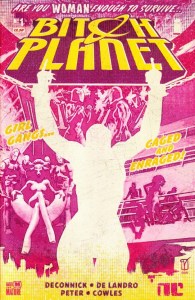
No. 20 — Kelly Sue DeConnick/Valentine De Landro: Bitch Planet, vol. 1

bitch-planet-1-deconnick-de-landro-image-cover-628x968

This comic is badass feminism 101. If I could force everybody I know to read it, I would, because for most of them it would be validating and triumphant, and for the rest it might disavow them of some dodgy notions.

Kelly Sue DeConnick’s brand of dystopian satire is a wonderfully blunt instrument. Aside from the literal existence of a prison planet where non-compliant women are sent for various crimes against the patriarchy, the world of Bitch Planet is essentially no different from our own. Its power comes from the fact that most of its characters’ struggles are stories you might actually have heard somebody tell from personal experience.

But aside from being merely (ha) progressive, Bitch Planet is also exquisitely crafted and detailed, right down to the zine-inspired design and 90s comics-style joke classifieds in every issue. As a trade-waiter on principle, the wait for the next volume is going to drive me insane.

No. 19 — BoJack Horseman

Has there ever been a more compelling unsympathetic loser on television than BoJack Horseman? In its far-superior second season, BoJack becomes the cartoon animal version of Don Draper: attaining his dreams, alienating everybody he loves, gradually self-destructing, and trying and failing and trying and failing to put himself back together. And everybody around him seems to be coming apart at the seams for their own particular reasons, as well.

But the fact that these plotlines are embedded in a show that’s this joke-dense and whimsical allows BoJack Horseman to do what lots of these trendy shows full of terrible people fail at: it can take for granted that people are often horrible and don’t deserve their good fortune, while still being compulsively watchable.

And on top of everything, this season gave us “Hank After Dark,” one of the most visually dense, funniest and also most chilling episodes of television of the year. As a response to the Cosby spectacle, it’s as powerful as anything. If the season has one weakness, it’s that “Hank After Dark” thoroughly eclipses even the second-best episode.

No. 18 — Africa Express: In C Mali

Even as a confirmed minimalism devotee, I couldn’t get into Terry Riley’s classic In C until I heard it performed by West African musicians.

Africa Express is a project started by the distinctly non-African Damon Albarn, with the participation of a couple other notably non-African people including Brian Eno, who is required by British law to be involved in everything.

The idea behind Africa Express was to forge meaningful connections between European and African musicians. Given that, you may well wonder whether it’s a tad suspect that Albarn’s second recording with these musicians is entirely focussed on a piece of Western classical music. But, just listen to the record.

The thing that’s immediately clear is that In C Mali is more than just another recording of In C. The music on this recording does not belong to Terry Riley nearly as much as it belongs to Africa Express. In C is freely structured to the point where every performance is slightly different, but this performance is entirely its own thing. The musicians own this music. Riley fades into the background.

I doubt I’ll listen to any other recordings of this piece for several years, at least.

No. 17 — Better Call Saul

Sometimes you see critics say things like “it was better than it needed to be” when a show or movie has a built-in audience from a beloved related property.

Better Call Saul was massively better than it needed to be.

The important thing that Vince Gilligan and Peter Gould realized is that they couldn’t, shouldn’t, and were under no obligation to replicate the successes of Breaking Bad. So, they made a show that fans of Breaking Bad would be sure to enjoy — it’s got that signature dialogue and all the stunning sights of Albuquerque, N.M. — but that is a fundamentally different show in terms of content and pacing.

Better Call Saul lacks its predecessor’s explosive plotline, allowing it to luxuriate in its characters and themes the way that Mad Men does, and the way that Breaking Bad didn’t. The greatest side effect of this is that it gives Bob Odenkirk and Jonathan Banks more space for multifaceted performances as Jimmy McGill and Mike Ehrmantraut, respectively.

This show didn’t just overcame the impossible expectations associated with being a Breaking Bad spinoff: it also staked out its own territory immediately. I suspect it’ll only get better.

No. 16 — The Hateful Eight

To some extent, Quentin Tarantino is a substance. Each of his movies is an additional quantity of that substance to be consumed. If you didn’t enjoy the last jar of Tarantino you ate, you’re not likely to enjoy any other ones either.

That said, there are things he does that I love, and things he does that I don’t. I could take or leave his action scenes and the more conspicuous exploitation movie tropes (I have zero time for Death Proof or Kill Bill: Vol. 1). But when he’s in talky mode, there’s nobody I like better.

The Hateful Eight is an entire movie’s worth of the Mexican standoff in Pulp Fiction, the barroom scene in Inglorious Basterds, or the final confrontation in Kill Bill: Vol. 2. It has an amazing cast full of people who clearly delight in saying the sorts of things that people say in Tarantino scripts. And, if you live in an opportune place, you can see it (as I did) in glorious 70mm projection, complete with the novelty of an overture and an intermission.

At this moment, it is my second-favourite jar of Tarantino.

Tomorrow, we’ll pick up from no. 15, with our most whiplash-inducing set of five yet: an album, a movie, a comic, a show and a podcast. 

Omnireviewer (week of Dec. 27)

My best of 2015 list will be ready by, oh let’s say the end of January. That’ll give me time to finish Three Moments of an Explosion and see Star Wars. In the meantime, I took advantage of the holidays to take in all sorts of fun stuff. And since podcasts make up a comparatively small amount of it, I’ve taken the liberty of awarding my picks of the week to two non-podcasts. Here are this week’s 27 reviews.

Television

Doctor Who: “The Husbands of River Song” — Well. In two consecutive episodes, my two favourite supporting characters in Doctor Who get marvellous sendoffs. The comedy in this plays wonderfully, but it’s the character drama between the Doctor and River that really sells this. That scene at the dinner table midway through really got me, though I’m not sure if it was the script and performances or just Wagner’s Siegfried Idyll playing in the background. Even if the resolution is a bit of a deus ex meteors and everybody ends up a bit in meteors res, it’s still a delightful romp. My only regret is that this is the first and last time we’ll see Peter Capaldi and Alex Kingston in these roles together. Because they are every bit the pair that Kingston and Matt Smith were. Lovely.

Deadwood: Season 1, episodes 11-12 — Firstly, I’ve really been enjoying Todd VanDerWerff’s essays on Deadwood from his days at the AV Club. In spite of being bundled up into sets of three episodes, they’re among his best writing: up there with his Sopranos reviews and the few seasons of Mad Men that he covered. Anyway, these last two episodes of Deadwood’s first season are outstanding. If the second season keeps the pace of these last three episodes, I’ll be a happy viewer. But I’m going to take a break from this before diving into that season, to watch Mildred Pierce as part of an ongoing Todd Haynes pilgrimage. But I’m really looking forward to seeing how the second season manages to be more acclaimed than the first.

QI: “Merriment” — Bill Bailey is dressed like Paul McCartney on the Sgt. Pepper’s cover!

The Graham Norton Show: “David Beckham, Carrie Fisher, Daisy Ridley, John Boyega & Kylie Minogue” — I could not love Carrie Fisher more. Also, why don’t more late night talk shows have multiple guests at once? Not many shows could give us David Beckham and John Boyega fighting with toy lightsabers and narrowly missing Kylie Minogue’s head.

Comedians In Cars Getting Coffee: “President Barack Obama” — Certain parts of this are a bit stagey, as you’d expect. But I’m always quite impressed by Obama’s ability to play himself in stuff. Really, though, you should watch this to see a president in a frame of mind where he doesn’t feel the need to pitch messages all the time. It’s not the Marc Maron interview, but it’s in the same vein and it’s got some funny moments.

Doctor Who: “The Eleventh Hour” — This was the first piece of media I consumed in 2016. It’s a great start, really. To my year, and to the Steven Moffat era of Doctor Who. By the end of this episode, any attentive viewer has Moffat’s game pegged, at least on a metafictional level: Amy is introduced as a diegetic insert of a Doctor Who fan, so we can assume even at this point that her story will be about what it means to love Doctor Who. As fresh starts go, this is one of the greats.

Sherlock: “The Abominable Bride” — And so would this be, if it hadn’t turned out to be something else entirely. I shall say no more, because spoilers. I will say this: I love that Benedict Cumberbatch plays a substantially different Sherlock in Victorian garb than he does in the modern stories. The other characters in Sherlock have always been fairly consistent with their portrayals in Conan Doyle. But the moody sociopathy of Cumberbatch’s modern Holmes is straight out of contemporary anti-hero television. It was a canny choice by Cumberbatch (and by Moffat and Gatiss) to strip back that element of his character and allow this Holmes to be the dour Victorian eccentric that he started off as. I had as much fun watching this as I’ve ever had watching Sherlock, no doubt partially because Moffat and Gatiss write Victorian witticisms with spectacular aplomb. But somehow, I’m left wondering if the fun that I had actually reflects the quality of the episode. There’s a sort of messy gratuitousness to this that almost matches that insane wedding episode from the last season. Still, there are enough bon mots and meta-critiques in this that I remain quite positively disposed to it.

Music

Frank Sinatra: Nothing But The Best — This is a compilation of Sinatra’s best singles for Reprise, which is not where he did his best work. His earlier Capitol recordings are the real reason he’s a legend. But still, there something about this more relaxed version of Sinatra that’s just better for putting on and pottering about doing other things. You can’t do that with In The Wee Small Hours, because it’ll make you cry all over your laundry.

Hawkwind: Hall of the Mountain Grill — I’ve never actually gotten around to listening to a full Hawkwind album, but the recent death of Lemmy seemed like it necessitated a spin of this. It took me back to a time when I was discovering music like this regularly. In spite of never having heard it, this fits right into the established grooves in my brain. “You’d Better Believe It” is a serious jam. More Hawkwind to follow, probably.

Caroline Shaw/Roomful of Teeth: Partita for 8 Voices — There’s something about vocal music that has the capacity to inspire sheer, giddy joy more easily than other idioms. I’d heard the Passacaglia from this spectacular piece many times, but I figured it was time I checked out the other three movements. They’re playful and emotive and hold the hell out of your attention. Roomful of Teeth is a vocal ensemble unlike any other and Shaw, being a member, knows what they’re capable of. She takes full advantage of the group’s technical capacities to the point where listening to the music becomes both an emotional experience and something like watching a really impressive high-wire act. A Pulitzer is not praise enough. Pick of the week.

Lou Harrison/Dennis Russell Davies et al: Symphony No. 3 & Grand Duo for Violin and Piano — Why Lou Harrison’s music isn’t at the centre of the repertory by this point is a mystery to me. His third symphony is one of the loveliest and most accessible pieces from late 20th-century America. If the classical music world made sense, conductors would be scrambling to put out full Harrison cycles rather than more goddamned Mozart.

Rush: Grace Under Pressure — I tend to make a lot of the first music I listen to in a given year. This time, I finished 2015 off with what was once the first side of this (with “Headlong Flight” thrown in for good measure — the perfect song to end a great year). On the walk home after midnight, side two rang in 2016. Given that this is one of the darkest Rush albums, I’m choosing to interpret my choice as a cautionary tale: I’d best not initiate any nuclear wars this year.

Rush: Permanent Waves — A perennial favourite. I love Permanent Waves so much that I have trouble listening to any other Rush album without immediately following it up with this.

The Chemical Brothers: Surrender — This really feels like Daft Punk in places. Which certainly isn’t a bad thing, but given the choice between psychedelia throwbacks (more prominent on both Dig Your Own Hole and Further) and French house, I’ll go with the former every time. “The Sunshine Underground” is a jam, though.

Literature, etc.

David Cavanagh: Good Night and Good Riddance — Finished! God, I loved this. Maybe it ended a little abruptly, but it’s such a minor problem in the face of everything that comes before that I don’t actually care at all. More shall be said about this in my year-end list, I’m sure. (Fated to be more of a “year-beginning list,” it would seem.)

China Miéville: “The Dusty Hat” — Do you ever read something, or see something that you don’t understand and that makes you like it more? It sort of pulls you in by its sheer incomprehensibility? That doesn’t happen to me all that much, but when it does, the thing in question often becomes an all-time favourite. It happened with Mulholland Drive, At Swim-Two-Birds, Trout Mask Replica, and a bunch more I’m forgetting. On first read, “The Dusty Hat” is very much like those things were. It has far and away the most adventurous and best prose of the stories in Three Moments of an Explosion so far and is immensely imaginative in its details. (A particular favourite: “I was glad I didn’t have a cat or a dog because I thought they’d die from being in the room with him.”) Overall, I kind of don’t know what even happened in this story. But I definitely enjoyed it more than any of the others in this collection, with the possible exception of “The Buzzard’s Egg” — which was immediately comprehensible and thus in a strange way less promising. If I remember, I plan to read this again right when I finish the book. Pick of the week.

China Miéville: “Escapee” — One of the pleasures of Three Moments of an Explosion is these little tiny stories of fewer than five pages, which often follow the larger stories like “The Dusty Hat.” This one’s an outline for a movie trailer — the second one of those in the book — for a movie about a man with a large hook embedded in his back. I actually wouldn’t mind seeing that movie, provided it were written by Miéville and directed by Robert Rodriguez.

Movies

Captain Phillips — My impression from the reviews was that this was only okay and mostly notable for being super Oscary and having a great performance by Barkhad Abdi. Both of those things are true, but I thought this was terrific overall. Paul Greengrass is a meat and potatoes director, who just gets out of the way of the story. That approach makes this totally gripping. The screenplay flags in scenes that aren’t ruthlessly procedural and full of people making decisions, i.e. the very beginning of the movie, where we meet Phillips’s family, and the quick pep talk he gives to his crew about a half-hour in. It would have been a better film with those two scenes removed altogether. But once the action starts, there are no weak points. Near the end of the movie, Tom Hanks’s performance is so good that I almost understand why he’s so esteemed.

The Hunting Ground — I watched this at a New Year’s Eve gathering. Yeah, I say “gathering” advisedly, because this is not a documentary you watch at a “party.” It is appalling, and not especially surprising to anybody who pays attention to these things. It is worth seeing. There are moments in this where a simple fact will appear onscreen as an intertitle, with seven or eight studies cited as sources for that fact. Those moments are surprisingly powerful, and bolster the personal narratives related by survivors of campus sexual assault, which are really difficult to take.

Vertigo — Yeah, I’d never seen Vertigo. It’s great, obviously. Maybe a little dated. It has a particular sort of expository writing that you don’t see much of anymore. Plus, Jimmy Stewart is definitely an actor from the 50s. And his character is probably the most conspicuous private eye in cinema history. Seriously dude, there’s no way she doesn’t see you there behind that pillar. It’s stuff like that that kept me at arm’s length, a bit. I suppose you’ve got to approach these old masterpieces on their own terms, but there are plenty of movies older than this that I find completely fresh and immediate even today: The General, Citizen Kane, The Rules of the Game, Sunset, tons more. On first viewing, the fact that this has now surpassed Kane in the estimation of the world’s critics (as per the last Sight and Sound poll) seems totally ridiculous to me. But I certainly wouldn’t argue with anybody who claims that Bernard Hermann’s score is the best in film history. Favourite line: “I’ve been right here all the time putting olive oil on my rubber plant leaves.”

Games

Undertale — Okay. So, if my last note on this made it seem like I’d finished the game… I hadn’t. I assumed I was close enough that I could basically offer a final assessment, but at the very last minute, Undertale turns into something dramatically different from and stranger that what it sets you up to think it is. I won’t spoil it, but I will say that the ending of Undertale is a complex metafiction of the sort that never fails to pull me in. I’ve seen these themes explored more effectively in other games (to say which ones would almost be a spoiler), but this is going to stick with me for a bit. Last week, I had this pegged as “worthwhile.” Now, I daresay it’s closer to essential. I had it pegged for a pick of the week until I got blown away by “The Dusty Hat.” Interestingly, they’re both things I don’t entirely understand.

Kairo — There are basically two things I’m looking for in a video game: a great story, and/or an interesting world that I can explore freely. If a game doesn’t have at least one of those things, I’m unlikely to be that interested. Steam has been recommending Kairo to me for ages, but I’ve been hesitant because it seemed like a game with no discernable story and a very minimal sort of environment with lots of puzzles. (I’m queasy about puzzles.) But it was on sale for a dollar this week, so why not. Turns out, it’s kind of the platonic ideal of a game. By that, I don’t mean that I’m blown away. More “pleasantly satisfied,” really. But you could easily point to Kairo to demonstrate what’s valuable about video games, and why they’re unique from every other medium. Kairo has nothing in it that could be done in a movie or a novel or a radio play. It’s purely the experience of “play” that makes up the content of Kairo. You explore and interact with your surroundings, and if you see something that suggests a story might have taken place here at some point (and you do) you can certainly surmise about it, but you’re not actually part of it. Kairo doesn’t require narrative conventions to make you feel stuff. Instead, it keeps a firm hold on its pacing and mood to make you feel by turns placid, proud and creeped out. Considering that it’s the most abstract game I’ve ever played aside from possibly Tetris (or SPL-T, I guess), it’s enormously effective. If you like this sort of thing, grab it while it’s still a dollar and spend a pleasant afternoon.

Kentucky Route Zero: Act 1 — Yeah, there’ll be more games than usual in the near future, since I can’t control myself during the Steam holiday sale. I’ve been meaning to play this for ages, but I’ve been waiting for the much-delayed Acts 4 and 5 to come out so I can down it in one big gulp. But then, you know, Steam sale. Kentucky Route Zero is the kind of game that I’m obviously going to like, in exactly the way that Kairo wasn’t that. It’s text-based to the point that it’s basically a Twine story with graphics — gorgeous, moody graphics. It’s mysterious and uncanny without being outright scary (which will almost certainly make it more preoccupyingly frightening to me in the end). And it wears its structural gimmicks on its sleeve. This was made for me. My favourite moment so far was something I stumbled upon by accident: an area where you can’t actually do anything except watch two men push a broken airplane down a road. It’s like something out of Beckett. Seems to bear no relation to anything, but it’s been sticking with me. I can tell already that this is going to be one of those games where the actual gameplay is only half of the interactive experience and the other half is trying to work out what the hell it all means. To be fair, we shouldn’t hold a game in higher esteem for being this way: this is a kind of interaction that comes attached to every medium. There’s a quote I heard once but can’t quite place — I think it might be Hitchcock — something like “the most important act in a movie is the fourth one, where you’re talking about it on the drive home from the cinema.” In that sense, all fiction is interactive fiction, Kentucky Route Zero is not significantly more interactive than Vertigo, and is thus fundamentally different from Kairo. I don’t know where this game is going. But I’m super excited about it.

Podcasts

Mortified: “Boys DO Cry (w/ special guest CHVRCHES)” — It was the “special guest CHVRCHES” bit that sold me, but the two stories of sensitive teenage boyhood are worth the price of admission. (What a strange expression to use about a free podcast. Never mind, I’m done with this.)

99% Invisible: “Bone Music” — In the Soviet Union, western pop records were bootlegged on exposed x-rays. They sound ghostly and ethereal. This podcast tells the story (which includes an interview with Nikita Khrushchev’s son) and also plays sound from some of the records. It’s produced in collaboration with the Kitchen Sisters. So basically, everything about this makes it worth a listen.

Serial: “Escaping” — The first really interesting episode of this season. And, it’s interesting because of the tape of Beau telling his own story. Looks like we’ll have less of Koenig explaining stuff from here on out, which in general is a good thing.

Radiolab: “The Fix” — Stories about addiction can get a bit heavy, and Radiolab can sometimes take heavy stories and make them oppressively bleak. But this isn’t like that. It’s interested in the personal stories of addicts, but it’s more interested in the story of how our perception of addiction has prevented us from taking known medical steps that can help some addicts recover.

Omnireviewer (week of Dec. 6)

A week full of lovely things, really. 22 lovely things.

Music

The year-end lists are coming out, so I was going to spend the week going through the stuff I missed. But then I got waaay more obsessed with this first one than I’d anticipated. It’s nearly embarrassing, but actually no it isn’t at all.

Lin-Manuel Miranda: Hamilton, An American Musical — They made a hip hop musical about the establishment of America’s national bank. Just when you thought Broadway was all superfluous Disney adaptations. This is incredible for so many reasons. It shifts seamlessly from convincing hip hop to straight-ahead showtunes about arcane political processes. And that’s not the only tonal shift it manoeuvres: it’s incredible how this flits back and forth between funny and tragic, arch and sincere, and from straight-ahead storytelling to meta-commentary. It is totally self-aware about its own unlikely subject matter, but it doesn’t let that self-awareness get in the way of its story, which you can get lost in to an extent that you seldom see in works of musical narrative. Unlike most cast albums, this works brilliantly as a bespoke object. As a concept album, it has a narrative thrust that keeps you listening to the words, even when the music threatens to beguile you away from the piece’s themes. And it’s bewilderingly allusive: it’s well worth listening to this with the Genius annotations (some of which come straight from Lin-Manuel Miranda himself) within arm’s reach. Miranda has everything. It’s not just that he can rap and sing and write a catchy hook and verses that lodge in your head, he also has something interesting to say about Alexander Hamilton as a historical figure and about how who tells the stories from history affects how we think about it. There are nothing but good things to say about this. I don’t care if you like musicals or not, listen to Hamilton. Pick of the week.

Kendrick Lamar: To Pimp a Butterfly — If it seems perverse to give pick of the week to a musical rather than what looks increasingly like the consensus best album of 2015, know that it’s only because I’m totally obsessed with Hamilton right now. To Pimp a Butterfly is as good as everybody says it is, and I would imagine that out of the two, it’s what I’ll be coming back to more frequently in 2016. If only to figure out what he’s on about. This is some seriously challenging stuff.

Africa Express/Terry Riley: In C Mali — I’m a huge fan of California minimalism in general, and Terry Riley specifically. But, his most famous piece, In C, was never one that I found myself listening to very much. Until I heard it played on African instruments when this thing came out earlier this year. Then I listened and I listened and I listened. Nice to revisit again after a few months.

CHVRCHES: Every Open Eye — Here’s something I’m not seeing on nearly enough year-end lists. CHVRCHES’ music is pure catharsis and people who don’t like it hate joy. This album is significantly better (or at least more consistent) than their first, which critics were all about. What gives? “Make Them Gold” is a clunker of a single, if we’re being honest, but the rest of the album is perfect pop.

Television

Deadwood: “Reconnoitering the Rim” — I don’t know where this show is going, but damn, Ian McShane can act.

QI: “Marriage and Mating” — Why am I reviewing an episode of QI? Tell you what, I’m not.

BoJack Horseman: “Hank After Dark” — According to my own rules, I’m not technically obligated to review this, since it’s my second time watching it in the course of this blog — and, in fact, in a fairly short span of time. I just felt obligated to pop back in and reiterate that this is one of the best episodes of comedy television I’ve ever seen. Okay? Okay.

Lost: “White Rabbit” — Reasons I don’t understand people who like the first season of Lost best: (1) Shannon and Boone are unwatchable; (2) Sawyer is a prick — and not in a way that any reasonable person should find charming, although the show sure seems to sell him like that; (3) it’s galling to see Jack take such a large role in the story when you know he was supposed to die in the first episode in what would have been the most brilliant bait-and-switch in television history, had the writers followed through. Jack’s story has more “it’s so hard to be a handsome rich hero dude” than I’d like. We wouldn’t have had to sit through that if they’d just done the right thing and killed the handsome rich hero dude. And that cliff dangle is ridiculous. I still basically like this, though. The hallucinatory manifestation of Jack’s daddy issues is properly creepy.

Literature, etc.

Alejandro Jodorowsky/Moebius: The Incal — A very thoughtful birthday present from some wonderful friends. I think I’m going to enjoy this. So far, Moebius is impressing more than Jodorowsky, whose writing has a lot of sci-fi clichés, and the juxtaposition of text and image sometimes seems arbitrary and lacks clarity. But this is a good yarn with some damn pretty pictures.

China Miéville: “Dreaded Outcome” — Here’s a narrator that Miéville can really sink into: a jargon-dropping therapist. I put this story down right at the point where a massive twist happens, then when I picked it back up, I didn’t even recognize it. This is good.

Lucas Adams: “An Illustrated Account of the Great Maple Syrup Heist” — This short comic about a thing that honest to god actually happened will make you very excited about the Jason Segal movie that Sony Pictures is honest to god going to make about it.

Podcasts

Pop Culture Happy Hour: “A Conversation with Trevor Noah” — I haven’t gotten around to watching any of Trevor Noah’s Daily Show, but I think I will now. In this interview with Linda Holmes (who should really do more hour-long podcast interviews; she’s fantastic) he proves to be refreshingly circumspect. There’s an awkward moment near the end when he’s talking about “things you’re not supposed to say,” but at least he’s willing to own up to his mistakes and learn as he goes.

Imaginary Worlds: “Origin Stories” — The superhero origin story imagined as a psychological necessity. Excellent.

Song Exploder: “Wilco – Magnetized” — This is my favourite song on the new Wilco album by a fair margin, so it’s great to hear it exploded. I love that Glenn Kotche’s drum part was inspired by Jeff Tweedy’s son’s drumming. But I still kind of think he’s just imitating Ringo.

On The Media: “Lies, Lies, Lies” — No tragedy this time, except for Donald Trump’s presidential candidacy. On The Media is a really dark show, sometimes. Throughout this episode, you realize gradually that the demonstrable truthfulness of a statement doesn’t really have that much to do with whether or not people are swayed by it. Let us all collectively shudder.

Serial: “DUSTWUN” — Back into the weeds we go. Look, I love Serial, and I love Sarah Koenig’s journalism. But this is one of those situations where it can be difficult to keep the thing itself separate from the phenomenon of the thing. The response to season one of Serial was huge and weird and bad. I remember it being compared to True Detective which is just wrong. Serial is not a fictional detective show; it’s real journalism about people who exist out in the world. The widespread disappointment in the ending of the season was naive and ruthless — you can’t just end a true story however you want. And while I’m a devoted listener to a great many non-fiction podcasts, some of which tell serialized stories, it’s distressing to me that the story of Adnan Syed ended up being fetishized by people in the same way that I fetishize, say, Doctor Who. So, Serial: the breakout podcast phenomenon is a thing I have very mixed feelings about. BUT, Serial: the longform non-fiction storytelling project is a thing I really love. So, this new season is properly exciting — especially given that it’s about a story that got international TV news coverage, and now we’ll get a totally new lens on it. Instead of people filing stories in a day, we’ll get one of the most ruthlessly detail-oriented journalists in the world, plus her team of producers, PLUS screenwriter Mark Boal (of Hurt Locker fame and Zero Dark Thirty infamy) all on the case and making no compromises to time. And if that last line is any indication, the next episode is going to be a corker. Let’s all keep our heads, though. This is actually happening. Pick of the week.

Reply All: “I Love You, I Loathe You” — Reply All is that rare podcast that focuses on fussy, meticulous, reported stories but can also pull off just having its hosts banter with each other for a whole episode. In that sense, it may be the “most podcast” of all podcasts: it combines the pre-taped public radio approach of shows like This American Life and On The Media (where both hosts once worked) with the podcast-native approach of people talking to each other into microphones with little adornment (à la Stop Podcasting Yourself, etc). There’s no reported story in this episode of Reply All, but it was still fantastic and still Reply All. This is Gimlet’s best podcast and it would take something staggering for them to top it. (Jonathan Goldstein, perhaps.)

Pop Culture Happy Hour: “Creed, Men Crying At Movies, and Visceral Responses” — I find I seldom have much to say about regular episodes of PCHH, but don’t be fooled: I love this show. It will likely take a slot on my year-end roundup of best podcasts for its sheer reliability in delivering insight and joy. And Gene Demby sounds so happy to be back.

The Moth: “Amir Baghdadchi & Dameon Wilburn: StorySLAM Favourites” — Two outstanding, riotously funny stories about travel, both distinguished more for the quality of the telling than by the story itself.

99% Invisible: “Pagodas and Dragon Gates” — These days, there are good episodes of 99pi, and “fine” episodes of 99pi. This is one of the good ones. It’s about why San Francisco’s Chinatown looks like it does architecturally, in spite of the fact that pagodas and dragon gates were long out of fashion in China when those structures were built in Chinatown. It’s more of a story than you might anticipate.

StartUp: “Pitch Perfect 2” — Alex Blumberg is absolutely pathological about playing that tape of him bombing a pitch over and over. This is super interesting, and I’m so happy that Gimlet has a new partner who shares Blumberg and Matt Lieber’s vision. I can’t wait to hear their new shows — especially Jonathan Goldstein’s. That guy is a master.

Fresh Air: “Historian Mary Beard Tackles Myths about Ancient Rome” — Research about antiquity is catnip to me. This interview (with Dave Davies, filling in ably for Terry Gross) contains such wonderful tidbits as Caligula hating being called Caligula, because it was a diminutive nickname from his childhood — “Bootikins,” essentially.

Omnireviewer (week of Nov. 29)

I realize I’m usually pretty effusive in these things, but this was such an effusive week that I’ve elected to award three picks of the week, rather than the usual two. This will be a rare occurrence, I promise. But this week, it was honestly difficult to give only three. I honestly could have given about six.

Literature, etc.

Reza Aslan: No God But God — If I could force everybody I knew to read one book, I’d have to think hard about which one. This would make the shortlist in any given year, but in 2015 I expect it might find its way to the top. This is a riveting, brilliantly argued history of Islam. Aslan’s prologue to the latest edition does a fantastic job articulating the extent to which Islam is misunderstood and misrepresented in Western media, and the extent to which the distrust and hate levelled at Muslims just keeps getting worse. So basically, we need Aslan’s expertise to offer context. Pick of the week.

Karen Weise: “The CEO paying everyone $70,000 salaries has something to hide” — This Bloomberg feature feels like the first rumblings of a gigantic storm.

Movies

Inside Out — Watching a Pixar movie at home isn’t a thing I would normally do, but I’ve got a monstrous cold that I just cannot handle right now and I’m marooned at home wearing pyjamas and eating mostly cereal. So, basically reverting to childhood. What better time to see this massively acclaimed movie that I didn’t make it to in theatres? I expected it to be brilliant; I’m not sure I expected it to be so dark. I mean, it’s basically watching a young girl’s personality gradually disintegrate through symbols. But it might well be the most inventive, and one of the most moving coming of age stories I’ve ever seen.

Music

The Smiths: RankPitchfork thinks this live album is filler in the complete edition of the Smiths. Pitchfork is very hip and modern and therefore doesn’t understand live albums. This is a lot of fun, and should be in anybody’s Smiths collection who actually has a Smiths collection.

The Smiths: Every non-album track by the Smiths — All of the tracks that aren’t on any of the proper studio albums or Hatful of Hollow are distributed between a number of compilations of varying degrees of redundancy. So, I just set all of the distinct tracks up and listened through. It’s not an ideal approach, and there’s plenty that isn’t great. Still, listeners who stop at the four key albums are missing out.

National Brass Ensemble: Gabrieli — Generally, I think that Gabrieli’s music needs to be played on period instruments to be satisfying. I tend not to like the bombast that modern brass instruments (and modern brass players) bring to this 16th-century music, which predates the invention of all of those instruments. It was written for the slight reediness of an ensemble of cornetts and sackbuts — a totally different texture to symphonic brass. And, while I have no fundamental objection to great musicians taking literally any music at all and playing it literally however they want, it’s always a risk. All of which is a giant throat-clear before I say that I actually really enjoyed this. It’s a tribute to an earlier modern brass recording of Gabrieli, featuring members of three great American orchestras. I never really warmed to that album, despite its classic status among brass players. (I played the trumpet, once upon a time.) But this new one, boasting modern recording fidelity and a generally higher standard of playing has won me over. It’s a big steamroller of a thing, where period instrument recordings are smart cars, but hey. Don’t fault an envelope for not being a treehouse, right?

Television

BoJack Horseman: Season 2, episodes 7-12 — “Hank After Dark” is a classic episode. It’s got an entire plotline that takes place mostly in the news tickers at the bottom of the screen. The density of visual jokes approaches Terry Gilliam territory. Also, many excellent puns and a Bill Cosby riff with teeth. And fantastic character beats for all of the main cast. And the line “That woman can knock a drink back like a Kennedy at a wake for one of the other Kennedys, but damn if she doesn’t get shit done!” And a great kicker at the end. It almost doesn’t matter that the last five episodes of the season (the second-last in particular) are also fantastic, because this one eclipses the entire series.

Deadwood: Season 1, episodes 1 & 2 — It was time I watched Deadwood. The black sheep of HBO’s trinity of David-helmed prestige shows, it might be the most acclaimed show of its time that I haven’t seen. These first two episodes are pretty damn good — I’m especially enjoying any scene with Ian McShane in it. I’m pretty sure I’ll love this eventually, but it might take a while for me to acclimate.

Doctor Who: “Hell Bent” — What “Heaven Sent” was for experimental, minimalist, self-contained Doctor Who, this is for sprawling, continuity-heavy, epic fantasy Doctor Who. And while I’ll generally take the former approach (Blink and Listen come to mind) over the latter (The End of Time and Day of the Doctor), there are times when I’m happy to see Doctor Who go really, really big. Taken together, the astonishing two-parter of “Heaven Sent/Hell Bent” is basically an inversion of my other favourite game-changing season finale: “The Pandorica Opens/The Big Bang.” Where that one started with an hour of threats from every bad guy in Doctor Who and closed with a personal story about Amy Pond’s wedding, this one opens with a chamber piece about the Doctor alone with his darkest thoughts and closes with an hour that includes Gallifrey and Rassilon and the Sisterhood of Karn and the diner from “The Impossible Astronaut” and Maisie Williams and a proper send-off for a major character. And taken together, they work brilliantly. On first viewing, I’m tempted to say that this is just as good as the end of Season 5. Pick of the week. (Happy, Sachi?)

Podcast

Oh man, when I get over this cold, I’m totally going to start running again. Because I’m so behind on my podcast listening. Seriously, I have 20 unlistened episodes on my phone right now. Sad state of affairs.

Mortified: “Jason: King of Scotland” — I don’t listen to Mortified very much, but the premise of this one, where a teenage misfit imagines himself as a Shakespearean Scottish king in his diary, was too good to pass up. It basically lived up to expectations, except that the guy consistently mispronounces the word “exeunt.”

Imaginary Worlds: “1977” — This has shot straight onto my “Religious Listens” playlist. (Those are the podcasts where I listen to every episode.) Imaginary Worlds tells well-written, well-produced stories about the cultural impact of geeky fiction. So… made for me. This is the first of a five-part series about Star Wars. I’ve always found that people talking about Star Wars is more interesting than Star Wars itself, so I’ll be listening to all five parts, for sure. Pick of the week.

Welcome to Night Vale: “A Carnival Comes to Town” — I wonder if I’ll get more invested in this show once I catch up and hear episodes the same time as everybody else? The ending of this is great, though. The thought of normal people stumbling on Night Vale and being totally baffled is wonderful.

Criminal: “American Dream” — I love stories of bank robberies. I absolutely see the romance in it. So, I had a certain amount of sympathy for the protagonist of this story from the start. Phoebe Judge doesn’t let you totally side with him, because that would be ridiculous. But, listening to this, you can imagine the thrill of standing in the queue for the tellers, knowing what you’re about to do — and knowing that nobody’s going to get hurt. This guy’s bank robberies were fairly mundane, as these things go. But when get to hear the stories as they play out in his head, it’s a rush.

Imaginary Worlds: “Empire vs Rebels” — An exploration of Star Wars’ central conflict as a sports and politics metaphor. It’s as good as that sounds, but the previous episode about the context for the first movie’s release is better.

Pop Culture Happy Hour: “Small Batch: Shonda Rhimes on her ‘Year of Yes’” — I’ve never seen anything that Shonda Rhimes has ever been responsible for, and this is kind of a “meh” interview anyway.

Surprisingly Awesome: “Concrete” — Look, I already knew that concrete was interesting thanks to… guess which podcast… 99% Invisible. I don’t think I like Surprisingly Awesome. The exclamations of breathless wonder from whoever isn’t hosting on a given week are so unnecessary and so irksome. I expect I’ll listen to this again sometime, but I’m dropping it for now. Oh well, Gimlet. Three out of four ain’t bad.

All Songs Considered: “New Mix: Missy Elliot, Macklemore & Ryan Lewis, PWR BTTM and more” — My list of artists I heard on All Songs that I need to check out properly is getting really long. This week’s key addition is the arty-rocky band Public Service Broadcasting. But for me, All Songs isn’t just useful for introducing me to music I’ll like; it’s equally worthwhile for playing stuff that I don’t like, but that I do find interesting. The kind of music that I don’t really ever want to hear again, but that I’m glad I at least heard once. (Urm, Macklemore.) In 2015, that’s kind of the ideal function of a music programme, I’d argue.

99% Invisible: “Worst Smell in the World” — This is fine. Not a standout episode, but fine. I have nothing to say about this perfectly fine episode.

Imaginary Worlds: “The Canon” — I seriously love this podcast. This is an early episode about the concept of SC/fantasy “canons:” the stories that are acknowledged to have happened “in-universe.” Eric Molinsky talks to a rabbi about how fandom’s relationship to canons are similar to religious scholars’ interpretations of sacred texts. It’s a genius approach. I wish I’d come up with it.

Reply All: “Quit Already!” — A collaboration between Reply All and Radio Ambulante. I love when my favourite English language shows collaborate with Radio Ambulante. It always makes me wish I spoke Spanish, so I could listen to Radio Ambulante.

All Songs Considered: “The Year In Music 2015” — If, like me, you spent a lot of the year continuing to obsess over old obsessions and missed a lot of the new music, just listen to this. Everything played on here is fantastic and will set you on track to hear the rest of 2015’s really great music. I can feel an obsession with the Hamilton cast album coming on. Watch this space.

The Moth: “The Moth StorySLAM” — These StorySLAM episodes can be dodgy, since literally anybody can get up onstage at a StorySLAM event. But they do tend to broadcast the best of them, and some of these stories are really fun.

On The Media: “On San Bernadino” — Another instalment in my recent trend of listening to On The Media after a crisis. The segment on gun control research being hamstrung by legislation alone is worth the time.

Pop Culture Happy Hour: “The Good Dinosaur, Pixar and Second Thoughts” — Well, now I will certainly not be seeing The Good Dinosaur. Especially not after Inside Out left me with such tremendous goodwill towards Pixar. But I likely would not have seen The Good Dinosaur anyway.

Imaginary Worlds: “Slave Leia” — I’m not sure I buy the redemptive readings of Leia’s plotline in Return of the Jedi. I’m more inclined to side with the critic in this podcast who feels that Leia is just really badly served in this movie, compared with the previous two. But it’s interesting to hear counter-arguments, and I’ll definitely be bearing them in mind when I re-watch Jedi before the new one comes out.

Surprisingly Awesome: “Tubthumping” — Okay, I’m dropping it after this one. I had to see how this episode came together in the end, after hearing the drafts of it on StartUp. Look: the topic of this episode is so obviously not boring that even Adam Davison — whose role it is here to act bored — can’t entirely sell it. I could definitely see these two guys making a great podcast together, but the seams of this format are showing already. Which is not to say that the content of this is bad; I’m inclined to think it’s the best episode they’ve made so far. But I’m still done with Surprisingly Awesome for now.

Omnireviewer (week of Nov. 8, 2015)

I’m adding a new feature, this time around. Each week, I will choose two things I particularly loved as my “picks of the week.” Due to the preponderance of podcasts in these reviews, one will always be a podcast, and the other will be something else. I won’t prioritize new things for my picks of the week, necessarily. It’s just a matter of what hit home the most on a particular day. So, it’s totally possible (and indeed, very likely) for a pick of the week to be a 40-year-old rock album. 29 reviews, this week:

Music

Van Der Graaf Generator: The Least We Can Do Is Wave to Each Other — You know how sometimes you’re listening to a song and you ask yourself, “Is this a good song?” and the answer is “no, it really isn’t.” But then you ask yourself “am I enjoying myself, though?” and the answer is “yeah I think I am!” That happens a lot on this album.

John Luther Adams/Glenn Kotche: Ilimaq — Adams is probably my favourite living composer. Become Ocean floored me; the subsequent recording of chamber strings music didn’t. This piece of percussion music, brilliantly performed by Wilco’s Glenn Kotche, falls somewhere in between. It’s not a masterpiece on the order of Become Ocean, Four Thousand Holes, or The Light that Fills the World, but it’s lovely, evocative, tense, etc.

Wilco: Yankee Hotel Foxtrot — Listening to Glenn Kotche play John Luther Adams made me want to listen back to Wilco’s masterpiece. This is still a basically perfect album. It sounds chaotic in places, but when you listen to the details you realize that it’s actually a meticulous approximation of chaos. In fact, I’m not sure I can name a rock album that’s more detail-obsessed in its production. The way that “I Am Trying to Break Your Heart” gradually coagulates from noise into a song is genius. And Kotche’s playing is outstanding. I was listening.

Max Richter/Antonio Vivaldi: The Four Seasons, Recomposed — At the risk of appearing heretical (oh, who am I kidding; I love appearing heretical) Richter’s remake of The Four Seasons is better than the original. These Vivaldi concertos are possibly the most moth-eaten body of work in the repertory, and for all of their objective virtues, I do not understand how anybody could legitimately prefer them to Richter’s clever, gorgeous, modern interpretations. I know it doesn’t have to be a competition. But I’m making it one. And Vivaldi’s lying knocked out at the edge of the ring.

Yes: Drama — This is comfort food to me. It’s one of those albums that I know every contour of so well that when I listen to it, it just snaps into the grooves in my head. It tends to get overlooked by Yes fans because Jon Anderson isn’t on it. And while that becomes a worthwhile critique when it happens again in 2011, in 1980 Anderson’s absence was exactly what Howe, Squire and White needed to go in the direction that felt natural. Also, I love that Yes and the Buggles basically made an album together. There aren’t many less likely collaborations out there, let alone ones that result in good music.

Hey Rosetta! Seeds — This comes recommended by the guy I went to the concert with last week. While I confess that I liked them better live (not a given for me; I tend to like most bands better on record), this has decent songs and great performances. And fantastic bass playing.

Movies

Crimson Peak — Sometimes I like my horror lavish, gothic and Victorian. This scratched that itch, but I’ve essentially forgotten it already.

Spectre — Fabulous. Christoph Waltz is no Javier Bardem and Ralph Fiennes is certainly no Judi Dench. And overall, this isn’t as good as Skyfall. But the Daniel Craig era of James Bond movies is still pretty much the bar for contemporary action franchises to clear. Marvel Studios can only aspire. A significant quibble: the entire London-based plotline with M and Moriarty is crap. This movie uses the threat of government surveillance (how am I already sick of this trope when it’s still a real-world problem?) to paper over the fact that the same ethical questions that have been posed about Jack Bauer apply equally to James Bond. But these days, I’m trying not to let things like this ruin my moviegoing experience. I believe I’m succeeding admirably.

Television

In the event of binge-watching, I won’t hold myself to writing reviews of every episode. Because, who wants that? We’ll just check in every week, like with books.

BoJack Horseman: Season 1 — As with Hannibal a while back, I endured the rough patches early in the first season because I’ve heard it gets way better. It already has, actually. At first, I laughed most at the dumb, cartoony sight gags. Which is fine, because why else would one watch cartoons? But as the characters got fleshed out (as much as they ever do — they’re resolutely stock characters, albeit well-played ones) I started to get invested in the ongoing story as well. Then, the last two episodes totally sold me. Also, Ira Glass jokes are never not funny.

Lost: Season 1, Episodes 1-4 — I’ve decided to start rewatching Lost alongside a fabulous new essay series called Lost Exegesis by Jane Campbell of Eruditorum Press (a group blog I read religiously but don’t review because that would be insane). I have several observations, re. the show. Firstly, I remember thinking that the pilot was overrated, and that is not in fact the case. I persist in the contrarian belief that the show got more interesting as it got more complicated, but this is so well made that I don’t care that none of my beloved mythology is in place yet. Secondly, the first episode (if not necessarily the show as a whole) would have been better if Jack had died at the end as originally planned. I mean, what a bait and switch. Third, at this stage, Sawyer is basically a very bad first draft of Rustin Cohle. Fourth, “Walkabout” is still one of the finest episodes of television ever made. And finally, Shannon and Boone are still stupid, stupid characters.

Doctor Who: “Sleep No More” — Mark Gatiss is not one of my favourite Doctor Who writers, but this is one of his better scripts. If I’m not mistaken, this is the first time that Doctor Who has done a found-footage horror story. And, to be clear, found-footage horror is a tired genre that should go slump off into a corner and never be heard from again. But Doctor Who has a unique ability to revitalize the genres it collides with — usually with metafiction, as it is here. As to the premise of the episode: the idea of a treatment that substitutes for sleep is something I’ve always dreamed of. Daydreamed of. Whatever. And the idea that this treatment would inevitably create monsters seems to follow. But the fact that those monsters are literally made of the stuff that collects in the corner of your eye when you sleep is super dumb. This is still probably my… fourth favourite episode of this season. Also, both this and Stasis (which I’m still playing, for some reason) take place in space stations orbiting Neptune. Funny how I’ve never seen “orbiting Neptune” as a story setting before and then it comes up twice in a few weeks.

Literature, etc.

Bit of a comics-heavy week, reading-wise. Still loving Good Night and Good Riddance, but I needed a diversion from that unwieldy tome.

Matt Fraction/Fábio Moon: Casanova, Volume 2 “Gula” — Along with Kieron Gillen, Fraction is my favourite writer in comics right now. I wasn’t 100% sold by the first trade collection of Casanova, but as ever, I was pulled in by the compulsive belief that it would get better. And it did. This second volume is a really solid bit of science fiction. It’s got a staggering twist ending that isn’t just played for the shock of it: it has serious consequences for the characters. I hope Fraction and DeConnick’s television production company at least considers adapting this.

Roger Stern/Tom Lyle: Starman #6 — My trivia team won at that nerd bar, again. We got a big ol’ stack of ‘80s comics, two apiece. The exciting one was a first printing of an issue of V for Vendetta. I didn’t take that. After all, I got the Klingon phrasebook last time. Fair is fair. Anyway, I picked this one because its Bowie-esque title made me favourably disposed to it. And, oh my god am I ever glad I did. It’s a DC comic about a hapless, reluctant superhero with fairly indistinct powers. (Wikipedia tells me he got them when he was hit by a bolt of energy from a satellite. OF COURSE.) The villains in this are a shadowy cabal that’s actually known as “the Power Elite.” It’s advertised as a crossover with several other heroes, including Green Lantern and several I’ve never heard of, but their appearances all basically boil down to Starman saying “Hey look! It’s that superhero! Okay, bye!” The story starts with the Sydney Opera House falling down, and Starman musing “How do you… hold up… a building?!” So, that gives you the jist of the actual comic, but what I really enjoyed were the ads. There’s an Atari ad in this, and one for Nintendo’s Bubble Bobble. Also, there’s an ad for something called a telephone role-playing game, which is a thing I didn’t know ever existed. And the classifieds page has an ad with the headline “BE TALLER,” another that promises to help you make your own stink bombs with household items if you send them two dollars, and ads for two separate companies that purport to sell real shark teeth. The letters page contains a fan letter entreating the writers to “keep thinking about those little things, like going to the bathroom.” This comic is terrible, obviously. But I thoroughly enjoyed it.

Charles Schulz: Peanuts (October/November 1964) — Throughout October of 1964, Charles Schulz wrote a series of Peanuts strips where Lucy convinces Linus to run for school president. In the end, he blows it because he uses his last speaking opportunity to raise awareness of the Great Pumpkin. What’s really amazing about this is how much better it works as a whole than as separate four-panel strips. Some Peanuts strips barely have jokes, let alone punchlines. But when you piece it together into a full narrative, the character beats make it start to feel like a sitcom. This is great. I love Peanuts. And it’s all online.

Jonathan Franklin: “Lost at sea: the man who vanished for 14 months” — I went into this Guardian feature half expecting an adventure story about a man showing nature who’s boss. Needless to say, that is not what it is. Being marooned for more than a year is not fun. The Martian is not a realistic movie. But this is still a hell of a story.

Javier Grillo-Marxauch: “The Lost Will and Testament of Javier Grillo-Marxauch” — This is a massive post on Grillo-Marxauch’s blog about the experience of working on the first two seasons of Lost. I remember meaning to read it when he first published it in March, but now that I’m re-watching the show, I have to. It’s a fascinating story, but here is what I really love: “While a lot of the accounts of Lost’s creation hinge on the question of whether we knew what the island was… few people ever ask if we knew the characters or had their stories worked out in advance. I find that curious.” Also, learning that David Fury was initially against the twist in “Walkabout” (which I resolutely refuse to spoil) is really something.

Kelly Sue DeConnick/Valentine De Landro: Bitch Planet, Volume 1 “Extraordinary Machine” — Kieron Gillen’s The Wicked and the Divine and Phonogram are among my favourite ongoing comics because they seem like they’re being made with me specifically in mind. I love Bitch Planet for the exact opposite reason: it doesn’t give a shit about pandering to me. Which, great. I’m over-served by the culture anyway. Pick of the week.

Mike Grell/Hannibal King/Elliot S. Maggin/John Koch: Secret Origins #38 — This is the other comic I won at the nerd bar. It’s from 1989 and it’s got two stories: one about Green Arrow, and the other about his sidekick, Speedy, who I’d never heard of. I have no opinions about either of them. Bog standard pulpy nonsense. Though there is a moment where Green Arrow takes down a couple of marijuana farming hippies. Took me a while to realize that they were actually supposed to be bad guys. The ads in this one are just as wonderful as in Starman #6. There’s one for Campbell’s soup with a variety of puzzles, like connecting the dots to find “the first thing you need for making a bowl of soup” — a can opener. There’s an ad for a Nintendo football game featuring an actual NFL quarterback playing the game on a couch with a gap-toothed child wearing Coke bottle glasses. These craven ad agencies and their shameless wish-fulfilment fantasies. Oh, and the back of the issue has an ad for this.

Podcasts

StartUp: “The Secret Formula” — Oh boy! Gimlet Media’s giving us a peek behind the curtain again. This is an inside look at the production of the new Gimlet show, Surprisingly Awesome. I was rough on Surprisingly Awesome last week, and I’ll probably keep being rough on it. But hoo boy, did it ever improve from the initial pass. This is a fascinating listen — possibly even for people who aren’t radio producers.

The Allusionist: “Spill Your Guts” — I wonder if Zaltzman is really going to co-host with all 12 of the other Radiotopians before getting back to regular, scheduled Allusionist episodes? (This was fine.)

Planet Money: “OMG TPP” — It says something about the team on Planet Money that they were able to put together a coherent episode about the TPP in a day. I now know something about it, whereas I didn’t before.

The Moth: “Jon Ronson & Mica Truran” — Jon Ronson is an autolisten. I’d actually heard the story he tells here before, on This American Life, but it was different hearing him tell it in a live audience situation. Plus, we learned that his wife says things to him at parties like “Make your smalltalk more… general.” Come for Ronson, stay for Mica Truran’s actually much more personal and meaningful story.

99% Invisible: “Fountain Drinks” — See? Even drinking fountains are interesting. And nobody had to claim they weren’t to help me through this. Also, Radiotopia being what it is right now, there was an episode of Song Exploder tacked onto the end of this (the one on tUnE-yArDs’ “Water Fountain”). And it was an excellent episode of Song Exploder about an excellent song that I am going to listen to again right now. (I’m back. Holy crap, that video.)

This American Life: “Transformers” — Sean Cole is one of my favourite TAL producers. His story about a young man coming out to his parents, and then that man’s mom coming out to him is worth listening in itself. The rest is fine.

In Our Time: “P vs. NP” — Look at me, listening to more of this. This episode is about an almost incomprehensibly complicated mathematical problem that nobody’s ever solved. It is a totally fascinating topic, and absolutely the kind of thing that almost every radio show in the world would toss aside immediately because confusing and because boring. I admire the sheer audacity with which In Our Time tackles this — not that it’s entirely successful. One sometimes wishes Robert Krulwich were around to lend clarity. Still, this may be the first show I’ve ever listened to where the host asks the guests for clarification not because he fears the listeners won’t understand, but because he himself is having trouble. I love that. I could get used to Melvyn Bragg, though I still think he could use a Red Bull or six before going to studio. All the same, there are moments of dour wit, here. When a guest explains to Bragg that “broadly speaking, exponential means hopelessly impractical,” Bragg replies: “Yes, broadly hopeless, right.” I’m beginning to delight in this, but it remains a somewhat knowingly perverse delight.

WTF with Marc Maron: “Lorne Michaels” — Michaels is astonishingly patient with Maron as he obsesses over a misbegotten SNL audition in 1995. That’s not an observation; that’s just a summary of this podcast. This is what we know to expect from Maron, but not necessarily what you’d expect from Michaels. If you’ve never heard WTF, this will show you what it’s all about, and why it’s so great on its best days. Pick of the week.

Pop Culture Happy Hour: “Live at the Howard Theatre” — Audie Cornish’s thoughts on horror movies are identical to my own. Glen Weldon’s thoughts on sports are similar to, though more dramatic than, my own. Linda Holmes’s delight in people getting trivia questions wrong resembles my own. Stephen Thompson’s rage at never getting trivia questions right himself is exactly my own. Also, Fred Armisen’s there.

The Memory Palace: “Artist in Landscape” — Gorgeous. Gorgeous and longer than usual. And sad. So sad. Listen to The Memory Palace. Just, listen to all of it.

Reply All: “The Rainbow Pug” — There was a time when StartUp and 99pi were undoubtedly my favourite podcasts. I think that recently, it’s shifted to The Memory Palace and Reply All. On the latter of which, this week, P.J. Vogt gets angry about a woman not being able to get her dog back from a shelter, and Alex Goldman tries to solve the problem. Reply All is possibly the most playful journalism outlet, full stop.