Category Archives: Popular Music

Things I loved in 2015: The rest of them

Well that’s that, then.

Except, I have a whole bunch of genre-specific lists of things I loved sitting in a Google doc, and I can’t resist posting them here, so the honourable mentions get their honourable mention. These are “top x” lists: just however many entries I could think of that I liked, ranked. The ones that made the top 25 are in bold.

Movies

  1. Mad Max: Fury Road
  2. Carol
  3. Inside Out
  4. The Hateful Eight
  5. Spotlight
  6. The Revenant
  7. It Follows
  8. What Happened, Miss Simone?
  9. The Lobster (saw it at VIFF; look out for the upcoming wide release)
  10. The Martian
  11. Star Wars: The Force Awakens
  12. Amy
  13. A Most Violent Year

Television

  1. Mad Men
  2. Unbreakable Kimmy Schmidt
  3. Better Call Saul
  4. BoJack Horseman
  5. Doctor Who
  6. Last Week Tonight
  7. Hannibal
  8. The Jinx
  9. Parks and Recreation
  10. Louie

Music

  1. Lin-Manuel Miranda: Hamilton: An American Musical
  2. Vulfpeck: Thrill of the Arts
  3. Björk: Vulnicura
  4. Africa Express: In C Mali
  5. CHVRCHES: Every Open Eye
  6. Kendrick Lamar: To Pimp a Butterfly
  7. Roomful of Teeth: Render
  8. Afiara Quartet and Skratch Bastid: Spin Cycle
  9. Max Richter: From Sleep
  10. Bryce Dessner: Music for Wood and Strings

Podcasts

  1. The Memory Palace
  2. Reply All
  3. Mystery Show
  4. Love and Radio
  5. Pop Culture Happy Hour
  6. Benjamen Walker’s Theory of Everything
  7. StartUp
  8. Radiolab

Books/Comics

  1. David Cavanagh: Good Night and Good Riddance: How Thirty-Five Years of John Peel Helped Shape Modern Life
  2. China Miéville: Three Moments of an Explosion
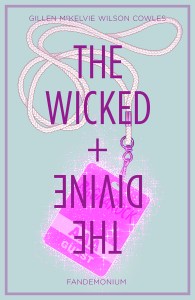
  3. Kieron Gillen/Jamie McKelvie: The Wicked and the Divine, vol. 2
  4. Kelly Sue DeConnick/Valentine De Landro: Bitch Planet, vol. 1
  5. Matt Fraction/Chip Zdarsky: Sex Criminals, vol. 2

Games

  1. Sunless Sea
  2. Undertale

(I played a couple of others but did not enjoy them.)

There you go. 48 wonderful things. A good year, by any standard.


Things I loved in 2015: Nos. 5-1

After much suspense, here are my top five things of 2015, including what I recognize is a hopelessly idiosyncratic number one that nobody who reads this will ever check out. But I’ve tried to be honest with myself about what I got the most enjoyment out of this year, and there’s really nothing that compares. Here are five incredible things:

No. 5 — Mad Max: Fury Road

Here is how fight scenes in movies generally work: there are two sides, the two sides fight, and one of them wins.

In Mad Max: Fury Road, there’s a scene where Max and Furiosa fight over a truck. They don’t know each other, and neither one necessarily wants to kill the other, but they both need the truck and they’ll do what they have to do.

There are a few complications. Firstly, Max is chained to Nux: an unconscious man who wants both combatants dead. There are five women standing by, who have nothing against Max, and who Max is not attempting to harm. Nonetheless, they need Furiosa to win. They aren’t trained fighters, so if they’re going to contribute they need to work together and be crafty. Also, Furiosa has one arm, though it’s doubtful whether this is actually an encumbrance for her.

Midway through the fight, the hostile unconscious man wakes up.

There are so many moving parts, here. Eight people, two gradations of combat expertise (Max, Furiosa and Nux as opposed to the other five), three separate allegiances (Max to himself, Furiosa and the five women to their own cause, and Nux against them all), and a chain holding two key combatants together.

The entire movie’s like that. Plots and motivations occur in miniature over the course of the extended chase scene that the whole movie basically is. I’ve never seen anything like it.

When I started writing this, I told myself I wouldn’t use this movie as a stick to beat other action movies with, but screw it. The reason Mad Max: Fury Road is the first proper action movie to get nominated for Best Picture in my lifetime is that it’s the only one that’s remotely deserved it. The entire genre seems lazy and vapid by comparison.

Self-evidently the best movie of the year.

No. 4 — Sunless Sea

Since this is the only game on the list, indulge me in a few extra words.

If 2014 was the year when I rediscovered video games, 2015 was the year when I realized the limits of my own tastes. Of 2015’s most notable games, there were many that I either had no interest in, didn’t love, or couldn’t runFortunately, the one game that I really adored this year is so vast that you can (and I did) spend a tremendous amount of time with it and be consistently enthralled. Sunless Sea, for the unfamiliar, is a game that’s approximately equal parts text adventure and roguelike. (I am now the kind of person who knows what that sentence means.)

In the game, you’re the captain of a vessel on a vast underground ocean. You’re living in a version of the 19th century where London was sold to a consortium of devils, fell far beneath Earth’s surface, and became a hilarious Lovecraftian parody of itself. As a captain hailing from this Fallen London, you spend the game making journeys of various lengths from home to a huge number of other creepy, surreal ports, and back. Your journeys from place to place allow you to freely explore the “Unterzee” in your craft, in a beautifully designed top-down view. But when you make port, the story is told entirely through text, aside from a few very expressive illustrations.

This ingenious design choice means that the game’s many stories can take some incredible turns. In Sunless Sea, it’s possible for the writers to include an island where time collapses: they just need to write all of their sentences in different tenses.

Sunless Sea has gotten a lot of well-deserved attention for its inclusiveness: there are characters of all races, genders and sexualities, and the game makes no impositions on your own character’s particular traits or background, or with whom you seek out relationships. (I play as a genderfluid poet, though I am neither of those things.)

It’s also gotten well-deserved attention for the superlative quality of its writing. Oftentimes, when we say that a game’s well-written, we’re grading on a very steep curve. Not here. Sunless Sea boasts top-flight comedic prose, and when the story turns dark or frightening, the writing shifts to adapt. The game speaks in a consistent, stylized voice, right down to the format of the names of characters: the Alarming Scholar; the Irrepressible Cannoneer; the Tireless Mechanic. It’s that attention to detail that makes Sunless Sea so convincing.

But, its real genius is that, rather than allowing itself to be governed by a single narrative throughline, Sunless Sea sets up hundreds of intertwined story threads for you to pull on depending on what interests you at any given time. I can see myself returning to this game for years to come. In a year where there was almost nothing in this medium of interest to me, Sunless Sea made me glad to live in a time when people can make a thing like this.

(If you’re considering shelling out for this, try the browser-based game Fallen London first. It’s not as immersive, but it’s free and features the same style of storytelling.)

No. 3 — Lin-Manuel Miranda: Hamilton: An American Musical

I once made the mistake of trying to sell a friend on Hamilton by calling it “a hip hop musical about America’s first treasury secretary.”

To be fair, that is how Hamilton tends to be sold. They hook you with the novelty of “history through rap.” But that one-liner does Hamilton a tremendous disservice. This isn’t a novelty; it’s the greatest work of musical theatre since Sondheim was at his peak.

There’s a point to telling the story of Alexander Hamilton by way of hip hop — I mean, as opposed to choosing some other story. First off, Lin-Manuel Miranda (the MacArthur genius who built this thing from the ground up) saw a classic hip hop narrative in the story of Hamilton: an immigrant who made it to George Washington’s inner circle through sheer grit and ingenuity.

But also, by telling this story by these means — and, crucially, with a multi-racial cast — Miranda is able to drive home one of the most important ideas in modern America: that the content of history depends entirely on who gets to tell the story.

Hamilton isn’t just a great musical. It’s also a more insightful historical narrative than the film and television industries have been able to muster for some time.

No. 2 — The Memory Palace

memory-palace

My favourite song of the year isn’t even a song; it’s an episode of The Memory Palace.

I can listen to “Craning” over and over, and it never loses its impact. It has specific turns of phrase that get lodged in my head for days. I take notice of a new detail every time. I can’t listen to it when there are people around because I can’t be sure I won’t cry.

“Craning” is about the launch of Apollo 11, but that doesn’t begin to cover what it does. No summary of any episode of this show can actually reflect the experience of listening to it. Nate DiMeo, the guy who made this podcast with no assistance until a couple of weeks ago, is the best writer in podcasting. Nobody can match his ear for an effective phrase, or his ability to imagine details in tiny moments in history. At the launch of Apollo 11, L.B.J. isn’t just there; he’s there in a blue suit and no sunglasses, “just that Hill Country squint.”

I’m going on about this one episode, but that’s just the one that hit me specifically. Nearly all of them are brilliant. You might enjoy the story about the first American woman to file a patent. Or, the one about the turbulent relationship between an ornithologist and his aristocratic wife. Or, the one about men who went mad from inhaling toxic gasses in the factories where they worked.

Something from The Memory Palace will hit you, and it won’t stop spinning around in your head for a while.

No. 1 — David Cavanagh: Good Night and Good Riddance: How Thirty-Five Years of John Peel Helped to Shape Modern Life

good night good riddance

My favourite kind of non-fiction tells a huge story through a narrow lens. David Cavanagh’s second book is the best example of that I’ve ever seen.

The story he’s telling is the story of counterculture in England between the late ’60s and the early ’00s. Hippies, punks, indie kids, goths, rappers. It’s a story of political radicalism and incremental social change. It’s the story of how modern Britain came to be a place whose margins are strangely intertwined with its mainstream.

The lens that he tells it through is the BBC Radio 1 DJ John Peel.

It is impossible to communicate what a masterstroke this approach is without throwing up your hands and saying “just read it.” The various incarnations of Peel’s radio show were all kaleidoscopic showrooms for the deepest, strangest music from out of England and elsewhere. So, Cavanagh just picked 265 of Peel’s shows from across more than three decades, and used them as a map to trace the path of British culture.

Cavanagh is as compelling a tour guide as you could hope for, tying each show in with the day’s news, the politics of the BBC, Peel’s personal life, and the state of the music industry.

I’m not selling this. I couldn’t possibly. Go to Amazon and read the free excerpt right now. They give you the whole introduction. No music geek — no person interested in culture in any capacity — will not love this.

Nothing else I consumed this year inspired, informed and entertained me like Good Night and Good Riddance. I feel like I need to find something else like this immediately, but I also know that it doesn’t exist.

Things I loved in 2015: Nos. 10-6

After four days winding our way through the thick jungles of culture with nothing but the dull pocketknife of my wit to cut through the overgrown foliage, we have at last cracked the top ten. Suffice it to say that everything from this point forth completely blew my mind.

No. 10 — Carol

The key line in Carol is spoken by Rooney Mara’s character, Therese: “I have a friend who says I should take more of an interest in humans.”

Critics have been saying that Todd Haynes should take more of an interest in humans since the beginning of his career. Even the simplest of his films are so meticulous and skillful that he’s open to accusations of “inauthenticity.” If you’re not paying close enough attention, you could easily mistake him for an artist who’s solely concerned with abstract matters like beauty, style and form, at the expense of the characters in his stories.

But like Therese (a photographer, notice), Haynes is not just a chilly aesthete. He has that tendency, but when presented with the fully-alive characters of Patricia Highsmith’s novel The Price of Salt (and Phyllis Nagy’s wonderful screenplay), Haynes becomes deeply interested in humans.

Carol is beautiful, and not just from a distance.

No. 9 — China Miéville: Three Moments of an Explosion

china mieville

Bob Dylan once said that every line of “A Hard Rain’s A-Gonna Fall” is the first line of a different song that he was never going to have time to write. China Miéville is primarily known as a novelist, and when you’re reading this collection of short stories, you get the sense that each one is the first chapter of a novel he’ll never have time to finish.

The stories in Three Moments of an Explosion differ wildly in theme and length, but they all share the tendency to state their premise in however many words are necessary, and then stop. Miéville can spin a yarn as well as anybody. But, in most of these stories he’s more interested in taking an unlikely notion he’s had, turning it around a few times to see it from different angles, and putting it away.

Most writers couldn’t pull that off for a whole book. But Miéville has a gift for coming up with incredibly specific and uncanny premises that you want to read about the implications of. One of these stories is about a disease that causes circular trenches to form around people when they stand still for too long. Lots of writers would be able to take that and turn it into a parable on the compulsion to keep moving, or whatever. Miéville thinks: “What happens if they’re in a car?”

Three Moments of an Explosion is a flagrant display of profound virtuosity. Nothing else this year gave me so many separate reasons to be in awe.

No. 8 — Vulfpeck: Thrill of the Arts

When I first heard this album, I described it as “one of those unexpected pleasures.” Since then I have realized that doesn’t begin to cover it. Vulfpeck is not just a band. Vulfpeck is a self-contained world of madness with a Wes Andersonian level of internal consistency. There are no half-measures in Vulfpeck. Their commitment to maintaining a uniform aesthetic doesn’t just extend to their music, but also to their videos and every bit of peripheral material they issue. Vulfpeck is as much about fake film grain and pictures of dogs as they are about sexy basslines and Rhodes piano. This is the band that raised $20,000 dollars in Spotify royalties by issuing a silent album and asking people to put it on repeat overnight. It’s not just about the music. Vulfpeck is a zaniness factory.

Their first full-length is their most controlled release yet. It’s funk, like all of their music, and they still sound like talented slacker dudes from a commercial music program at some community college. But more than on any of their EPs, the music on Thrill of the Arts sounds like it was recorded in an airless room. They are truly earning their German affectation here: this is Parliament by way of Kraftwerk.

And it has some of the most technically astonishing performances I’ve heard this year. Antwaun Stanley’s amazing vocal on “Funky Duck” is probably in my top ten favourite committed performances of stupid lyrics. (The other nine are all Rush.) And Blake Mills’ guitar on “Rango II” (a sequel to a previous song, because that’s a thing they do) is one of those moments where you don’t actually know how he’s even doing that.

Vulfpeck is the kind of band I would hope to be in if I were in a band. What higher praise can any music geek offer?

No. 7 — Mad Men

TV’s not made for endings. I’m not the first to observe this. The whole idea of a TV show is to have an central concept that can sustain years-worth of stories. It’s not about having a complete narrative worked out from day one. That’s why people who say “the ending ruined the whole thing” or, “they didn’t have a plan” are missing the entire point of the medium.

But I don’t think it’s even possible to say those things about the ending of Mad Men, which was perfect in every way. Like everything else about the show, it’s impossible to know quite where it sits on the spectrum of sincere to cynical, and there was no ham-handed attempt to try and tie off every storyline in a neat bow. Mad Men ended in a way that it can continue to be a thing rich with multiple meanings, many of which even Matt Weiner probably never thought of.

If you tell me it’s the best show ever, I won’t argue.

No. 6 — Reply All

There are two kinds of podcasts: the kind that could (or do) air on public radio and the kind that couldn’t. There is no value judgement implicit in that taxonomy. Before public radio caught on that it was a possible future, an aesthetic had developed around podcasting. And, that aesthetic was basically two or more people talking, without a huge amount of craft or artifice.

Reply All, the brightest jewel in Gimlet Media’s increasingly dazzling crown, is the first public radio-ready podcast where the hosts seem aware of that legacy. P.J. Vogt and Alex Goldman’s personalities can carry the show a long way. Consider their recurring segment “Yes Yes No,” where they explain various convoluted internet things to their boss. That’s some good podcasting, right there. And that dynamic informs every episode of the show.

But this is still a Gimlet show, and they are On The Media alumni. So, these episodes are still finely-crafted, thoughtful, borderline fussy radio. Plus, they’ve got a premise (“a show about the internet”) that allows them to do anything. If you don’t know this show, listen to the episode above, then start from the first one and listen to all of them. They’re remarkably consistent in their brilliance.

Be sure to come back for the thrilling conclusion, wherein several eternal questions shall be answered: What’s the number one album going to be? Did Matthew play any games this year? And, will anybody have actually heard of the thing that tops the list???

Things I loved in 2015: Nos. 15-11

How do you follow up prison planets, drunk horses, West African minimalism, Jonathan Banks in a tollbooth, and BIG WIDE 70MM SUPER CINEMASCOPE? Like this:

No. 15 — Mystery Show

The twin notions that everything is connected and that there must be a conspiracy are classic engines for genre fiction, from Lovecraft to From Hell to Welcome to Night Vale. But I’m not sure that it’s ever been taken up in non-fiction with such total aplomb as on this podcast.

Mystery Show is ostensibly about actual, real-world mysteries with actual real-world solutions. But each story is told according to the semi-ironic non-logic of real-world Dirk Gently, Starlee Kine. So, the plotline of Must Love Dogs becomes crucially important to finding a forgotten video store. The life story of a guy who works for Ticketmaster customer service could yield crucial clues to discovering Britney Spears’ reading habits. And the members of the Phoenix Culinary Association could (and do) prove invaluable in the quest to find the owner of long-discarded belt buckle.

Mystery Show is funny, sure. And it’s presented with one eyebrow at least halfway raised. But, it also makes you feel like we all live in a world where there are amazing stories beneath every rock — as long as you take for granted that it’s the most important rock in the universe.

No. 14 — Unbreakable Kimmy Schmidt 

If you’re not completely sold on this show on the basis of its theme song, we cannot be friends.

Unbreakable Kimmy Schmidt is on this list primarily because it made me laugh and laugh like a big dumb idiot. It’s like Tina Fey and Robert Carlock decided that 30 Rock just wasn’t quite packed-full-o’jokes enough, and they’d have to do better next time.

But what I really remember most fondly about my embarrassingly fast binge of Unbreakable Kimmy Schmidt is the first two minutes. I don’t think I’ve ever seen a show establish its premise and characterize its lead quite so efficiently before. That theme song certainly does a lot of the heavy lifting, but really watch Ellie Kemper’s performance as she emerges from the bunker where Kimmy’s been kept for 15 years. There’s not a shred of anger or resentment about what she’s missed out on — just overwhelming joy that the world outside still exists.

I’m not saying it’s psychologically realistic, but in that moment you realize that this is a character you want to spend a lot of time with.

Even if Unbreakable Kimmy Schmidt hadn’t given us the profound gift that is “Peeno Noir,” it would still be my favourite new comedy in ages.

No. 13 — Kieron Gillen/Jamie McKelvie: The Wicked and the Divine, vol. 2

WicDiv2

Do you ever get the feeling that the intended audience for a thing is specifically you, and nobody else? It probably happens to me more than a lot of people, to be fair. But I’m not sure there has ever been a narrative premise that is such obvious Parsonsbait as “a pantheon of gods from various mythologies are periodically incarnated as rock stars.”

The first volume of The Wicked and the Divine bowled me over, but this second one, “Fandemonium,” is where things really seem to be picking up. We learn more about the history of the pantheon, our protagonist’s story takes some completely unexpected twists and turns, and — best of all — we meet a genderfluid incarnation of the Sumerian love god(dess) Inanna who dresses like Prince.

Also people trip out at a rave hosted by Dionysus.

This comic is bonkers and beautiful and I’m more invested in it than almost any other ongoing serial narrative. I’m picking up the third trade collection later this week, and will devour it immediately.

No. 12 — Inside Out

I tend not to watch kids’ movies — not out of a lack of respect for them, or out of self-consciousness; it’s just that my reaction is usually something like “Boy, I wish I could have seen this when I was ten.”

Not Inside Out. This movie hit me straight in the 25-year-old feels. First off, the premise of exploring the changing psyche of a young girl by way of personified emotions is brilliant. And the casting is spot-on. But it’s specifically the exploration of sadness’s role in maturity that makes Inside Out one of the most thoughtful children’s movies I’ve ever seen.

No. 11 — Björk: Vulnicura

Björk’s creative peak is lasting a ludicrously long time. Vulnicura is, to my ears, as good an album as she’s ever made. It’s certainly a mode we haven’t seen her in before. And with an artist like Björk, the best you can possibly hope for is yet another new direction.

Sonically, Vulnicura could be seen as a retreat to the barren, strings-and-drum-machines-only timbres of her acclaimed Homogenic. But this time, that timbre doesn’t make her seem tough: it leaves her exposed. Which is apropos, since this is Björk’s breakup album. I think it’s destined to become both a classic of that minor genre and of her discography.

“Stonemilker” is pure catharsis, and one of my favourite songs of the year.

More whiplash tomorrow, as we enter the top ten with a beautiful movie, a beloved show, a kaleidoscopic podcast, a disappointingly overlooked album, and the list’s first non-comic book.

Things I loved in 2015: Nos. 25-21

Being that this is the second time I’ve done this, I suppose we can call my year-end list an annual tradition. A key part of this year-end tradition is that it always happens well after the year has ended. Whatever. Timeliness isn’t everything.

I’m doing things a bit differently this year. First off, I’ve decided to rank the entries. This is, of course, foolish. It’s not so much that it’s like comparing apples to oranges; it’s more that it’s like comparing apples to oranges to kiwis to ribeyes to Chanel No. 5 to Chevrolets to ravens to clouds. But that is exactly the fun. Throughout this list, you’ll find things that have absolutely nothing in common, except that I enjoyed them. Their ranking is nothing more than an index of my goodwill towards them in the weeks immediately preceding this one.

And speaking of weeks, I’m ramping up the suspense by breaking my top 25 down into five separate posts: one per day until Friday. In practice, this is because I’m never going to have time to write the whole thing at once. But it may also be fun for the six of you who’ll read this.

Speaking of you six loyal Omnireviwer readers (bless you), you’ll have gotten to know my tastes by now. Specifically, you’ll know that they are capricious and semi-arbitrary, and that my experience of the year’s media, while extensive by normal person standards, is far from complete. This list is compromised and imperfect, but hopefully idiosyncratic enough to make for decent reading and introduce a few things you might have missed. 2015 was a good year, much like all the rest of them.

Today, we’ve got an album, two movies, a TV show and a podcast. Let’s begin:

No. 25 — CHVRCHES: Every Open Eye

This is the album that I was most disappointed to see overlooked on so many major year-end lists. I loved CHVRCHES’ debut album, as did everybody, but Every Open Eye is self-evidently a more assured and consistent record. I periodically go back to the singles on the debut, but I tend not to want to listen to the whole album. Whereas, Every Open Eye is a unified 42-minute catharsis. And Lauren Mayberry’s voice sounds even better this time around.

There are albums that I’m leaving off this list that I think are possibly more accomplished than this one, and certainly more important. But this is an album that I lived with, this past year. Don’t deny yourself joy. Go listen to CHVRCHES.

No. 24 — The Revenant

It’s big and ambitious and prestigious and self-serious and Oscary, and I loved it so much.

Common wisdom around The Revenant seems to be that it’s bleak and difficult — a movie you “should” go see, rather than one you “have to!” go see. And it is bleak, and it is graphic and visceral and painful at times. It’s Alejandro Iñárritu. But it is also a hell of an experience. I’d gladly see it a second time.

A lot of that is down to Emmanuel Lubezki, the most distinctive cinematographer alive, and the man who will once again prevent Roger Deakins from winning his Oscar this year. Lubezki’s immaculately choreographed long takes remove all of the artifice from the movie’s action scenes — that bear fight, and especially the battle at the start of the movie, which is one of the best battle scenes ever. His approach puts you right there. Plus, he has an unparalleled eye for a staggering vista.

Lubezki’s photography and Ryuichi Sakamoto’s beautiful score tone down the terrors of the story and Leonardo DiCaprio’s impressively committed performance. The Revenant is horrifying, yes. But it isn’t unrelenting. It’s watchable. Beautiful, even. If it won Best Picture, I wouldn’t be especially disappointed.

No. 23 — Doctor Who

The latest season of Doctor Who divides conveniently into its first half, an extended failure to ignite, and its second half, which blazes magnificently. If we were to separate those two halves, the first wouldn’t place on this list and the second would probably be a lot higher. In that latter string of excellence, head writer Steven Moffat, returning favourite Peter Harness and newcomer Sarah Dollard all offer top-flight Doctor Who scripts, and even the series’ longest-dangling dead weight, Mark Gatiss rises to the occasion.

Peter Capaldi and Jenna Coleman both give their best performances of the series in Harness’s Zygon two-parter, and they (especially Capaldi) keep it up through Moffat’s two-part season finale. And what a finale. First, in “Heaven Sent,” Moffat offers one of his signature high-concept scripts like “Blink” or “Listen,” which is a sort of drama that no other show can do. Then, in “Hell Bent,” he gives us the best episode of Doctor Who in giant, explosive, plot-heavy mode since “A Good Man Goes To War.”

Altogether, series nine is a lesser season than its predecessor, Capaldi’s debut series. But, there are at least five hours of the best Doctor Who since 2005 in here somewhere. It’s a shame that Moffat’s tenure has to come to an end, and a bigger shame that it’s not Harness replacing him. But Doctor Who has had 53 years to prove that it can weather pretty much any change in the long term. And there’s still one more series that’s bound to be a corker.

No. 22 — Spotlight

There’s no way to prepare yourself for how good Spotlight is. That trailer sure as hell doesn’t suggest it. No matter how many people tell you this movie is great, and no matter how many positive reviews you read, Spotlight still seems like it’s going to be a well-made, soft-spoken, mid-budget movie for grown-ups. It looks boring. Pedestrian. Sophisticated. But actually, I don’t think I’ve been so consistently excited by a movie that’s almost entirely talking since The Social Network.

The screenplay hits a perfect balance where it lets you be thrilled by the twists and turns of its journalism procedural storyline while also never forgetting that it’s a movie about child molestation. It’s sensitive to the details of the story that the journalists are telling, while also realizing that it’s own story is not that story — it’s the meta story: the story of the story.

The really great thing about this movie is that while it celebrates the extraordinary work these journalists did, it doesn’t shy away from also implicating the entire institution of journalism for letting the abuse in the Catholic Church go unexamined for so long. As much as anything, Spotlight is a movie about how systems turn a blind eye to themselves.

In that sense, it reminds me of The Wire. What more can I say?

No. 21 — Love and Radio

This podcast feels like a different show every episode, which makes each episode essential almost by default. The producers of Love and Radio episodes find people with stories and perspectives that fall outside most people’s experience and then say, “we’re just going to listen to this person for a while.” Host Nick van der Kolk and his team are generally present, but off-mic. It’s like every month, Love and Radio has a different host. It empowers voices that would otherwise never have that kind of power.

This totally changes the power dynamic of the radio interview — for better and worse. Sometimes, people say horrifying things on this podcast, which can be troubling given that the interviewer’s voice is made subordinate to the guest’s. (See this year’s fabulous and infuriating A Red Dot.) But, the underlying philosophy is that it’s better to listen to people than not to, and I agree.

The episode I’ve embedded above is certainly in my top three podcast episodes of the year. Hit play, and feel every feel you possess.

The countdown will pick up with no. 20 tomorrow. There’ll be two more shows, a movie, an album you might have missed and our first comic. 

Omnireviewer (David Bowie edition)

Ugh, what a week. David Bowie was a totally inspiring person and I’m gutted. I’m splitting this week’s reviews into two posts: the Bowie edition and the standard one. This is the larger of the two. I’d figured early on that this week was mostly going to be Bowie, but I’ve basically stuck to old favourites rather than seeking out any of the stuff I haven’t heard. I’m in no rush to get through it all, now that the number of David Bowie albums in the world is finite. It’s nice to still have some of the really acclaimed ones to look forward to.

So, here are this week’s 14 Bowie-related reviews, hopefully without too much goop, under one subhead:

A category of his own

David Bowie: Blackstar — Just before I started writing these weekly posts, I was listening to almost nothing but Bowie, and had been for the better part of three months. What’s more, I’d been listening to only about three or four of his albums, over and over. That’s how much there is in his best albums, which seems to account for a fairly large percentage of them. They bear limitless repetition. When I finished my first listen of Blackstar, I immediately put in on again. I’ve been living with it all week. It’s good that this was released before Bowie passed, if barely. In 2016, critical consensus comes together fast enough that we know this album was beloved before it became loaded with the sentimental baggage it now carries. Now, we can see that Blackstar was built to take on that baggage from the beginning. But, it’s good to know that it didn’t need the extra push. I’m glad that I didn’t personally get around to listening to it until after Bowie’s death, though. Many of these tracks — particularly “Lazarus” — pack an extra punch when you know that Bowie intended them as a farewell. Also, you can’t help but feel like it adds a couple more layers to the riddle. I wrote elsewhere this week about how “Station to Station” encourages paranoid readings: where even the most minute details seem like they could be deeply meaningful. There are only a few artists who can pull that: James Joyce, Bob Dylan, David Lynch. And David Bowie. And on the title track of Blackstar, he leaves us with another tangled web of symbols to unravel. I expect that a hundred million conspiracy theories are immediately forthcoming. Think of these lines: “Something happened on the day he died/Spirit rose a meter then stepped aside/Somebody else took his place and bravely cried:/I’m a blackstar.” Who’s he talking about? Who’s the blackstar? Regardless of the specifics, here is my working theory: David Bowie’s final opus stands as a coded warning to anybody in the future who would dare revere him above the artists of their own time. This is what I choose to believe, because there’s a certain amount evidence in the text pointing there, and because Bowie’s always had the future in mind: I’m thinking of “Changes,” “Oh, You Pretty Things” and “All The Young Dudes,” especially. I believe it because I’ve also got the recently departed Pierre Boulez on my mind, who famously articulated a similar view. And I believe it because it’s such a positive message that we need to hear so badly. But of course, all theories of this sort will remain working theories forever, because as Bowie sings on the last track of his final album — “I can’t give everything away.” Nobody ever died with more panache.

David Bowie: The Next Day — It’s good that Bowie had time to make Blackstar. This would have been a perfectly fine final album, but it would have been an accidental one. An artist like Bowie deserves an Abbey Road: a swansong by design. But also, you can’t imagine that Bowie would have been content with this being his final statement, because The Next Day captures Bowie in an uncharacteristic moment of nostalgia. The album cover looks backwards; the lyrics to “Where Are We Now?” look backwards; the style of the music is neoclassical rock ‘n’ roll. Ending his career with The Next Day would have been a tacit endorsement of an attitude that the young man who wrote “Changes” would never stand for. Far better to explore entirely new sonic territory and sing about brave young artists who will take your place when you die.

David Bowie: Stage — I feel like a lot of music geeks today don’t appreciate live albums enough. In the case of somebody like Bowie, they might seem a little bit beside the point. Isn’t it really mostly about the songs? Well no, actually. One of the things that’s best about Bowie is the incredible range of musical personalities that he hired as members of his various bands. And live albums are the best way to really hear a band’s collective sound. The Bowie band on this recording is a particular favourite of mine, featuring the mighty two-guitar tag team of Carlos Alomar and Adrian Belew. It’s worth the price of admission just to hear those two take on the opening of “Station to Station.” Some of the Spiders From Mars era stuff sounds a little thin without Mick Ronson, but it’s great to hear the Berlin Trilogy material played for an audience. Imagine starting a show with “Warszawa.” Don’t overlook Bowie’s live records.

Alex Pappademas & Chuck Klosterman: “The Nobituary: David Bowie” — This is a 15,000 word email correspondence between two of the cleverest culture writers around. It was intended to generate thoughtful obituary material when Grantland got a tip three years ago that Bowie was on death’s door. Obviously, he was not. But they ran this anyway, and it’s a fantastic read that ended up having more to do with the deaths of celebrities in general than Bowie specifically. Some of the specifics seem prescient in the wake of the actual event this was supposed to follow. At one point, Klosterman refers to “Where Are We Now” as “a song a bedridden Bowie might have recorded just before his secret death.” Um. I have to say though: there’s a thread running through this about how people grieve celebrities on social media as a matter of personal image management. And, I think they’re probably right to observe that this is a thing that happens. But it made me realize that one of my least favourite things about social media (and I have many least favourite things about social media) is that cynics are constantly calling bullshit on people’s genuine emotions. I’d much rather see the outpouring of appreciation that followed Bowie’s death as an actual reflection of how much he was loved than a collective act of branding by an image-conscious world.

David Bowie: Hunky DoryHunky Dory is the album to go with to demonstrate to somebody the concept of “David Bowie: preternaturally gifted songwriter.” It’s probably the Bowie album with the highest density of novel musical and lyrical ideas. You get a new appreciation for “Changes” when you try and figure out the chords. “Life On Mars?” is one of those songs that manages to live up to its acclaim, against all odds, like “A Day in the Life” or “Like a Rolling Stone.” I can’t think of any other work of art that captures that feeling when the world feels less excellent than it should and you crave escape. It’s a miracle that it doesn’t eclipse the entire album. But everything on this, from iconic anthems like “Queen Bitch” on down to album tracks like “Andy Warhol” and “Bewlay Brothers” is pretty much classic.

David Bowie: The Rise and Fall of Ziggy Stardust and the Spiders from Mars — Never one of my favourites. Call it perversity; call it hipster contrarianism. It may be either or both. But the truth is, when I start listing the songs on the album that I do really like, I end up pretty much listing them all. There’s no resisting. Ziggy is an immortal force of nature.

David Bowie: Aladdin Sane — Some days, I like this better than Ziggy Stardust, even though the songs aren’t as good, on average. But it’s a far better-made recording, with better instrumental performances — and the introduction of Mike Garson on piano, who is totally wonderful. This is Bowie with the glam turned all the way up. “Lady Grinning Soul” is possibly his greatest vocal performance.

David Bowie: Diamond Dogs — I take it back. “Sweet Thing” is his greatest vocal performance. Diamond Dogs is perpetually underrated because it is fragmented and incohesive — it’s made of bits of three separate abandoned stage musicals. But the parts that make it up are among Bowie’s strongest work. There are no bad tracks on Diamond Dogs; it just sort of doesn’t work as an album. But that’s better than being cohesive and bland. I love this.

David Bowie: Young Americans — To me, this is the least essential Bowie album of the ‘70s. But that’s what you could call praising with faint damns. The important thing about this is that it was the most extreme about-face in Bowie’s career thus far. It’s one of those moments like George Washington not running for another term as president, or William Hartnell being replaced by Patrick Troughton as Doctor Who: these are moments where it becomes clear that the thing we’re dealing with might be infinitely sustainable by way of regular shake-ups. So, if Bowie’s plastic soul isn’t one of his most successful directions in its own right, it’s still essential because it paved the way for, in my opinion, Bowie’s best music in the next several years.

The Man Who Fell To Earth — This is the first feature in the Bowie movie night I wrote up elsewhere, this week. In practice, the Bowie movie night I went to ended up being a combination Bowie/Rickman tribute, because it really has been a hell of a week. This was the first time I’d seen this movie, which I kind of can’t believe. I mostly knew what to expect, having seen a couple of other Nicolas Roeg movies (Performance and Don’t Look Now, both incredible). But I didn’t really know what to expect from Bowie. I read in Roeg’s memoir that he cast Bowie after realizing that he was so totally isolated from the rest of humanity (and in the throes of cocaine addiction, Roeg declines to mention) that he could basically just tell him what to say and point a camera at him, and Bowie wouldn’t really even have to act. His character, Thomas Newton is an amoral alien. For all intents and purposes, so was Bowie in 1975. He is totally fascinating to watch in this, and carries the movie. I loved this and will probably watch it again fairly soon. I feel like seeing this is absolutely key to understanding where Bowie was at during this phase in his career. On which note…

David Bowie: Station to Station — These days, this is my favourite Bowie album. Having now seen The Man Who Fell To Earth, it’s amazing how much this could have been recorded by Thomas Newton — if Newton could sing. There is much of this that I like even better in various live renditions, but there are also moments on the record that are totally inimitable: the transition in “TVC15” from barrelhouse piano in the verse to an ad jingle in the chorus, the propulsion of Earl Slick’s solo on the outro of “Stay,” Bowie’s vocal in the chorus of “Word on a Wing.” Hunky Dory might have more inventive songwriting, but Station to Station is probably a more well-rounded picture of Bowie’s art. It’s full of riddles, mysteries, science-fiction pastiches, funk beats, incredible vocals, great performances from a killer band, and the side-effects of the cocaine (or possibly love). Everything you could want.

David Bowie: Live Nassau Coliseum ’76 — This is the bonus concert on the special edition of Station to Station. It’s an interesting companion to both that album and to Stage. It’s from Bowie’s deliriously coked-up period, but he’s totally on point here. So is the band. Stacey Heydon is a through-and-through blockhead rock ‘n’ roll guitar player (the opposite of Adrian Belew), and there are moments where you kind of want him to just go away and let Alomar play the riffs. But, it’s interesting to hear “Fame” and “Station to Station” approached as flat-out rock. This is to the era from Diamond Dogs through Station to Station as Stage is to the era from Station through “Heroes”.

David Bowie: Low — David Bowie was a whole bunch of my favourite musicians: a composer of interesting novelty songs, an idiosyncratic folk rock one-hit-wonder, a glam rock alien, a gaunt paranoid in a fabulous white suit, a clever jazz fusion dilettante… but the one I’ll miss most is this detoxing depressive on this album, trying as hard as he can to get his life back in order. To be fair, that guy been largely absent for a long time, because he did actually get it together in the end, and he disappeared into a happier life. He’s reared his head now and again, on parts of The Next Day, for instance. But Low will always be his high-water mark: his turning point. Low’s reputation as a dark, brooding masterpiece is only halfway founded; it is just as frequently hopeful and generous, in the face of truly dire circumstances. There aren’t many songs that can make me as instantly happy as “A New Career in a New Town.”

David Bowie: “Heroes” — The thing that really gets me about “Heroes” is those quotation marks. The title track famously tells the story of two lovers from opposite sides of the Berlin Wall having an affair and getting killed by guards as they try to meet up surreptitiously. These people aren’t heroes — they’re just going about the usual, sordid business of being human. But, due to the confluence of personal and political factors, they briefly become something larger than themselves. If these two can’t be heroes, they can at least be “heroes,” just for one day. Even Bowie’s punctuation was astonishing. We ought to all try to heed the warning implicit in “Blackstar” (see above), but Bowie doesn’t make it easy. This man was singular.

DAVID BOWIE, 1947-2016. Pick of the week.

Omnireviewer (week of Dec. 27)

My best of 2015 list will be ready by, oh let’s say the end of January. That’ll give me time to finish Three Moments of an Explosion and see Star Wars. In the meantime, I took advantage of the holidays to take in all sorts of fun stuff. And since podcasts make up a comparatively small amount of it, I’ve taken the liberty of awarding my picks of the week to two non-podcasts. Here are this week’s 27 reviews.

Television

Doctor Who: “The Husbands of River Song” — Well. In two consecutive episodes, my two favourite supporting characters in Doctor Who get marvellous sendoffs. The comedy in this plays wonderfully, but it’s the character drama between the Doctor and River that really sells this. That scene at the dinner table midway through really got me, though I’m not sure if it was the script and performances or just Wagner’s Siegfried Idyll playing in the background. Even if the resolution is a bit of a deus ex meteors and everybody ends up a bit in meteors res, it’s still a delightful romp. My only regret is that this is the first and last time we’ll see Peter Capaldi and Alex Kingston in these roles together. Because they are every bit the pair that Kingston and Matt Smith were. Lovely.

Deadwood: Season 1, episodes 11-12 — Firstly, I’ve really been enjoying Todd VanDerWerff’s essays on Deadwood from his days at the AV Club. In spite of being bundled up into sets of three episodes, they’re among his best writing: up there with his Sopranos reviews and the few seasons of Mad Men that he covered. Anyway, these last two episodes of Deadwood’s first season are outstanding. If the second season keeps the pace of these last three episodes, I’ll be a happy viewer. But I’m going to take a break from this before diving into that season, to watch Mildred Pierce as part of an ongoing Todd Haynes pilgrimage. But I’m really looking forward to seeing how the second season manages to be more acclaimed than the first.

QI: “Merriment” — Bill Bailey is dressed like Paul McCartney on the Sgt. Pepper’s cover!

The Graham Norton Show: “David Beckham, Carrie Fisher, Daisy Ridley, John Boyega & Kylie Minogue” — I could not love Carrie Fisher more. Also, why don’t more late night talk shows have multiple guests at once? Not many shows could give us David Beckham and John Boyega fighting with toy lightsabers and narrowly missing Kylie Minogue’s head.

Comedians In Cars Getting Coffee: “President Barack Obama” — Certain parts of this are a bit stagey, as you’d expect. But I’m always quite impressed by Obama’s ability to play himself in stuff. Really, though, you should watch this to see a president in a frame of mind where he doesn’t feel the need to pitch messages all the time. It’s not the Marc Maron interview, but it’s in the same vein and it’s got some funny moments.

Doctor Who: “The Eleventh Hour” — This was the first piece of media I consumed in 2016. It’s a great start, really. To my year, and to the Steven Moffat era of Doctor Who. By the end of this episode, any attentive viewer has Moffat’s game pegged, at least on a metafictional level: Amy is introduced as a diegetic insert of a Doctor Who fan, so we can assume even at this point that her story will be about what it means to love Doctor Who. As fresh starts go, this is one of the greats.

Sherlock: “The Abominable Bride” — And so would this be, if it hadn’t turned out to be something else entirely. I shall say no more, because spoilers. I will say this: I love that Benedict Cumberbatch plays a substantially different Sherlock in Victorian garb than he does in the modern stories. The other characters in Sherlock have always been fairly consistent with their portrayals in Conan Doyle. But the moody sociopathy of Cumberbatch’s modern Holmes is straight out of contemporary anti-hero television. It was a canny choice by Cumberbatch (and by Moffat and Gatiss) to strip back that element of his character and allow this Holmes to be the dour Victorian eccentric that he started off as. I had as much fun watching this as I’ve ever had watching Sherlock, no doubt partially because Moffat and Gatiss write Victorian witticisms with spectacular aplomb. But somehow, I’m left wondering if the fun that I had actually reflects the quality of the episode. There’s a sort of messy gratuitousness to this that almost matches that insane wedding episode from the last season. Still, there are enough bon mots and meta-critiques in this that I remain quite positively disposed to it.

Music

Frank Sinatra: Nothing But The Best — This is a compilation of Sinatra’s best singles for Reprise, which is not where he did his best work. His earlier Capitol recordings are the real reason he’s a legend. But still, there something about this more relaxed version of Sinatra that’s just better for putting on and pottering about doing other things. You can’t do that with In The Wee Small Hours, because it’ll make you cry all over your laundry.

Hawkwind: Hall of the Mountain Grill — I’ve never actually gotten around to listening to a full Hawkwind album, but the recent death of Lemmy seemed like it necessitated a spin of this. It took me back to a time when I was discovering music like this regularly. In spite of never having heard it, this fits right into the established grooves in my brain. “You’d Better Believe It” is a serious jam. More Hawkwind to follow, probably.

Caroline Shaw/Roomful of Teeth: Partita for 8 Voices — There’s something about vocal music that has the capacity to inspire sheer, giddy joy more easily than other idioms. I’d heard the Passacaglia from this spectacular piece many times, but I figured it was time I checked out the other three movements. They’re playful and emotive and hold the hell out of your attention. Roomful of Teeth is a vocal ensemble unlike any other and Shaw, being a member, knows what they’re capable of. She takes full advantage of the group’s technical capacities to the point where listening to the music becomes both an emotional experience and something like watching a really impressive high-wire act. A Pulitzer is not praise enough. Pick of the week.

Lou Harrison/Dennis Russell Davies et al: Symphony No. 3 & Grand Duo for Violin and Piano — Why Lou Harrison’s music isn’t at the centre of the repertory by this point is a mystery to me. His third symphony is one of the loveliest and most accessible pieces from late 20th-century America. If the classical music world made sense, conductors would be scrambling to put out full Harrison cycles rather than more goddamned Mozart.

Rush: Grace Under Pressure — I tend to make a lot of the first music I listen to in a given year. This time, I finished 2015 off with what was once the first side of this (with “Headlong Flight” thrown in for good measure — the perfect song to end a great year). On the walk home after midnight, side two rang in 2016. Given that this is one of the darkest Rush albums, I’m choosing to interpret my choice as a cautionary tale: I’d best not initiate any nuclear wars this year.

Rush: Permanent Waves — A perennial favourite. I love Permanent Waves so much that I have trouble listening to any other Rush album without immediately following it up with this.

The Chemical Brothers: Surrender — This really feels like Daft Punk in places. Which certainly isn’t a bad thing, but given the choice between psychedelia throwbacks (more prominent on both Dig Your Own Hole and Further) and French house, I’ll go with the former every time. “The Sunshine Underground” is a jam, though.

Literature, etc.

David Cavanagh: Good Night and Good Riddance — Finished! God, I loved this. Maybe it ended a little abruptly, but it’s such a minor problem in the face of everything that comes before that I don’t actually care at all. More shall be said about this in my year-end list, I’m sure. (Fated to be more of a “year-beginning list,” it would seem.)

China Miéville: “The Dusty Hat” — Do you ever read something, or see something that you don’t understand and that makes you like it more? It sort of pulls you in by its sheer incomprehensibility? That doesn’t happen to me all that much, but when it does, the thing in question often becomes an all-time favourite. It happened with Mulholland Drive, At Swim-Two-Birds, Trout Mask Replica, and a bunch more I’m forgetting. On first read, “The Dusty Hat” is very much like those things were. It has far and away the most adventurous and best prose of the stories in Three Moments of an Explosion so far and is immensely imaginative in its details. (A particular favourite: “I was glad I didn’t have a cat or a dog because I thought they’d die from being in the room with him.”) Overall, I kind of don’t know what even happened in this story. But I definitely enjoyed it more than any of the others in this collection, with the possible exception of “The Buzzard’s Egg” — which was immediately comprehensible and thus in a strange way less promising. If I remember, I plan to read this again right when I finish the book. Pick of the week.

China Miéville: “Escapee” — One of the pleasures of Three Moments of an Explosion is these little tiny stories of fewer than five pages, which often follow the larger stories like “The Dusty Hat.” This one’s an outline for a movie trailer — the second one of those in the book — for a movie about a man with a large hook embedded in his back. I actually wouldn’t mind seeing that movie, provided it were written by Miéville and directed by Robert Rodriguez.

Movies

Captain Phillips — My impression from the reviews was that this was only okay and mostly notable for being super Oscary and having a great performance by Barkhad Abdi. Both of those things are true, but I thought this was terrific overall. Paul Greengrass is a meat and potatoes director, who just gets out of the way of the story. That approach makes this totally gripping. The screenplay flags in scenes that aren’t ruthlessly procedural and full of people making decisions, i.e. the very beginning of the movie, where we meet Phillips’s family, and the quick pep talk he gives to his crew about a half-hour in. It would have been a better film with those two scenes removed altogether. But once the action starts, there are no weak points. Near the end of the movie, Tom Hanks’s performance is so good that I almost understand why he’s so esteemed.

The Hunting Ground — I watched this at a New Year’s Eve gathering. Yeah, I say “gathering” advisedly, because this is not a documentary you watch at a “party.” It is appalling, and not especially surprising to anybody who pays attention to these things. It is worth seeing. There are moments in this where a simple fact will appear onscreen as an intertitle, with seven or eight studies cited as sources for that fact. Those moments are surprisingly powerful, and bolster the personal narratives related by survivors of campus sexual assault, which are really difficult to take.

Vertigo — Yeah, I’d never seen Vertigo. It’s great, obviously. Maybe a little dated. It has a particular sort of expository writing that you don’t see much of anymore. Plus, Jimmy Stewart is definitely an actor from the 50s. And his character is probably the most conspicuous private eye in cinema history. Seriously dude, there’s no way she doesn’t see you there behind that pillar. It’s stuff like that that kept me at arm’s length, a bit. I suppose you’ve got to approach these old masterpieces on their own terms, but there are plenty of movies older than this that I find completely fresh and immediate even today: The General, Citizen Kane, The Rules of the Game, Sunset, tons more. On first viewing, the fact that this has now surpassed Kane in the estimation of the world’s critics (as per the last Sight and Sound poll) seems totally ridiculous to me. But I certainly wouldn’t argue with anybody who claims that Bernard Hermann’s score is the best in film history. Favourite line: “I’ve been right here all the time putting olive oil on my rubber plant leaves.”

Games

Undertale — Okay. So, if my last note on this made it seem like I’d finished the game… I hadn’t. I assumed I was close enough that I could basically offer a final assessment, but at the very last minute, Undertale turns into something dramatically different from and stranger that what it sets you up to think it is. I won’t spoil it, but I will say that the ending of Undertale is a complex metafiction of the sort that never fails to pull me in. I’ve seen these themes explored more effectively in other games (to say which ones would almost be a spoiler), but this is going to stick with me for a bit. Last week, I had this pegged as “worthwhile.” Now, I daresay it’s closer to essential. I had it pegged for a pick of the week until I got blown away by “The Dusty Hat.” Interestingly, they’re both things I don’t entirely understand.

Kairo — There are basically two things I’m looking for in a video game: a great story, and/or an interesting world that I can explore freely. If a game doesn’t have at least one of those things, I’m unlikely to be that interested. Steam has been recommending Kairo to me for ages, but I’ve been hesitant because it seemed like a game with no discernable story and a very minimal sort of environment with lots of puzzles. (I’m queasy about puzzles.) But it was on sale for a dollar this week, so why not. Turns out, it’s kind of the platonic ideal of a game. By that, I don’t mean that I’m blown away. More “pleasantly satisfied,” really. But you could easily point to Kairo to demonstrate what’s valuable about video games, and why they’re unique from every other medium. Kairo has nothing in it that could be done in a movie or a novel or a radio play. It’s purely the experience of “play” that makes up the content of Kairo. You explore and interact with your surroundings, and if you see something that suggests a story might have taken place here at some point (and you do) you can certainly surmise about it, but you’re not actually part of it. Kairo doesn’t require narrative conventions to make you feel stuff. Instead, it keeps a firm hold on its pacing and mood to make you feel by turns placid, proud and creeped out. Considering that it’s the most abstract game I’ve ever played aside from possibly Tetris (or SPL-T, I guess), it’s enormously effective. If you like this sort of thing, grab it while it’s still a dollar and spend a pleasant afternoon.

Kentucky Route Zero: Act 1 — Yeah, there’ll be more games than usual in the near future, since I can’t control myself during the Steam holiday sale. I’ve been meaning to play this for ages, but I’ve been waiting for the much-delayed Acts 4 and 5 to come out so I can down it in one big gulp. But then, you know, Steam sale. Kentucky Route Zero is the kind of game that I’m obviously going to like, in exactly the way that Kairo wasn’t that. It’s text-based to the point that it’s basically a Twine story with graphics — gorgeous, moody graphics. It’s mysterious and uncanny without being outright scary (which will almost certainly make it more preoccupyingly frightening to me in the end). And it wears its structural gimmicks on its sleeve. This was made for me. My favourite moment so far was something I stumbled upon by accident: an area where you can’t actually do anything except watch two men push a broken airplane down a road. It’s like something out of Beckett. Seems to bear no relation to anything, but it’s been sticking with me. I can tell already that this is going to be one of those games where the actual gameplay is only half of the interactive experience and the other half is trying to work out what the hell it all means. To be fair, we shouldn’t hold a game in higher esteem for being this way: this is a kind of interaction that comes attached to every medium. There’s a quote I heard once but can’t quite place — I think it might be Hitchcock — something like “the most important act in a movie is the fourth one, where you’re talking about it on the drive home from the cinema.” In that sense, all fiction is interactive fiction, Kentucky Route Zero is not significantly more interactive than Vertigo, and is thus fundamentally different from Kairo. I don’t know where this game is going. But I’m super excited about it.

Podcasts

Mortified: “Boys DO Cry (w/ special guest CHVRCHES)” — It was the “special guest CHVRCHES” bit that sold me, but the two stories of sensitive teenage boyhood are worth the price of admission. (What a strange expression to use about a free podcast. Never mind, I’m done with this.)

99% Invisible: “Bone Music” — In the Soviet Union, western pop records were bootlegged on exposed x-rays. They sound ghostly and ethereal. This podcast tells the story (which includes an interview with Nikita Khrushchev’s son) and also plays sound from some of the records. It’s produced in collaboration with the Kitchen Sisters. So basically, everything about this makes it worth a listen.

Serial: “Escaping” — The first really interesting episode of this season. And, it’s interesting because of the tape of Beau telling his own story. Looks like we’ll have less of Koenig explaining stuff from here on out, which in general is a good thing.

Radiolab: “The Fix” — Stories about addiction can get a bit heavy, and Radiolab can sometimes take heavy stories and make them oppressively bleak. But this isn’t like that. It’s interested in the personal stories of addicts, but it’s more interested in the story of how our perception of addiction has prevented us from taking known medical steps that can help some addicts recover.

Omnireviewer (week of Dec. 20)

Merry Christmas! I’ve been compiling my favourite things of the year for a list that I’ll have up soon. But as usual, a lot of the stuff I spent my time on this year wasn’t from this year. I sometimes wonder what the major year-end top music lists would look like if they included everything that the critics were actually listening to, regardless of release date. It wouldn’t be an effective way to assess the year’s music, obviously. But it would make for a sort of index of continuing relevance. That could be fun.

Anyway, a couple of the major things I discovered this year that weren’t new are discussed here. Here are your 24 reviews for the week.

Television

Deadwood: Season 1, episodes 9-10 — “Mister Wu” is probably my favourite episode so far, which is inevitable, given that it focusses more on Al Swearengen’s machinations than any other episode, and when it comes down to it that’s sort of what I’m in it for. But it also has a great plotline for the increasingly ill and increasingly interesting Reverend Nickelback.

QI: “Middle Muddle” — Much ado about unfair medieval sports.

South Park: “Margaritaville” — I have trouble with South Park because of its tendency to pay too much respect to both sides of any given issue. But this is pretty brilliant, because for the most part it’s too caught up in the inherent bafflement of the crashing economy to take a side other than “how does this make sense?” It even manages to juggle two separate, unrelated ongoing analogies side-by-side without getting bogged down. I see why this is regarded as a classic, even if I don’t generally like this show.

Music

Björk: Vulnicura — I’ve already nailed my colours to the mast by putting this in my top five albums of the year. But I don’t think there’s any understating this: Vulnicura is not just a return to form for Björk, it’s as good an album as she’s ever made. I’d take this over Homogenic, and it would be a legitimately difficult choice between this and Vespertine. It’s less immediate than either of those. There’s no “Jöga” or “Pagan Poetry” to offer respite from the album’s more out-there moments. (“Stonemilker” comes close, but it’s the first track of the album, so…) But in all of its lugubriousness, Vulnicura still manages to be an impressively kaleidoscopic musical response to the end of a relationship. As breakup albums go, this is as good as In The Wee Small Hours and within shouting distance of Blood on the Tracks. Though naturally, it sounds no more like either of those than they sound like each other.

Brian Eno: Taking Tiger Mountain (By Strategy) — Before 2015, I knew and loved Another Green World, and to a lesser extent (No Pussyfooting), and much of Eno’s work as a producer. But this was the year when I listened to the rest of his gigantic discography. All of it is interesting, most of it is good; but the albums I keep coming back to are the four rock records he made before dedicating himself to ambient music. Of those, Another Green World is still my favourite, and one of the best albums of the ‘70s. But there’s a sense in which that album’s flawlessness keeps it at arm’s length. Think about this: what would be the point of hearing Another Green World performed live? It’s a bespoke object: those songs aren’t things that can or should exist elsewhere in the world. They are the recordings that were made of them. (In a sense, literally: Eno wrote almost nothing ahead of time for the Another Green World sessions. It’s all just what happened in the studio.) Everything that is good about “Spirits Drifting” is good because of the way it turned out on the album. Performing it would be beside the point. The two records that precede Another Green World, on the other hand, are totally different. (So is Before And After Science, but it just isn’t quite as good.) When I listen to Taking Tiger Mountain or Here Come the Warm Jets, I can imagine myself playing that music, which sometimes makes those albums more enjoyable. I tend to prefer whichever of the two I’ve listened to most recently, but they really are totally different albums. Here Come the Warm Jets is a record like Robert Fripp’s Exposure or the first Peter Gabriel album: a rotating drum of disparate sounds and personalities, guided into some semblance of cohesiveness by a strong central creative sensibility. Taking Tiger Mountain is a band record. It’s mostly the same people playing on each track, so cohesiveness arises naturally (as on the second Peter Gabriel album). This is not my pick of the week, but along with the rest of Eno’s catalogue, it’s probably my discovery of the year.

Literature, etc.

China Miéville: “After the Festival” — Well, that was gross. This is a story about a person whose best friend starts acting strangely. The interesting part is that rather than being confident that she’s the one person who can get through to him, as would often be the case in a narrative like this, she knows him well enough and sees the situation clearly enough to realize how unlikely that actually is. It’s a really good story, and also totally disgusting.

David Cavanagh: Good Night and Good Riddance — Picked this up again. I’m into the early ‘90s now, at which point Peel was playing Nirvana in England over a year before they broke into mainstream American success and recognizing the brilliance of Aphex Twin well into his 50s. This guy.

Games

Undertale — I warmed to this immensely. About halfway into the game, the fight sequences start getting esoteric and character-driven and start telling stories in themselves. The writing is patchy, but there are great moments, and the whole thing has a lot of heart. No masterpiece, but I’m certainly glad I played this.

80 Days — This, on the other hand is a masterpiece. I’ve played it about six times through, and I’ve seldom seen any of the same stories twice. This would have been my favourite game (and probably my single favourite thing) of last year, if I’d actually played it that year. There’s so much to admire, but the real clincher is that it takes on the task of adapting Jules Verne’s Around the World in Eighty Days as a game and ends up being a far superior work than its source. Meg Jayanth’s prose is superior to Verne’s in translation, and she even goes out of her way to challenge the notions of colonialism that Verne’s original novel propped up. She pushes the fantastical elements of the original even further, so that there are armies of automata to contend with, and cities atop giant walking machines. This offers what’s probably a more emotionally true perception of what the 19th century’s technological marvels must have felt like at the time than Verne’s novel would to contemporary readers. And, of course, there’s the fact that Jayanth’s rendition is a gigantic branching narrative with a 750,000 word script that you see about three percent of on any given playthrough. So, there’s just more of it. I’m actually struggling to be adequately effusive about this truly magnificent marvel of modern storytelling, so here’s this: 80 Days is easily in my top three games ever, and it is the only game that I would comfortably recommend to anybody, regardless of their interests. It is magic and wonder incarnated as an iOS app. I just dipped in for a quick jaunt this time, so this isn’t my pick of the week. But, as with Eno, you may rest assured that it is one of my most treasured discoveries of the year.

Movies

The Danish Girl — I’m mixed on this. Both lead performances are good, though Alicia Vikander manages to steal the movie from Eddie Redmayne’s stunt performance. The story is worth knowing, but it’s badly served by the movie’s script, which is laden with obvious metaphors and clunky dialogue. It’s got some nicely composed shots, but Tom Hooper is still basically a purveyor of blandness, to me. At least The King’s Speech had a great screenplay.

Inside Llewyn Davis — Not one of the Coens’ best, but it’s got lots of those wonderful understated comedic moments like they’re so good at. Plus, excellent performances by Oscar Isaac, John Goodman and Carey Mulligan.

Carol — This is as obsessive a throwback to an earlier style of cinema as The Artist was. But, like The Artist, it is very much a contemporary film dressed in the trappings of the era in which it is set: everything from the beautifully grainy 16mm filmstock to Cate Blanchett’s exceptionally mannered performance is from another era, but the narrative sensibility is from our own. I adored this as much as I knew I would, Todd Haynes being probably one of my top three directors. (Now that I’ve written that, I really ought to go watch all the stuff he’s done that I haven’t seen.) There’s a line near the beginning of this that rings especially true, something like: “I have a friend who says I should take more of an interest in humans.” Haynes’s movies have always been as much about the film conventions that they employ as they are about the stories they tell and the people in them. Velvet Goldmine is about glam rock and David Bowie, but it’s just as much about what happens when you nick the frame narrative of Citizen Kane in the service of a totally different story. Carol is about an affair between two interesting women, but it’s just as much about those flawlessly decorated period-accurate sets, and about how you can’t quite make out the details behind a fogged-up car window when it’s shot on 16mm. Haynes is a stylist. You can imagine that his brain is basically a movie camera, and that movies work as his interface with the real world around him. He’s a filmmaker for people who marinate themselves in pop culture and assay their own lives primarily in relation to what they consume. Pick of the week.

Podcasts

Pop Culture Happy Hour: “Frank Sinatra with Sonari Glinton” — 14 minutes really isn’t long enough for a Sinatra primer, and as engaging as Glinton is, Stephen Thompson doesn’t sound that convinced. Eminently skippable.

StartUp: “Diversity Report” — The white boss of a super white company talks to the few employees he has who aren’t white about what he’s doing wrong. This is a great listen.

Slate’s Culture Gabfest: “The Room Where it Happens Edition” — This is to me a lesser podcast than NPR’s Pop Culture Happy Hour because it sounds so distinctly like a bunch of people who are in the same room together because it’s their job to say smart things into microphones, rather than a group of people who would and probably do have those conversations anyway. But this was about Hamilton, so I just had to. Stephen Metcalf’s analysis of why the musical is great is basically the same as my own. But, I do wish somebody had dove in a little more when the point “I’m 40 and white and don’t like hip hop and even I loved this hip hop musical” came up. On the face of it, that sounds like a way into a legitimate critique of Hamilton, which is otherwise being rightly marvelled at by all and sundry. On the other hand, I do appreciate that this podcast will discuss people like Judith Butler, who wouldn’t necessarily fit with the general tone of PCHH.

Pop Culture Happy Hour: “Star Wars: The Force Awakens and Movie Merchandise” — OKAY FOR GOD’S SAKE I’LL GO SEE STAR WARS. (I was always going to see Star Wars.) My opinion about Star Wars is roughly coextensive with Stephen Thompson’s, so this may be instructive to those of you who are curious about my opinions on things. (…) Also, this is 100% worth a (spoiler-free) listen JUST to hear about Thompson’s insane collection of whimsical movie merchandise.

This American Life: “Sinatra’s 100th Birthday” — You wouldn’t especially expect This American Life to dedicate a full hour to the Chairman of the Board, but who better to assess what he means as part of American culture? The critique of “My Way” as Sinatra’s funeral song in act two is genuinely brilliant music criticism.

The Moth: “Eve Plumb and the Pittsburgh StorySLAM” — Eve Plumb is a former child actress known for her role on The Brady Bunch. The story she tells here is barely a story at all, actually. It’s basically a summary of her whole relationship with her mother. This is uncharacteristically unfocused for The Moth. Maybe it’s like Celebrity Jeopardy: expectations are just lower for famous people.

On The Media: “Politically Correct” — Gladstone and Garfield tackle a bunch of rage-making topics, from the GOP’s war on political correctness to the (lack of) reporting on the Paris climate summit. This podcast keeps me sane.

Radiolab: “The Cold War” — Two ice cream vendors go to war and the joy returns to Radiolab. Pick of the week.

The Heart: “Mr. Claus+Mrs. Claus” — Nope.

All Songs Considered: “Holiday Spectacular, 2015” — Apparently, every year All Songs breaks from their roundtable format and makes a grandiose radio drama with musical guests for Christmas. I can hardly believe I made it through this. You’d think that no amount of Amy Mann can make me stomach a half-hour of Christmas music. But it’s a wonderful production, and more than anything I just love that they do this. Bob Boilen is a totally convincing Scrooge, and the amount of sheer joy that Stephen Thompson brings to his cameo makes this worthwhile in itself. (Two out of three for Thompson, this week. Not bad.)

WTF with Marc Maron: “Gloria Steinem/Kliph Nesteroff” — Maron talks too much in the conversation with Gloria Steinem. It had good moments, but Terry Gross is the place to go to hear Steinem on this particular book. On the other hand, the segment with Nesteroff is gold. He knows every story in the history of showbiz and his book sounds amazing and I will probably read it.

Welcome to Night Vale: “The University Of What It Is” — This has a couple of familiar-seeming jokes, but also a really good story and some interesting background on Carlos, who is my favourite non-Cecil character. Lovely.

Omnireviewer (week of Dec. 6)

A week full of lovely things, really. 22 lovely things.

Music

The year-end lists are coming out, so I was going to spend the week going through the stuff I missed. But then I got waaay more obsessed with this first one than I’d anticipated. It’s nearly embarrassing, but actually no it isn’t at all.

Lin-Manuel Miranda: Hamilton, An American Musical — They made a hip hop musical about the establishment of America’s national bank. Just when you thought Broadway was all superfluous Disney adaptations. This is incredible for so many reasons. It shifts seamlessly from convincing hip hop to straight-ahead showtunes about arcane political processes. And that’s not the only tonal shift it manoeuvres: it’s incredible how this flits back and forth between funny and tragic, arch and sincere, and from straight-ahead storytelling to meta-commentary. It is totally self-aware about its own unlikely subject matter, but it doesn’t let that self-awareness get in the way of its story, which you can get lost in to an extent that you seldom see in works of musical narrative. Unlike most cast albums, this works brilliantly as a bespoke object. As a concept album, it has a narrative thrust that keeps you listening to the words, even when the music threatens to beguile you away from the piece’s themes. And it’s bewilderingly allusive: it’s well worth listening to this with the Genius annotations (some of which come straight from Lin-Manuel Miranda himself) within arm’s reach. Miranda has everything. It’s not just that he can rap and sing and write a catchy hook and verses that lodge in your head, he also has something interesting to say about Alexander Hamilton as a historical figure and about how who tells the stories from history affects how we think about it. There are nothing but good things to say about this. I don’t care if you like musicals or not, listen to Hamilton. Pick of the week.

Kendrick Lamar: To Pimp a Butterfly — If it seems perverse to give pick of the week to a musical rather than what looks increasingly like the consensus best album of 2015, know that it’s only because I’m totally obsessed with Hamilton right now. To Pimp a Butterfly is as good as everybody says it is, and I would imagine that out of the two, it’s what I’ll be coming back to more frequently in 2016. If only to figure out what he’s on about. This is some seriously challenging stuff.

Africa Express/Terry Riley: In C Mali — I’m a huge fan of California minimalism in general, and Terry Riley specifically. But, his most famous piece, In C, was never one that I found myself listening to very much. Until I heard it played on African instruments when this thing came out earlier this year. Then I listened and I listened and I listened. Nice to revisit again after a few months.

CHVRCHES: Every Open Eye — Here’s something I’m not seeing on nearly enough year-end lists. CHVRCHES’ music is pure catharsis and people who don’t like it hate joy. This album is significantly better (or at least more consistent) than their first, which critics were all about. What gives? “Make Them Gold” is a clunker of a single, if we’re being honest, but the rest of the album is perfect pop.

Television

Deadwood: “Reconnoitering the Rim” — I don’t know where this show is going, but damn, Ian McShane can act.

QI: “Marriage and Mating” — Why am I reviewing an episode of QI? Tell you what, I’m not.

BoJack Horseman: “Hank After Dark” — According to my own rules, I’m not technically obligated to review this, since it’s my second time watching it in the course of this blog — and, in fact, in a fairly short span of time. I just felt obligated to pop back in and reiterate that this is one of the best episodes of comedy television I’ve ever seen. Okay? Okay.

Lost: “White Rabbit” — Reasons I don’t understand people who like the first season of Lost best: (1) Shannon and Boone are unwatchable; (2) Sawyer is a prick — and not in a way that any reasonable person should find charming, although the show sure seems to sell him like that; (3) it’s galling to see Jack take such a large role in the story when you know he was supposed to die in the first episode in what would have been the most brilliant bait-and-switch in television history, had the writers followed through. Jack’s story has more “it’s so hard to be a handsome rich hero dude” than I’d like. We wouldn’t have had to sit through that if they’d just done the right thing and killed the handsome rich hero dude. And that cliff dangle is ridiculous. I still basically like this, though. The hallucinatory manifestation of Jack’s daddy issues is properly creepy.

Literature, etc.

Alejandro Jodorowsky/Moebius: The Incal — A very thoughtful birthday present from some wonderful friends. I think I’m going to enjoy this. So far, Moebius is impressing more than Jodorowsky, whose writing has a lot of sci-fi clichés, and the juxtaposition of text and image sometimes seems arbitrary and lacks clarity. But this is a good yarn with some damn pretty pictures.

China Miéville: “Dreaded Outcome” — Here’s a narrator that Miéville can really sink into: a jargon-dropping therapist. I put this story down right at the point where a massive twist happens, then when I picked it back up, I didn’t even recognize it. This is good.

Lucas Adams: “An Illustrated Account of the Great Maple Syrup Heist” — This short comic about a thing that honest to god actually happened will make you very excited about the Jason Segal movie that Sony Pictures is honest to god going to make about it.

Podcasts

Pop Culture Happy Hour: “A Conversation with Trevor Noah” — I haven’t gotten around to watching any of Trevor Noah’s Daily Show, but I think I will now. In this interview with Linda Holmes (who should really do more hour-long podcast interviews; she’s fantastic) he proves to be refreshingly circumspect. There’s an awkward moment near the end when he’s talking about “things you’re not supposed to say,” but at least he’s willing to own up to his mistakes and learn as he goes.

Imaginary Worlds: “Origin Stories” — The superhero origin story imagined as a psychological necessity. Excellent.

Song Exploder: “Wilco – Magnetized” — This is my favourite song on the new Wilco album by a fair margin, so it’s great to hear it exploded. I love that Glenn Kotche’s drum part was inspired by Jeff Tweedy’s son’s drumming. But I still kind of think he’s just imitating Ringo.

On The Media: “Lies, Lies, Lies” — No tragedy this time, except for Donald Trump’s presidential candidacy. On The Media is a really dark show, sometimes. Throughout this episode, you realize gradually that the demonstrable truthfulness of a statement doesn’t really have that much to do with whether or not people are swayed by it. Let us all collectively shudder.

Serial: “DUSTWUN” — Back into the weeds we go. Look, I love Serial, and I love Sarah Koenig’s journalism. But this is one of those situations where it can be difficult to keep the thing itself separate from the phenomenon of the thing. The response to season one of Serial was huge and weird and bad. I remember it being compared to True Detective which is just wrong. Serial is not a fictional detective show; it’s real journalism about people who exist out in the world. The widespread disappointment in the ending of the season was naive and ruthless — you can’t just end a true story however you want. And while I’m a devoted listener to a great many non-fiction podcasts, some of which tell serialized stories, it’s distressing to me that the story of Adnan Syed ended up being fetishized by people in the same way that I fetishize, say, Doctor Who. So, Serial: the breakout podcast phenomenon is a thing I have very mixed feelings about. BUT, Serial: the longform non-fiction storytelling project is a thing I really love. So, this new season is properly exciting — especially given that it’s about a story that got international TV news coverage, and now we’ll get a totally new lens on it. Instead of people filing stories in a day, we’ll get one of the most ruthlessly detail-oriented journalists in the world, plus her team of producers, PLUS screenwriter Mark Boal (of Hurt Locker fame and Zero Dark Thirty infamy) all on the case and making no compromises to time. And if that last line is any indication, the next episode is going to be a corker. Let’s all keep our heads, though. This is actually happening. Pick of the week.

Reply All: “I Love You, I Loathe You” — Reply All is that rare podcast that focuses on fussy, meticulous, reported stories but can also pull off just having its hosts banter with each other for a whole episode. In that sense, it may be the “most podcast” of all podcasts: it combines the pre-taped public radio approach of shows like This American Life and On The Media (where both hosts once worked) with the podcast-native approach of people talking to each other into microphones with little adornment (à la Stop Podcasting Yourself, etc). There’s no reported story in this episode of Reply All, but it was still fantastic and still Reply All. This is Gimlet’s best podcast and it would take something staggering for them to top it. (Jonathan Goldstein, perhaps.)

Pop Culture Happy Hour: “Creed, Men Crying At Movies, and Visceral Responses” — I find I seldom have much to say about regular episodes of PCHH, but don’t be fooled: I love this show. It will likely take a slot on my year-end roundup of best podcasts for its sheer reliability in delivering insight and joy. And Gene Demby sounds so happy to be back.

The Moth: “Amir Baghdadchi & Dameon Wilburn: StorySLAM Favourites” — Two outstanding, riotously funny stories about travel, both distinguished more for the quality of the telling than by the story itself.

99% Invisible: “Pagodas and Dragon Gates” — These days, there are good episodes of 99pi, and “fine” episodes of 99pi. This is one of the good ones. It’s about why San Francisco’s Chinatown looks like it does architecturally, in spite of the fact that pagodas and dragon gates were long out of fashion in China when those structures were built in Chinatown. It’s more of a story than you might anticipate.

StartUp: “Pitch Perfect 2” — Alex Blumberg is absolutely pathological about playing that tape of him bombing a pitch over and over. This is super interesting, and I’m so happy that Gimlet has a new partner who shares Blumberg and Matt Lieber’s vision. I can’t wait to hear their new shows — especially Jonathan Goldstein’s. That guy is a master.

Fresh Air: “Historian Mary Beard Tackles Myths about Ancient Rome” — Research about antiquity is catnip to me. This interview (with Dave Davies, filling in ably for Terry Gross) contains such wonderful tidbits as Caligula hating being called Caligula, because it was a diminutive nickname from his childhood — “Bootikins,” essentially.

Omnireviewer (week of Nov. 29)

I realize I’m usually pretty effusive in these things, but this was such an effusive week that I’ve elected to award three picks of the week, rather than the usual two. This will be a rare occurrence, I promise. But this week, it was honestly difficult to give only three. I honestly could have given about six.

Literature, etc.

Reza Aslan: No God But God — If I could force everybody I knew to read one book, I’d have to think hard about which one. This would make the shortlist in any given year, but in 2015 I expect it might find its way to the top. This is a riveting, brilliantly argued history of Islam. Aslan’s prologue to the latest edition does a fantastic job articulating the extent to which Islam is misunderstood and misrepresented in Western media, and the extent to which the distrust and hate levelled at Muslims just keeps getting worse. So basically, we need Aslan’s expertise to offer context. Pick of the week.

Karen Weise: “The CEO paying everyone $70,000 salaries has something to hide” — This Bloomberg feature feels like the first rumblings of a gigantic storm.

Movies

Inside Out — Watching a Pixar movie at home isn’t a thing I would normally do, but I’ve got a monstrous cold that I just cannot handle right now and I’m marooned at home wearing pyjamas and eating mostly cereal. So, basically reverting to childhood. What better time to see this massively acclaimed movie that I didn’t make it to in theatres? I expected it to be brilliant; I’m not sure I expected it to be so dark. I mean, it’s basically watching a young girl’s personality gradually disintegrate through symbols. But it might well be the most inventive, and one of the most moving coming of age stories I’ve ever seen.

Music

The Smiths: RankPitchfork thinks this live album is filler in the complete edition of the Smiths. Pitchfork is very hip and modern and therefore doesn’t understand live albums. This is a lot of fun, and should be in anybody’s Smiths collection who actually has a Smiths collection.

The Smiths: Every non-album track by the Smiths — All of the tracks that aren’t on any of the proper studio albums or Hatful of Hollow are distributed between a number of compilations of varying degrees of redundancy. So, I just set all of the distinct tracks up and listened through. It’s not an ideal approach, and there’s plenty that isn’t great. Still, listeners who stop at the four key albums are missing out.

National Brass Ensemble: Gabrieli — Generally, I think that Gabrieli’s music needs to be played on period instruments to be satisfying. I tend not to like the bombast that modern brass instruments (and modern brass players) bring to this 16th-century music, which predates the invention of all of those instruments. It was written for the slight reediness of an ensemble of cornetts and sackbuts — a totally different texture to symphonic brass. And, while I have no fundamental objection to great musicians taking literally any music at all and playing it literally however they want, it’s always a risk. All of which is a giant throat-clear before I say that I actually really enjoyed this. It’s a tribute to an earlier modern brass recording of Gabrieli, featuring members of three great American orchestras. I never really warmed to that album, despite its classic status among brass players. (I played the trumpet, once upon a time.) But this new one, boasting modern recording fidelity and a generally higher standard of playing has won me over. It’s a big steamroller of a thing, where period instrument recordings are smart cars, but hey. Don’t fault an envelope for not being a treehouse, right?

Television

BoJack Horseman: Season 2, episodes 7-12 — “Hank After Dark” is a classic episode. It’s got an entire plotline that takes place mostly in the news tickers at the bottom of the screen. The density of visual jokes approaches Terry Gilliam territory. Also, many excellent puns and a Bill Cosby riff with teeth. And fantastic character beats for all of the main cast. And the line “That woman can knock a drink back like a Kennedy at a wake for one of the other Kennedys, but damn if she doesn’t get shit done!” And a great kicker at the end. It almost doesn’t matter that the last five episodes of the season (the second-last in particular) are also fantastic, because this one eclipses the entire series.

Deadwood: Season 1, episodes 1 & 2 — It was time I watched Deadwood. The black sheep of HBO’s trinity of David-helmed prestige shows, it might be the most acclaimed show of its time that I haven’t seen. These first two episodes are pretty damn good — I’m especially enjoying any scene with Ian McShane in it. I’m pretty sure I’ll love this eventually, but it might take a while for me to acclimate.

Doctor Who: “Hell Bent” — What “Heaven Sent” was for experimental, minimalist, self-contained Doctor Who, this is for sprawling, continuity-heavy, epic fantasy Doctor Who. And while I’ll generally take the former approach (Blink and Listen come to mind) over the latter (The End of Time and Day of the Doctor), there are times when I’m happy to see Doctor Who go really, really big. Taken together, the astonishing two-parter of “Heaven Sent/Hell Bent” is basically an inversion of my other favourite game-changing season finale: “The Pandorica Opens/The Big Bang.” Where that one started with an hour of threats from every bad guy in Doctor Who and closed with a personal story about Amy Pond’s wedding, this one opens with a chamber piece about the Doctor alone with his darkest thoughts and closes with an hour that includes Gallifrey and Rassilon and the Sisterhood of Karn and the diner from “The Impossible Astronaut” and Maisie Williams and a proper send-off for a major character. And taken together, they work brilliantly. On first viewing, I’m tempted to say that this is just as good as the end of Season 5. Pick of the week. (Happy, Sachi?)

Podcast

Oh man, when I get over this cold, I’m totally going to start running again. Because I’m so behind on my podcast listening. Seriously, I have 20 unlistened episodes on my phone right now. Sad state of affairs.

Mortified: “Jason: King of Scotland” — I don’t listen to Mortified very much, but the premise of this one, where a teenage misfit imagines himself as a Shakespearean Scottish king in his diary, was too good to pass up. It basically lived up to expectations, except that the guy consistently mispronounces the word “exeunt.”

Imaginary Worlds: “1977” — This has shot straight onto my “Religious Listens” playlist. (Those are the podcasts where I listen to every episode.) Imaginary Worlds tells well-written, well-produced stories about the cultural impact of geeky fiction. So… made for me. This is the first of a five-part series about Star Wars. I’ve always found that people talking about Star Wars is more interesting than Star Wars itself, so I’ll be listening to all five parts, for sure. Pick of the week.

Welcome to Night Vale: “A Carnival Comes to Town” — I wonder if I’ll get more invested in this show once I catch up and hear episodes the same time as everybody else? The ending of this is great, though. The thought of normal people stumbling on Night Vale and being totally baffled is wonderful.

Criminal: “American Dream” — I love stories of bank robberies. I absolutely see the romance in it. So, I had a certain amount of sympathy for the protagonist of this story from the start. Phoebe Judge doesn’t let you totally side with him, because that would be ridiculous. But, listening to this, you can imagine the thrill of standing in the queue for the tellers, knowing what you’re about to do — and knowing that nobody’s going to get hurt. This guy’s bank robberies were fairly mundane, as these things go. But when get to hear the stories as they play out in his head, it’s a rush.

Imaginary Worlds: “Empire vs Rebels” — An exploration of Star Wars’ central conflict as a sports and politics metaphor. It’s as good as that sounds, but the previous episode about the context for the first movie’s release is better.

Pop Culture Happy Hour: “Small Batch: Shonda Rhimes on her ‘Year of Yes’” — I’ve never seen anything that Shonda Rhimes has ever been responsible for, and this is kind of a “meh” interview anyway.

Surprisingly Awesome: “Concrete” — Look, I already knew that concrete was interesting thanks to… guess which podcast… 99% Invisible. I don’t think I like Surprisingly Awesome. The exclamations of breathless wonder from whoever isn’t hosting on a given week are so unnecessary and so irksome. I expect I’ll listen to this again sometime, but I’m dropping it for now. Oh well, Gimlet. Three out of four ain’t bad.

All Songs Considered: “New Mix: Missy Elliot, Macklemore & Ryan Lewis, PWR BTTM and more” — My list of artists I heard on All Songs that I need to check out properly is getting really long. This week’s key addition is the arty-rocky band Public Service Broadcasting. But for me, All Songs isn’t just useful for introducing me to music I’ll like; it’s equally worthwhile for playing stuff that I don’t like, but that I do find interesting. The kind of music that I don’t really ever want to hear again, but that I’m glad I at least heard once. (Urm, Macklemore.) In 2015, that’s kind of the ideal function of a music programme, I’d argue.

99% Invisible: “Worst Smell in the World” — This is fine. Not a standout episode, but fine. I have nothing to say about this perfectly fine episode.

Imaginary Worlds: “The Canon” — I seriously love this podcast. This is an early episode about the concept of SC/fantasy “canons:” the stories that are acknowledged to have happened “in-universe.” Eric Molinsky talks to a rabbi about how fandom’s relationship to canons are similar to religious scholars’ interpretations of sacred texts. It’s a genius approach. I wish I’d come up with it.

Reply All: “Quit Already!” — A collaboration between Reply All and Radio Ambulante. I love when my favourite English language shows collaborate with Radio Ambulante. It always makes me wish I spoke Spanish, so I could listen to Radio Ambulante.

All Songs Considered: “The Year In Music 2015” — If, like me, you spent a lot of the year continuing to obsess over old obsessions and missed a lot of the new music, just listen to this. Everything played on here is fantastic and will set you on track to hear the rest of 2015’s really great music. I can feel an obsession with the Hamilton cast album coming on. Watch this space.

The Moth: “The Moth StorySLAM” — These StorySLAM episodes can be dodgy, since literally anybody can get up onstage at a StorySLAM event. But they do tend to broadcast the best of them, and some of these stories are really fun.

On The Media: “On San Bernadino” — Another instalment in my recent trend of listening to On The Media after a crisis. The segment on gun control research being hamstrung by legislation alone is worth the time.

Pop Culture Happy Hour: “The Good Dinosaur, Pixar and Second Thoughts” — Well, now I will certainly not be seeing The Good Dinosaur. Especially not after Inside Out left me with such tremendous goodwill towards Pixar. But I likely would not have seen The Good Dinosaur anyway.

Imaginary Worlds: “Slave Leia” — I’m not sure I buy the redemptive readings of Leia’s plotline in Return of the Jedi. I’m more inclined to side with the critic in this podcast who feels that Leia is just really badly served in this movie, compared with the previous two. But it’s interesting to hear counter-arguments, and I’ll definitely be bearing them in mind when I re-watch Jedi before the new one comes out.

Surprisingly Awesome: “Tubthumping” — Okay, I’m dropping it after this one. I had to see how this episode came together in the end, after hearing the drafts of it on StartUp. Look: the topic of this episode is so obviously not boring that even Adam Davison — whose role it is here to act bored — can’t entirely sell it. I could definitely see these two guys making a great podcast together, but the seams of this format are showing already. Which is not to say that the content of this is bad; I’m inclined to think it’s the best episode they’ve made so far. But I’m still done with Surprisingly Awesome for now.