Run the Jewels: Live at the PNE Forum — In the middle of what was, by Vancouver standards, a snowstorm, Run the Jewels played a show in basically a huge barn. I honestly couldn’t be bothered to make the metaphor subtler. Near the end of the show, El-P assured us all that we weren’t crazy to believe that the world outside that room was batshit insane. But Killer Mike reminded us that there’s a community of people, some of whom were gathered in that huge barn, with whom we can at least commiserate. The latest Run the Jewels record is angry and resistant, which is the only thing that a Trump era Run the Jewels record could possibly be. But I can think of worse things for a Run the Jewels live show to be in 2017 than a locus of understanding and warmth.
Music
Danish String Quartet: Adès/Nørgard/Abrahamsen — A stunning disc, with music by one modern composer I knew I loved (Abrahamsen), one that I wasn’t sure I loved (Adès) and one that I’d never heard (Nørgard). Adès’s Arcadiana is my favourite work here, and in particular the sixth movement, inspired by Elgar. Abrahamsen’s preludes are trifles in themselves, but they add up to a lot when combined. The neoclassical finale is a hoot. The Danes play all of this with extreme subtlety and seeming ease. Between this and their folk album, they’ve basically confirmed themselves as my favourite string quartet of their generation.
William Basinski: The Disintegration Loops —This five-hour long set of pieces is maybe the most depressing music I’ve ever heard. Half ambient music, half concept art, The Disintegration Loops depends on you knowing at least something about the method by which the music was produced to get the full effect: this music is the sound of tape loops playing over and over until they’re so decrepit that they barely produce sound anymore. There’s no good way to put the effect of it into words. It’s like death, rot, wasting diseases and the collapse of civilization made into music. Particularly affecting is loop 2.2, on the second volume of the collection, which starts off as a moodily stagnant snippet of what can barely be called melody and disintegrates to an extent that every repetition contains near-silences. The continual rotation of the tape in spite of its degradation sounds like failure in spite of effort. The fact that the tapes were finished on September 11, 2001 has become a crucial part of this music’s paratext, but its effect goes well beyond the events of that day. The Disintegration Loops manages to evoke just about every negative, undesirable abstraction ever conceived by a human, and it does so by almost prosaically simple means. Its elegance is as undeniable as it is dreadful, and I will likely listen to it many more times in spite of it making me feel sick. Pick of the week.
Jethro Tull: Aqualung — I’m doing a bit of remedial listening for my upcoming week on Jethro Tull for One Week // One Band. I say “remedial” because this album is the one classic Tull album that I haven’t really given its due in terms of listening time over the years. Ironic, perhaps, since it’s their most popular by a mile. The thing that always kept me at arm’s length was the recording quality. If I remember the story correctly, this was recorded in the sanctuary of a big church that had been converted into a studio (and Led Zeppelin were in the nicer studio in the basement), so the whole record sounds sort of distant and hazy. Well, I just listened to Steven Wilson’s 40th anniversary remix, and it definitely goes some distance towards correcting this. It’ll never sound as perfect as Thick as a Brick, or even the three earlier albums, but it’s nice to have a version of the album that allows the material on it to be shown in the best light. And every time I listen to this, the material is a lot better than I remember.
Laurie Anderson: Big Science — One of my favourite discoveries of the year. Laurie Anderson has always been on my radar as “that performance artist who also made pop albums.” Given that resoundingly positive impression, what took me so long to actually listen to this? We’ll never know. Big Science is funny, scary, and addictive. Anderson is a captivating presence, chilly and affectless to the point of coming off like a deadpan comedian at times. Anderson’s spoken word pieces are just that: spoken word pieces. They’re performance-dependent, and the drama comes from the hearing of them. In “From the Air”: listen to how she times the lines “We are going down; we are all going down… together.” Instant pathos, only to be undercut by “And I said, uh oh. This is gonna be some day,” and the refrain: “Stand by.” The best tracks on this album make me remember how much I love language. Just, in general. “Your eyes. It’s a day’s work just looking into them.” I mean, it’s a miracle that we have an infrastructure like language to express meaning in that way. Obviously, “O Superman” is the highlight. The way that it manages to bring together its two main themes in the end is outstanding. To crib ever so slightly from Isaac Butler’s understanding of this song (see below), somebody is sitting alone, listening to the phone ring. It’s their mom. She leaves a concerned message. It rings again. And then things really get going. It’s unclear to both the listener and the protagonist of the song who is actually speaking. (“And I said okay: who is this really?”) But it’s clear that this is a person who knows something very frightening and is trying to deliver a warning. (The use of a vocoder even makes it sound like a deliberately disguised phone voice.) And at the end, the most chilling part of the song, the protagonist is alone once more, nostalgic for home and mother — except that the language and sentiment of the mysterious caller has infected the nostalgia so that the protagonist is wishing to be held in her mother’s “military arms.” There’s almost no better expression of anxiety in all of music: the kind of generalized, non-specific anxiety that something very bad is going to happen, and even a retreat into the past won’t save you. I can’t wait to dive deeper into this.
Literature, etc.
Isaac Butler: “Here Come the Planes” — This is an outstanding essay that uses a piece of pop culture to help understand the cultural magnitude of a major world event, namely the attacks on the World Trade Centres. The fact that the cultural artifact in question, Laurie Anderson’s “O Superman,” predates that event by twenty years only makes the argumentation more interesting. Thought processes like this are the reason I’m a pop culture obsessive. I just wish I could express mine so eloquently.
Television
Battlestar Galactica: Season 2, episodes 9-17 — Within this set of nine episodes, this show rises to one of its highest points and sinks into meandering nonsense remarkably quickly. “Pegasus” is one of the best single episodes of the series, managing to totally alter the status quo (albeit briefly), and the “Resurrection Ship” two-parter is completely thrilling. And then, in short order, we get “Black Market” and “Sacrifice,” which feature some of the most ludicrous and unmotivated character developments we’ve seen so far, and bespoke plotlines that feel like they belong in some other show (CSI and 24 respectively). I confess, I’m concerned. I was ready to be one of the weirdos who thought that the back half of BSG is actually good. But I don’t think this is even the point where most fans feel it drops off. Here’s hoping it picks up in the next few. Also, R.I.P. Richard Hatch.
Games
The Silent Age — First off, if the title is a Bowie reference, it isn’t noticeably borne out in the game itself. Which is fine. Secondly, it’s always fun to see that there are devs out there intent on continuing the legacy of Hugo’s House of Horrors. It’s incredible how similar an experience this is to that 1990 title, at least in the fundamentals. That isn’t a slight — I always loved that game as a kid. Long live point-and-clicks. (Or, well, I guess Hugo was parser-based, but it’s functionally the same.) The Silent Age is admirable as much for its straightforwardness as anything. Narratively, it’s an unabashed cookie-cutter time travel potboiler, and it doesn’t try to play with or deconstruct the tropes, aside from a quick throwaway line about a certain plot twist that “reads like bad science fiction.” It’s interesting to play a game that’s basically sincere after having been through so many super-meta adventure games. This is one of those games where the story is essentially a mode of conveyance for puzzles. And the puzzles themselves are reminiscent of ones from early adventure games as well, given that they’re largely sets of obstacles placed between you and a fairly obvious goal. Turn this valve, and that formerly flooded room drains, revealing a handgun that you can use to shoot out the power of a huge fan, allowing you to pass through and rummage around in the tool kit on the other side for a pair of wire cutters that will allow you to cut the power supply to some poor welder’s torch, thus distracting him so that you can grab his wrench, which will help you unbolt a trapdoor. That sort of thing. The one thing that sets it pleasantly apart is that its protagonist, Joe, is an unassuming janitor whose inner monologue puts him constantly two steps behind the player. Thus he always seems surprised when a puzzle solution that he ostensibly devised works out. This was routinely amusing to me. It’s a fun game, seemingly devised to cater more to those of us who crave the familiar rhythms of these sorts of games than to anybody looking for something especially preoccupying or innovative. Nothing wrong with that.
Podcasts
Pop Culture Happy Hour: “Super Bowl Thoughts, From ‘Overdog’ Tom Brady To Sparkly Lady Gaga” — For the third year running, I seem to have watched the Super Bowl. I still do not understand the rules of football or how you win or what they’re doing. But I enjoy cooking and eating decadent food and being in the presence of people in an enthusiastic frame of mind. However, I actually do understand enough to know what Stephen Thompson, Gene Demby and Linda Holmes are talking about in this episode, and I know enough to be distinctly unpleased with this Super Bowl’s outcome. But at least there was Lady Gaga. And nachos. Nachos make everything better.
The Gist: “The Business of Corporate Protest” — I was making an omelette while I listened to this, so I wasn’t giving it my full attention. But Pesca’s spiel about why niceties are a good thing to definitely not ignore in national politics caught my attention and is therefore probably worth your time. My omelette turned out great, by the way.
Crimetown: “A Deal With the Devil” — A great instalment, with a rather pleasing parallel narrative that contrasts three different ways to get out of the mob: to take witness protection, to gradually go straight, or to go to jail. Of course, the fourth one is to get killed, and there’s a bit of that in there too. This is probably my favourite episode of this show so far, which is interesting given that I’ve generally been more inclined towards the ones that deal with the office of the mayor. But this is just so beautifully self-contained. It almost works as a narrative on its own.
The Memory Palace: “The Rose of Long Island” — Nate DiMeo has a large back catalogue of episodes about women who lived their lives running counter to the expectations and strictures of their time. This is one of the most complex of those stories, because it ends with its protagonist doing something that is about as anti-anti-establishment as it gets. The complexity makes it more beautiful, and DiMeo’s writing is profoundly sensitive and lovely.
On the Media: “The Ties That Bind” — Brooke Gladstone is away, but this is quite good for an all-Bob Garfield episode. Highlights include Garfield’s boss (politely) chastising him on the show, and Garfield’s piece on the present state of media concentration (which is much, much worse in today’s supposedly post-fragmentation world than it ever was before the internet). It’s lovely to hear my favourite media criticism source tackle my favourite media-related issue. And I’m grateful to Garfield for pointing me towards Jonathan Taplin’s upcoming book Move Fast and Break Things, about how Facebook, Google and Amazon are ruining everything. Sounds like my kind of book.
Reply All: “Storming the Castle” — Alex Goldman’s interview with Longmont Potion Castle sheds a bit of light on him, the same way that “Shine On You Crazy Goldman” did on P.J. Vogt. But it’s not especially entertaining. Longmont is funny in the right context, but he clearly hasn’t thought through his reasons for doing what he does enough to actually talk meaningfully about it.
99% Invisible: “The Eponymist” — This is a set of two stories by The Allusionist’s Helen Zaltzman, with guest appearances by Roman Mars, both dealing with eponyms. I, like Roman, would also listen to a podcast that was just this every week. This reminded me that I like The Allusionist. I should listen to it more.
On the Media: “#PresidentBannon” — I do not understand Steve Bannon at all. I know I hate him, but I definitely do not understand him. “Facts get shares; opinions get shrugs?” Can a top aide in the Trump administration seriously believe this?
Chapo Trap House: “Our Values Are Under Attack” — Bit of a limp one. Tim Heidecker operates on a similar level of insincerity and insideriness as the Chapos, but he’s politically not super informed. The Chapos need to be able to talk politics without explaining things. That’s why Matt Taibbi and Adam Curtis were better guests than Heidecker.
Longform: “Ezra Edelman” — Edelman is admirably eloquent for a person who so obviously doesn’t want to talk about O.J. anymore, or himself, ever. But there’s nothing here that you don’t get from watching the film itself. O.J.: Made in America is one of those creations that just lays it all out on the table. After eight hours of that, what else is there to say?
The Heart: “The Beloved” — A lovely personal narrative produced by the person whose narrative it is. This is at once an exploration of a unique gender identity, a guided meditation, and a bit of total smut. It’s The Heart.
You Must Remember This: “Dead Blondes” Parts 1 & 2 — Mostly it’s just nice to be listening to this again. These two stories of, what else, dead blondes are relatively slight in themselves, but I have confidence that Karina Longworth will gradually build to something close to a grand theory of blondeness in old Hollywood. Even if she doesn’t though, it’s fun to hear her tell sleazy gossipy stories.
Theory of Everything: “Doomed to Repeat” — Once again, the preparation of eggs prevented me from paying full attention to a show. But this time, it was Chinese-style eggs and tomatoes with sesame oil and Shaoxing rice wine served on steamed rice. No mere omelette. But Benjamen Walker will always manage to cut through my attention to another task, and this exploration of how targeted advertizing changed drastically over the last few years (and yes, may have contributed to Trump winning the election) is fascinating stuff. But slightly less fascinating than the tangy sauce and scallions that I finished off the dish with.
In Our Time: “Hannah Arendt” — A really fantastic hour of radio, offering an introduction to a figure so complex that it’s not even clear exactly what discipline she belongs to. Melvyn Bragg and his panel spend their allotted time summarizing the salient points of Arendt’s most important books, particularly The Origins of Totalitarianism, and they push straight past the reductive mischaracterizations of Arendt that resulted from the misunderstanding of some of her pithier slogans. They also discuss the opposition that she faced for things like her ironic treatment of the Eichmann trial, and they’re willing to entertain the notion that she may in fact have been wrong to take that approach as a writer. It’s lovely stuff, and I’ll certainly be seeking out Arendt’s work myself, like every panicked liberal seems to be doing right now. Pick of the week.
Code Switch: “Oscars So Black… At Least, In Documentaries” — Ava DuVernay is the best. This just reinforces the extent to which I need to watch 13th, and also I Am Not Your Negro. I’m still in the tank for O.J.: Made in America, but this seems like a pretty stacked category.
99% Invisible: “Usonia 1” — Ah, I love a good meaty architecture story on this show. This is about the moment in Frank Lloyd Wright’s career when he switched for a moment from making big, beautiful extravagant homes for rich people to designing a home that would cost the equivalent of $85,000 today. Could somebody please start thinking like this again?
If things seem a bit scant this week, well, I’ve been busy with my annual wrap-up, which I posted yesterday, and from which some of this is repurposed. 21 reviews.
Movies
Arrival — I came out of this genuinely feeling that it’s the best movie of the year. One gradual process I’ve been through this year is that I’ve come to see how spoilers are an actual thing that’s worth avoiding. And it’s really hard to talk about Arrival without dealing with the twist. This is one of those movies that becomes an entirely different film from start to finish once you know the whole of the story. I suspect that’s probably why everything I’ve seen written about it seems more effusively positive than it can actually back up with analysis. To talk about what makes this movie extraordinary as opposed to great is to spoil it. This movie’s ending is a narrative rug pull of Steven Moffat proportions. Still, for the bulk of Arrival’s running time, we don’t know the big secret, and it’s still an excellent movie. Amy Adams gives one of the best performances of the year (again, a performance that is elevated by knowledge of the ending) as the person that the military brings in to help them communicate. Specifically, with aliens. Couching a first contact story in terms of understanding language is a winning premise, especially when the story introduces the idea (a real idea in linguistics) that language actually fundamentally affects the way that a person thinks. That makes it critical to any understanding of another culture, yet alone another species. As far as I can tell all of this comes straight from the Ted Chiang story that Arrival’s excellent screenplay is based on. But if the movie were only a brute force expression of some clever ideas, it wouldn’t be my favourite of the year. Director Denis Villeneuve imparts an element of profound lyricism to the story by allowing us to see small moments, and letting our eyes linger on images that one assumes the citizens of this movie’s world are being fed through a much more frenetic TV news approach. Villeneuve is a director that I’ve been aware of since he made Incendies in 2010, but this is the first of his movies that I’ve seen. It’s clear that he’s a major talent, and one hopes that he’ll continue making movies like this, even after he’s made his franchise juggernaut debut later this year with the new Blade Runner. Pick of the week.
Mad Max — I saw Fury Road when it was in theatres, because it was essential viewing. And oh my god am I ever glad I did. But I hadn’t seen any of the previous Mad Max movies. Now I’m rectifying that. This is astonishing for having been made for $2.3 million, adjusted for inflation. So much is communicated by implication here, with cuts made in opportune places so that major events are left to the imagination. It’s both dramatically effective, and a great way to cut expenses. Considering how far off from Fury Road this movie is — in terms of time, budget and the series not having yet built its cultural legacy — it’s incredible how many of the ingredients are already in place. The deranged gang of predatory biker dudes in this are so over the top that they don’t even need makeup. But, when you throw a bit of magic character design juice over that same basic formula, you get Fury Road’s war boys. And of course, their leader is the same guy, just younger and with more of his face visible. Neither of the Mad Max movies I’ve seen have especially involved stories, but of course this isn’t a problem. It’s more of a problem in Mad Max, though. Because, in Fury Road, the chase scenes are so detailed that plot can occur at a micro level: every chase and fight scene has dozens of tiny plot events. A character gets plucked from a friendly vehicle into an unfriendly one; a man being pursued spies the promise of sunlight through a grate; the unconscious guy chained to Max as he’s fighting wakes up. That’s what $150 million well-spent buys you. In the 1979 rendition, you have to be content with a slightly blunter instrument. Still, well worth the hour and a half.
Television
Downton Abbey: Season 3, episodes 6-9 — At its best, this season is like a less thoughtful, more conservative, British Horace and Pete. More than either of the previous seasons of Downton Abbey, it foregrounds the series’ central tension, which is that things can’t remain as they are. Lord Grantham is the most interesting character, at least symbolically, because he is the primary representative of the old guard, and we see him undermined again and again: regarding how his estate is to be run, the church in which his granddaughter will be Christened, whether his middle daughter should be allowed to write a newspaper column, and most compellingly which doctor to listen to when there’s a life at risk. The fact that he makes his every decision based on a crumbling value system that will only lead to his own ruin is a tremendously interesting throughline that also serves to explain at a granular level why the big houses like Downton fell, historically. It really comes down to people like Grantham being entirely out of touch with any traditions and ways of life save their own. (A personal favourite moment: Grantham’s valet is released from prison and his chummy advice for how to spend his first day of freedom is: “Stay in bed! Read books!” Honest to god.) However, that’s where the positives stop. This is the first season where the upstairs plotline has struck me as substantially more interesting than the downstairs plot, which in this season is completely insufferable. It revolves around O’Brien trying to take brutal revenge on Thomas for something I don’t remember, and a messy, dull love pentagon between Thomas, two new footmen, Daisy and the kitchenmaid. Good lord, kill me now. And then, off in their own tangentially connected world, are Matthew and Mary, who have been highlights of previous seasons, but who are actually worse in this season than the love pentagon. Even if the huge twist at the end of the season is incredibly contrived (and Jesus Christ, the writing around it could not be more hamfisted), I’m quite happy that it’s removed a relationship from this show that has become a source of aggravation. Actually, the entire final episode of this, a Christmas special, is awful. The worst episode of the show so far. At some point during its running time, Lord Grantham bids his fellow toffs “good hunting,” which only reminded me of that other show I’m much more enthusiastic about getting back to.
Literature, etc.
Emily Nussbaum: “How Jokes Won the Election” — This feature is a good corollary to HyperNormalisation. It argues that the rapidly thinning line between “joke” and “not a joke” is a clear contributor to Trump’s victory. It also contains an excellent assessment of Trump, Obama and Clinton as varying comedic personalities.
Michiko Kakutani: “Why ‘1984’ Is a 2017 Must-Read” — Here is a confession. I have never read 1984. Here is another confession. I have been lying about having read 1984 for years. In fact, I think I’ve been lying about having read 1984 for so long that this isn’t the first time I’ve gone public about not having read 1984. It may actually be the third. But nonetheless I feel another confession is necessary, because it’s a lie I’ve repeated as recently as a couple of weeks ago. And it’s such an easy one to keep up, given how familiar the central tenets of 1984 are in our culture. But perhaps I should take this opportunity, while this whole American fascism thing is going on, to see for myself why it is so enduring. I’ll add it to the list.
Olivia Laing: “The Lonely City” — The very act of writing a book about one’s own loneliness is an act of bravery. If this book were simply Olivia Laing’s account of the period in her own life when she felt the most alienated, it would still be worth reading, and not at all self-indulgent. Nothing could be less self-indulgent than proclaiming loneliness, because we all intuitively know that such a proclamation will have the counterintuitive effect of worsening one’s own isolation. But Laing only uses her own narrative as a spine: a framing device that she uses to string together her readings of the lives and works of several definitively lonely American artists. Though it is often conflated with depression, Laing considers loneliness as a unique affliction: an undesirable one by definition, but one without which the human experience is incomplete and possibly less inspired. The chapter that focuses on Andy Warhol’s outsiderness, his alienation through not having a firm grasp of language, is shattering and actually makes Warhol’s famous repeated images take on a bittersweet quality that I had never detected in them before. Laing is sensitive to the alienating tendencies of patriarchy and heteronormativity, and offers compelling portraits of people who lived lonely lives due to a society-wide lack of understanding. A substantial amount of the chapter that begins by focussing on Warhol veers off to consider Valerie Solanas, an early radical feminist of some genius who has since become known for only one thing: shooting Andy Warhol. The Lonely City is a beautiful book: equal parts sad and validating. It made me want to jump on a plane to New York to go look at art. By myself.
Music
The Tragically Hip: Live Between Us — I’ve been into live albums lately, and it occurred to me that maybe I could start to understand the Hip a little better if I heard a full live show from them in their prime. I think it worked. Gord Downie has always been the part of the band that I liked: his lyrics, his whimsical character as a frontman, his conscience. It’s the rest of them, with their almost aggressively generic sound that always posed a problem. But live, that sound is almost a virtue, because there’s no more semiotically rich sound than two guitars, a bass, drums and a screaming crowd. This is straightforward rock and roll, with a very non-straightforward frontman. I’m sold.
Podcasts
Reply All: “Man of the People” — This is another story from the annals of American demagoguery — and one that played out on a similarly massive scale to the current one, relative to its time. It’s about John Brinkley: a fake doctor who patented a raft of fake medicines and marketed them to a nation of credulous customers on a radio station that he owned. (This was the earliest days of commercial radio, and it already sucked.) It’s gratifying to hear that flimflam was always a thing. It’s depressing that it’s still just as much of a thing in an era where we’re each equipped with far more of the facts than we were in the 20s.
99% Invisible: “Tom Swift and His Electric Rifle” — The story of the taser is as fraught as you’d think it would be. Framing this as a design story is a great idea, because then it becomes the story of whether the design of the taser is a fitting design or a catastrophic one — and that depends, of course, on whether you’re talking to a police officer.
Crimetown: “Power Street” — Ohhhh, it’s back. This show is catnip to me. It’s basically everything that Criminal isn’t, which isn’t a slight to either of them. Criminal is a show that demonstrates the multifacetedness of criminality, and thrives on telling stories of all sorts of different characters. Crimetown is True Crime, note the capitals. It’s got charismatic gangsters, fisticuffs, mob hits, and corruption that goes right up to the top. It’s a yarn that you can just get lost in the grisly details of. It’s the best. I’m just as much looking forward to hearing what city their next season will focus on as I am to how they deal with the rest of this one.
Welcome to Night Vale: “[Best Of?]” — This basically proves that it’s the structure of Night Vale that annoys me most. Every time they break from the structure, I love it. This episode responds to Cecil taking a bit of time off by installing a mysterious new host in his seat. It features a clip from Cecil’s early career (but not as early as you’d think, considering) where he reports on the invention of radio, which of course begs the question… how was he reporting it? This is clearly one of the classics, and has an absolutely haunting twist at the end. If I can expect periodic episodes like this one, I’ll happily groan my way through a few potboilers. Pick of the week.
Chapo Trap House: “Mr. Chapo Goes To Washington” — An incredibly edifying hour of the Chapos and their guests bitching about the inauguration, which is clearly the worst thing that ever happened. Just as good: general bitching about Washington, D.C., which is clearly the worst place that ever happened.
On the Media: “Future Tense” — This is an hour on the future of the White House press corps in the Donald Trump administration. The usefulness of that institution isn’t universally agreed upon, even in the media. So this is a contentious hour with no easy answers. But easy answers are not what you come to On the Media for in the age of Donald Trump. You come to it for the BIG WIDE 70MM SUPER CINEMASCOPE view of how fucked we are.
The Gist: “Don’t Mind Us, We’re Just Collapsing” — Ahhh, lovely. This features an interview with an archeologist who’s actually calling from the jungle to talk about the warning signs before the fall of a civilization. I love that they thought to talk to somebody like this. Pesca’s spiel about reconsidering #oscarssowhite is less convincing to me — last year’s Oscars were so white.
Twenty Thousand Hertz: “What Makes up a Movie Soundtrack?” — This isn’t that interesting, story-wise. A big segment of it is given to the great sound designer Ann Kroeber. She’s a good talker, but the stories she tells about getting animal sounds for movies don’t really go anywhere. (This is something that 99% Invisible does too — where it just throws stuff at you rather than telling a linear story. But I think you’ve really got to be a radio grandmaster to pull that off.) The most interesting bit is where they take apart the layers of sound in a movie explosion. I could have listened to more like that: an entire episode of deconstructing sound effects would have been great. (Explosion Exploder?) Anyway, this show has mostly been really good in its short life so far. It’s allowed an off week here and there.
The Gist: “Deregulation Nation” — I think I need to read this guy’s book. Jacob Hacker argues that it was the effective use of government that made America prosper in the first place, and that Republicans have fundamentally misunderstood the history of policy-making. Really interesting.
The Gist: “Yeah, We’re Scared Too” — Oh, good. Here’s an interview with a Bush appointee about how establishment Republicans are still as terrified of Trump as during the primaries. Excellent. Flippancy aside, Eliot Cohen is a reasonable person, and it’s good to know they exist in Trump’s party, even if they have no hope in hell of actually swaying him to the centre.
On the Media: “New Reality” — Bob Garfield visits the flailing White House press corps, and commiserates and berates in equal measure. That’s something we needed. Also, there’s an interview with Jay Rosen, who’s always great to hear on this show, on the question of why the hell anybody would even bother interviewing Kellyanne Conway.
99% Invisible: “The Revolutionary Post” — The post office invented America. That’s a hell of a premise, and with evidence found at the bottom of the Grand Canyon and in the life story of Benjamin Franklin, it doesn’t seem absurd.
On the Media: “Week One” — Sean Spicer is a piece of shit. Honest to god, there are no decent people among Trump’s staff at all. The most powerful country in the world is being run by goblins. The only thing that makes him seem a little less noxious is that Steve fucking Bannon is even worse.
Imaginary Worlds: “Winning the Larp” — I love the idea of LARPing. I just love it. The part of me that used to do improv and also the part of me that admires Wagner for fusing a bunch of art forms together are both complicit in this. But I don’t think I’ll ever do it, because there are lines that even I won’t cross.
It has become customary for me to post my best-of list for any given year at the end of the following January. I do this partly to give myself a bit more time to digest everything, including albums or movies that might have come out in December, and books I haven’t finished. But mostly I do it as a perverse act of protest against modern “EVERYTHING NOW” culture. I won’t have that. I think we can afford to take a bit more time.
But this year, I’ve put myself at a disadvantage. Faced with the task of belatedly summing up the most recently completed planetary rotation period, I find myself with little to say — since there simply are no more clichés available to describe it. The media, social and otherwise, exhausted them all. With no clichés to rely on, how is one to describe 2016? We’re in uncharted territory.
So, I’ll simply introduce this list by telling one of my own personal 2016 stories. It is not an especially consequential story, nor does it necessarily define the year in any profound way. But it’s a story that I’m fairly confident didn’t happen to anybody else. At least, not in the details.
I was working late the night of the American election. I’d been tasked with writing a short piece on Leonard Cohen for a year-end feature. Cohen, as far as I knew, was still alive. So, I wrote a piece that tried to reconcile the morbidity and resignation of his recent album You Want It Darker with the inherent triumph of creating a great work of art in a state of unwellness.
I was just about through it when Trump won Florida. I watched the New York Times’ probability meter zoom up into the red. The ground slipped, etc. I finished off the last few sentences of my Cohen piece. They went like this: “2016 has saddled us with the deaths and diagnoses of many artists we hold dear. Leonard Cohen persists. That is a straw to clutch at.”
The next day, Hillary Clinton conceded the election to Donald Trump. Two days after that, news broke that Leonard Cohen had died. And moreover, that he had died on Monday. Little did I know while I was writing those final, celebratory lines that Leonard Cohen was already dead. Probably he died regretting that he wouldn’t get to see the seemingly inevitable victory of the first female president.
I edited the Cohen piece. I managed to keep the last sentence, but it wasn’t as good in the new context.
You Want It Darker isn’t on this list. Neither is Chance the Rapper’s Colouring Book, which was the album I reached for to ring in 2017 on New Year’s Eve (specifically “Finish Line”). Both of those albums seem to have a lot to say about this past year, but so does everything. That’s because we let 2016 get under our skin, even though it was just a year — a semi-arbitrary way of measuring reasonably-sized blocks of time.
All the same, I can’t help but think that this list reflects the extent to which I let 2016 get under my skin as well. Many of its entries are here because they seem to resonate intensely in the here and now. For the first time, this seems to be a more important criterion for me than whether or not I can see myself revisiting a particular entry in the future. The world has become dangerously interesting of late.
Oh, and another thing: the list is ranked. I find the exercise of comparing apples to oranges to beach balls to crows to Chevrolets to be inconceivably satisfying, so that is what I’ve done here. Take it for what it’s worth.
Honourable mention: 887
It seemed weird to include a piece of theatre in the proper list, given that there is currently no way for most people to see it, and that the cities that saw it this year may not ever see it again. But Robert Lepage’s one-man show about memory would be very close to the top of this list if it didn’t seem so perverse to do that. Any footage or promo text that you’re likely to find about this show online will likely make it seem like a spectacle: a technical marvel. And it is that, to be sure. But it’s spectacle on an incredibly intimate scale. Most of the show is composed of Robert Lepage simply talking to the audience, directly, casually and out of character. It’s a testament to the strength of the material that even with its rotating set, video screens, live cameras, and various tricks of light, 887 would still work as a radio drama, and it would be only marginally less awesome. It’s like a TED Talk inside of a magical realist diorama. The subject is memory, in nearly every sense of the word: the neurological phenomenon of memory, Lepage’s own childhood memories of his family and of major national events, the process of memorization. Along the way, he explores the origins of theatre, he remembers his father, and he reflects on Quebec nationalism and the FLQ. These are themes that may not seem on the surface like they should connect. But Lepage keeps the balls in the air seemingly effortlessly, and never makes a forced attempt to draw an unnatural thematic link. It’s a deft, haunting and cathartic experience, and if you find yourself able to see it, I could not urge you to see it in strong enough terms.
This is the year’s most inevitably underrated movie. It’s a big, rompy action comedy that just allows itself to just be that thing. Like all halfway convincing modern comedy, it is trope aware. But unlike most modern comedy, the humour in this mostly doesn’t come from undercutting the tropes: it comes from great, great iterations of those tropes. There’s a bit near the end with a luxury car on one of those rotating drums you see at big fancy car shows, and it is such a perfectly intuitive physical comedy setpiece that you wonder why you’ve never seen it done before. Speaking of physical comedy, it says something about both director Shane Black and leading man Ryan Gosling that the movie can get laughs from pratfalls in 2016. The Nice Guys relies on that kind of humour more than any contemporary movie not made by Wes Anderson, and it gets away with it without being compulsively stylized. At various points during this list, it may seem like I don’t actually consume media for fun, but for some other misguided, principled reason. The Nice Guys is pure fun. No other movie entertained me so uncomplicatedly this year. But since everything is political, it’s worth noting that this movie corrected a problem that’s always bothered me in movies: mostly Coen Brothers movies. It’s got dumb comedy liberals in it, who stage vacuous protests about social ills they don’t adequately understand — but it also has comedy conservatives who monologue villainously about American exceptionalism. Politically, this movie traffics exclusively in caricature, and can thus be read as essentially disinterested in politics altogether. If this were a Coen Brothers movie, the monologuing villain would have been subbed out for some variant of the plainspoken cowboy, who espouses moderate views and good old-fashioned common sense — as if that’s what the liberals are fighting against. If it were South Park, the script would have attempted to make a sincere reading of its own caricatures, and come out with some sort of false equivalency that suggests there’s right and wrong on both sides of every issue. The Nice Guys does none of this: rather, it explicitly invites us to completely ignore the politics that may or may not underpin the film. I, for one, was happy to do so.
No. 29: The Lonely City
The very act of writing a book about one’s own loneliness is an act of bravery. If this book were simply Olivia Laing’s account of the period in her own life when she felt the most alienated, it would still be worth reading, and not at all self-indulgent. Nothing could be less self-indulgent than proclaiming loneliness, because we all intuitively know that such a proclamation will have the counterintuitive effect of worsening one’s own isolation. But Laing only uses her own narrative as a spine: a framing device that she uses to string together her readings of the lives and works of several definitively lonely American artists. Though it is often conflated with depression, Laing considers loneliness as a unique affliction: an undesirable one by definition, but one without which the human experience is incomplete and possibly less inspired. The chapter that focuses on Andy Warhol’s outsiderness, his alienation through not having a firm grasp of language, is shattering and actually makes Warhol’s famous repeated images take on a bittersweet quality that I had never detected in them before. Laing is sensitive to the alienating tendencies of patriarchy and heteronormativity, and offers compelling portraits of people who lived lonely lives due to a society-wide lack of understanding. A substantial amount of the chapter that begins by focussing on Warhol veers off to consider Valerie Solanas, an early radical feminist of some genius who has since become known for only one thing: shooting Andy Warhol. The Lonely City is a beautiful book: equal parts sad and validating. It made me want to jump on a plane to New York to go look at art. By myself.
No. 28: We Are The Halluci Nation
This is the album that finds A Tribe Called Red well past the proof-of-concept phase: the brilliance of their fusion of powwow music and EDM has already been established and accepted. As of this year, ATCR is as much an albums band as a live act, and they have thus secured their legacy. We Are The Halluci Nation is a mind movie. It uses a rich sonic palette of synths, beats, hand drums and throat singing. It layers that palette with the words of some like-minded collaborators including Saul Williams, Yasiin Bey and Leonard Sumner. And from that alchemy emerges a story, impressionistically told, of oppression and resistance. It is the most forceful music on this list by miles. And when it isn’t, it’s tense, coiled up and ready to do battle. It naturally feels like music of the present moment, but of course it is more than that: it’s music of a brutal historical moment that is ongoing and five centuries old. (“500 years and still drumming,” says the album cover.) I saw ATCR live this year as well, and they’re magnificent in that setting. But given a full album’s length to work with plus your undivided, sober attention, they are both infectiously righteous and some of today’s finest musical architects.
No. 27: Love and Radio
After the election, Nick van der Kolk did what many people in the media did, i.e. he had a muted existential flail in public. He expressed his doubts that anything he could do on his show would have any impact on the world at all, and asked the audience for feedback as to what they’d like to hear on the show. I sent him an email to this approximate effect: listening to Love and Radio, it’s always struck me that the show feels like it belongs to somebody different every episode. I don’t know that there’s any other show that’s so willing to surrender the story to its guest. It requires an active investment of empathy from the listener. I believe that people can come away from art and media compelled to act differently in the world. And if that’s true, then this is among the most important work that anybody’s currently doing on a podcast — even and especially after this past election. It seems likely that we could be entering an era that’s even more defined by fear and hatred of the ‘other’ than the present one. This is a podcast that starts from the contention that it’s better to listen to people than not to. I can’t imagine anything more powerful.
I’ve spent more time listening to ambient music this year than any other. It has come to serve a particular purpose in my life: to quiet and focus me, and occasionally to provide a sustained moment of catharsis. I don’t tend to think of Tim Hecker’s recent music as ambient, for the very specific and personal reason that it doesn’t serve that purpose for me. Since 2013, Hecker has been making bracing, heterogenous electronic music that is not content to simply drift: it very nearly seems to be trying to speak. On Love Streams, this becomes almost literal, as Hecker bases the entire project on recordings of choirs, processed and warped into unrecognizable shapes and semblances. The presence of voices and the absence of words combine to offer the impression of direct, emotional communion: bypassing logic and reasoning. It was another esteemed instrumental musician who bid Goodbye to Language this year, but it’s Love Streams that best demonstrates how music can be disquieting and moving for reasons that exist beyond the reach of words. There’s a sweetness in this album that is new to Hecker, and is basically the polar opposite of the music on his acclaimed previous record Virgins, which remains the darkest and strangest album of Hecker’s career — and thus also, the best received. But the fact that Love Streams hasn’t been a mainstay of the music press’s year-end lists is unfortunate evidence that he’s not the sort of musician who gets to become a “major artist.” He can have his one watershed album, but no more. And that is a shame, because Tim Hecker is only now demonstrating his tremendous capacity to surprise. This album is every bit Virgins’ equal, and thus among the very greatest abstract electronic musical works.
No. 25: Captain America: Civil War
It’s safe to say this is the first superhero movie that reminded me of The Rules of the Game. That movie details the foibles of pre-war French aristocrats rather than quippy costumed vigilantes, true. But Captain America: Civil War is one of very few movies that shares one crucial element with it: everybody does what they think is right. Consequences arise regardless. Unlike in The Rules of the Game, there is a bad guy in Civil War. This is a Marvel movie, after all: not a French drama from 1939. But, the villain here is essentially a MacGuffin. He even conceives of himself as a MacGuffin: he’s just trying to start a process that he himself will not have much to do with. That structural decision makes this the closest thing I’ve seen to a juggernaut franchise blockbuster that doesn’t rely on the idea of evil. It’s almost immaterial whether you align yourself with “Team Cap” or “Team Stark”: the important thing is that they both think they’re doing what’s right, and violence ensues regardless. Even after all that’s happened this year, I’m still fairly convinced that this isn’t misguided. Evil’s not the enemy. Ignorance is. In any case, a lack of evil is almost unprecedented in this kind of movie, and marks it as something really special in contemporary genre fiction. The fact that it won me over in spite of my prejudices marks it as a miracle.
No. 24: Dolls of Highland
I listened to “Lady of the Ark” more times than any other song this year. There’s something about it that is more purely cathartic than anything else I heard in 2016, and it’s all in the performance. Craft’s lyrics are a blend of non-specific mysticism and a sense of romance seemingly derived mostly from Blood on the Tracks. And for the most part, I’m not entirely certain what he means by any of it. But most of my favourite lyricists are similarly obtuse, and the secret to it all is this: some words and phrases just sound great coming out of certain throats. It’s really that simple. When Craft sings “Swing low, low sweet heathen / Swing for the wretch and the rock and roll kids / Who roam this earth repeating / All this sin until this wicked world makes sense in time,” it sounds like a sermon delivered by a fire alarm. Surely, he’s got one of the most bracing voices to emerge so far this decade. And musically, welcome to the concept of glam country. He’s halfway between the Band and the Spiders from Mars, and the fact that it was all recorded in a laundry room just makes it sound bigger. I have been obsessed with every song on this album at some point during the year. That’s an auspicious debut.
No. 23: More Perfect
I wouldn’t have thought that a Radiolab spinoff about the Supreme Court was a good idea before I heard it. But in the second episode, “The Political Thicket,” I realized why it makes sense: Jad Abumrad is better than almost anybody at breaking down byzantine concepts and processes. “The Political Thicket” is about how a decision about something seemingly mundane — redistricting — led to a precedent that completely changed the way the Supreme Court works in the U.S., and subsequently to a raft of social changes. It was a decision that broke one of the justices at the time. It was a decision that allowed the Supreme Court to wade into what were previously thought of as “political” questions, or legislative affairs. It’s the decision that, decades later, allowed the Supreme Court to determine the outcome of the 2000 presidential election. And most crucially, it’s a decision that will likely have staggering effects in the near future, depending on how many justices Donald Trump gets to appoint during his administration. “The Political Thicket” is just my personal favourite episode of More Perfect. The entire series is among the best journalism of the year. It is the best argument for long-view journalism that I’ve heard in a long time. The world today will make more sense once you listen to this, even though many of its stories happened decades ago.
No. 22: I, Gemini
I have a soft spot for very deranged music. And since I didn’t listen to Danny Brown’s Atrocity Exhibition until late in the year and haven’t quite come around to it, my deranged record of choice for 2016 comes courtesy of a pair of teenagers. Perhaps that shouldn’t be surprising. There’s nobody more deranged than teenagers. Let’s Eat Grandma’s debut record is a worthy application to join the annals of England’s great musical eccentrics, from Brian Eno to Genesis P-Orridge. But it is also fabulously self-assured. There’s an almost shocking sense of self-knowledge in this record, as if Jenny Hollingworth and Rosa Walton are five times their age and have long since stopped giving a shit what anybody thinks. It’s sludgy psychedelia that doesn’t sound like anything else, and whose basic ethos seems to be, “why not?” Recorder solo? Why not? Rap verse? Why not? Glockenspiel recorded too hot on a super-close mic? Why not? There are a few tracks that stand out as comparatively immediate (“Deep Six Textbook,” “Eat Shiitake Mushrooms,” and especially “Rapunzel”), but it’s the kind of album whose deep cuts creep up on you until you’ve had a half-dozen or more favourite tracks at various times. I’m partial to “Chocolate Sludge Cake,” these days. This is one of a few debut albums included on this list, and it’s not the highest-placed one. But it’s probably the one that leaves me most curious about what the second record will sound like.
No. 21: Kentucky Route Zero: Act IV
When the fifth and final act of Kentucky Route Zero finally comes out and we have the whole thing in front of us for evaluation, it may well be the single most profound computer game ever made. The developers at Cardboard Computer are taking the simple story of an old man making his last delivery of antiques and crafting it into a complex exploration of post-recession anxieties. It ties together more thematic strands than any other currently ongoing serialized narrative in any medium. What other game/show/film series/comic can you think of that deals with the history of computers, the malignancy of debt, the process of creating art, the reasons behind the impulse to travel, and the pull of addiction, all while establishing three-dimensional characters and dreaming up beautiful, impossible spaces for them to inhabit? The series as a whole is a modern creative miracle. Judging this year’s fourth act as a thing in itself is a bit more challenging. Certainly, it’s a different beast than any of the three prior acts, being substantially more linear and less exploratory in terms of gameplay, and being substantially more bittersweet and elegiac in tone. Rather than presenting the player with a map to explore at their leisure and a variety of mysterious locales to uncover and explore, Cardboard Computer gave us a set of discrete vignettes this year: an excursion to a tacky bar on an underground beach; breakfast at a fish shop that serves catches from the deepest most mysterious depths of a secret river; a theremin recital on the bow of a tugboat. Most astonishingly, it allows the player to control a character in security footage, with events narrated in past tense. It almost reminds me of The Animatrix, in the sense that it consists of a bunch of small stories that take place in a world with bigger stories. But each of these vignettes is so resonant that it’s impossible to object to the relative lack of control. It’s an even more lovely choice, when you consider that our protagonist, Conway, is at the turning point of his story here. We know there’s something tragic happening to him, but our focus is turned elsewhere, on these little stories of unusual lives going on regardless, until it actually happens. And when it does, it’s shattering. It’ll likely be a long wait until we get to see how the story ends. But that’s fine, because the world of Kentucky Route Zero is rich enough that no amount of playthroughs can really serve to fully reveal it.
No. 20: Blackstar
We’ve finally reached the first item on the list that might be too ubiquitous to write meaningfully about anymore. Bowie has found himself at the centre of far too many Grand Unified Theories of 2016 Celebrity Deaths already, so I’ll just offer a couple of thoughts about this album, which still hits me just as hard as when it came out. David Bowie died less than a week apart from the great French avant-garde composer/conductor Pierre Boulez. To attempt to draw general connections between the two of them would be facile (though it didn’t stop many from trying), but there’s a line on Blackstar that haunted me from the beginning, especially given that when I first heard it, I’d been thinking about Boulez for a few days: “Something happened on the day he died / Spirit rose a meter, then stepped aside / Somebody else took his place and bravely cried / I’m a blackstar.” Since Bowie is first and foremost rock and roll’s greatest purveyor of riddles and enigmas, we can and should speculate wildly about what (or who) he meant by “blackstar.” But even without knowing, the sentiment here is clear. On a track that’s demonstrably about Bowie’s death, he’s not singing about his legacy: he’s singing about the artists who will replace him — the artists he’s stepping aside for. Those lines are positioned almost like a thesis statement. They recur throughout the opening song, with different musical settings. I think I know what this is: Bowie is using his last musical breath to admonish future generations who may revere him above the artists of their own time. This, by a wonderful coincidence, was the cornerstone of Boulez’s artistic philosophy. Boulez considered music history a “great burden,” and claimed that “we must get rid of it once and for all” in favour of the art of the present day. Whatever Boulez might have thought about Bowie, there’s no doubt that he helped to build popular music into an idiom that values innovation and novelty more than traditions and dubious notions of timelessness. So, if you occasionally hear somebody make that well-meaning claim that one day we’ll remember David Bowie (or, conceivably, Pierre Boulez) the way we now remember Mozart, take a moment to consider that he might not have wanted us to. Not that he can help it.
No. 19: Swiss Army Man
Known on the internet primarily as “The Daniel Radcliffe Farting Corpse Movie,” this is a movie that was exactly as bonkers as I thought it would be, but also much much better. In spite, or more likely because of its relentless devotion to its own ridiculous premise, Swiss Army Man is never less than riveting for a single second. It is essentially a feature-length two-hander, with Paul Dano and Radcliffe together in almost every frame of the movie. The fact that the whole thing doesn’t come crashing down under the weight of its own childishness is largely due to the fact that Dano and Radcliffe both offer grounded, emotionally realistic performances within an absurd context. Even Radcliffe, who plays a talking (farting) corpse, gives his character a believable emotional arc. To the credit of directors Dan Kwan and Daniel Scheinert, the movie never gets bogged down in the mechanics of what’s real and what isn’t. Instead, the Daniels just allow the story to be a visual fantasia that proceeds entirely according to the logic of pacing and character. They bring their expertise as music video directors to bear, allowing the score to interact freely with the story — at times reflecting what’s going on in the character’s heads, and at times actually being sung by the characters themselves. Swiss Army Man’s hallucinatory dream sequences also double as Rube Goldberg machines, with sets built largely of found objects. It’s dazzling, in a jerry-rigged sort of way. It’s hard to say what, if anything, the themes of this movie are. But that seems almost beside the point. It is realistic character drama that takes place within a high-concept, gross-out, borderline trolling indie comedy that gets laughs out of subjecting a corpse to untold indignities. It almost seems like a deliberate response to assholes like me who complain ad nauseum about how there are no new ideas in the movies. But honest to god, I would take an endless stream of movies like this to inevitable Christmas Star Wars forever.
No. 18: Jerusalem: The Burroughs
Yes, technically, this is only a ranking of book one of Alan Moore’s magnificent brick of a novel. Because that’s as far as I’ve gotten. Nonetheless, Jerusalem isn’t the kind of book that you need to be finished to know whether you like it. It was quite clear from the very beginning that I did. He’s every bit as engaging as a novelist as he is in his comics. I daresay that in some cases there’s not much difference between the two experiences, given how verbose he is as a comics writer as well. But on the other hand, there’s intrinsic merit to reading a novel by Alan Moore, because it allows him to really occupy the insides of his characters’ heads more than he often can in comics. This is very much a novel in the English modernist tradition of Mrs. Dalloway and Ulysses, where characters’ inner selves are revealed by way of their responses to the city streets that they walk through. If you’re a fan of books about people thinking as they walk — and how could you not be? — you will love this. Each chapter in “The Burroughs” focusses on a different character’s inner monologue — every one of them as fully realized and vibrant as Watchmen’s Rorschach or From Hell’s Sir William Gull, but without their seductive danger. This is, after all, a novel about Moore’s home: Northampton, the town where he’s lived for his whole life. And though there is a general, pervading sense of squalor, dilapidation and desperation throughout, Jerusalem is thus far proving to be a remarkably warm novel. Moore’s obsessively detailed descriptions of tiny local landmarks (often seen at different points in history) are obviously acts of love — and acts of preservation. Jerusalem opens with an artist proclaiming that she’ll save Northampton from complete gentrification with a magical ritual involving paintings. That’s transparently Moore’s goal as well. And in transcribing the sights and stories of his beloved surroundings, he’s done a service to his community, as well as to those of us who love his fiction. I’m convinced that the remaining two books will be better still.
No. 17: let me tell you
Let’s start broad and work towards the specifics. Classical recordings like let me tell you offer a fundamentally different value proposition to classical recordings of familiar repertoire: Beethoven; Liszt; whatever. let me tell you contains a single work: the title work, by the Danish composer Hans Abrahamsen. It is a new work, and it has never been recorded before. It was written specifically for the soprano Barbara Hannigan, who performs it here. So, this recording will be the first time that most people will have heard this music. And those for whom it isn’t would have heard it in concert, performed by this same singer — Hannigan is, to my knowledge, the only person who has performed it as of yet. So, this album is offering brand new music, performed by an artist with real ownership over it. It is the music itself that is being offered. This is the same value proposition offered by pop albums. By contrast, a recital disc from a singer doing Verdi and Puccini arias, or Schubert lieder, is specifically offering a performance. The music itself cannot be the primary driving factor of such a recording, since it’s been recorded hundreds of other times, and what would be the point. I’ll be more strident, because who’s going to stop me: what is the point? Unless your recording reaches Glenn Gould levels of idiosyncrasy, isn’t it redundant upon arrival? (I should mention that the one classical musician recording standard rep nowadays who I do feel reaches those heights is the violinist Patricia Kopatchinskaja, who made my second and third-favourite classical recordings of the year.) This is why I’m so glad to see this recording gracing so many of the 2016 classical lists (including one I helped compile). Abrahamsen’s piece is so beautiful and so directly expressive that I feel it can serve as proof-of-concept for modern classical music. My hope would be that listeners would hear this and realize that there isn’t such a fundamental divide between classical music and pop. Not in the sense that this sounds like pop music. It doesn’t, and that’s never the answer. Rather, it bridges the divide in the sense that it offers the same value proposition as pop music, and is also self-evidently brilliant. As for the specifics, which are what’s ultimately important, the Bavarian Radio Symphony Orchestra is a truly great ensemble. Conductor Andris Nelsons leads them through this challenging new work like it’s Mozart 40. Barbara Hannigan is quite simply the best singer alive.
No. 16: The Heart
This is the podcast that customarily makes me too bashful to say anything meaningful in my weekly reviews. However, I’m certain that the producers of this show would be extremely disappointed in me for that, so let’s give it a go. The Heart is a show that explores love and sexuality without self-censorship, and with an emphasis on the perspectives of women and queer people. Like Criminal, Reply All, or 99% Invisible, it has the capacity to tell an infinitude of stories through the lens it chooses to focus it. Also, like those shows, it has a house style that tames its variety into a semblance of order. That style is best described by the show’s former title: Audio Smut. 2016 saw the release of three uniquely focussed seasons of episodes. “Ghost,” the first of them, is a series of stories about being haunted by past relationships. It’s possibly their most poetic season so far, with the routinely brilliant mixing often simulating the sensation of having an intimate conversation with yourself in your head. This is likely one of the two or three outright best sounding podcasts being made today, and not in a flashy way. It’s subtle, but always perfect. The second season of the year is the real flagship: “Silent Evidence” tells the rather difficult-to-hear but important story of a woman who decides to confront her childhood sexual abuser years later. It’s brave, it’s beautifully written, and it is very much its protagonist’s own story. The next full season, “Diaries,” is simpler, less ambitious, and does essentially what it says on the tin. But somewhere in the midst of all this was a standalone episode that ranks as maybe the most gutwrenching, affecting single podcast episode of the year. “Mariya” is the first-person story of a woman dealing with the fallout from female genital mutilation. It is heavy listening, but I’m not sure I’ve heard a more nuanced exploration of trauma before. The Heart expanded what it’s capable of this year, and it was already one of the best shows being made.
No. 15: Firewatch
The thing that initially impressed me most about Firewatch is that it solves the problems with two kinds of games by just stacking them on top of each other. This game is a walking simulator of the Dear Esther or Gone Home persuasion, with a branching narrative à la the Telltale Walking Dead games worked into it. That offers all of the freedom to explore that the walking sims offer, but tempers the aimlessness of some of those games by forcing you to make choices consistently. And, it offers the narrative propulsion of Telltale’s method, but combats the sense that you’re being driven through the game on linear tracks. I could see this exact set of mechanics working brilliantly for just about any story, and I imagine we will see that happen in the coming years. But none of this would have impressed if the story hadn’t been up to snuff. I slightly resent that this game has occasionally been characterized as a perverse attempt to make being a fire lookout fun (a whiff of Papers, Please, perhaps). This isn’t that. Nobody would bat an eye about a movie being made about a fire lookout, so why not a game? Besides, the idea that a guy takes a job as a fire lookout after a damaging experience in his personal life is an obvious setup for a proper adventure story. And it’s also a perfect setup for a great character drama. The best part of playing Firewatch is in hearing the interactions of its two main characters: Harry, the player character (voiced brilliantly by Mad Men’s Rich Sommer), and Delilah, his boss in another lookout tower who is available only by radio (voiced equally brilliantly by Cissy Jones). You get to shape their relationship through the dialogue choices that you make, which would be a game enough in itself. And wandering around in a beautifully-rendered forest would be nearly enough in itself as well. But again, it’s the combination of the two that makes this game unique. Firewatch is a rare thing: a fun, straightforward, not especially arty video game that nonetheless feels like it’s for grown-ups. Hopefully it’s a harbinger of more.
No. 14: Planet Earth II
The best that can be said of Planet Earth II is that it lives up to Planet Earth I. These two series both feature the most beautiful and virtuosic cinematography that’s ever been done, and it is beautiful in spite of the fact that the events it documents are as unscripted as it’s possible to be. Komodo dragons don’t take direction well. Mind you, I’m sure that the editing proved equally virtuosic: you don’t get sequences this perfect without a bit of fakery. There’s a sequence in the grasslands episode that keeps coming back to mind: a mouse climbs to the top of a blade of tall grass, has to dodge an approaching barn owl, and falls off of the blade of grass, into the frame of another shot. The whole thing is seen from several different angles. Who’s to say if all of those shots are even of the same mouse? But even if there is a certain amount of fudging going on, it’s hard to think of this as cheating. The amount of (quality, beautiful) footage that they must have had to shoot to tell complete, engaging stories must be gigantic. The BBC Natural History Unit’s secret weapon is the “personal narrative”: rather than showing us the generalities of things that happen in nature, the filmmakers introduce us to one specific sloth, or a particular pair of snow leopards, and show us their story. David Attenborough’s voiceover is as beautifully written and delivered as ever (contrived segues aside), but it’s also an infinitesimally small part of the undertaking of Planet Earth II. Credit belongs to the camera operators and producers who went out into the field and managed the most impossible of logistics to obtain the most stupefying footage ever seen. As ever, the behind-the-scenes segments at the end of each episode are as compelling as the footage itself. The season finale, which focusses anomalously on cities and the animals who have adapted to thrive there, is different from anything that this show has done before. But it’s also the unquestionable highlight. A rooftop conflict between monkeys results in a fight scene straight from a Jackie Chan movie; leopards stalk the streets of Mumbai; Catfish hunt pigeons on the shores of Rome; and birds perform elaborate mating rituals using colourful man-made trinkets. It’s as entertaining and surprising as any episode before, and also serves as a reminder that the boundary between the natural world and the built world is permeable. One hopes that the world is still in a place where Attenborough’s warnings about our responsibility to the rest of the planet don’t fall entirely on deaf ears.
No. 13: Pretentiousness: Why It Matters
If I had the money for grandiose acts of largesse, I would buy a whole case of Dan Fox’s latest and send them out to all of my friends and relatives, my member of parliament, Canada’s minister of heritage, every arts administrator and broadcaster I’m acquainted with, and as many heads of state as I think would actually read it. This monograph is a stunning defense of thinking and behaving in ways that contravene convention — a deeply necessary defence to make in our time. Fox isn’t attempting a whole-hog refutation of populism. Rather, he has composed an eloquent love letter to broad-mindedness. Fox notes the obvious point that the word “pretentious” is generally used in a derogatory fashion: to put somebody back in their place when they’re perceived to have overstepped a social boundary. But he argues persuasively that the act of overstepping social boundaries — which necessitates a certain amount of pretense or pretending (to the throne, even) — is inherently praiseworthy. And he has some choice words for those who prefer the epithet “elitist,” too. He cites a Guardian columnist who literally professed hatred — hatred — for a pair of flashily-dressed young people he saw randomly at a contemporary art exhibit. He tears that columnist apart for what he rightly calls “cheap, them-versus-us populism.” He continues: “It speaks to an ugly intolerance for difference, to an expectation that people must share the same aesthetic tastes and appearances and that if they don’t they must be complicit members of an elitist racket hell-bent on excluding ‘ordinary’ people from its world. Those ‘ordinary’ people, it is assumed, could not possibly be interested in complex ideas and conversant in different forms of visual literacy.” Boom. That quote alone is reason enough for everybody involved in art in any capacity to read this book. There’s a quote near the end that I now consider words to live by: “To fear being accused of pretension is to police oneself out of curiosity about the world.” Open-mindedness is an ideal among ideals. If more people were devoted to the cultivation of a broad base of knowledge, as opposed to fearing or resenting those qualities in others, societies would be stronger, less divided, and make better decisions as an electorate. Pretentiousness is not the enemy. Quite the opposite. This is a short and powerful book that everybody who cares about the legacy of human thought should read immediately, lest that legacy come to an end in the miasma of anti-intellectualism that the Trump administration is already promising to perpetuate.
There’s a promo graphic for this year’s season of BoJack Horseman that says “Soprano, Draper, Underwood, Horseman.” It would be easy to construe the point of that graphic as being something to the effect of: “Don’t let the fact that it’s a funny cartoon fool you! BoJack Horseman is a Serious Anti-Hero Television Programme!” If that actually is what the graphic is trying to say, it is a facile misreading of the show that it’s promoting. The third, and so far, best season of the show finds BoJack (a role in which Will Arnett just gets better and better) realizing that success doesn’t fill the emptiness. On its surface, that’s the premise of a standard “difficult man” show of the sort that has defined the last decade or so of prestige television. But BoJack Horseman differs from those sorts of shows in the sense that it focuses relentlessly on the malignant impact that its difficult protagonist has on the characters around him — particularly the women. The twin emotional spines of this season are BoJack’s relationship with his longsuffering, hypercompetent agent Princess Carolyn (Amy Sedaris keeps getting better, too) and with his former co-star and surrogate daughter Sarah Lynn (likewise for Kristen Schaal). In Princess Carolyn’s case, we see how she has helped BoJack out of countless situations where he’s made terrible errors, but she is not permitted a single mistake. With Sarah Lynn, we see how BoJack’s self-destructive tendencies are not only self-destructive, but also harmful to the most vulnerable people around him. In this sense, BoJack Horseman is the most realistic anti-hero show that’s been made so far. Because in real life, these sorts of people aren’t redeemed by their wit or charisma: they’re just bad. They’re bad for the world. BoJack is a great character because he realizes this and wants to change. But the fact that he doesn’t change means that he continues to cause pain and misfortune to those around him, and the show has no compunction about emphasizing this. In general, I’m not sure there’s another comedy out there that quite so willing to assume that the viewer is passingly conversant in feminist discourse. It’s gratifying to see that in a show that’s also full of silly animal jokes and has a whole episode of sight gags with almost no dialogue.
No. 11: Theory of Everything
Benjamen Walker is more committed than any other public radio refugee in podcasting to making a show that could never work on public radio. Theory of Everything deals with big, difficult, abstract subjects like the mathematics of coincidence. It dives head-on into anxieties about the future of information and labour. It fearlessly dances over the line between fiction and nonfiction. And it does not hold your hand. It trusts you to be smart enough to parse it. This year saw the beginning of a lengthy project exploring surveillance, which has taken Walker in all sorts of directions, and which plays into his anxieties beautifully. (He’s at his best when he’s getting anxious about something.) It also addressed the moment when the CIA weaponized abstract expressionism during the Cold War, and the gentrification of Paris. But the defining moment of Theory of Everything this year came from the episode “Useful Idiots,” in which a guest connects Vladimir Putin to Jeremy Bentham by way of Vladislav Surkov and Grigory Potemkin. That is the kind of thing that regular listeners know to expect from Benjamen Walker. And as the Trump era gets underway, I’m certain that his series on surveillance will only become more relevant and essential.
No. 10: Phonogram vol. 3: The Immaterial Girl
Kieron Gillen and Jamie McKelvie had a big year, amping up the action in their blockbuster comic The Wicked and the Divine, but it’s this beautiful conclusion to their longstanding passion project Phonogram that best demonstrates what I love about them. For one thing, it accidentally prefigured the year of celebrity deaths that we’ve had, which is just one example of the crazy synchronicity that surrounds Gillen and McKelvie’s work. The premise of Phonogram is that music is magic: it isn’t only the most useful index of human culture that we possess, but it also exerts force on the world and has the capacity to change it by changing people’s minds. “The Immaterial Girl” finds the characters that we’ve known since way back in the first issue of Phonogram struggling with the consequences of having too thoroughly mediated their interface with the world through music. This arc’s protagonist, Emily, has literally cut her personality in half by surrendering to the seductive pull of a musical icon. It’s a curiously relatable story. But the most affecting moment in this, or any Gillen/McKelvie comic so far, comes courtesy of David Kohl, a protagonist from a bygone story arc. When confronted head-on with the concerns of somebody else’s real life, he has a small epiphany: “I realized that the most important things in the story — the things which really matter — aren’t in this story.” For maybe the first time ever, Kohl finds himself face-to-face with somebody else’s reality: a reality that isn’t mediated entirely by pop records. Music is magic: we know it is because it has the capacity to frame the world and affect the way that we act upon it. But Kohl’s realization provides a profound addendum to that: the world still exists outside of that frame. To a certain extent, “The Immaterial Girl” is about breaking the spells that bind you to a certain way of thinking. For those of us who are single-mindedly pop culture-obsessed enough to be into Phonogram, it’s a hard pill to swallow. But that’s why I love it.
No. 9: HyperNormalisation
Adam Curtis’s latest completely uncompromising, non-hand holding, fearlessly complex, nuanced and lucid documentary came out exclusively on the BBC iPlayer. It’s refreshing to see a public broadcaster look at the internet and say “I suppose this is where we put the stuff that’s too ambitious for broadcast television” instead of “I guess this is where the memes go.” Curtis’s stated aim seems ludicrously grandiose at first: he’s going to demonstrate that we’ve come to live in a world that’s fake. But once you realize what he means by that, you come to realize that his thesis isn’t only demonstrable in theory, it’s almost inarguably true. HyperNormalization begins with stories in New York and Damascus, and continues symmetrically mapping the gradual dissolution of politics into a false narrative-making machine through America and the Middle East. There are quick asides to the U.K. and Russia, but this is mostly a story about the U.S., Syria, and most compellingly, Libya. The figure who is the lynchpin of Curtis’s entire sprawling argument is Muammar Gaddafi: a cartoonish lunatic who wasn’t responsible for much that the U.S. (knowingly wrongly) accused him of, but who was deranged enough to take responsibility anyway. Curtis traces Gaddafi’s transformation from America’s handmade bogeyman that let them conveniently remain allied with Syria through the Gulf War, into a political intellectual and friend of the West after 9/11, and subsequently into an enemy again when the U.S. allied itself with the Libyan rebels. This strand of Curtis’s narrative alone makes it clear that reality hasn’t been tremendously important in American politics for a long time. Throw the internet into the mix and things get really spooky. Curtis demonstrates how some of the most notable revolutionary movements of recent times, the Arab Spring and the Occupy movement, fomented on social media — a reductive, simplified simulacrum of reality. Social media is really good at letting people organize and do things, but it’s really bad at fostering the kinds of discourses that produce viable ideas for how to run a country. So, after Occupy and after Tahrir Square, nothing really changed. Because you can’t build a real revolution in a fake version of the world. The documentary was released before the election of Trump, let alone the mainstreaming of the term “alternative facts.” But HyperNormalisation makes our inconceivably confusing and appalling contemporary world look like the inevitable consequence of a gradual, global, decades-long withdrawal from reality.
No. 8: Lemonade
I default to resenting juggernauts. It’s not a matter of principle, and in fact I’d rather approach music, movies, etc. with a more open mind than I do. But there are cases where this natural bias that I have against the ludicrously successful cannot find the slightest toehold. Lemonade, the most talked-about and obsessed over artwork of the year, is also virtually perfect: in both of its forms. The HBO special was the source of the initial buzz more so than the record, but they are equal accomplishments, each complete artworks in themselves. The record is the version that ultimately insinuated its way into my life, soundtracking my year in a way that might have been surprising, given how personal and specific an album Lemonade is. But it is also a demonstration of how the personal is political, as the motto goes. And, it’s a demonstration of how to make an intensely personal work of art within the context of expensive, shiny, commercial, heavily-resourced music. This must be what it felt like when Sgt. Pepper came out. Like that record, Lemonade was made by a massively popular artist. Like Sgt. Pepper, this record is following on the heels of a previous one that had massively intensified its creator’s critical acclaim. And like Sgt. Pepper, Lemonade surpassed virtually all of its near contemporaries in terms of ambition, depth of human understanding, and sheer studio perfection. Lemonade contains the best R&B, rock, hip-hop and country music of the year. A sonically flawless, intensely poetic celebration of black womanhood from Beyoncé was something that needed to happen, and it needed to happen specifically when it did. Thank the goddamn lord.
No. 7: You Must Remember This
Karina Longworth’s podcast about Hollywood’s first century is the best cultural history lesson you can experience on a weekly basis. The world’s podcast obsessives really started to take notice of You Must Remember This during last year’s “Charles Manson’s Hollywood” series. But 2016 found Longworth doing her most ambitious — and timeliest — project so far: a 16-part (21-part, if you count the completely essential re-runs of prior episodes sprinkled throughout for context) series about the Hollywood blacklist. These stories of how some of an era’s most creative people were forced out of their industry and into hard times because of their politics (and just as often, their race) would be fascinating in itself. But during a period where the pendulum has swung decisively back towards the fearmongering and hatred of the other that defined the HUAC era, it takes on the tenor of a warning. A meticulously-researched, hyper-detailed warning. (Remember the scary moment when it looked like Newt Gingrich might get a cabinet post and he said he wanted to reinstate HUAC? The fact that it didn’t happen with Gingrich doesn’t mean it couldn’t ever happen.) And yes, this is a podcast about celebrities and movie moguls. That might make it seem a bit distant from the concerns of the majority of the American electorate. But in focussing on cultural icons, Longworth doesn’t only impart glamour to her history lessons (though she does do that). She also emphasizes how government has always courted celebrity — at the very least, as a source of scandal. These are stories of resistance, cowardice, fear and persecution. They are stories of how governments can influence the culture industry and vice versa. And they will also probably introduce you to some colourful characters from American movie history that you might not know about. (The episode about Dorothy Parker is my personal favourite.) Longworth has even begun incorporating more archival tape into her show, so that it feels less like an audiobook with musical accompaniment. But her writing is still the be-all-and-end-all of the show, demonstrating that research and synthesis are potentially the equals of reporting and interviewing as working methods for making good nonfiction podcasts.
No. 6: Manchester by the Sea
This movie made me have every feeling I’m capable of. I’m not sure that I’ve ever been so pulled in by a movie with so little artifice. This is very much one of those movies that feels like dropping in on a period in somebody’s actual life. There’s nothing stylized about it. I usually like movies that announce their movie-ness as loudly as they can. (Recall that Swiss Army Man is on this list.) So why did Manchester make me respond like this? I think it might be because of the complete absence of emotional manipulation. Short of a bit of maudlin Albinoni music during the climactic scene, this movie declines to be openly expressive, opting instead to just be sad. In that, it is taking a cue from its protagonist. Manchester is basically a character study of Casey Affleck’s Lee. Still, I wonder why a movie so focussed on its main character should be titled after its setting instead? You might think that a film called Manchester by the Sea would focus more on the community around him. But aside from Lee’s nephew and a short but shattering performance from Michelle Williams as his wife, it really doesn’t. Here are my thoughts: I believe that Manchester by the Sea receives its title because this is first and foremost the story of what happens to a man when he’s forced to revisit a place that’s haunted by a past trauma. Manchester-by-the-Sea is the place where an unthinkable thing happened to Lee. The name of the town is as much a metonym for Lee’s personal tragedy as Wall Street is for high finance. So, Manchester by the Sea isn’t titled for its setting, so much as for its central horror: less Philidelphia than Poltergeist. There’s an alternate universe where Manchester is a horror movie: a haunted house story about what happens when you force a person to live in a place that’s full of ghosts. This is a profound film: a paradigm-shifting dissertation on what hides behind the facades of difficult, impenetrable people.
No. 5: Until the Horror Goes
This is the item on this list that I debated and deliberated about the most. I swung from one extreme to the other on this album throughout the course of 2016. When I first heard the singles, and then the full album, I thought it was without a doubt the best music I’d heard in years. Congleton writes huge cathartic anthems in the vein of Arcade Fire, or even U2. Then he twists them into warped shapes, with abrasive dissonances making a near-mockery of the basic material’s natural beauty. And he pairs the music with some of the bleakest lyrics you’re likely to hear outside of metal. The profoundest appeal of Until the Horror Goes is the fact that the latent beauty of Congleton’s anthems still shines through the muck, which to me makes them more poignant than anything on Funeral or The Joshua Tree. That is, when it hits me. Because this album — the one I’m currently proclaiming is my favourite of the year — doesn’t always work for me. It can get particularly dodgy when I pay close attention to the lyrics. In the right mood, Congleton’s nihilism is actually kind of satisfying. But the same part of me that doesn’t understand True Detective season one occasionally recoils at this. At the worst of times, John Congleton comes off like a 14-year-old goth: “If a tree falls in the woods… it doesn’t matter.” These are things you begin to get concerned about when an album captures your attention as completely as this captured mine. I feel more than ever that nihilism (as opposed to existentialism, which isn’t what this is) is an irresponsible philosophy and that the connections that we see and make in the world are actually meaningful. But I’ll confess to finding Congleton’s assurances that everything is meaningless and we might as well make the best of it more comforting these days than I did before November. If there’s a sentiment in music that’s defined 2016 for me, it’s surely “stay with me, stay with me, stay with me, stay with me… until the horror goes.”
No. 4: On the Media
If there’s one podcast episode from 2016 that I’m likely to remember for the rest of my life, it’s the short segment that On the Media put out in its feed the morning after the election. It starts off as the sound of the two most incisive media critics working in America realizing “oh my god, even we were wrong.” And it spirals from there. At the risk of infantilizing myself, the most contentious moments of this episode felt exactly like being a kid and overhearing my parents fighting. Two people I had come to trust almost implicitly were disagreeing about things I trusted them to inform me about. This, for me, was the moment when it really sunk in how destabilizing this election result actually was. Brooke Gladstone — by my usual estimation, “the smart one” — was most disturbed by the fact that the elements in the media and the political system that they’d been reluctant to engage with had effectively chosen the president. She argued that this might be the time to start broadening the types of people they’re willing to give a platform to, though certainly not to let them get away with saying what they want. Her co-host Bob Garfield, who had spent the year proving his usefulness with a series of beautifully written and argued segments on why the media should cover Trump as an existential threat to democracy rather that as a normal politician. He was more audibly shaken by the election, and wanted to talk about whether or not it’s time to start using Hitler comparisons. It’s almost physically painful to listen to. However, the worst that can be said about On the Media this year is that they missed what everybody missed. In a media criticism show, that may seem like a substantial problem. But the fact remains that every assertion that Gladstone and Garfield made about Trump’s false narratives, media hustling and ongoing normalisation was correct. They’re still correct. And it’s not like it was all Trump all the time: the season’s highlight was Gladstone’s series on America’s poverty myths, and how they affect policy. It’s possible that this show is in the midst of an existential flail at the moment. But I’m confident that it will only become more important as we move into an era with a media-hostile president.
No. 3: Horace and Pete
This was the year when Louis C.K. got to the point where he could do whatever he wanted. Before we even get into the actual content of Horace and Pete, my favourite scripted show of the year, let’s note that it’s a self-financed, independently distributed web series, written and filmed largely on a week-by-week basis — and it has Steve Buscemi, Alan Alda, Edie Falco and Jessica Lange in it, alongside some of the best comedians around… and a theme song by Paul Simon. Oh, to be a person who can make this happen. It’s possible that Louis C.K.’s imperial phase has only just started. But that leads us to what exactly Horace and Pete is, which is to say, political drama. It’s a critique of American values, with characters being split into camps that wish to either maintain traditional power structures or acknowledge that the world is changing. This manifests through the story of a generations-old bar that’s been run by the same family since its inception — always managed by two men named Horace and Pete. Obviously, given the presence of women in the family who are not entitled to the same role in the business as the generations of Horaces and Petes, this raises some questions that need addressing. And thus begins the drama. For the most part, Horace and Pete isn’t openly polemical. The first episode introduces a useful division of labour: supporting characters are allowed to sit at the bar and talk politics explicitly, but the main contest of old values vs. new values takes place symbolically in the A plot, with no explicit references to, for instance, the primaries, which were ongoing at the time. Nothing in this show is a straightforward allegory, thank god. But it captures American anxieties in the year before the election of Donald Trump better than any other work of fiction this year. It is also a simple testament to the power of good writing and good acting presented straightforwardly. The show’s standout episode is its third, which begins with a ten-minute monologue in a single close-up shot of a character who we’ve never seen before. She just tells a story. We don’t even know who she’s telling the story to, or why, because the first reaction shot is ten minutes into the episode. It is electrifying, and the kind of gutsy move that I want more of in television. I haven’t gone back and watched any of this since the election, but I’m curious how the ending would read now in light of Trump’s win. Without spoiling too much, C.K. opted to end his show twice. A happy ending is immediately undercut by staggering bleakness, with an undercurrent of muted hope for change. I’m curious now: clearly the ending we got was a horrifying one, but was the alternative really that happy? Horace and Pete is an audacious and flawed show, with some unnecessary fat in the middle episodes, but I can’t help feeling that its imperfections only enrich it. We’ve always known that Louis C.K. is one of the great contemporary comics, but this reveals him to be the reincarnation of Eugene O’Neill as well.
No. 2: Arrival
It’s possible that recency bias is a factor in this high placement, since I saw Arrival this past week. But I came out of it genuinely feeling that it’s the best movie of the year. One gradual process I’ve been through this year is that I’ve come to see how spoilers are an actual thing that’s worth avoiding. And it’s really hard to talk about Arrival without dealing with the twist. This is one of those movies that becomes an entirely different film from start to finish once you know the whole of the story. I suspect that’s probably why everything I’ve seen written about it seems more effusively positive than it can actually back up with analysis. To talk about what makes this movie extraordinary as opposed to great is to spoil it. This movie’s ending is a narrative rug pull of Steven Moffat proportions. Still, for the bulk of Arrival’s running time, we don’t know the big secret, and it’s still an excellent movie. Amy Adams gives one of the best performances of the year (again, a performance that is elevated by knowledge of the ending) as the person that the military brings in to help them communicate. Specifically, with aliens. Couching a first contact story in terms of understanding language is a winning premise, especially when the story introduces the idea (a real idea in linguistics) that language actually fundamentally affects the way that a person thinks. That makes it critical to any understanding of another culture, yet alone another species. As far as I can tell all of this comes straight from the Ted Chiang story that Arrival’s excellent screenplay is based on. But if the movie were only a brute force expression of some clever ideas, it wouldn’t be my favourite of the year. Director Denis Villeneuve imparts an element of profound lyricism to the story by allowing us to see small moments, and letting our eyes linger on images that one assumes the citizens of this movie’s world are being fed through a much more frenetic TV news approach. Villeneuve is a director that I’ve been aware of since he made Incendies in 2010, but this is the first of his movies that I’ve seen. It’s clear that he’s a major talent, and one hopes that he’ll continue making movies like this, even after he’s made his franchise juggernaut debut later this year with the new Blade Runner.
No. 1: O.J.: Made in America
This is the best documentary I’ve ever seen. I don’t think I’ve ever seen anything that’s quite this good at telling the big story and the little story at the same time. This is not just the story of the O.J. Simpson trial. And thank god for that: I would have little to no interest in watching eight hours on a trial so well-known that I’ve become intimately familiar with its finer details simply through osmosis. (I was four when it actually happened.) But director Ezra Edelman takes advantage of the story’s basic familiarity to use it as an illustration of a much larger story. The story starts with a pre-infamy O.J. Simpson making the conscious attempt to distance himself from his race. (“I’m not black; I’m O.J.”) Edelman allows long stretches of the series to unfold with very little mention of Simpson at all, in order to establish the context of race relations in late 20th-century Los Angeles. The story continues through Simpson’s abusive relationship with his wife, Nicole Brown, who is finally afforded the space in this narrative that she always should have had. Only then, a few episodes in, does Edelman get to the trial of the century. This would be a key storytelling challenge in a lesser documentary, because how does one tell this story, again? But, having laid the groundwork, Edelman deconstructs the Simpson trial by mapping the convergence of two narratives: the increasing awareness and preponderance of police violence against black people, and O.J. Simpson’s attempt at a “post-racial” public persona. Edelman deftly demonstrates how Simpson’s defence team commandeered one of the most important cultural discourses of the late 20th (and early 21st) century in defence of a man who had openly worked against that discourse in his prior career. These are the broad strokes, but there are more individual moments in this that will chill your spine than I could possibly enumerate. O.J.: Made in America is nonfiction storytelling of the very highest order. It is the ultimate synthesis of complex ideas by way of narrative. It is modern America, photographed from a helicopter.
***
Well, that was an exertion, wasn’t it? In case you’re interested, here are the lists that I drew from, broken down by genre with several runners-up in each category. You’ll note the preponderance of auditory entertainments, because those are the things I can consume while running or doing the dishes. There were simply more of them in my life last year, and this reflects that. Entries that made the top 30 are in bold.
Television
O.J.: Made in America
Horace and Pete
BoJack Horseman
Planet Earth II
Better Call Saul
Stranger Things
Fleabag
Orange is the New Black
Movies
Arrival
Manchester By The Sea
HyperNormalisation
Swiss Army Man
Captain America: Civil War
The Nice Guys
High Rise
I Am The Pretty Thing That Lives In The House
Moonlight
Doctor Strange
Music
John Congleton and the Nighty Nite: Until the Horror Goes
Beyoncé: Lemonade
Hans Abrahamsen/Barbara Hannigan et al.: let me tell you
David Bowie: Blackstar
Let’s Eat Grandma: I, Gemini
Kyle Craft: Dolls of Highland
Tim Hecker: Love Streams
A Tribe Called Red: We Are The Halluci Nation
Justice: Woman
Chance the Rapper: Colouring Book
Bon Iver: 22, A Million
Patricia Kopatchinskaja, Teodor Currentzis, MusicAeterna, et al.: Tchaikovsky Violin Concerto & Stravinsky Les Noces
Big week! 31 reviews! I’m working part-time and it feels GREAT. Also, I have some magical new running pants that allow me to run in the cold. So, podcasts! But first, everything else.
Literature, etc.
Ken Doctor: “The Newsonomics of Podcasting” — Doctor’s analysis of the current state of podcasting is probably the most in-depth bespoke piece of journalism out there on the matter at the moment. (I say “bespoke” because the best way to stay informed about the podcast biz remains a subscription to Nick Quah’s weekly newsletter Hot Pod.) There is much here for podcast producers and enthusiasts to be scared about — especially in the fourth of the five parts in this series, which details how dynamic advertising (something that contributed to the web’s current state of dilapidation and skeeziness) will soon be implemented into podcasting at the cost of its current, open RSS-based model of distribution. However, the fifth and final section offers some reasons to be optimistic, as it seems that the people at the heads of the companies responsible for many of the most popular podcasts don’t want to see this industry go the way of commercial radio, or of digital publishing. As long as there are people in powerful positions at big podcasting companies who believe in the primacy of good programming over all other concerns, we’ll be fine. Right? Right??
Jed Gottlieb: “Curtains fall on arts critics at newspapers” — Well, this is intensely discouraging. Still, it’s gratifying to read a quote from a formerly full-time critic that calls the situation for what it is: “It’s all for kids. The papers, the movies and music. There is nowhere to go for smart analysis, beautiful features. Social media means everyone has a voice but what’s lost in the cacophony is that intelligent voice commenting on intelligent art.” Welcome to the abyss.
Olivia Laing: The Lonely City — Another 2016 notable book I’m hurrying through before my end-of-January list. This is unexpectedly cathartic: a study of urban loneliness in American art, and an examination of how that art can help ease loneliness. Halfway between straight art criticism and memoir, Laing’s book sets out exactly the headspace she found herself in when she became obsessed with the art of loneliness. The first chapter focusses on the work of Edward Hopper, whose paintings I have apparently seen plenty of without actually ever knowing who he was. But it also focusses on the way that the experience of loneliness of the acute sort that Laing has experienced, and that I can sympathise with in a much more muted form, has a tendency to further isolate you from the people that you want in your life. Moreover, Laing notes that there’s social science research that details how, once the loneliness subsides, we tend to forget the sensation altogether and fail to recognize and sympathize with it in others. So, for anybody who has experienced what Laing describes and has come out the other side, this is a useful read because it contains a description of the sensation that you may have forced yourself to forget. The appeal of this book lies in the intersection between Laing’s ability to articulate the experience of loneliness and her ability to look at and interpret pictures in interesting ways based on that experience. Familiar Hopper paintings like Nighthawks take on more beauty when seen through the lens that Laing offers. The next chapter’s on Warhol. No idea where she’ll go with that, but I’m looking forward to finding out.
Games
Steve Jackson’s Sorcery!: Part 4 — Not finished yet, but I’m happy to report that this is everything I’d hoped it would be. It incorporates the mechanical improvements of the third instalment into a setting that has more of what appealed to me in the second part: I’ll always prefer a text-based game that takes place in a city to one that takes place in a vast wilderness. Even a vast wilderness with nifty time beacons. So much of what makes me like interactive fiction is getting to interact with NPCs from fictional civilizations. Or fictionalized versions of real civilizations. The other advantage in this game is that the rewind feature is disabled at a crucial point, so that your decisions aren’t reversible and you can’t be tempted to try all of the routes through any given situation: a big part of what sunk the last instalment for me. That said, I’m only just getting to a situation where I wish I could rewind my choices, because I think I might have actually trapped myself somewhere I can’t get out of without rewinding back past the point where the rewind was disabled. My final assessment of this will likely depend on my level of frustration in getting out of this situation. But let’s just bequeath something on this pre-emptively, in case I decide I hate it later for unfair reasons, namely that I’m a terrible and idiosyncratic gamer. Pick of the week.
Television
Battlestar Galactica: Season 1, episodes 5-13 — Okay, so I powered through the rest of this season faster than I’ve watched any show since before I entered the workforce. Here’s a thick slurry of thoughts. There’s something marvellously David Cronenberg about the way that the Cylon spacecraft are semi-organic. I don’t think I’ve seen spaceships that bleed in any other bit of science fiction. Also, those ships’ capacities feel refreshingly analogue: if the humans destroy a fleet of eight Cylon scouts, they’re safe. They haven’t been discovered. For 2004, this feels really pre-internet. What does it say about 2017 that Battlestar Galactica feels like a retreat into a world with less sophisticated surveillance? On the other hand, it’s clear now that Commander Adama has an extremely selective code of ethics. He has previously advocated for leaving behind huge swathes of the remaining human race for the safety of even bigger swathes. But when one of his pilots is stranded on an inhospitable moon, he risks the lives of his entire fleet to save her. It’s a clever decision on the show’s part to make Starbuck that pilot, because she’s far and away the most sympathetic character the show has. It’s the only thing that could make us support Adama in what is increasingly obviously a series of horrible decisions. (Also, it’s telling that Adama gets his way with this in the end — and he also comes damn close to getting his way when the president starts making seemingly awful decisions of her own in the two-part finale. The power of the presidency is dependent on the goodwill of the military.) However, putting Starbuck in that scenario specifically is also a bit of a cop out, because we know that she’s smart enough to find her way out of this situation without Adama’s help. We aren’t genuinely ever faced with a potential consequence, because Starbuck’s survival is never really in serious doubt. Still, “You Can’t Go Home Again” is one of my favourite episodes so far. Ditto for “Six Degrees of Separation,” in which Six appears to have superpowers. I’m generally less invested in worldbuilding and mythology than I am for the actual plotline of a series, but I confess to being fascinated by Cylon spirituality, and I wonder if this will end up being a Game of Thrones situation where one of the religions turns out to be correct and allows its worshippers to do seemingly impossible things. The seemingly prescient nature of President Roslin’s visions only makes the question: which one? Both? Also, intriguingly, given the show’s much vaunted willingness to engage with the ongoing war on terror, the human religion is founded on the belief that time repeats itself. “All of this has happened before and will happen again.” Perhaps the show’s metaphors are meant to be literal recurrences of the early 21st-century sociopolitical events they’re critiquing? (When you consider that there’s a line in “Colonial Day” about how the largest point of speculation at the start of an event regards whether or not two political figures will shake hands, the show seems oddly prescient — and thus backs up its own point.) “Tigh Me Up, Tigh Me Down” is by miles the stupidest episode in the show thus far. It is only redeemed by Mary McDonnell’s performance of intense suspicion and strained tolerance of Tigh’s wife — about whom, oh my god get this character off of the screen. I think that’s just about all of my thoughts. In any case, it seems like enough. Also, much as I enjoyed Todd VanDerWerff’s Deadwood recaps on the A.V. Club, I halfway think that Sonia Saraiya’s BSG recaps are even better — specifically the one on the Starbuck two-parter. Check that out for sure.
Sherlock: “The Lying Detective” — Bizarrely, I think I liked Mark Gatiss’s episode last week better than this one by Steven Moffat. It’s not that it’s bad, certainly. It’s just that the tension of this episode rests largely on whether Culverton Smith (Toby Jones, at his leering creepiest) is actually a serial killer or if Sherlock is just finally too off his head on drugs to know up from down. That’s not a particularly interesting tension, and it isn’t resolved in an especially interesting way. The huge twist at the end is indeed a huge twist, but it doesn’t have much to do with the actual story of this episode: it’s just laying groundwork for the next one. On the plus side, Amanda Abbington is still in the show, as we all knew she would be. On the down side, Mary is still dead, and seemingly for no good reason.
Music
Hans Abrahamsen/Ensemble MidtVest: Works for Wind Quintet — Abrahamsen is responsible for my favourite newly-recorded classical work of the year, let me tell you, a song cycle for the magnificent Barbara Hannigan. I don’t generally write about the stuff I listen to for work on this blog, to avoid cannibalizing myself. But you can find my remarks about that recording at the top of this list for CBC Music. This recording is the only other music of Abrahamsen’s that I’ve heard. Being wind quintet music, it’ll be of limited accessibility to lots of listeners, I’m sure. But I’ve always loved the explicit heterogeneity of wind music, probably because I grew up playing in wind bands. Abrahamsen uses this format to its greatest possible advantage, allowing the instruments to play independent lines that are meant to diverge as much as they’re meant to blend. It’s interesting to note that the two original pieces featured here predate let me tell you by nearly 40 years, because they sound identifiably like they’re by the same person, even if let me tell you is a lot more satisfying. Abrahamsen took a ten-year hiatus in his compositional career, which the history books will look at as a dividing line the same way as they do with Bob Dylan’s motorcycle crash. But as with Dylan, the two sides of that line aren’t as distinct as all that. The latter half of the disc is devoted to Abrahamsen’s transcriptions of Schumann and Ravel, which if they were by anybody else would be derided as curiosities, or mere necessities to pad the limited repertoire of the wind quintet. That’s unfair, of course. But these transcriptions are genius of the same sort as Schoenberg’s orchestration of Brahms’s G minor piano quartet. Schumann has always been my very least favourite of the major composers, and I confess that I enjoy Kinderszenen more in this formation than the original piano version. At least there’s timbral variety in a wind quintet. Abrahamsen’s transcription of Ravel’s Le Tombeau de Couperin is less surprising on account of Ravel’s familiar orchestration, but it is lovely and intimate. The wind players of Ensemble MidtVest comport themselves ably. Nothing’s perfect: especially not wind quintet playing. But this comes acceptably close. I will certainly not be returning to this as often as let me tell you, but it leaves me assured that Hans Abrahamsen is a voice in classical music that I ought to be keeping track of.
Brian Eno: Reflection — This is an excellent alternative to silence. Perhaps that sounds like faint praise, but for anybody who admires John Cage as much as Brian Eno does (and indeed as much as I do), it is among the highest compliments to offer a piece of music. Eno’s ambient music projects fall into two camps. There are the sublime ones like Music for Airports and On Land, which in the midst of their drones and textures contain memorable musical material, spread out judiciously. These records are deeply unobtrusive, as Eno intended, but they still announce their presence in the gentlest ways possible. The melodies on Music for Airports are like supportive friends. Along with Brahms’s German Requiem, it is the most profound musical expression of human compassion that I’ve ever heard. Loving these records so much can tend to make you underestimate the power of the ambient records that fall into Eno’s other camp: records like Thursday Morning and this new one. These records are built differently. They feel like audible spaces as opposed to audible objects. As such, they’re unlikely to be perceived as something so specific as “compassionate,” because they’re seemingly conceived to be neutral. Music for Airports is a record you turn to to lower your heart rate and quiet your mind. Reflection is a record you turn to as an alternative to silence, to bring us back to where we started. Any attempt at finding true silence will inevitably fail. Cage taught us that. But we can substitute what passes for silence for music like this: music that proceeds nearly invisibly, whose musical events possess the seeming uniformity of randomness. Reflection will allow your mind to remain a bit noisy. It can help you get things done. It can help you think in a straight line. It is perhaps a less profound gift than some of Eno’s more intentionally beautiful music, but it is a gift nonetheless.
Daniel Lanois: Goodbye to Language — This construction of ambient sounds with pedal steel is the kind of ambient music that has presence. It feels like a person making sounds with an object, and then making decisions about what to do with those sounds. It isn’t ethereal at all; it’s physical. There are times when this feels like an intentional attempt to bend time. It’s like there’s an early version of Goodbye to Language sitting somewhere that’s a straight line, but the one that got released is full of knots, and swerves and loops. Of the numerous ambient albums from 2016 that I’ve heard, I like this one the best — with the proviso that I don’t consider Tim Hecker’s Love Streams to be ambient.
Esperanza Spalding: Emily’s D+Evolution — Oh, I like this. I really like this. I have nothing against virtuosity. I’m for it. And I do think that it’s a viable end in itself. But personally, I’m more attracted to music with a big plan, these days: an idea. And Emily’s D+Evolution has a plan, and ideas o’plenty. This is virtuosity placed at the service of poetry. And equally, it’s poetry placed at the service of virtuosity. Spalding’s singing and bass playing are both astonishing here, and the lines she writes for herself to deliver with both instruments are worthy of her abilities. That’s not something you come across a lot. This is socially conscious music, delivered through a Bowie/Janelle Monaé-esque constructed persona. And it’s also a record you can listen to for the sheer joy of hearing people play instruments really freaking well. It is equally strong in concept and execution. I’m hard pressed to isolate favourite tracks, because the whole thing is so strong, but I’ll suggest “Good Lava” for its unison lines, “Ebony and Ivy” for its killer lyrics and awesome a capella opening, and also the extended cut of “Unconditional Love” for Matthew Stevens’ shit-hot guitar solo. Truly awesome.
Mitski: Puberty 2 — A good album, but I tend to prefer this kind of messy, grungy indie rock in song-length doses. All the same, there’s plenty of variety here, and the best tracks on the album (“Happy,” “Fireworks,” and especially “Your Best American Girl,” which is staggeringly good) are intensely repeatable. Mitski is a good songwriter and a committed enough rock ‘n roller that she doesn’t let her songwriting skill get in the way of making a gigantic loud noise. I’ll inevitably revisit my favourite tracks more than I’ll revisit the album as a whole, but that’s fine. Not everybody has to be an album artist.
Childish Gambino: Awaken, My Love! — A lovely little divertisment, with some truly impressive range from Donald Glover as a singer. He’s doing something different on nearly every track. The songwriting is a bit whatever, but that’s hardly the point. The point is this beautiful production that’s at once modern and a throwback to the 70s. Miles Davis and Teo Macero would have loved this. I haven’t heard either of the previous Childish Gambino records in their entirety, but what I have heard doesn’t leave me feeling entirely convinced about Glover as a rapper. I can definitely get into him as a person who does weird creative projects like this alongside big things like Atlanta, which I will certainly try to get to eventually. Nice.
Podcasts
All Songs Considered: “Viking’s Choice 2016” — Bob Boilen references Tales from Topographic Oceans! Never thought that would happen. I am so excited for more Lars Gotrich on All Songs in 2017. This guy has the most interesting taste at NPR. For every bit of hardcore that doesn’t connect, there’s a piece of weird synth music that I need in my life. He’s not as articulate as Ann Powers or Stephen Thompson, but he’s got such a depth of knowledge about music on what’s generally considered to be “the fringes” that it makes him essential to this operation. This is a great episode. The tracks by Oathbreaker and Zao were the standouts to me. I’ll at least check out the complete tracks, if not the complete albums.
Song Exploder: “Oathbreaker – 10:56 / Second Son of R.” — I actually like this song less upon hearing it in its entirety. I love the juxtaposition between quiet acoustic music and hardcore, but it doesn’t coalesce structurally in the way that I like. Maybe it would be a grower, but I think I’m past the point where I can listen obsessively to heavy music. Ah, well.
Chapo Trap House: “We Live in The Zone Now” — This show hits me where I live. This is their post-election episode, and it is the second-most indicative podcast episode I’ve heard of that destabilizing moment (the first being the On The Media post-election story meeting tape). I do think that in their (justified) zeal to tear down the DNC and the mainstream media for allowing Trump’s rise, the Chapos downplayed the material role of racism in the election, i.e. a segment of America either doesn’t recognize racist attitudes in themselves and their candidates or openly supports those attitudes. And either way, they were profoundly unprepared to prevent overt racism from overtaking the white house. In a decent world, rule number one ought to be “Don’t vote for a racist. Every other quality is secondary.” (You could also easily replace “racist” with “sexual abuser.” That is an equally valid rule number one.) But regardless, the red hot rage that these guys can articulate against the DNC is refreshing. I have been of many minds about the kind of comedy I want in a post-Trump world. And in spite of what I’ve written in the past, it’s not Samantha Bee. This is closer, at least.
Welcome to Night Vale: Episodes 63-65 — “There Is No Part 1: Part 2” is a single joke stretched too thin. But the following two episodes are excellent, and I’m very much enjoying the plot arc about Cecil periodically losing consciousness only to find upon awaking that he’s saved the mayor yet again. I have a suspicion about who purchased Cecil as lot 37 at that auction, which is verifiably either right or wrong, considering how behind I am on this. Nonetheless, here it is: I think Cecil purchased himself. I think he got tired of only reporting on the struggles of his loyal friend and former intern Dana, and decided that he could only get involved if he could do so under the pretense of unconsciousness. This will preserve his journalistic integrity, and also allow him an extra measure of bravery. I’m not clear on the mechanism by which he purchased himself. Maybe it has something to do with time travel. Maybe he’ll go visit Carlos in his desert otherworld, and time will turn out to work differently there in such a way that future Cecil can purchase past Cecil at a bygone auction. Just a guess. Anyway, I’m backed up on podcasts again, so who knows when I’ll actually get back to this and discover whether I’m right.
Pop Culture Happy Hour: “Small Batch: The Golden Globes” — This appears to be all of the Golden Globes 2017 that I could possibly need, i.e. eleven minutes of recap on a podcast, plus Meryl Streep’s speech on YouTube. Jimmy Fallon is the worst host on late night, so it stands to reason that he’d be awful here as well. I couldn’t care less about who won or lost, save that I’m disappointed Kenneth Lonergan didn’t win in one of his two categories. But WHATEVER.
The Gist: “The Secret to Meaningful Work” — Not Pesca’s most revelatory interview, but it’s nice to know that there are people doing research on how work does and doesn’t relate to personal self-worth.
Longform: “Terry Gross” — The most revealing moment in this great interview with America’s interviewer-in-chief is the bit where she talks about how she gradually became more willing to do media herself. As recently as a year ago, when she went onstage with Marc Maron, she seemed deeply uncomfortable with the idea of talking about herself. To be fair, that was in front of a live audience, whereas this is an intimate conversation in her Philadelphia office. But there’s something reassuring about hearing Gross talk about her own process and why she does what she does. It makes it clear that she’s not just a disembodied consciousness with above average levels of empathy. I also admire her approach to interviewing politicians. They’re the only group of people who don’t get the option to take back something they say or to refuse to answer a personal question. And hearing that clip from her Hillary Clinton interview again made me remember just why she sets my teeth on edge.
Twenty Thousand Hertz: “From Analogue to Digital” — If Twenty Thousand Hertz’s episodes thus far were compiled into an album, this would be filler. It doesn’t really have much to say about the value of analogue sound technology other than that it’s different from digital sound technology in ways that everybody is entirely aware of: i.e. there are rituals associated with analogue music that have died off. No matter, this show’s batting average is still high.
NPR Politics Podcast: “Obama’s Farewell, Russian Intel Reports, Senate Hearings” — Oh my god there is so much news right now. The real value of podcasts like this is that sometimes you only have time to catch the headlines of things that happen. On days when you’re not inclined to trawl through news articles, you can turn to this show instead and they’ll shove context and analysis directly into your head. It’s nice! It’s a good feeling. Makes things make sense. Well, no it doesn’t. But it allows me to be aware of the nonsensical, inexplicable things that are happening in the world, and also sometimes the reasons for them.
99% Invisible: “Mini-Stories: Volume 2” — I’ve enjoyed these two episodes because it’s nice to hear unscripted conversation on this show. Not as a usual thing, but every so often it’s nice to hear the facade drop away.
The Gist: “How the Onion Remade Joe Biden” — Joe Biden has been the best character on the Onion for a while now. It’s interesting to hear the editor talk about how the character came together, and particularly how they handled the death of Biden’s son. Lovely stuff.
The Heart: “Twirl” — A very promising start to the new season, which I suppose is going to be about femininity in male-identified people? Anyway, this particular episode where Kaitlin Prest interviews her exes (and her current boyfriend) about their feminine aspects is as thoughtful and intimate as the show always is. The high point is the conflict between Prest and her current boyfriend about whether his aversion to being thought of as having feminine traits is masked misogyny or not. It’s much deeper than “yes it is,” “no it isn’t.” Pick of the week.
Imaginary Worlds: “Atari vs. The Imagination Gap” — I had no idea that the culture at Atari was so intense. I suppose the madness of the videogames industry goes back right to the start. That aside, the most interesting thing about this is the notion that the packaging and promotional materials surrounding janky old Atari games served a purpose beyond marketing: it helped to fill in the gaps left open by the games’ primitive graphics. I happened to flip through the book mentioned in this, The Art Of Atari when I found it at my comics shop the day I listened to this, and it really is some fantastic stuff. Worth checking out.
Fresh Air: “Why More Americans Are Giving Up On Banks” — I came to this thinking that it would be about credit unions and all that: people who are leaving their banks as a protest against their investment in fossil fuels, etc. It’s not that. It’s actually about people who use cheque cashing services and payday lenders. Which is interesting in its own way, but I should have read the description more carefully. Still, one thing about podcasts as opposed to actual radio is that you don’t often hear something by accident. This isn’t the sort of interview I’d normally listen to, and I learned something. Maybe I should institute a further element of randomness to my listening practices.
NPR Politics Podcast: “Trump’s Press Conference, Tillerson’s Hearing” — Once again, there is too much news. Also, has anybody else noticed how dangerously interesting the world is these days? Would I be paying attention to senate approval hearings if Clinton had won? No, I wouldn’t, because they’d be dull. Which, to be clear, I’d definitely prefer. And also, I don’t deny that this speaks to my insufficiency as a citizen. Though I do have an ironclad excuse where American politics is concerned: I’m Canadian. In any case, this is good. I don’t so much recommend this episode as I recommend that you definitely listen to whatever episode of this show is most recent when there’s a lot happening in American politics and you feel the need to make sense of it.
On The Media: “January Surprise” — Brooke Gladstone breaks down the ethics of Buzzfeed’s publishing the unverified Trump dossier with a Slate writer. It is what it is, and what it is is intensely valuable.
Code Switch: “Obama’s Legacy: Callouts and Fallouts” — Part two of maybe Code Switch’s best project yet: their wrapup of the Obama presidency. This one is about the various ways in which he failed people of colour during his administration. Especially interesting is the final interview with the immigration advocate who called him the “deporter-in-chief.” This offers a bit of necessary context to that remark, i.e. she was responding to allegations that Obama wasn’t enforcing the current policies. There’s more. You should listen to this.
Reply All: “The Reversal” — When I heard that Reply All had an ALS-related story, I assumed it would be about the ice bucket challenge, but it is mercifully not. It is actually about a doctor who set up a site by which he found that every so often, there’s a person who seems to recover from ALS. And by the providence of the internet, he may yet be able to find enough people to do a study on why it happens and whether it can be used as a treatment. Fascinating.
Pop Culture Happy Hour: “Hidden Figures and One Day at a Time” — I love Brittany Luse on this podcast. I hope they bring her back again before she’s utterly consumed by whatever her big new secret Gimlet project is. I never liked Sampler, but that’s because the premise was dumb. She was great on it, and I’m confident that whatever is replacing it will be better. Also, this show is about two broadly admirable things that I don’t have a lot of interest in. Maybe Hidden Figures. We’ll see. But I’ll definitely go to Hell or High Water, given Stephen Thompson’s intense enthusiasm and the fact that Glen Weldon agrees with him. I wouldn’t have thought it would be something that either of them would like. Good sign.
Janet Malcolm: “Yuja Wang and the Art of Performance” — This is an outstanding rejoinder to the shitty critics who have made a career of telling Yuja Wang that she can’t dress that way. It is very Janet Malcolm, in the sense that you feel like at least a few of the people she interviewed (not Wang) are scared of her. But aside from being delightful in all of her usual ways, she also demonstrates here that she knows something about classical music — or at least, she has made sufficient inroads to write about it as a facet of modern culture (which is challenging, because by and large it is not one). There’s a brilliant moment partway through this where Malcolm describes the contrast between seeing Wang perform in one of her famously dramatic dresses versus in a more conventional one, and it ought to be a “case closed” moment for any critic who’s still trying to convince readers that Wang’s style isn’t a key part of her artistry. Lovely stuff.
Television
Battlestar Galactica: Season 1, episodes 1-3 — The first episode of this season, “33,” is almost a classic. The premise is a brilliant one to employ this early in the series. (To be clear, for those just tuning in, it’s not the actual first episode; there’s a miniseries that precedes the first season.) It’s a basic idea: the Cylons are attacking every 33 minutes, so the crew is massively sleep deprived. Seeing them in this state so early in our relationships with them is telling for us viewers. I do have a concern, though: the plotline in the second half of the episode deals with a civilian ship called the Olympic Carrier that could pose a threat, so the crew has to decide whether or not to potentially kill a small number of civilians to eliminate a threat to a larger one. It is, if I’m not mistaken, the second trolley problem in as many episodes. And there have only been three at this point. Uh-oh. “33” is still a solid 8/10 episode, though. I’d say the two that follow it fare a bit worse. “Bastille Day” in particular makes a noble attempt to deal with the ethics of violent revolution, but confuses it by having our violent revolutionary demand that an election be held, which seems to signal tacit approval of the democratic system he had previously tried to overthrow (presumably in favour of a different sort of democratic system, but that’s a bit beside the point). Overall, though, this show is off to a great start. I actually feel a bit silly not giving it my pick of the week, but frankly the below-reviewed programme took up so much more of my week that it seems only right.
Downton Abbey: Season 1 — Well, I’m home for Christmas, and what better way to kill some time in a small town with one’s mother than watch the English aristocracy wistfully while away their final glory days? I feel deeply conflicted about the messaging of this show: it takes for granted that we’ll be able to at least empathize with Lord Grantham’s belief that the cultivation and maintenance of a great house is a suitable raison d’etre. It is not. The aristocracy that is portrayed here as being at best an ideal of elegance worth striving for and at worst a little bit out of touch was in fact intensely socially poisonous. This wouldn’t even warrant saying in most decent company, but that belies the popularity of this show. So, why is it so popular — even among people who would normally find it (and the fact that it’s written by a Tory peer) something close to offensive? And more to the point, why am I so completely in love with every goddamned second of it? Two things. Firstly, it’s just really good. The acting is completely wonderful, and the characterization is swift and effective. The plotlines are the stuff of soap operas, and I’m always in for that, provided that I’m not watching an actual soap opera. I have standards, thank you. And the show is good enough about including enough elements of the period’s counterculture that you can read against its grain and think of the ostensible heroes of the show as uncannily sympathetic villains. The social change-adjacent narratives can be slightly overcooked: at one point, a commoner traipses into Downton, points his finger and yells something like “Things are changing! Soon, you’ll all be down in the muck with us!” But who’s complaining. Also, I have to marvel at this show’s mastery of televisual language. The very first episode of this season is brilliant about introducing the goings-on about the house, using the exact same trick that Battlestar Galactica’s first episode used to show us around the battlestar: tracking shots. We see the operations of the downstairs, where the service lives and works, and we learn how that part of the house is laid out in relation to the more opulent upper floors. We only see our ostensible (but dubious) protagonist, Lord Grantham, several minutes into the episode, descending a staircase from behind — moments after having seen countless maids and footmen hurriedly ascending a staircase from their world to his. It’s lovely symmetry, and brilliantly efficient storytelling. As for characters, Maggie Smith’s dowager countess is the obvious highlight, and she kills me in every scene. (“No Englishman would dream of dying in someone else’s house!”) But I’m also a big fan of Carson the butler, and Mary the insufferable daughter. That last performance is a thing of incredible complexity. Michelle Dockery makes Mary intensely unlikable in her less considerate moments, but still makes us root for her because we understand why she feels compelled to act in such perverse, counterintuitive ways. This is a really lovely series in almost every way except for being completely ass-backwards in its opinion of its characters. I love it, I love it, I love it. Pick of the week.
Downton Abbey: Season 2, episodes 1-6 — The opening of the first episode is as skilled as the series premiere: look at the way that characters are reintroduced with fanfare: we hear Maggie Smith before we see her, and when we do, she’s right in the middle of the frame, and the camera pushes in slowly. Ah. Lovely to see her again. Bates emerges from a train, into a pool of exhaust — cane first, then the rest of him. Everybody gets their grand entrances. This is still excellent though so far, not quite as good as the first season. To his credit, Julian Fellowes’ decision to set the first two seasons in the pre-war years and WWI respectively ensured that they would go off into usefully divergent directions. The second season may be slightly less good, but it would be a lot more less good if it were simply more of the same. My biggest complaint with this show so far (at least in terms of craft; in terms of ethics, I’m still not remotely on board) is that it’s villains are straight out of melodrama. Thomas and O’Brien seem to never be given anything else to do but scheme. And Mrs. Bates is almost comically truculent. Frankly, I’d rip them all out of the series if I could, and give all their screen time to Mr. Carson and Mrs. Hughes.
Games
Super Mario Run — Nope. Played the free bit, and I’m not going to be forking over 14 of my hard-earned Canadian dollars for more of this. It’s certainly better constructed than your average mobile running game, but it still feels more like the cheap free-to-plays that usually have the word “run” in their titles than like a Mario game. (And for that matter, it’s a lot less fun than the Rayman auto-runners.) This is what it feels like to live in a world where Apple eats everything. If Mario’s going to have a new life on iOS, he’d damn well better behave like he did on Nintendo devices rather than like any old character in a crap iPhone game. And here, he does not. Dire.
Music
Kate Bush: Before the Dawn — A lovely Christmas gift, of the sort that we’ve all gotten used to not getting anymore because music is something you subscribe to for nine bucks a month. Kate Bush made the characteristically Kate Bush decision to not allow this on streaming services, and I’m rather glad to have the physical copy, since it’s full of photos of the shows that this three-disc set comes from: Bush’s massively acclaimed 2014 run of shows at the Hammersmith Apollo — her first live dates in 35 years. How like her to return to live performance only when she had a specific concept to execute, rather than just because live shows are what musicians do. One of the many things I love about her is that she’s done everything on her own terms since… oh, the last time she was playing concerts, I imagine. This is made up of theatrical performances of Bush’s two largest conceptual pieces, “The Ninth Wave” and “A Sky of Honey”: the second halves of Hounds of Love and Aerial, respectively. (Plus a seven-song prologue and a couple encores.) Listening to the audio from these without the visuals is a less-than-complete experience, but I do respect Bush’s reasoning that presenting them effectively as radio plays (oftentimes with the audience mixed out completely) could be more honest to the theatrical experience than a concert film would be. (Plus, we know that the footage exists. It’ll come out eventually.) Bush’s voice sounds brilliant throughout — even in the pre-recorded “And Dream of Sheep,” which may have been more difficult to get right than any of the live stuff, given that Bush recorded it while floating in a tank of water. Her instrument has darkened and lost a bit of its flexibility, but she makes up for it with renewed expressiveness in this live setting. At times, I feel that the tracks hue a bit too closely to the album versions, especially given the lack of audience sound at times. I was dying to hear “Running Up That Hill” with a guitar playing the synth line, like in the performance floating about with David Gilmour. But no dice: the dated preset from the album makes its appearance just where you’d expect. Fine. But when the tracks are allowed to expand a bit, like “King of the Mountain” and “Waking the Witch” are, it’s a glorious thing. If there’s anything at all to complain about it’s just that the conceit of the show prevents certain records from getting their fair representation. Even outside of the major pieces, the album is dominated by Hounds of Love and Aerial, with a couple Red Shoes tracks thrown in, plus one from The Sensual World and my least favourite song on 50 Words for Snow. I would have sacrificed one or two of the spare Aerial tracks for something more from 50 Words, which I think is terribly underrated — “Wild Man,” maybe, or even “Misty.” And I would have axed a Red Shoes track (though I think that album’s underrated too) for something from Never for Ever, or The Dreaming. Or maybe the title track from The Sensual World. But overall, this is a wonderful document of what sounds like it was a monumental live event. And I confess that this live version of “A Sky of Honey” has sold that music to me more effectively than its studio counterpart, which I never quite understood. (And the new song “Tawny Moon” is a good addition, and legitimately brilliantly sung by Bush’s son, Albert McIntosh.) I only hope this isn’t the last we see released from these shows. I do want to know what the staging was like, in motion.
Podcasts
Radiolab: “Bringing Gamma Back” — Breaking science news! This episode about a new study that finds mice with Alzheimer’s can be treated with light, of all things, is astonishing. But it also has the distinct aroma of something that is going to be a non-story when the results of the human trials come out. Call me a sceptic, but I learned this kind of thinking from Radiolab’s WNYC stablemates at On the Media.
Crimetown: “Gerald and Harold” — I have generally enjoyed the episodes of this show that focus on Buddy Cianci more than the ones more broadly about organized crime. But this is a good one because it focuses on the conflict between ratting out your fellow mobster and thus breaking a sacred code (that helps keep you alive) and other aspects of your life: i.e. the possibility of your innocent brother going to prison.
On the Media: “Spy vs. Spy” — The best part of this was just getting a quick refresher of what was actually in that massive New York Times piece about the Russian hacks. It’s a lot to take in after one go.
Radiolab: “It’s Not Us, It’s You” — The follow-ups at the end of this, particularly the one for their “Gray’s Donation” episode, are great. But I don’t know why they feel the need to repeat the call to action to donate again and again in a podcast episode. It’s not radio. I get that this is basically an episode with that purpose, but come on. Say it once at the beginning and once at the end. On the other hand, it’s telling that Radiolab can actually put together an episode like this and make it reasonably compelling.
The Memory Palace: “Promise” — This is basically Karina Longworth’s blacklist series in extreme miniature. It’s the story of Hazel Scott, the massively talented pianist who spanned jazz and classical and overcame the intense social biases of her time, only to be labelled a threat by McCarthy and his goons, and find that her career had disappeared. It’s heartbreaking and a reminder of what happens when a nation institutionalizes the vilification of difference. Pick of the week.
Code Switch: “Hold Up! Time For An Explanatory Comma” — I’ve always sort of wondered how much the members of the Code Switch team imagine themselves to be writing for a white audience. I suppose, given that it’s an NPR property, they’re inevitably going to be writing for a white audience. But as a white dude listening to this show, I’m constantly wondering how much they feel they need to condescend to me. I mean, I know who Tupac is. But what don’t I know??? I probably don’t even know what I don’t know!!! It’s nice to hear them address this, even if they are quite conflicted.
The Heart: “That Smell” — Oh, man; oh jeez. Once again, I’m too bashful to properly engage with The Heart in words. I’ll just do my usual thing and say it’s excellent, powerful, pathbreaking, and that you should listen to it. But you should heed the content warning, although who are you if that actually makes you queasy?
In case you’re one of the people who I don’t actually know who wanders through here from time to time, here is a link to my new, other, much more specific blog that you might like to check out. It is about Pink Floyd, progressive rock, and the way that societies make collective decisions about art.
For everybody else: 23 reviews.
Literature
Kurt Vonnegut: Slapstick — I think this may be Vonnegut’s most misunderstood book. This isn’t a broad satire of anything specific, though Vonnegut does snipe at his favourite targets from time to time: war, American exceptionalism, etc. This begs to be read not as a story but as a sort of self-therapy on Vonnegut’s part. It’s a way for him to express his grief about his sister’s death and his despair at the resulting loneliness. When you read it semi-psychoanalytically, it’s maybe the saddest book of Vonnegut’s career. If you try and read it only for its content, it doesn’t make a whole lot of sense. (Though, considering how direct Vonnegut is about the autobiographical nature of the story in the prologue, I’m not sure how anybody reads this any other way.) This is exceptionally companionable book during a sleepless night, and the most underappreciated thing that Vonnegut ever wrote.
Eric Lipton, David E. Sanger & Scott Shane: “The Perfect Weapon: How Russian Cyberpower invaded the U.S.” — I don’t usually include news pieces in this thing, but this New York Times feature is magnificent journalism. Its content is extremely disquieting, especially where the D.N.C.’s response to the initial discovery of its security vulnerabilities is concerned. But the construction of the piece is a thing to be marvelled at. Without sacrificing fairness or veering out of the somewhat austere voice that news should be presented in, the authors make careful note of the quiet poetry in certain elements of this story: the fact that the infamous filing cabinet from the Watergate burglary is sitting in the D.N.C.’s basement, or that the Russians sent a phishing email in which the bad link was to a fake Harvard paper called “Why American Elections Are Flawed.” The investigation is thorough, and the story is presented in a way that makes linear sense in spite of the many moving parts and their various aliases. I would likely not have taken the time to read this if I hadn’t subscribed to the Times. I am already glad that I did. This is top shelf.
Shirley Wu: “An Interactive Visualization of Every Line in Hamilton” — I confess that I find Wu’s actual analysis a little bit obvious throughout this feature, but having the data broken down in this interactive format is endlessly fascinating, and maybe my new favourite piece of Hamilton’s fan-made paratext. This allows you not only to look at visualizations of characters’ lines throughout the musical, but also to see where they are addressing each other directly, and when they make use of particular lyrical leitmotifs like “that would be enough” or “who lives, who dies, who tells your story.” It makes certain observations simple, like the fact that Aaron Burr’s role is actually not much smaller than Hamilton’s, and also that Lin-Manuel Miranda almost never makes two characters sing together in duets. This is the lord’s work.
Gideon Lewis-Kraus: “The Great A.I. Awakening” — This is the best magazine feature I’ve read in a long time. It is impressive mostly because it has so much business to attend to throughout its length. It has to juggle a huge cast of characters, mostly computer scientists at Google. It has to touch on decades of history that are relevant to its story. It has to deal with the complexities of institutions, such that a relatively small service (Google Translate) can be at the forefront of innovation for a company. And, perhaps most dauntingly it has to explain complicated computer science concepts to a lay audience. Lewis-Kraus pulls it all off while also being funny. He is also neither alarmist nor boosterist where Silicon Valley is concerned, though he’s closer to the latter than the former. Also interesting is that I read this on the same day I started watching Battlestar Galactica. And in spite of Lewis-Kraus’s reassurances that A.I. in its current state is only here to help, there were many moments here where I found myself interjecting: “But Cylons.” Nonetheless, a fascinating read. Provided that Google doesn’t bring about the apocalypse in the next few years, I’d suggest that Lin-Manuel Miranda should learn to rap in about 100 more languages and consider this as the subject for his next musical. Look back at that list of all the business that Lewis-Kraus has to deal with in this feature and tell me it doesn’t play to LMM’s strengths.
Television
Planet Earth II: “Cities” — I had not expected this somewhat tangential finale to be the highlight of the series, but it absolutely was. The opening sequence features monkeys fighting over turf on rooftops, and it’s like something out of a Jackie Chan movie. Throw in adorable Torontonian raccoons and catfish who have learned to hunt pigeons, and you’ve got an incredible episode of television that also makes a compelling argument: the natural world is powerful enough to coexist with us in our modern environments if we only allow it to. This whole series has been some of the year’s best television, and this single episode is the one that makes this new instalment of Planet Earth the most distinct from its esteemed predecessor. Pick of the week.
QI: “Kinetic” & “Knowledge” — The “Knowledge” episode is one of the funniest of all, partially on account of its premise, which is that most facts turn out not to be true — and that therefore QI’s history is packed with falsehoods. Makes it disquieting to watch back episodes on YouTube. But what am I going to do, stop?
Battlestar Galactica: The Miniseries — Ooh, this is exciting. It’s been a long time since I binged a show, and I can feel a bender coming on with this one. This two-part backdoor pilot for the show that followed is mostly stunning television. Specifically, part one is outstanding throughout. The efficiency with which it introduces its world, setting and characters (that long take!) is really impressive, and the opening exposition sequence is genius. Let’s think about that for a second. If you haven’t seen it, just go watch the first five minutes of this. And note how much labour is done simply through the set design. The détante between the humans and the Cylons is explained through onscreen captions, but the interior set for the armistice station tells you exactly how the meetings between the two factions are supposed to work. There’s a long hallway with a big metal door on each side. The hallway widens a bit in the middle, and there’s a desk there, with a chair on each side. When a man walks through one of the doors and sits down at the chair on his side of the hallway, we know that the same thing is supposed to happen on the other side because of the symmetry of the set. This is brilliant. And the entire first episode, jumping as it does from character to character, is buoyant and propulsive, even when it turns into a war movie. The second part doesn’t fare quite as well. The first half hour introduces a moppetty child whose only function is to make a standard trolley problem a bit more emotionally wrenching, but it doesn’t work because the strings are so visible. It also introduces a sort of ostentatious philosophizing that I would like to go away, please. Mind you, the character most responsible for that becomes more interesting very quickly. So, a fabulous bit of television that flies off the rails halfway through. Sure hope this isn’t foreshadowing of anything.
Music
Donnie Trumpet & the Social Experiment: Surf — This is just pure joy. I’ve never quite heard this particular genre fusion: rap meets jazz and gospel in a mix that would rather relax then be aggressive. It’s super fun, and “Sunday Candy” is a masterclass in why everybody should love Chance the Rapper.
John Cale: Paris 1919 — I guess it was about time to give John Cale another shot. Years and years ago, I bought the set called The Island Years, which collected his albums Fear, Slow Dazzle, and Helen of Troy, plus some bonus material. I had high expectations for Fear, at least, given that it was one of his most acclaimed albums and featured notable contributions from Brian Eno. But I was thoroughly underwhelmed by all three records. They seemed to me like songwriter records, except that they were made by somebody who is definitely more of an experimental musician than a pop songwriter. Based on my recollection, the songs aren’t that interesting, either in their lyrics or their structures. So, I was never particularly inclined to check out the one John Cale album that most fans would recommend. How much better could it be? Well, as it turns out, a lot better. This is still not quite my thing, but it’s drastically different from the albums that came after in that it is a huge symphonic record rather than a stripped back art pop record. And that broader sonic palette (reminiscent of Procol Harum, but with a sense of irony) makes Cale’s pedestrian lyrics and taste for extremely basic chord progressions and song structures less important. If that seems like faint praise, it is. I don’t love this album. I think it’s fine. But by and large, John Cale’s solo career is one of those bodies of work that music nerds love for reasons I will never understand.
The Velvet Underground: The Velvet Underground — The first time I reviewed this album, I said this: “I’ve loved the first two Velvet Underground albums for years, but never got around to checking out this or Loaded. Apparently, Eno loves this album so much that he’s never owned a copy for fear of becoming overfamiliar. I do see the appeal, though I definitely prefer the debut. I love the first album as much for its noisy sonic adventures as for its songwriting, and that element sort of left the band with John Cale. Still good.” Reading that now, I’m reminded of the value of repeat listening. There was a time when listening obsessively to full albums was my default, but that gradually fell away as I stopped buying physical CDs. These days, the temptation is huge to just listen again and again to the one or two tracks on a given album that capture me initially. And the temptation is even bigger to dismiss albums like this one, that don’t make an immediate strong impression. But I’m glad I took it in mind to hear this again, because the second listen was astronomically more meaningful than the first. Now, I think that “I’m Set Free” might be Lou Reed’s most beautiful song, “The Murder Mystery” might be their most compelling extended experimental track, and the entire album is full of subtle gems. It’s an introverted record, unlike its two predecessors. Nothing here has the epic sweep of “All Tomorrow’s Parties” or “Venus in Furs.” But it’s the kind of thing that’s designed to sink in gradually. I think I need to consider whether writing this ridiculous blog encourages me to listen more broadly and less deeply. I like writing this blog, so occasionally I find myself listening to new stuff and things I haven’t heard before just to have something to write about. That takes away from the time I spend getting to really know an album. In any case, I’ll be listening to much more of this.
Podcasts
Pop Culture Happy Hour: “This Is Us and Speechless” — Maybe it’s just because my personal pop culture experience of 2016 has revolved around music a lot more than around TV and movies, which remain the primary focus of this show, but I’m not getting as much out of PCHH as I used to. I have no intention of stopping, obviously. But I wouldn’t mind if this panel did tackle music once in awhile. Because All Songs Considered isn’t ultimately about discussion. It’s about playing music, usually. Anyway, this is fine.
A Point of View: “Holes in Clothes” — Presumably, right now Adam Gopnik is thinking “I was clearly so insightful about Trump… I wonder if I can get people to listen to me talk about jeans with holes in them?” And the answer is obviously yes. And his take is neither stodgy or vapid. This is a slight thing, but proof that Gopnik is a worthwhile voice, even when he’s tackling current affairs from an oblique angle.
Homecoming: “PINEAPPLE” — This continues to be dark and beautiful, but I’m not feeling myself pulled in by the suspense in the same way that I did with, for instance, Limetown. Possibly it’s in part because the story comes in such small bits, and possibly it has something to do with the MANDATORY documentary segments at the ends of the episodes. But this feels slight to me. I imagine it’ll grow on me. Maybe I’ll try a few episodes at a time, next I listen. I am behind, after all.
On the Media: “Imagine That” — OTM’s public existential crisis continues apace, but they’re still doing great work on topics like digital security. If the segment on Pizzagate is somewhat underwhelming, that’s only because OTM’s former reporter Alex Goldman has already covered the hell out of it elsewhere.
Too Much Information: “On Four Lions, Comedy, Radio and Idiots” — Firstly, it’s weird to hear Benjamen Walker do a straight interview. He’s in a strangely good mood here, grunting affirmatively at most of what Chris Morris says. But then, Benjamen Walker is clearly a huge fan of Chris Morris. And with good reason: Chris Morris is the comedian equivalent of Benjamen Walker. Everything is tediously researched. Nothing is sacred. Most of what’s called “progress” isn’t. They’re two peas in a pod. Interesting.
Theory of Everything: “Useful Idiots” — Holy bonkers. The final segment of this episode connects Jeremy Bentham to Putin’s key advisor by way of Grigory Potemkin. And after some cursory verification, I don’t think I’m being fucked with. This show is valuable as much for its tendency to breed scepticism as anything. I have often felt compelled to make sure that something on this show that seems fake is actually fake, and vice versa, because I fear being made a credulous fool. But that final interview here (starts at 16:50) seems like the real thing. And it is earthshaking. Pick of the week.
Bullseye: “John Cale & TJ and Dave” — This is really why I listened to Paris 1919 this week: the live version of the title track that Jesse Thorn plays a snippet from here is infectious. The interview is great, though it does hue rather closely to the best-known elements of Cale’s career: meeting Lou Reed, getting kicked out of the Velvet Underground, producing the Stooges, etc. The TJ and Dave segment isn’t as funny as you’d like, but it’s vulnerable. Bullseye is a pop culture interview show done mostly right, in that the focus never really moves too far away from the sensibility of its host. It’s not trying to be for everyone. But also, it’s just so cool, sometimes. And I find that offputting, frankly. That’s why I listen so seldom. On the other hand, I can wholeheartedly recommend the one segment from the episode after this one that I did listen to: Jesse Thorn’s love letter to 19th-century paintings of cows. Magnificent.
Code Switch: “Audie and the Not-So-Magic School Bus” — Nice to hear Audie Cornish on Code Switch finally. This is a bit odd in the sense that it’s a behind-the-scenes look at a story that Cornish did on All Things Considered, but they don’t play the actual story. I suppose I could go find it, but it would have been nice if they could have played at least a little bit more than the one tiny clip that they used. Still, this is a really interesting trip through the history of busing and school segregation.
99% Invisible: “Plat of Zion” — The best 99pi in ages. (I think I probably say that a lot. But I honestly don’t remember another episode this year that’s as good as this one.) This is a discussion of the urban planning of Salt Lake City, Utah, which is seen by Mormons as having been divinely revealed. This is maybe the single greatest urban planning story in American history, on account of simply being so crazy. I love it.
Crimetown: Episodes 4-5 — This turned out to be really bingeable. This show is built around incredible interviews with charismatic mobsters, of various degrees of regretfulness. It is so fun to listen to these complicated people talk. Gimlet doesn’t hit it out of the part every time, these days. But this one is destined to be one of the crown jewels in their stable.
Imaginary Worlds: “Working On the Death Star” — I guess now this podcast is also doing Star Wars every year? Whatever. This is fun. Hearing serious people talk about non-serious things is always fun. And in this episode, a prosecutor and a judge argue about the legality of the Galactic Empire’s labour practices, and an economist argues that the Rebel Alliance might have been wrong to blow up the Death Star, because it would throw the galaxy into economic disarray, which would have dire consequences even for those with no enthusiasm for the Empire itself.
StartUp: “Anger” — This is a fairly elegant solution to the problem that Dov Charney won’t talk on the record about the shit he did that got him fired. Lots of other people will. This is a details-heavy episode with lots of contractual talk, but the drama never flags. I’ve actually really warmed to this season of StartUp since I started hating Charney. Lisa Chow has always been more of a reporter and less of a personality than some of her fellow Gimlet hosts, which is greatly to her credit. Even when she’s stretched to her limit by an extremely complicated subject such as Charney, who is occasionally openly hostile to her, she doesn’t make the story about her for more than a couple of minutes. It’s kind of amazing. This season is a real return to form for this show.
Pop Culture Happy Hour: “Rogue One: A Star Wars Story and La La Land” — I think I’ll actually sit Rogue One out. Maybe I’ll watch it when it’s on Netflix. But I’m not giving money to Disney for a bad Star Wars movie. I’ll give them money for the good ones. I was more enthusiastic about La La Land before I listened to this, but the panel kind of threw cold water on that as well. What can you do.
I’ve decided to start adding links to things. I apologize for how stupid and distracting it looks. But some things deserve to be clicked. Most don’t. But many do. If I link to it, it means I think you should check it out.
22 reviews.
Live events
Joyce DiDonato: In War And Peace, live at the Orpheum — I’d like to be charitable on account of being so fond of Joyce DiDonato in general, but this was an only okay performance from possibly my favourite singer. There were moments of brilliance scattered throughout, particularly in the more lyrical moments. I’ve never heard “Lascia ch’io pianga” from Handel’s Rinaldo sung better. And the finale, Strauss’s “Morgen,” was basically perfect. But the thing I’ve always loved most about listening to DiDonato’s recordings (including recordings of her singing live) is just marvelling at her technical wizardry. I like listening to her sing runs, basically. And all of that stuff went kind of badly last night, which is a shame given that this was the first time I’d heard her sing in person. Coloratura passages were messy. She missed a lot of the middle notes in arpeggios. Her voice didn’t fill the hall like I was expecting. On that note, I really think the Orpheum was the wrong venue for this show. Il Pomo d’Oro is an astonishing baroque chamber orchestra, but their sound doesn’t carry in a big room. I strained to hear the details all night. If these musical problems had been less present, I would likely have been more indulgent of the production as a whole, which was a little inscrutable. Rather than presenting a straightforward recital for this tour about war and peace, DiDonato elected to bring a dancer onboard, use some fancy lighting, and wear Ziggy Stardust makeup. Actually, I think the Ziggy makeup was a rather nice touch. But I found the lighting and the dancer distracting, and couldn’t quite figure out what the point was. Not spectacle, certainly. This is the sort of thing I’m loathe to criticize too harshly, because I’d rather musicians try it than just stick to the safe route and not take creative risks. But for me, it took away more than it added, and completely failed to make up for the musical shortcomings. I don’t want to make this sound like a complete waste of time — the best musical moments were truly stunning, and the impression overall was of a great singer and a great orchestra performing in a lukewarm production and having a bad night. Ah, well.
Television
Fleabag: Episodes 4-6 — This latter half-season of Fleabag is extraordinary. Not because of the huge plot reveals or the inventive editing and unreliable narrator stuff. That’s fine, but it’s not completely unique. It is extraordinary because all of the revelations about its protagonist’s life seem to stem logically from the character we’ve gotten to know — and not the other way around. In life, your character exerts as much sway on your life story as your life story exerts on your character. This is rarely true in fiction. Fiction tends to frame stories primarily as sequences of events, and characters are just the people they happen to. Their specific traits are engineered to reflect the story that they’ve been planted in. Fleabag, on the other hand, starts by showing you a unique character that you can completely understand, just on the basis of her actions. Then then it builds a backstory that makes perfect sense for that character. It introduces the character first, and then it asks, “What would happen if this character existed in the world? What sorts of things would she cause to happen?” It isn’t characterization in the traditional sense, because the character arrives fully formed. It is story emerging from character as opposed to the other way around. And the fact that the characters are so clearly-drawn, and possess such agency over their stories (not their lives, mind you, but their stories) means that the show sparkles on a scene-by-scene basis, because all you have to do is put them in the right combinations and situations, and poetry happens. Phoebe Waller-Bridge is a genius. I’d love to see more of this, but I’d be just as happy to see her do something completely different. Brilliant. Pick of the week.
Last Chance to See: Episodes 1-4 — I’ve been meaning to watch this for ages. It’s Stephen Fry’s televised sequel to his late friend Douglas Adams’s radio/prose masterpiece of the same title. The book, co-authored with naturalist Mark Carwardine (who rejoins as Fry’s guide), is one of the most profound works of nonfiction ever — humourous or not. It contains some of the greatest prose ever written in the English language: more beautiful even than the most cathartic moments in the Hitchhiker series. So, it’s probably wise for Fry to attempt a follow-up only in an entirely different medium. I am enjoying it enormously. It has all of the requisite gorgeous nature footage that you’d expect from the BBC, but it’s also brilliantly conceived and presented. A huge part of the joy in this series is just watching Fry and Carwardine talk to each other. They take an instant liking to one another, in spite of their drastically different temperaments, and a double act is born. So far, there’s been one slightly jarring segment in the episode on Madagascar where Fry and Carwardine visit a local village of indigenous people. There’s a certain amount of hand wringing done over the fact that the superstitious locals kill lemurs because they think them to be bad omens. But by this point, they’ve already established that the real threat to the lemurs’ survival is rampant forestry. So why bother? Surely if not for forestry, the lemurs could withstand the beliefs of the island’s first people. Seems a bit unnecessary, and certainly condescending. But it’s a bum note in what is otherwise proving to be an immensely satisfying documentary series.
Movies
Moonlight — This movie might have been too subtle for me. After watching it Friday night, I racked my brains for a way to frame its observations on race, class and sexuality in a couple of tidy sentences, and it’s just not possible. This should make me like it more. And it definitely does make me admire it more. I like movies that refuse to just put their cards on the table. It puts the onus on the audience to make connections for themselves. But with this movie, I’m not sure I’m up to the task. I appreciate it as a beautifully shot character study with universally fantastic acting. I enjoyed it enormously on a scene-by-scene basis, particularly towards the end of the movie where the tension of things left unspoken between the two key characters grows more and more unbearable. And of course, it’s extremely gratifying to even see a movie like this get made: one about a poor, black, gay kid living in a part of Miami that never gets shown in the movies. But I still feel as though there’s something I’m not getting. Also, there are jarring bits of dialogue here and there, especially in the film’s second act, in which teenagers occasionally talk the way that adults think teenagers talk. But that’s not what’s bothering me. What’s bothering me is that, like many similarly austere movies (those of Yasujirō Ozu, for instance), it doesn’t offer up a loose corner for me to peel back and see what it’s actually saying. Presumably, other viewers will find that loose corner and be in awe. Power to them.
Doctor Strange — I saw this with a couple of friends immediately after watching Moonlight, which may seem a slightly perverse double feature, but it was actually kind of perfect. See the big serious, austere movie that will take up residency in your brain for a while, then wash it down with a helping of amazing froth. I have railed against the Marvel Cinematic Universe (and the very concept of cinematic universes) on a couple of occasions, but I have to admit that between this and Civil War, it has provided the four-and-a-half funnest hours I’ve spent in movie theatres this year. There are big problems with Doctor Strange, including whitewashing and cultural appropriation, and those problems do legitimately put it out of the running for the year’s best movies, and also for the MCU’s best movies. But there are moments here that remind me what I love about going to movies the same way that Mad Max: Fury Road did last year. In an odd sense, both this and Moonlight serve as reminders of why cinema is an art form that stands alone in its aptitudes. Cinema makes us look at things. Moonlight’s story plays out on its actors’ faces in close-up more so than in the words they speak. Doctor Strange shows us impossible, kaleidoscopic, psychedelic, Escher-esque deformations of modern cityscapes that would be impossible to convey by any means but modern filmmaking. The visual inventiveness of this movie owes something to Inception, whose story and structure it can’t hope to equal, but it is infinitely more thrilling in its aesthetic. The chase and fight sequences that take place in magically elongated hallways and city streets turned on their sides are so far removed from the usual dull boilerplate fare in these movies that it reminds you of the initial promise of CGI, rather than its increasingly lazy modern applications. When you throw in a snarky protagonist who can tell you specifically when Chuck Mangione’s anomalously flugelhorn-centric “Feels So Good” charted, a few measures of Pink Floyd’s very apropos “Interstellar Overdrive” during a car crash sequence, and an incomprehensible Lovecraftian god, you’ve made a movie that I was always going to love.
Literature, etc.
Emily Bazelon: “Billionaires Vs. the Press in the Era of Trump” — This deeply disquieting New York Times Magazine piece doesn’t just go through the recent, high-profile cases of wealth silencing speech in America, but also contextualizes it within legal precedent and makes note of how things could change (i.e. by what mechanisms) under a media-hostile Trump administration.
Scott Shane: “Combative, Populist Steve Bannon Found His Man in Donald Trump” — The biggest takeaway from this piece is that Steve Bannon is more an extremist than he is a conservative. There’s an alternate universe not far from this one where he’s attempting to foment an American communist revolution. Alas, we all live in the Trumpiverse.
Music
The Pogues: Rum Sodomy & the Lash — Figured I’d best get to know the rest of their oeuvre before “Fairytale of New York” gets stuck in my head for a month. I really enjoyed this. Maybe it connects to something in my Newfoundland heritage. But there’s something in the combination of pipes, accordion and liquored-up story-songs that just hits me where I live. The bookends strike me as the strongest points. “The Sick Bed of Cúchulainn” is pure drunken euphoria, and the Pogues’ rendition of “And the Band Played Waltzing Matilda” gives it exactly what the song needs: a complete lack of sentimentality. In its brutal straightforwardness, it is profoundly moving. I’ll be obsessing over this for a while.
Podcasts
Pop Culture Happy Hour: “Arrival and Pop Culture Serotonin” — Arrival sounds very much like my kind of thing. And the second segment was wonderful, because it basically just allowed the panel to spend half the episode on “what’s making us happy this week.” Nice.
StartUp: “Introducing Gimlet’s Fall Slate” — I am enormously excited for all of these shows. Initially, Homecoming was the one that seemed most exciting, but after hearing this preview of all three, I’m now most looking forward to Crimetown. Undone is still the clear runt of the litter.
A Point of View: “A Liberal Credo” — Adam Gopnik makes a convincing argument for centrist liberalism as something more than just a compromising middle ground. This is the sort of thing it does me good to hear occasionally, so I don’t go full communist and cease to be welcome at Thanksgiving dinner.
The Memory Palace: “under our feet” — God, I feel like it’s been ages since I listened to The Memory Palace. This is a completely wonderful story of the guy who was responsible for capturing the public imagination with dinosaurs for the first time. One of Nate DiMeo’s strengths as a writer is capturing the sensation of wonder, even when it is directed at something that’s less wondrous to us now than it was to the characters in his stories.
The Memory Palace: “Met Residency #3 (Full Circle)” — This is the most self-supporting of DiMeo’s Met residency stories. The tale of a painter who never quite made it, it works as a standalone radio piece, even if it does make you really want to see the panorama in question.
All Songs Considered: “How David Bowie’s Songs Became The Musical ‘Lazarus’” — I’d be interested in seeing Lazarus, if only to see what sort of musical David Bowie would attach his name to in his last years. But this interview and these music clips really make it seem like a garden variety jukebox musical. And that version of “Life On Mars?” is borderline sacrilege. And not the kind I like.
Love and Radio: “Wood Fighting with Steel” — Nick Van Der Kolk’s brief existential crisis at the start of this episode is fascinating, if only because he seems not to realize that the show he’s making is literally the most relevant podcast it’s possible for anybody to make in a world where Donald Trump was elected president of the United States. It seems likely that we could be entering an era that’s even more defined by fear and hatred of the ‘other’ than the present one. Here’s a podcast that starts from the contention that it’s better to listen to people than not to. I can’t imagine anything more powerful. This particular story sits somewhere in the middle of the pack, honestly. But like every episode of this show, it’s an opportunity to get to know somebody on their own terms. That’s quietly amazing. Love and Radio is more essential than ever.
This American Life: “Duty Calls” — A punishingly sad story about a man who can’t quite help his mother get over her addiction. A cameo by Starlee Kine helps leaven the heft.
Imaginary Worlds: “The Man In the High Castle” — The latest I’ve heard in the emerging subgenre of “things that are obviously about Trump but don’t actually mention his name.” The Man in the High Castle sounds like the show for our times. And learning about the ways that it expands on the Philip K. Dick story helps to sell me on it. I still don’t know if I’ll commit to watching it, though. Could be a bit heavy-handed. I may yet be convinced.
Fresh Air: “‘Manchester By The Sea’ Director Kenneth Lonergan” — This mostly just reassured me that a movie I am already excited about will be worth my time. And also that there are moments of humour in it instead of it just being punishing from start to finish.
A Point of View: “Bob Dylan and the Bobolators” — Nice to hear Adam Gopnik talk about something relatively light and unimportant. I’m not totally convinced that he understands the extent to which Bob Dylan is a troll. One of the best things about Dylan is how utterly scornful he is of the very people who seek to raise him up. Every modern critique of the baby boomer cultural hegemony that made Dylan a legend was basically anticipated by Dylan himself, in his pathological antipathy for his audience. I love that. But I also love Gopnik’s defence of people like Paul McCartney, who are scorned because the want to be loved. This is a great essay. I intend to make a point of tuning into this whenever Gopnik’s on. He’s a worthwhile tonic for the ailments caused by listening to Roger Scruton.
Pop Culture Happy Hour: “Gilmore Girls and Moana” — The discussion of Gilmore Girls went way the hell over my head. Moana sounds fine. Basically, this is most worthwhile for the “what’s making us happy” segment, which features five panelists instead of the usual four. Glen Weldon is funny. My dishes got done.
StartUp: “Boundaries” — Okay, Dov Charney is a sleazebag. Any tolerance I’d built up for him in the first three episodes of this series is now gone. But the series itself is quickly winning me over.
On The Media: “Normalize This!” — It’s nice to see that, in the short period that I haven’t been listening, OTM has gotten past it’s post-election primal screaming phase and gotten on with the important work of thinking about how to cover a president who is indifferent to truth. This is an episode that is concerned with concrete strategies, right down to the most granular level of what specific words to use and to avoid using. I’ll say it again: thank god for this show. Pick of the week.
Do you ever listen to podcasts at 1.5X speed? Pro-tip: do that. You can listen to more podcasts that way.
27 reviews.
Television
QI: “Keys,” “Jumpers” & “Jobs” — If I am not mistaken, I have watched three episodes (in a random batch of six) of QI in the past two weeks that all reference bungee jumping.
Fleabag: Episodes 1-3 — Watched on the recommendation of the panel on Pop Culture Happy Hour. I’m really enjoying this, even if my snootiest, least charitable self wants to believe that I had it pegged as a Louie-esque-difficult-person-dramedy-with-an-occasionally-cloying-indie-sensibility right from the start. The important thing is not that it happens to fall into an increasingly identifiable box, but that it’s brilliantly executed and succeeds at being both sensitive and hilarious at the same time. Also, it’s always nice to see a show that succeeds without having a big, pitchable marquee concept (“women’s prison show” or “washed-up cartoon horse”). How would you summarize Fleabag? “A young woman deals with grief?” Yawn. Yet, I’d love to see more of this sort of thing. Television producers take note: “show with ordinary, real-life story, interesting characters, and good jokes” might actually be an elevator pitch worth paying attention to.
Movies
Fantastic Beasts and Where to Find Them — Well, I went to a movie theatre and was pleasantly diverted for a couple of hours, so I guess that’s a win. But this is not a very good movie. Aside from just being sort of superfluous in general (also, five movies!?!? that’s far too many movies), it has some problems even when taken entirely on its own terms. The plotline suffers from the sense that groundwork is constantly being laid for later things. Jon Voight shows up pointlessly about three times, and will presumably be important later. Also, in the end, the focus turns to a thing called the Obscurus, which is a big evil repression monster, but the bulk of the movie is just people running around chasing other, unrelated escaped monsters. Those plotlines don’t sit easily together, and I think Rowling should have just picked a thing. Story concerns aside, there are also character concerns. Namely, the two main characters are both ill-conceived ciphers. Eddie Redmayne’s Newt Scamander is fun to watch in the way that Eddie Redmayne is usually fun to watch, but he has to state outright that he has the tendency to annoy people because he is never seen to do that thing. Anyway, this is genuinely weak in most respects, but also strangely hard to dislike. It’s nice to be back in the wizarding world, even though the absence of Great British Character Actors A through Z makes this feel like a drastically different thing, tonally. (The cast here is fine, but the thing that makes the Harry Potter movies occasionally more than workmanlike is that particular species of British acting proffered by Alan Rickman, Maggie Smith, Richard Harris, Michael Gambon, Robbie Coltrane, Helena-Bonham Carter, and tons more. Nothing of the sort here — by design, clearly. But I do miss that.) If there’s one silver lining to an American-set wizarding world franchise, it’s that modern fantasy’s least subtle left-wing allegorist has been unleashed on a country that just elected Donald Trump. This is not necessarily a winning formula, but I’ll hold out hope that future instalments could be interesting. Also thievery platypus.
I Am The Pretty Thing That Lives In The House — This is my kind of horror. The premise is classic pulp fodder: a young hospice nurse moves into a house to care for a senile author who used to write horror novels, and the house turns out to be haunted. But this film takes a dramatically more ambitious approach to this material than you might expect. It is slow and contemplative, with deliberately artificial performances and artfully framed static shots. The bulk of the script is delivered in voiceover, pairing enigmatic images with obtuse, circuitous discussions of themes rather than exposition. It’s a movie that actively challenges you to figure out what it’s really about, given that its story is so basic and told at such a slow, deliberate pace. I’m not entirely sure what the answer to that is. There’s lots in there about the act of looking, but I’m not quite sure what to make of that. Seems like something I might be able to parse on a second viewing, when I’m not preoccupied with the curry I’m eating. And there will be a second viewing. This is that kind of movie.
Literature
Dan Fox: Pretentiousness: Why It Matters — I can’t remember the last time I read a book that felt this much like it was written specifically to connect with me. This monograph by Dan Fox is a stunning defense of thinking and behaving in ways that contravene convention. It is by no means a refutation of populism, but rather a love letter to broad-mindedness. Fox notes the obvious point that the word “pretentious” is generally used in a derogatory fashion: to put somebody back in their place when they’re perceived to have overstepped a social boundary. But he argues persuasively that the act of overstepping social boundaries — which necessitates a certain amount of pretense or pretending (to the throne, even) — is inherently praiseworthy. And he has some choice words for those who prefer the epithet “elitist,” too. He cites a Guardian columnist who literally professed hatred — hatred — for a pair of flashily-dressed young people he saw randomly at a contemporary art exhibit. And he tears that columnist apart for what he rightly calls “cheap, them-versus-us populism.” He continues: “It speaks to an ugly intolerance for difference, to an expectation that people must share the same aesthetic tastes and appearances and that if they don’t they must be complicit members of an elitist racket hell-bent on excluding ‘ordinary’ people from its world. Those ‘ordinary’ people, it is assumed, could not possibly be interested in complex ideas and conversant in different forms of visual literacy.” Boom. That quote alone is reason enough for everybody in the media to read this book. There’s a personal anecdote in the postscript about how Fox grew up in a time and place when a young person could be introduced to the films of Kenneth Anger and the music of John Cage by way of the public broadcaster. Makes one wistful, frankly. There’s a quote near the end of the book that I consider words to live by: “To fear being accused of pretension is to police oneself out of curiosity about the world.” Open-mindedness is an ideal among ideals. Fox doesn’t quite go there in his book but I think if more people were devoted to the cultivation of a broad base of knowledge, as opposed to fearing or resenting the same in others, societies would be stronger, less divided, and make better decisions as an electorate. Pretentiousness is not the enemy. Quite the opposite. Pick of the week.
Alanna Bennett: “The Harry Potter Fandom Is At A Crossroads” — This is a fascinating portrait of a fandom growing up. The really interesting thing about the Harry Potter fandom right now is that they (we? I would include myself, if I weren’t so obviously less invested than the superfans referred to here) learned about social justice in part from Harry Potter, and now they find themselves butting heads with J.K. Rowling herself when she does boneheaded, offensive things like trying to fictionalize Native American culture. This is fascinating. About halfway through, I stopped to reread the first chapter of The Philosopher’s Stone. (It’s all I could get on iBooks; my own copies have been packed away in boxes in my hometown for years.) And I suddenly understood the fans in this story even more. It sort of all came rushing back: even at that early stage, writing for young children and nowhere close to the height of her powers, J.K. Rowling wrote the most compelling characters in modern children’s literature and was brilliant at conveying a sense of place. As soon as Albus Dumbledore appears for the first time, sucking the light from the streetlamps of Privet Drive, you’re forced to think of modern Britain as a hiding place for another whole, glorious world. It’s a magical book. With that in mind, it’s easy to see how so many fans have had more trouble than I have accepting the mediocrity of Rowling’s post-Deathly Hallows Potter projects. I’ll reread these books just as soon as I can get into those boxes.
Music
Kate Bush: The Dreaming — I think I’ve returned to considering this my favourite Kate Bush album. I gave it a listen this week in anticipation of her new live album, which has nothing from this on it. And holy smokes, this is the most intricate songwriting, maybe ever. There’s a tempting narrative about Kate Bush that suggests that the directness she embraced on Hounds of Love was the result of lessons learned from the critical and commercial failure of The Dreaming. But that’s ridiculous — why on earth would she care? I think that a better reading is simply that The Dreaming represented the furthest possible extension of this kind of songwriting. There’s no out-dreaming The Dreaming, so Bush took a different approach. Both albums are masterpieces. But this is the more virtuosic by far.
Pink Floyd: Cre/Ation: The Early Years 1967-1972 — God, I want that 27-disc box set so bad I could curl up in a ball. This paltry two-disc sampler only makes me lust after it more, because so much of it is exactly what I’ve been wishing for from Pink Floyd for ages. It is only the very nerdy among us who are interested in hearing an early version of “Echoes” that consists almost entirely of the triple-time bit that comes right before the final reprise on the album version, but I am extremely nerdy. I want to hear every miniscule step in the evolution of this band. I suppose I’ll have to wait for it to gradually find its way onto streaming services. Because I do not have the wealth to indulge this obsession. Still though, for a two-disc sampler, this is really a lot of fun.
Podcasts
All Songs Considered: “Guest DJ: The Politics and Passions of Roger Waters” — “I know I sound like a crazy person, but I’m not. I’m actually a wise man.” He’s not wrong, on either count. Bob Boilen and Robin Hilton are simply not the people to interview Roger Waters. He is far too given to extraordinary statements and long rants for a pair of music broadcasters to handle. Marc Maron managed, somehow. But this is a mess.
Benjamen Walker’s Theory of Everything: “Targeted” — I can’t quite tell if Walker’s story about giving his son a stuffed Pepe is true. If so, that was a dumb move. The segment about facial recognition software is as disquieting as anything in this series so far.
All Songs Considered: “What Was It Like To See Pink Floyd In 1966? Joe Boyd Knows” — This is the highlight of the three parts of this show’s Pink Floyd week. Joe Boyd has a unique perspective on the band, given that he was right there in the early days, but his recollections aren’t necessarily coloured by having been involved beyond that. I will say that I think he gives Rob Chapman’s argument in the book A Very Irregular Head a bit too much credence. Chapman is probably right to argue that the narrative about Barrett declining because he took too much acid is too simple. But considering the extremity of his post-Floyd condition, Chapman’s assertion that his behaviour was part of a grand conceptual art project is patently ridiculous, and clearly born from an impulse towards hagiography. That aside, this is a nice interview. I do wish that Boilen had chosen to play some of the previously unreleased stuff from the box set instead of just returning to the iconic songs. That’s what the box is for, after all. Ah, well.
99% Invisible: “Space Trash, Space Treasure” — A fascinating look at the necessity of cleaning up the junk we keep leaving in space. But the really fascinating part is an interview with a professor who responds to the moniker “Dr. Space Junk” about why we should also consider leaving some of it there for anthropological reasons.
Code Switch: “Everyone Is Talking To Barry Jenkins But Our Interview Is The Best” — I need to see Midnight so bad. This is one of Gene Demby’s best interviews, partially because of how much he obviously loves the movie, but also because of how much he openly identifies with elements of the story and the filmmaker’s perspective. I think this show is really successfully walking a tonal tightrope where it acknowledges some of the tropes of thinkpiece journalism — but still does it, because the alternative is being dumb.
Reply All: “Flash!” — One of the most lacklustre episodes of Reply All in a while. The Yes Yes No segment is as funny as usual, but the story of a lost tortoise ad on Craigslist ends up being exactly as boring as it sounds.
Science Vs: “Antidepressants” — The subject matter of this is fascinating, but there is a recurring Hamilton reference that defines what I find grating about this show. There’s a thing in mental health research called the Hamilton scale, and every time but one that it is referenced here, a sample from Hamilton is used. A reference. Is not. A joke. And I know it may be a little much to expect top-notch humour from a science podcast, but this kind of thing is so much a part of its aesthetic that I think I’m out at this point. That was the last straw. Never thought it would be Hamilton.
A Point of View: “In Praise of Prophets of Doom” — A wonderfully curmudgeonly defence of dissatisfaction from Howard Jacobson. I tend to be a rather optimistic sort, though I have my particular doomy moments. It’s vindicating to hear something like this in a world that often feels full of mindless boosters for things that aren’t making our lives better.
NPR Politics Podcast: “Musicals and Politics” — This almost made me feel better about politics. What’s most incredible about this rundown of political musicals (aside from the regrettable absence of any Kander and Ebb) is not so much that there’s such a preponderance of them, long before Hamilton. It’s that Hamilton still stands head and shoulders above them all. It’s not just that there are no other musicals that have engaged so thoroughly in the political process, it’s that there are barely any other works of art that have done that. Save a few by Aaron Sorkin.
99% Invisible: “The Shift” — I’ll listen to sports stories when they’re on 99pi. That said, this is really the same story as the earlier one about basketball: innovations in the game make it less exciting and provoke a backlash. Still, fun.
On the Media: “Debunking the AIDS ‘Patient Zero’ Myth” — A quick story about how horribly Gaëtan Dugas was treated by the media: he did not give the world AIDS. That’s the Coles Notes version.
StartUp: Season 4, episodes 4-6 — Dov Charney is a compelling character, but this isn’t popping out of the headphones for me. I appreciate the return to serialized storytelling (I remain one of the few staunch defenders of StartUp season two) but I can’t help but think that this show is now suffering by comparison to its more consistent Gimlet stablemates. (I have not been reviewing Heavyweight because of an upcoming thing I’m doing, but informally: it is one of my favourite new shows of the year.) We’ll see how this ends.
Pop Culture Happy Hour: “Doctor Strange and Moonlight” — I wish the rest of the panel had given Kat Chow a bit more space to say her piece on Doctor Strange. It does sound like a fun movie that I’d like to see, but the whitewashing is some serious bullshit. Moonlight on the other hand sounds like something I am going to love unreservedly. Can’t wait.
99% Invisible: “Reverb” — Ooh, this is some great 99pi. I was aware of Wallace Sabine before, because the story of his minuscule acoustic measurements is incredible, but I was unaware that his formula has become obsolete in our increasingly quiet world. There’s also apparently a technology that simulates different reverbs in the same sized room using microphones and speakers distributed around the walls and ceiling. I would love to experience that.
Reply All: “Hello?” — The premise “P.J. and Alex open their phone lines to anybody for 48 hours” was bound to result in something bonkers, but this is far longer and more bonkers than you could possibly expect. A meandering, borderline pointless, destined classic of this amazing podcast. Pick of the week.
Code Switch: “Want Some Gravy With Those Grievances?” — The Code Switch team plays phone messages from people who are dreading Thanksgiving dinner because they have family members who voted for Trump. It is what it is.
Theory of Everything: “Nolite te bastardes carborundorum” — Benjamen Walker’s speculative story behind the appalling image (which I missed on election day) of Trump spying on Melania’s vote is a brilliant way of working Trump into his surveillance season. I mean, there are other more obvious ways. But why go the obvious route? I love the approach Walker is taking right now, of just continuing to do his show and respond to current events, but through the lens of surveillance. This series is going to get awesome eventually. It’s already great.
Pop Culture Happy Hour: “ Romantic Comedies With Kumail Nanjiani” — Nanjiani and Linda Holmes talking about rom coms is great. Throw in a markedly less enthusiastic Steven Thompson and a MUCH less enthusiastic Glen Weldon, and you’ve got… almost gold. Yellow-tinged silver.
99% Invisible — “Dollar Store Town” — Audibly a shorter version of a longer, more visual documentary. Still, the fact that there is a town in China where they manufacture nearly all of the worthless tchotchkes sold in American dollar stores is amazing.
Here’s a fun game! Guess which reviews I wrote before armageddon, and which I wrote after!
22 reviews.
Television
Last Week Tonight: November 6, 2016 — Well, it survives the election by not being primarily about the election. But interestingly, it also announces itself as a “web video” in spite of the fact that it’s on television. Which is interesting, and demonstrates that Oliver has entirely embraced his role as the most viral comedian.
Full Frontal with Samantha Bee: “Post-Election” — First off, getting Lizzo to perform at the end of the episode where Samantha Bee’s natural enemy became the most powerful person in the country was a masterstroke. When everything is shitty, Lizzo. I dunno if she would have been there regardless, but it worked well as an ending to the episode. I admire Bee’s optimism in the face of the worst possible outcome. She closes the episode by echoing the most worthwhile sentiment in Clinton’s concession speech: “there is more work to do.” During the Bush administration, Jon Stewart was the comedic voice that held the right’s feet to the fire and kept progressive people sane. Of the available heirs to the throne, my money’s on Samantha Bee to do the same during the Trump administration.
Doctor Who: “The Dalek Invasion of Earth” — This is a mess. The story is boilerplate adventure serial nonsense and there are too many moments where an attempt at a heartstring-tugging catharsis falls totally flat because of bad acting or obvious manipulation. But there are positives. Firstly, the on-location shooting makes this one of the most visually distinctive early serials, and there are actually some really great shots in there. You know, between all of the crap edits that obscure cause and effect. Also, William Hartnell has thoroughly figured out his role at this point. He’s completely charming in this. He’ll never be one of my favourite Doctors, but he’s adorable when he gets to be a hero. For the first time, you can start to see the universal characteristics of the Doctor that would be expanded on in iterations I like better (Patrick Troughton, Tom Baker, Sylvester McCoy, David Tennant, Matt Smith, Peter Capaldi). In this, you see the Doctor as a humanist, an ingenious man of action and a loveable weirdo. The one thing Hartnell doesn’t pull off is the scene where he bids Susan farewell, and that’s not his fault. That is quite simply one of the most completely bungled emotional beats in this show. It would have been so simple to just have Susan decide for herself to stay behind with David. Then, the Doctor could be forced to say goodbye in his way. And that is something you could see Hartnell pulling off brilliantly: trying to stay aloof while the emotions well up. As it stands, it looks like what it is: a presumptuous old man stranding his granddaughter on a foreign planet. A fitting end to a really not very good serial at all.
Movies
Mean Girls — It transpires that almost all of my Vancouver guy friends have moved away, and I now find myself in a social circle of almost entirely women. And, apart from occasionally feeling like the fly in the ointment, this is fine. It also means that I occasionally find myself in a room where a movie is playing that I didn’t necessarily feel like I’d ever watch. But when that movie is Mean Girls, there are no protests to be raised. Mean Girls is singularly brilliant. It’s astonishing the extent to which Tina Fey’s writing has maintained its aesthetic through this film, 30 Rock and Unbreakable Kimmy Schmidt. This movie is joke dense to a level that would not become standard for at least another several years. (30 Rock premiered in 2006, but Fey was clearly ahead of the curve. On the other hand, Archer premiered in 2009.) The acting is uniformly fantastic, with the titular mean girls stealing the show. Rachel McAdams offers an uncanny performance as the queen bee we can all remember as part of our high school experience. And it’s hilarious to see Amanda Seyfried playing dumb when she’s been taking totally different roles since then. Also: I’m pretty sure I’ve never actually seen Lindsay Lohan in a movie before. She’s always just been a pop culture reference point — and specifically, one relating to drug abuse and lost innocence. So, to see her offering an actually very sympathetic performance in this movie was something of a welcome shock. Amy Poehler does that thing she does where she’s funny every time she’s in the frame, even if she’s not saying anything. But what’s really remarkable about this film is that it manages to conform to a standard comedic plotline while remaining honest to the realities of high school: Lohan’s character gradually becomes the very thing she detests, which is both narratively ripe and truthful to the experiences of adolescence. And if Tina Fey has a tendency to put the moral of the story in her own character’s mouth, at least that character is something of a feminist role model — and not at all a drug pusher. I completely enjoyed watching this, and I’m happy to have seen it in the company of a number of people for whom it appears to be a formative text: a quotable and relatable film that maintains its power twelve years on.
Music
Leonard Cohen: New Skin for the Old Ceremony — If there’s an upside to great artists dying (and let’s be fair, Cohen’s death is less sad than Bowie’s or Prince’s because he was 82), it’s that they get to be back in the conversation for a while. And that means I can listen to his music and talk to people about it with the benefit of a news hook, which is basically necessary. I’ve learned that I can’t just talk at people about Jethro Tull for no reason other than being obsessed. (Though nothing will, and nothing should, stop me from doing essentially that on this blog. You can opt out. And the fact that you haven’t is frankly bizarre.) So, I figured I’d give a spin to one of the classic Cohen albums that I hadn’t actually heard. New Skin for the Old Ceremony is firstly one of the best album titles ever. Think about it for a second. Good. Also, it seems to me on first listen to be essentially the equal of Songs of Leonard Cohen in terms of consistency (high, but not 100%), although it is more the stylistic cousin of the somewhat better Songs of Love and Hate. What I’m saying is it’s better than its “lesser classic” reputation would suggest. Also, this is the album on which Cohen seems to most embody Joni Mitchell’s characteristically dismissive description of Cohen as a “boudoir poet.” But that’s not a strike against the album. He puts aside some of his more existential questions here, but they’re replaced with compelling, intimate pictures of specific relationships. “Chelsea Hotel No. 2” is the obvious highlight in this sense. I reckon it’s not merely the most romantic song to have a blowjob reference in the third line, but possibly the most romantic song ever to be written about a one-night stand. Famously, it’s about Janis Joplin, and famously Cohen regrets having revealed that. But putting that indiscretion aside, “Chelsea Hotel” is one of many reasons I feel that Leonard Cohen is an effective model of non-toxic masculinity. There’s no sense of self-congratulation in this story, and Cohen emphasizes the value that he places on his lover’s entire self. That sort of thoughtfulness is rare enough in songs about long-time romantic partnerships, let along hookups. (If anybody reading this disagrees with me, I’d be interested to hear. Because I’ve been wrong about these sorts of things before.) The rest of the album stays the course. It’s not entirely about love and loss, but enough of it is that you come away from it feeling like those are the key themes. I’d say this is Cohen’s Blood on the Tracks, but frankly just about any Leonard Cohen album could be his Blood on the Tracks. Blood on the Tracks is Bob Dylan nicking Cohen’s schtick (and doing it better, but that’s not the point). Leonard Cohen was awesome. I hope the rest of the world is also spending some time with his records right now. Pick of the week.
Literature, etc.
David Remnick: “Leonard Cohen Makes it Darker” — I read this just before Cohen died, so I kind of assumed that he was exaggerating the extent of his illness. He did, after all, say that he was. But regardless of any of that, this is a really fascinating portrait of Cohen at the end of his life. He seems happy, fulfilled and resigned. And he’s completely in possession of his faculties. It really highlights how Cohen’s lyrics are darker than his personality. This is a lovely companion piece to You Want it Darker, if only to add a touch of levity to Cohen’s final chapter.
Sala Suleri: “Meatless Days” — Suleri’s prose is truly wonderful, and her descriptions of food are worthy of the best authors in the “food writing” genre. Which is definitely not what this is. This is a memoir about childhood, and how food plays into how we see the world as we grow up. Lovely.
Philip Sandifer: TARDIS Eruditorum Volume 1: William Hartnell — I bought this ages ago and it’s taking me a ludicrously long time to get through, for reasons that have nothing to do with Sandifer. I just find it hard to dredge up the will to actually watch these dull old stories from the earliest days of Doctor Who. My enthusiasm for Sandifer’s writing is such that I’ll put myself through the dull-as-shit experience of watching a story written by Terry Nation, just so that I’ll be equipped to read Sandifer’s essay on that story. In this period at least, Sandifer’s TARDIS Eruditorum entries are often superior works of art to the television that they critique. I just read the book version of one of my favourite posts on Sandifer’s blog, which is on “The Rescue.” His observation of how clever it is to have a man in a rubber suit actually turn out to be a man in a rubber suit as opposed to being a monster is brilliant, makes watching “The Rescue” more fun, and is exactly the reason why I like reading Sandifer’s criticism. But, since the next Doctor Who story that I haven’t seen is “The Romans,” for which I have exactly no enthusiasm, it’ll probably be another several months before I get any farther in this book.
Podcasts, etc.
Slate Election Day Special — This is the reason for the “etc.” in the heading. Slate did a clever thing here, by putting out updated editions of the same podcast (sort of) periodically throughout election day, adding and updating stories as they become relevant. It’s like a newscast, except more polished, more discretely packaged, and without the need for an anchor who can fill time, which has always been a stupid idea and is part of the reason why traditional broadcasting is largely so stupid. This is definitely a format I could see working in other situations in the future. As for the content itself, Alison Stewart and Zoe Chace are both brilliant and covered the stories they chose with rigor and fairness. It was nice to hear Mike Pesca show up from time to time, since he’s got the fastest brain in the business. He was made for this sort of thing.
Fresh Air: “Trump And The White Working Class” — George Packer’s take on this election is hugely informed by his work on The Unwinding, which I haven’t read, but which sounds fascinating. He comes down mostly on the side that views Trump’s voters as disaffected, but his position is more nuanced than many who claim this, and he’s well aware of the extent to which the white working class does not actually make up Trump’s base.
A Point of View: “America Votes” — Adam Gopnik has been, along with Bob Garfield, one of my most treasured voices of reason in this election. This is possibly his most succinct summation of why Trump is awful. It’s ten minutes. Just listen to it.
On the Media: “Poor Judgement” — The final instalment of Brooke Gladstone’s poverty myths series takes the form of an OTM news consumer guide, which is a really good idea, because the media apparently cannot portray poverty in anything close to an accurate semblance. This series has been among the best radio of the year.
This American Life: “Master of Her Domain… Name” — I listened to this on November 8th. It has a story about how Hillary Clinton does not know how to use a computer. Then it has a story about a man making cat puns. Then it has a story about a police officer who was bested by a squirrel. Then the United States elected Donald Trump as their president.
On the Media: “Now What?” — This was the first podcast I listened to after the election of Donald Trump. It is the most difficult 17 minutes of radio I’ve listened to all year. On the Media has been one of my favourites, and possibly my very favourite show of 2016. Bob Garfield is a big part of that. His call to arms, where he implored reporters not to settle into familiar routines as Trump’s campaign went on — to acknowledge that he is a totally unique candidate and highlight his obvious unfitness for office at every opportunity — was one of very few moments in this election season where somebody said something that I thought made sense. His closing line was a killer: “The voters will do what the voters will do, but it must not be, cannot be because the press did not do enough.” And Brooke Gladstone has always been one of the most valuable people on the radio, because she’s one of the few who can explain to people how they’re processing information, so that they can then examine their own interface with the media and arrive at something closer to the truth. This was massively evident in the poverty myths series that just wrapped. So, hearing Garfield and Gladstone disagree so vehemently in this taped conversation with Katya Rogers about the future of the show is extremely disquieting. At the risk of infantilizing myself, there’s an element of “mom and dad are fighting” to this. It’s two people you’ve come to deeply trust, and who you take for granted will present a united front, not seeing eye to eye. At no point during this episode did I know whose side I was on. I kept listening, but I wanted it to stop. I think these next four years are going to be very bad. And when even the most reliably sane and measured source of analysis is existentially spiralling in the wake of the election, it seems like an indication that things might be worse than I thought. Pick of the week, if only because it’s the most preoccupying thing on the list.
Pop Culture Happy Hour: “Small Batch: The Election and Political Comedy” — This is either the last, second-last, or third-last pre-election, election-related podcast I will listen to. It’s just too painful to listen to missives from that more innocent time. *sniff. Also Glen Weldon doesn’t understand that John Oliver’s show doesn’t have any jokes on it, and that’s distressing.
The Heart: “Love, Harry” — One day I will go back through the entire archive of The Heart and Audiosmut. Because it is such engrossing radio. This extremely gutsy and vulnerable piece details the near-romantic relationship between the show’s host and one of its early producers. It feels like listening to something you’re not supposed to be listening to. I love it. And, as always, it has some of the best, most subtle, least ostentatious sound design in all of radio. I think it’s Kaitlin Prest who does the mixing? I don’t really know. But it is top shelf, always.
99% Invisible: “Ten Letters for the President” — Listening to this post-election is distressing. Because, it’s clear that President Obama’s dedication to reading a sample of the citizenry’s correspondence will not be continued by President Trump. Ruined my listening experience.
Code Switch: “A Muslim and Mexican Walk Into A Bar…” — It’s as good as you could expect from a clearly shell-shocked Code Switch team. It’s funny, for much of its duration. But I would have been just as satisfied, or more, if Gene Demby had just unloaded all of his fears and doubts into the microphone for 25 minutes.
On the Media: “Wrong Number” — A deeply unsatisfying post-election hour. But, to be fair, Brooke Gladstone knows that and directs listeners to the existentially terrifying podcast extra from earlier this week. Part of me feels like Nate Silver ought to have been made to sweat a bit more, but the rational part of my brain knows that he’s justified to say that Five Thirty-Eight’s predictions were within the margin of error. But frankly, if the margin of error can encompass such drastically different outcomes as American fascism vs. no American fascism, then my faith in data remains slightly shaken. Call me a plebe. Go ahead.
The Bugle: “Tony The Tiger: RIP” — This has its moments, but there are long stretches of laughlessness. I’m confident that Andy Zaltzman will reach equilibrium eventually, but the key is going to be finding collaborators that think he’s funny, as opposed to just a weird old dude who’s good at puns. Also, it is legitimately weird that this is a Radiotopia podcast now. Zaltzman doesn’t even seem to have a clue what that means. Or maybe he’s just being funny. Who can tell?
The Bugle: “ZERO DT” — It must be a good sign that I went on to listen to another episode of The Bugle right away after listening to the season premiere. However, it was mostly just because I needed to hear how these same two people reacted to Trump’s election. Short answer: not well. Longer answer: this is a better episode than the other one I listened to, even if Hari Kondabolu sounds like he’s been severely beaten in the interim. Which he sort of has. We all have.
NPR Politics Podcast: “The Election of Donald Trump” — This is about all I need in terms of election wrapup, I think. Gonna try to not think about this too much until Trump takes office. For my own sanity.
Slow week for media consumption. This is partially because I’ve been busy, partially because I’ve been listening to fragments of albums rather that full ones or podcasts, and partially because I’ve been playing a fair bit of Sunless Sea, which I think has gotten pretty close to enough words expended on it on this blog. For now.
14 reviews.
Television
Last Week Tonight: October 30, 2015 — I’ve observed that I’m always more involved in Oliver’s long segments when they’re about stories that I’m not especially familiar with. And I was sort of familiar with the state of school segregation in modern America, thanks to This American Life’s staggeringly good two-parter “The Problem We All Live With.” So, my thoughts on this generally were that I knew most of what was discussed, and having just watched it, I can’t remember any of the jokes. This would seem to lend credence to the idea that Oliver is a better pundit than a comedian. Still, that clip of Joe Biden’s reaction to hearing about the Anthony Weiner emails is amazing.
Full Frontal with Samantha Bee: “President Obama” — The Obama segment isn’t the highlight of this, though watching the president laugh at Samantha Bee’s millennial impression is curiously satisfying. It’s the segment where Bee interviews Russia’s government-employed professional trolls that really steals the show. Also, I’m always happy to watch funny people getting angry about the Alt-Right.
Movies
A Nightmare on Elm Street — I enjoyed this a lot more than I expected to. I’ve generally steered clear of the classic slasher movies because they’re neither scary nor smart. But, firstly, this is the perfect thing for a Halloween movie night because it’s campy and full of incredible overacting (Nancy’s mom is amazing in every scene). And secondly, the premise of a killer who stalks people in their dreams to kill them in reality is truly, genuinely creepy — even if the execution doesn’t live up to the concept. Worthwhile.
Music
Buggles: The Age of Plastic — I was getting a haircut last weekend, and “Video Killed the Radio Star” came on the radio. Not being much of a haircut conversationalist, I actually listened to the song — for the first time, really. There’s a difference between “hearing” and “listening.” And I had it stuck in my head for several days. That’s not a thing that normally happens to me, but “Video Killed the Radio Star” is a different kind of infectious once you really listen to it. Because, it’s got so many moving parts in it, and every one of its dozen-or-so musical motives is a hook. It’s an enormously complex and fussy pop song, befitting an album called The Age of Plastic. And the lyric conjures a classic and still-relevant anxiety: what happens when the machines take over the things we care about? It’s a staggeringly good pop single. The rest of the album, which I figured it was about time I checked out (knowing the Buggles not just from this single but also from their befuddling tenure as members of Yes, during which they made an album I actually love) is less excellent, though “Living in the Plastic Age” is impressively detailed. Its dated production even manages not to chafe, given the obvious campness of the Buggles’ devotion to synths. After those two opening tracks, things go downhill, though not so far that I’m unlikely to listen again. The Buggles make a truly attractive sound. Trevor Horn is a really fantastic singer, and Geoff Downes’ keyboard-playing is like nobody else. The combination of his staccato attack on the electric piano with his symphonic approach to synths is instantly recognizable. This is a band that’s due for a widespread rediscovery, given that modern life has given credence to their obsessive anxieties about technological innovation.
Yes: Drama — I couldn’t not follow up The Age of Plastic with this. It’s an extremely unusual entry in Yes’s discography, of course, but for my money it’s the creative equal of Going for the One. Having heard a Buggles album, it’s especially remarkable how much Trevor Horn and Geoff Downes’ sensibility comes out, here — and how compatible that sensibility is with the musical direction of Chris Squire, Steve Howe and Alan White during this period. Aside from “White Car,” which is literally just a Buggles song (only Horn and Downes play on it) the tracks that the Buggles brought to the table (“Run Through the Light” and “Into the Lens”) are essentially Buggles tracks where the bits that would be symphonic synth parts are instead performed by the most proficient band in rock music. That is self-evidently something worth hearing. The other tracks benefit from Horn’s straightforward lyrics (what Jon Anderson would have done with these songs is extremely hard to imagine) and Downes’ symphonic approach to synths, as opposed to Rick Wakeman’s soloistic approach. This lineup was clearly unsustainable, but the one album we have from them is one of progressive rock’s (and, I suppose, new wave’s) most treasurable anomalies.
Opeth: Blackwater Park — I gave up on Opeth after Heritage. Not because they quit metal, but because they abandoned a distinctive (I just about dare say unique) musical idiom in favour of bland throwbacks. There are plenty of bands out there who do ‘70s prog nostalgia, and that’s all well and good. But once you’ve established yourself as that rare band who can infuse an entirely different sort of music with the spirit of prog as opposed to its actual aesthetic and tropes, I feel like it’s almost a betrayal to start aping King Crimson. I haven’t heard Sorceress, and it’s possible that I’ll never listen to a new Opeth album again. But I’m no longer so disappointed by them that it’s painful to listen to them in their prime. And Blackwater Park is Opeth in their prime. It’s probably my favourite album of theirs, for the way that its songs effortlessly weave together the band’s two extremes: pastoral folk and growling death metal. It’s an album less interested in the middle ground than many of their others, and yet it coheres better than any of them. “The Drapery Falls” is the most obvious illustration of this, with the lighter side coming through in the details of even the track’s heaviest moments. (Think of the acoustic frills in the background of the song’s first heavy bit.) But it’s the driving aesthetic of each of the album’s main pieces (“Harvest” and “Patterns in the Ivy” being lovely in themselves, but less substantial), and that’s what makes it really work. “Dirge for November” has always left me a bit unmoved — more repetitious than the other tracks, and with less inspired material to repeat — but it’s the weak link among a staggeringly strong group of compositions. I didn’t get far in my exploration of metal. It took me a while to warm to it, and once I did I quickly found myself more interested in other things, like Mahler and Kanye. But Blackwater Park is objectively a masterpiece, and I imagine I’ll return to it periodically for the whole foreseeable future.
Leonard Cohen: You Want It Darker — I’ve been listening to heavy metal lately. And yet the most gothic music I’ve heard in recent weeks is a gospel record by an 82-year-old poet. You Want It Darker finds Cohen sounding more vampyric than ever, and offering recitations that blur the line between talking to a lover with whom things are complicated and talking to a god with whom things are complicated. The title track is the clear highlight, both musically and lyrically. The instrumental track sets the tone immediately: it’s anchored by a choir, recorded distantly and with plenty of room noise. If you haven’t come to this record to pray, you may be in the wrong discography. Gospel organ and murky bass guitar complete the picture, and when you feel (yes, feel) the opening words of Cohen’s lyric, it’s clear that we’re in ritual territory. “If you are the dealer, I’m out of the game,” Cohen intones, and he continues in that vein for the next 35 minutes. It’s an album about fruitlessly seeking attention from personages who’d rather you left them alone. It’s an album about giving up on connecting with God and your fellow man. And the irony of all this is that any reasonable music fan would not want Leonard Cohen to disengage. His god may have abandoned him, but music geeks emphatically have not. It’d be good luck for us if he does in fact turn out to be a vampire. Pick of the week.
Literature, etc.
Adam Gopnik: “Why Trump Is Different — And Must Be Repelled” — A fabulous analysis of Trump’s apparently not-yet-dead campaign, which is most notable for rigorously denying the condescending narrative that Trump supporters are to be pitied for they know not what they do. It’s part and parcel of the veneration of the “white working class,” a group that Gopnik is careful to point out is not at all monolithic: “The white working class built unions and raised children and fought wars—and lynched black people and supported Joe McCarthy. Sometimes those attitudes could be held together in a single personality. No group is invulnerable to bad causes. We should have no hesitation in calling deplorable attitudes deplorable—without imagining that those who hold them are deplorable people. They can be wrong without being bad. And, in any case, it would be good to balance the endless hand-wringing about the pathos of the Trump voter with some countervailing sense of the pathos, still larger, of the Clinton voter: the Latina motel cleaner in Nevada or the single mother in Brooklyn. No category of voters in a democracy is especially virtuous, none immune from evil.” That is a staggeringly good articulation of a thing that’s extremely easy to forget.
Podcasts
All Songs Considered: “EL VY’s Song Against Trump, New Conor Oberst, Kristin Hersh, More” — Great show. The Conor Oberst and Kristin Hersh tracks are particularly fantastic. I even went back and listened to that chunk of the show a second time. Hersh’s new double album is now on my list of stuff to check out, but it unfortunately also means I have another book to read this year, because they’re packaged together. Where will I find the time.
WTF with Marc Maron: “Roger Waters” — I could listen to Roger Waters talk all day. He’s that rare thing: an aging baby boomer rock star with a social conscious that hasn’t become an affectation. None of the requisite blandness or platitudes here. He’s passionate; he has wit. He knows the power of rhetoric and employs it advisedly. He’s earned his place as an intellectual among rock stars in a way that I’m not always convinced that people like Pete Townshend or Neil Young really have. He’s really earnest, but you can forgive him because he’s got a whole career’s worth of consequential activism behind him. There are a few moments that chafe, sure. Like his slightly condescending attitude towards the underprivileged children he brings onstage during “Another Brick in the Wall, Part 2.” His heart’s in the right place, but it’s hard to avoid the sense that he’s using poor kids as props. On the other hand, his blatant refusal to allow the children of arena-owning executives onstage with him is quite charming. You can picture him flying off the handle: “They get everything! They don’t get to have this!” Naturally, it’s fascinating to hear Waters talk about his evolving thoughts on the dark times in Pink Floyd’s tenure. Interesting that he felt condescended to by David Gilmour and Rick Wright. I find that hard to picture, somehow, and I do wonder how much of it was insecurity on Waters’ part. Because, there’s no denying that for all his brilliance as a songwriter, builder of musical structures and concept artist, he was the least sophisticated musician in Pink Floyd by a fair margin. (Nick Mason wasn’t a great drummer, but he was a more distinctive drummer than Waters was a distinctive bassist.) And while he’s right to claim that writing an opera is a real challenge and a badge of honour, it’s super weird than anybody ever asked him to write music to a pre-existing opera libretto. It’s the exact opposite to the appropriate task. I think he’d probably be a great librettist. He’s the most sophisticated dramatist in rock music. Also, Maron is right to point out that this podcast is the appropriate venue for old rockers to read long poems. The one Waters brings out near the end of the episode is cringeworthy in places — Waters himself makes it clear that it’s “doggerel,” but he values it because it’s heartfelt — but it’s nice to have it out there. He clearly doesn’t want to talk much about the past. But Maron dances around his unwillingness with more grace than he can usually conjure. This isn’t as good an episode as the one with Margo Price, but Waters is a compelling guest.
Imaginary Worlds: “Caps Lock Harry” — This mini-season about Harry Potter is proving to be the best thing Eric Molinsky has done aside from his Cthulhu story. So far, he’s isolated two of the most fascinating things about the series: first the implications of the Sorting Hat’s logic on educational philosophy, and now the way that J.K. Rowling depicts Harry’s PTSD. I wasn’t one of the kids who got annoyed with Harry’s moodiness and anger in Order of the Phoenix, but I do recall wishing that the literal use of caps lock would go away. But it’s obviously much more meaningful to people who have experienced similar traumas to Harry. One of Molinsky’s guests has an absolutely heartwrenching personal analogy to the Mirror of Erised, which has always been one of the richest, saddest elements of the Harry Potter canon. But the whole episode is full of marvellous, moving stuff. Really outstanding. Pick of the week.
Science Vs: “DNA and the Smell of Death” — Think it’s time to relegate this to sometimes-listen status. While this is notable for really making Dr. Arpad Vass look horrible — this is a scientist who claims not to understand the importance of replicability in studies — I confess to finally being sick of the tone of this show. I’ll listen to the season finale, and probably just drop in occasionally from there.
On the Media: “The System is Rigged” — One of the best episodes of On the Media this year. And it has been a great year. For On the Media. It brings together the two best elements of the year’s coverage: Bob Garfield’s critiques of how the media covered Trump during the primaries, and Brooke Gladstone’s series on poverty myths. Gladstone’s piece is the clear highlight here, including such great writing as the line where she characterizes the story of the modern American safety net as “the narrative equivalent of ‘boom-SPLAT.’” Brilliant, sad, upsetting stuff.
Reply All: “In the Tall Grass” — I guess everything has to be about the election now. I’m not being spiteful, it just appears to be true. In keeping with that, Reply All highlights a useless app that promises to bring the country together, and a cartoonist’s efforts to reclaim his cartoon frog from hateful trolls. As election-related journalism goes, it’s admirably non-exhausting.
 The very act of writing a book about one’s own loneliness is an act of bravery. If this book were simply Olivia Laing’s account of the period in her own life when she felt the most alienated, it would still be worth reading, and not at all self-indulgent. Nothing could be less self-indulgent than proclaiming loneliness, because we all intuitively know that such a proclamation will have the counterintuitive effect of worsening one’s own isolation. But Laing only uses her own narrative as a spine: a framing device that she uses to string together her readings of the lives and works of several definitively lonely American artists. Though it is often conflated with depression, Laing considers loneliness as a unique affliction: an undesirable one by definition, but one without which the human experience is incomplete and possibly less inspired. The chapter that focuses on Andy Warhol’s outsiderness, his alienation through not having a firm grasp of language, is shattering and actually makes Warhol’s famous repeated images take on a bittersweet quality that I had never detected in them before. Laing is sensitive to the alienating tendencies of patriarchy and heteronormativity, and offers compelling portraits of people who lived lonely lives due to a society-wide lack of understanding. A substantial amount of the chapter that begins by focussing on Warhol veers off to consider Valerie Solanas, an early radical feminist of some genius who has since become known for only one thing: shooting Andy Warhol.
  I wouldn’t have thought that a
  Yes, technically, this is only a ranking of book one of Alan Moore’s magnificent brick of a novel. Because that’s as far as I’ve gotten. Nonetheless,
 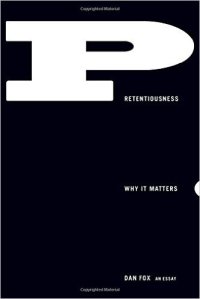 If I had the money for grandiose acts of largesse, I would buy a whole case of Dan Fox’s latest and send them out to all of my friends and relatives, my member of parliament, Canada’s minister of heritage, every arts administrator and broadcaster I’m acquainted with, and as many heads of state as I think would actually read it. This monograph is a stunning defense of thinking and behaving in ways that contravene convention — a deeply necessary defence to make in our time. Fox isn’t attempting a whole-hog refutation of populism. Rather, he has composed an eloquent love letter to broad-mindedness. Fox notes the obvious point that the word “pretentious” is generally used in a derogatory fashion: to put somebody back in their place when they’re perceived to have overstepped a social boundary. But he argues persuasively that the act of overstepping social boundaries — which necessitates a certain amount of pretense or pretending (to the throne, even) — is inherently praiseworthy. And he has some choice words for those who prefer the epithet “elitist,” too. He cites a Guardian columnist who literally professed hatred —
  Kieron Gillen and Jamie McKelvie had a big year, amping up the action in their blockbuster comic
  If there’s one podcast episode from 2016 that I’m likely to remember for the rest of my life, it’s the short segment that
  The great and shameful archive