If you’ve never actually had a conversation with me, count yourself lucky.
There are only a few things I can really talk about, and they’re almost certainly not the same things you like to talk about.
One thing I prattle on about all the time is my love for Jethro Tull. And, once I’ve found myself deeply involved in a satisfying rhetorical conversation on that topic, I almost always get the same vaguely disinterested response from my unlucky company: “Yeah, that guy can sure play the flute.”
I know that they all mean well, when they say that. But they’re entirely missing the point.
Ian Anderson’s flute playing isn’t what makes Jethro Tull a great band. It’s not even what makes Ian Anderson a great musician. Or, not the only thing, anyway.
So, let’s take a look at a different side of everybody’s favourite rock & roll man-flamingo – his singing voice.
Anderson makes no claim to be a good singer. He’s said before than when he joined the band that would become Tull, as a harmonica player, the mic was thrust upon him because his voice was slightly less awful than everybody else’s. But Anderson can do more with that nasal baritone than he gives himself credit for: indeed, more than anybody gives him credit for.
Here’s my argument in brief:
Proposition: Ian Anderson, the unsung hero of rock vocalists, is in some respect as agile a singer as some of his more acclaimed contemporaries.
…which of course begs the question, in what respect?
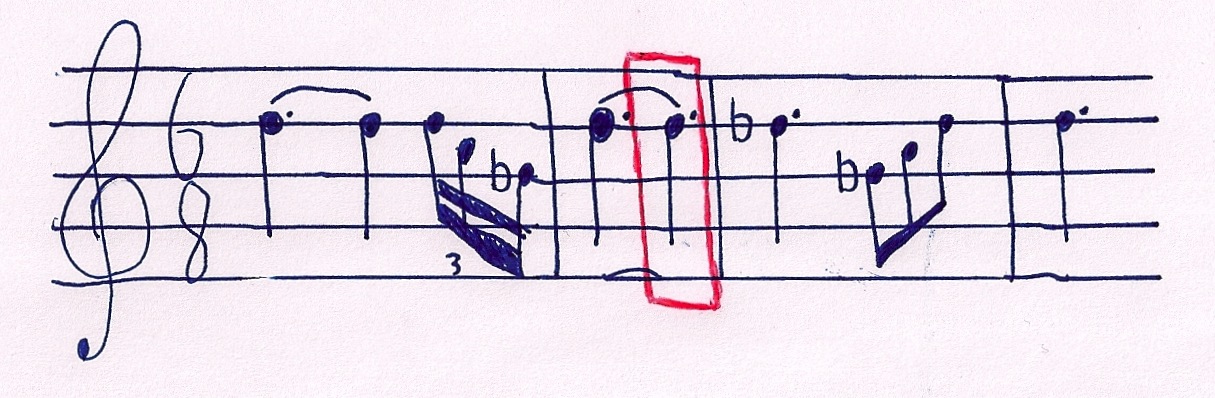
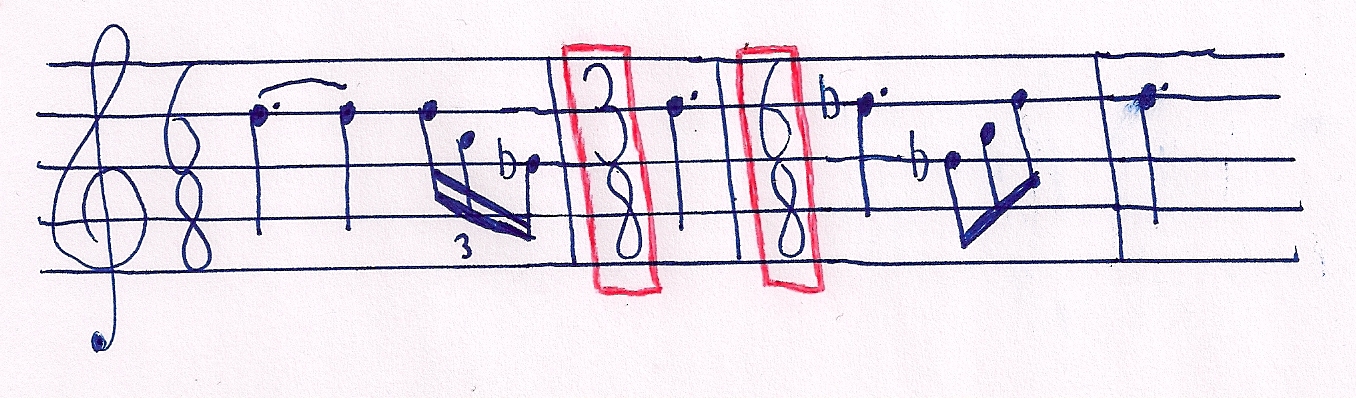
Well, for now, let’s consider Anderson’s use of melisma. That’s when you sing more than one note on a single syllable of text. It’s the opposite of syllabic singing, which is when you sing one note per syllable.
This should make it clearer:
We often associate melisma with ornate, baroque vocal music and gospel-inflected pop. In recent years, it’s become popular as a tasteless mechanism to show off your dubious technique on TV talent competitions. But, there’s no question that it takes some vocal agility and control to pull off highly melismatic singing.
Ian Anderson sings melismas kind of obsessively. He’s even mentioned in the Wikipedia article on melisma: “Melisma is also used, though rarely and briefly, in the music of Jethro Tull: examples include the eponymous track of the album Songs From the Wood, and the song Skating Away (On the Thin Ice of the New Day).”
Actually, Anderson’s melismas are neither rare nor brief. Almost every Tull album up to Crest of a Knave is loaded with them.
So, here’s the crazy thing I did to prove my proposition.
Method: I chose three songs by three different rock bands of the 1970s. One of the bands is Jethro Tull. All of the songs chosen show an accomplished vocalist at the peak of his abilities. I analyzed each song to determine which is, on average, the most melismatic.
Of course, trying to rank rock singers’ vocal abilities by any objective measure is a fool’s errand. But maybe when you see the way this shakes out, you’ll listen to Anderson’s snide, sardonic rasp a little differently.
Let’s meet our contestants:

Contestant #1: Ian Anderson
On behalf of our intrepid contender, I have submitted the track “Minstrel in the Gallery.” It’s a powerhouse vocal performance that shows Anderson’s approach to melodic, acoustic music and riff-powered hard rock in equal measure.

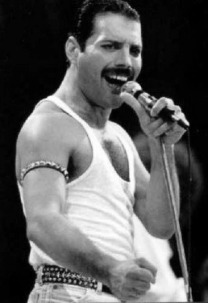
Contestant #2: Freddie Mercury
It was an obvious choice, really. Mercury’s four-octave range is enough to ensconce him in the top tier of his generation’s great singers. Add expressiveness and flexibility to that, and he’s a shoe-in for a spot in our contest.
“Somebody to Love” sees Mercury singing in every corner of his massive range. And, unlike most Queen, it’s got a bit of church in it. Church is, of course, the ultimate domain of the melisma, so we can expect Freddie to score pretty high with this track.

Contestant #3: Robert Plant
Sometimes, when you listen to music from the ’70s, you wonder what the singer gets up to during the ten-minute instrumental breaks. Not so with Led Zeppelin. Plant is right there in the thick of it. No rock singer understands that the voice is an instrument quite like he does.
We’ll judge him according to his performance on “Kashmir.” The track is mostly based on repetitive patterns in the guitar and drums, with an orchestral arrangement that doesn’t command much attention. So, the responsibility of keeping the listener’s interest throughout the track’s eight-and-a-half-minute duration falls squarely on Plant. He “oohs” and “whoahs” his way through the task with great finesse.
Process:
If you’re not interested in how I reached my conclusions, and I wouldn’t judge you for that, you can skip to the section titled “Results.” Just take for granted that my methods are totally precise and scientific, and that there were no grey areas for me to exploit for my own purposes. I would never cook the books like that. Trust me.
The ultimate goal of this little experiment is to calculate the ratio of notes per syllable in the lead vocal of each selected track. That means we need to count the syllables and the notes in each performance. So, we need an accurate transcription of the lyrics of each song as sung, complete with any incidental “heys,” “yeahs” etc. Then, we can count the syllables in each text, and listen closely to each recording to count the notes.
Here’s what I came up with:
Minstrel in the Gallery
Transcription
The minstrel in the gallery looked down upon the smiling faces.
He met the gazes, observed the spaces between the old men’s cackle.
He brewed a song of love and hatred, oblique suggestions and he waited.
He polarized the pumpkin-eaters, static-humming panel-beaters;
Freshly day-glow’d fact’ry cheaters, salaried and collar-scrubbing.
He titillated men-of-action, belly warming, hands still rubbing
On the parts they never mention.
He pacified the nappy-suff’ring, infant-bleating one-line jokers.
T.V. documen’try makers, overfed and undertakers,
Sunday paper backgammon players, fam’ly-scarred and women-haters.
Then he called the band down to the stage and he
Looked at all the friends he’d made.
The minstrel in the gallery looked down upon the smiling faces.
He met the gazes, observed the spaces in between the old men’s cackle.
And he brewed a song of love and hatred, oblique suggestions and he waited.
He polarized the pumpkin-eaters, static-humming panel-beaters;
The minstrel in the gallery looked down on the rabbit-run.
And he threw away his looking-glass – and saw his face in everyone.
Hey!
He titillated men-of-action, belly warming hands still rubbing
On the parts they never mention, salaried and collar-scrubbing, yeah.
He pacified the nappy-suff’ring, infant-bleating one-line jokers.
T.V. documen’try makers, overfed and undertakers,
Sunday paper backgammon players, fam’ly-scarred and women-haters.
And then he called the band down to the stage and he
Looked at all the friends he’d made.
The minstrel in the gallery looked down on the rabbit-run.
And he threw away his looking-glass – and saw his face in everyone.
Huh-hey!
The minstrel in the gallery, yes.
Looked down upon the smiling faces.
He met the gazes, yeah.
Mm, the minstrel in the gallery.
Mm, and he waited, yeah.
Notes
For our purposes, it’s important to note the way that Anderson pronounces the words “suffering,” “family,” “documentary,” and “factory.” Each of these words could be sung with a varying number of syllables, depending on the context. Anderson always chooses the shorter one. For example, “documentary” becomes “documen’try,” so that it’s pronounced with four syllables. Accounting for this, Anderson sings a total of 458 syllables.
Counting the notes isn’t quite so black and white. I frequently wondered whether Anderson was singing six notes on a given word, or seven; seven or eight; nine or ten. It’s easy to lose count when the notes fly by as fast as they do here. Where there was ambiguity, I generally erred towards the lower number, to counteract my pro-Anderson bias. In the end, I counted a total of 704 notes in the lead vocal.
So, the average number of notes per syllable in “Minstrel in the Gallery” is about 1.54.
Here’s a picture of my notes for this track, which look like something only an insane person would produce. They show the number of notes that I heard in each word of the song. All in the interest of transparency:

Somebody to Love
Transcription
(Note: This is a transcription of the lead vocal only. Mercury does sing backup in this track as well, but for the sake of comparison, I’ve left that out. Also, like I could seriously pick him out in the mix…)
Can…
Ooh…
Each morning I get up I die a little,
Can barely stand on my feet,
Take a look in the mirror and cry,
Lord what you’re doing to me,
I have spent all my years in believing you,
But I just can’t get no relief, Lord!
Somebody, ooh somebody…
Can anybody find me somebody to love?
Yeah…
I work hard every day of my life,
I work till I ache my bones,
At the end,
I take home my hard earned pay all on my own,
I go down on my knees,
And I start to pray,
Till the tears run down from my eyes,
Lord somebody, ooh somebody,
Can anybody find me somebody to love ?
Everyday – I try and I try and I try,
But everybody wants to put me down,
They say I’m going crazy,
They say I got a lot of water in my brain,
Ah, got no common sense,
I got nobody left to believe.
Ooh somebody – ooh,
anybody find me somebody to love?
Got no feel, I got no rhythm,
I just keep losing my beat,
I’m OK, I’m alright,
I ain’t gonna face no defeat,
I just gotta get out of this prison cell,
Someday, I’m gonna be free, Lord!
Uhhh-ooh
Find me – Find me – Find
Ooh – Find me – Find me somebody to love
Ooh
Ooh, can anybody find me
Somebody to love.
Ooh
Find me somebody somebody somebody somebody to love
Find me find me find me find me find me
Ooh somebody to love
Ooh
Find me find me find me somebody to love
Anybody anywhere, anybody find me somebody to love love love love
Find me, find me, find me
Love.
Notes
Once I stuck all of Mercury’s improvisatory flights of fancy into the transcription, I found that he sings 369 syllables in total, not counting backup vocals.
The number of notes that he sings is even more ambiguous than in Anderson’s case, due to the fine line between melisma and portamento, which is where you slide up or down between notes, singing all of the pitches between the two. There are two key notes in such a gesture, at the beginning and the end, with an undefined number of pitches in between.
If we were to make a distinction between melisma and portamento, we could say that in melisma, the singer moves cleanly between the notes, and in portamento, he slides between them in a more relaxed fashion. Still, that’s a pretty fine line to draw, so in the spirit of generosity, and to once again counteract my bias, I have counted some of Mercury’s portamenti as two notes, rather than one “bent” note.
I have only done this where Mercury clearly intends to move from one note of the melody to another, rather than to ornament a single note. An example of the former would be the word “look” in the line “take a look in the mirror and cry.” That gets counted as two. An example of the latter would be the word “stand” in the line “can barely stand on my feet.” That’s just one.
This is one of those grey areas that I said didn’t exist.
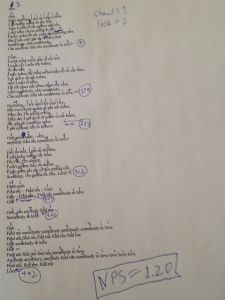
All said and done, I counted 442 notes, resulting in a notes-per-syllable ratio of 1.20.
Here are my notes.
Kashmir
Transcription
(Note: Where the vocal fades out at the end of the song, I assumed that Plant follows the same pattern as previously, both in terms of words and notes.)
Oh let the sun beat down upon my face, stars to fill my dream,
I am a traveler of both time and space, to be where I have been,
Sit with elders of the gentle race, this world has seldom seen,
Talk of days for which they sit and wait – all will be revealed.
Talk and song from tongues of lilting grace, whose sounds caress my ear,
But not a word I heard could I relate, the story was quite clear,
Whoah, whoah.
Oooh, oh baby, I been flyin’…
No yeah, ah-mama, there ain’t no denyin,’
Ow, Oooh, yes. I’ve been flying, mama-ma, ai… ain’t no denyin’, no denyin’.
All I see turns to brown, as the sun burns the ground,
And my eyes fill with sand, as I scan this wasted land,
Tryna find, tryna find where I’ve been-ahh.
Oh, pilot of the storm who leaves no trace, like thoughts inside a dream,
Heed the path that led me to that place, yellow desert stream,
My Shangri-La beneath the summer moon, I will return again,
Sure as the dust that floats high in June, when movin’ through Kashmir.
Oh, father of the four winds, fill my sails, across the sea of years,
With no provision but an open face, along the straits of fear,
Whoah-ohh. Whoah. Ohh. Ohhhhh.
Well, when I’m on, when I’m on my way, yeah,
When I see, when I see the way, you stay-yeah.
Ooh, yeah-yeah, ooh, yeah-yeah, when I’m down…
Ooh, yeah-yeah, ooh, yeah-yeah, when I’m down, so down,
Ooh, my baby, oooh, my baby, let me take you there.
Oh, oh. Come on. Come on. Ohh.
Let me take you there. Let me take you there.
Ooh, yeah-yeah, ooh, yeah-yeah, let me take you there. (faded)
Notes
Another one of those fine lines: Is he singing “whoah,” or “whoah-ohh?” Anyway, it sounds to me like Plant sings 348 syllables, here.
The same distinction between melisma and portamento applies here, as it did with Mercury. I’ve treated it the same way.
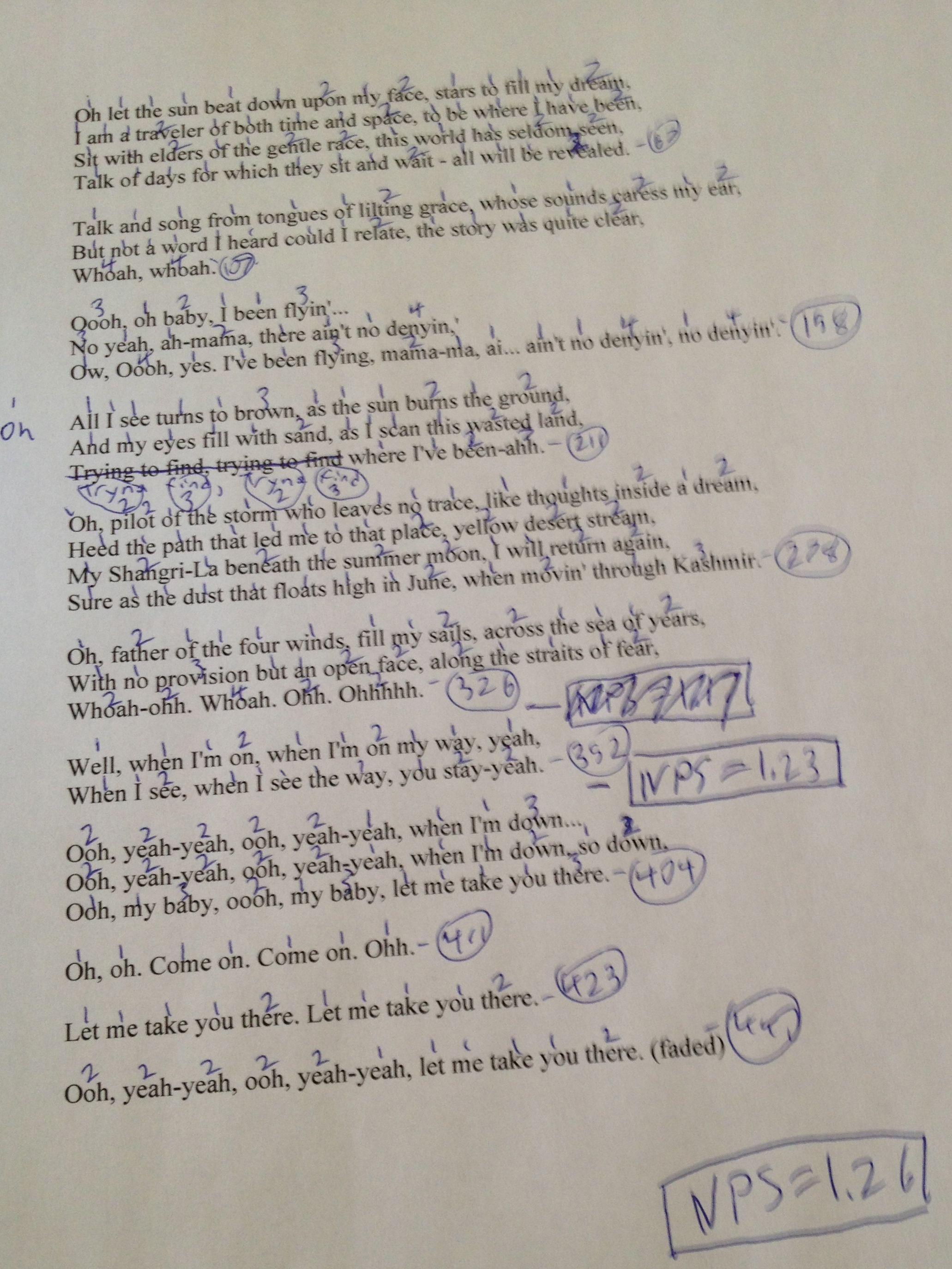
When I calculated the notes-per-syllable ratio of this track, I realized it’s kind of unfair. The end result is a higher score than Mercury received, but the majority of Plant’s melismas are only two notes long: hardly melismas at all, compared to Mercury’s nine and eleven note beauties. Nonetheless, Plant sings two notes on a syllable frequently enough to put him just over the top, for a total of 440 notes, and a ratio of 1.26.
Another page of notes:

Results:
The proposition stands. Ian Anderson’s notes-per-syllable ratio of 1.54 is the highest of the three by a clear margin. Robert Plant is the runner-up with a ratio of 1.26, and Freddie Mercury, in spite of singing far longer melismas than Plant, brings up the rear with a score of 1.20.
These may seem like small numbers, but bear in mind that the standard number of notes to sing on a syllable of text is one. Melismas are the exception rather than the rule, even in the three songs examined here.
Perhaps it seems slightly trivial to rank singers based on inconsequential little numerical values like these. But it certainly pegs Anderson’s claim not to be a good singer as false modesty. For all his shortcomings, whatever they are, he has a lot of vocal flexibility.
Moreover, it’s always used in service to the song. “Minstrel in the Gallery” deals with the relationship between the performer and his audience. It uses the image of a medieval minstrel to shed light on the public personas of ’70s rock idols. A teeny bit of technical showmanship can be expected, given that theme. You can also find a lot of melisma on side two of Aqualung. That’s the churchy side, so it fits. (See “Hymn 43” in particular.)
But also, that guy can sure play the flute.