Category Archives: Comics

Omnireviewer (week of Nov. 15)

Only 23 reviews, this week. Dear me, what could I have been up to? No, I’m seriously asking. I don’t remember anything I did in the past seven days that I didn’t write down.

Games

It’ll surely be a rare week that I write about four games. But hey, I had a free Sunday.

Stasis — Finished, at long last. This was not at all worth the time or money. It’s laden down with bad writing, bad acting, one-dimensional characters, a hackneyed “science gone wrong” plot, needless brutality, an uninteresting atmosphere, and the most predictable last-minute twist imaginable. The bulk of the story is told through diaries lying scattered haphazardly around the ship, each of them containing secrets that these characters would never have dared to write down, let alone just leave out in the open for anybody to find. I would have been willing to suspend my disbelief in this, if only the story told by the diaries were compelling, the characters were believable, or — at the very least — the prose were written competently. Maybe it’s petty to pick on an indie title that was apparently made by, like fifteen people. But that’s exactly the kind of game out of which I would expect something unique. Instead, this is a stew of familiar genre tropes out of which nothing new or interesting emerges. The fact that this is accruing significant acclaim demonstrates the extent to which I don’t understand video games. Fine. I’m happy to remain a dilettante in this particular field.

Sunless Sea — Oh, but then there’s this. I’ve been playing Sunless Sea on and off for the better part of a year. It’s the sort of game where you can do that, because it’s not linear; it’s a giant web of stories that you can explore as you like. And it is so vast and fascinating and nuanced and beautifully written that I never tire of it and it makes me thankful to live in a time when things like this can exist. If you somehow don’t know about this, read up on it, play its free cousin Fallen London, and then if you’re still not convinced, just buy it anyway because it’s that good. A lovely palate cleanser after a sub-par gaming experience.

SPL-T — This is the sort of thing I normally wouldn’t even bother reviewing. It’s not a game like the above-listed entries here are games. It’s a game like Angry Birds is a game. Or, more relevantly, Tetris. It’s not a discrete unit of cultural experience. It’s a pastime. Which is just fine, but that makes it the sort of thing I’m not usually into. But, the reason I’m interested is that it was made by the Swedish game developers Simogo. And, since we’re in a games-heavy week, I may as well take this opportunity to nail my colours to the mast — Simogo are the best game developers in the world. They do interesting, outside-the-box things with mobile devices, such that three of my favourite mobile games ever (favourite games, period, really) are made by Simogo: Year Walk, The Sailor’s Dream, and especially Device 6. SPL-T has nothing to do with any of those narrative-rich, immersive experiences. It has more in common with their early, casual games like Bumpy Road, except that it’s far more minimalistic. Like, Space Invaders minimalistic. It’s fun. But I’m not sure what they’re driving at here. I used to think that Device 6 was Simogo’s Sgt. Pepper, and The Sailor’s Dream was their White Album. But maybe this is their White Album. Maybe this is the inscrutable piece of concept art that will keep people talking about Simogo for decades to come. Or maybe I’m overthinking this, as ever, and it’s just a fun, retro little puzzle game. Either way, lovely.

Papa Sangre — What with me being a radio geek who sometimes plays games, I was inevitably going to play Papa Sangre at some point. This is a game with no graphics — only sound. Given what I like sound to do, I would certainly prefer there to be more story in this. But I must say, that game where you try to find something while blindfolded as somebody says “warmer… colder” is a lot more tense when there’s a carnivorous hog sleeping fitfully in the room. And that is unlikely to happen in real life.

Television

Last Week Tonight: November 8 and 15 — The thing that stands out most to me in either of these episodes (aside from John Oliver’s bizarrely cathartic profanity-laden response to the Paris attacks) is Mike Birbiglia playing a guy who’s strangely proud of having lost all his money playing fantasy football.

Doctor Who: “Face the Raven” — Oh, god, I just. Okay. Let’s just make a simple comment, because if I talk about my feelings I’ll make an ass of myself. Over the course of the past two seasons, Steven Moffat has brought in two writers that I wouldn’t mind seeing as showrunner when he departs: Peter Harness (still my frontrunner) and now Sarah Dollard. This is outstanding. Pick of the week.

Music

Musically, it was a week of work-related classical listening. So, I’m either not reviewing those or will subsequently be writing them up elsewhere. Here is what remains:

Kid Koala: Carpal Tunnel Syndrome: Kid Koala is astonishing. Listening to this, I can hardly quite understand how it was made. He’s a virtuoso turntablist, no doubt. But I still feel an echo of an old complaint: this feels like “a very attractive coat that nobody’s wearing.”

NoMeansNo: Wrong — Another revisitation of a Two Matts assignment. This is one of those albums where my favourite songs keep changing. That’s a good sign. At first, I liked “The End of All Things” and “It’s Catching Up” best. These days, I seem to prefer “Rags and Bones” and “All Lies.” It occurred to me listening to this recently that the verse in “All Lies” is nearly an Indian classical pastiche — minus the obligatory sitar and tablas. There’s a clever juxtaposition: a key trope of Flower Power music — which even today is conceived as a plausible moment zero for “pop as art” — keeps getting interrupted by Rob Wright shouting “all lies!”

The Smiths: The Smiths — I love The Queen is Dead so much that I can’t believe I’ve never heard any other Smiths albums. It was time that changed. This isn’t as good as that that album, but it’s only a hair’s breadth behind it. I do wish Morrissey would just never ever sing in falsetto, though. Not a good look on him.

The Smiths: The Queen is Dead — This was bound to happen. When I hear a new thing by an artist I like, I always end up going back to the old favourites. There are very few albums I’ve discovered in the years since, oh, let’s say my 22nd birthday, that really matter to me. This is one.

The Smiths: Meat is Murder — Okay, if we’re going to do this, let’s do this. Can’t say this one quite works for me as well as the debut or The Queen is Dead, but the Smiths are a band that I can listen to almost regardless of what songs they’re playing because I just love the noise they make. Though I do prefer Morrissey once he’s learned to sing more-or-less in tune. He’s getting there on this, but there’s a ways to go. We will continue our survey of the discography (including relevant ephemera) in the coming week.

Comedy

John Mulaney: The Comeback Kid — It’s amazing that anybody could still have funny things to say about marriage. Or kids. Or pets. Or minivans. Or Bill Clinton. But this made me laugh out loud about all of those topics. I never laugh out loud watching stand-up. This is really, really funny.

Literature, etc.

Jonas Tarestad/Simon Flesser: Year Walk: Bedtime Stories for Awful Children — The other thing I love about Simogo is that they have versatile enough talents at their disposal to just take a break from video games and put out an illustrated e-book instead. Or a podcast the caliber of professional radio drama. Or whatever The Sensational December Machine is. And it all turns out good. I’m sure this was basically intended as an ad for the new(ish) Wii version of Year Walk. But, a collection of horrifying Swedish folktales told similarly to the Grimm fairy tales constitutes a pretty fantastic ad. The last one in particular is spectacularly, arbitrarily brutal.

David Cavanagh: Good Night and Good Riddance — Apparently the Smiths owe their early success to Peel and his producer John Walters. Imagine. Also, there’s so much music covered in this book that sounds interesting, and I don’t have remotely enough time to investigate all of it. One day, I’ll just skim through the chapters covering the years after 1977 and listen to as much of what Peel played as I can.

Kelly Sue DeConnick/Valentine De Landro: Bitch Planet, Volume 1 “Extraordinary Machine” — This is mighty powerful stuff that I would force everybody in my life to read if I could. It’s a rare and wonderful thing when fiction has the power to incite righteous anger even in people who aren’t specifically afflicted by the injustices it illustrates. This might have been pick of the week, but it was last week’s, so Doctor Who takes it.

Podcasts

I rolled my ankle a while back and haven’t been running much, lately. That’s put me behind on my podcasts, of which there are only eight this week. Shocking, I know. How will I ever catch up?

Love and Radio: “Points Unknown” — The approach of this podcast makes each episode essential almost by default. Love and Radio finds people with stories and perspectives that fall outside most people’s experience and then says, “we’re just going to listen to this person for a while.” The interviewers are present, but off-mic, which gives the impression that every time out, the show belongs to a different person — a monthly guest host. It totally changes the power dynamic of the radio interview. Sometimes, people say horrifying things on this podcast, which can be troubling given that atypical power dynamic, where the interviewer’s voice is secondary. But the underlying philosophy is that it’s better to listen to people than not to, and I agree. There’s nothing objectionable in this episode, but there’s plenty that’s shocking. It isn’t a standout episode of Love and Radio, but it’s still outstanding.

The Moth: “Wedding Dress, Prison Choir, and a Hotdog” — The first story is by a producer on Amy Schumer’s show and is predictably hilarious. It dives from there. The second story in particular is rough listening, and not in the good way that The Moth sometimes is. It’s trite. There are clichés o’plenty. And maybe I just wasn’t in the mood, but I didn’t find the show ever recovered after that.

99% Invisible: “The Landlord’s Game” — The board game Monopoly originated as an interactive parable on the ills of capitalism. I will be bringing this up in conversation at my own earliest convenience.

The Truth: “Where Have You Been?” — I love the sound of this podcast, every time. But there’s often something in the writing that doesn’t click for me. Sometimes it’s jokes that fall flat. But usually, it’s a sort of furrowed brow seriousness that’s just totally unrelenting. It can get a bit like that scene in Life’s Too Short where Liam Neeson is just too serious to function. Except not played for laughs. This story is clever and well acted, but there’s a bit of brow-furrowiness in there. The Song Exploder episode tacked onto this is great, though. It breaks apart the Radiotopia station ID, which was made by the producer of The Truth. It’s amazing how much can go into a couple seconds of audio.

The Allusionist: “Toki Pona” — Okay, this justified all of the cross promotion. Nate DiMeo and Helen Zaltzman learn the smallest language in the world. It’s wonderful, and at some point Zaltzman expresses perfectly what I fear and despise about learning new languages: “I’m just going to be a nothing in other languages. Everything that I consider to be myself will just be nullified by my inability to speak properly.”

All Songs Considered: “Music for Healing” — An elegiac instalment of All Songs, with the Paris attacks in mind. Bob Boilen and Robin Hilton’s choices of “comfort music” are heavy on spare, drifting post-Eno instrumental music, with a bit of pensive indie rock thrown in as colour. Actually, it’s a spectacular playlist for any day — not just the day after an international tragedy. I’ll be checking out more music from Nils Frahm and Goldmund, for sure. Pick of the week.

The Memory Palace: “Shore Leave” — An average episode of The Memory Palace, which still makes it one of the best podcasts of the week. It uses music more playfully than usual, which is nice. I’m almost glad that this show is on hiatus until January, because it’ll give me time to listen through the entire list of back episodes. There must be about 60 that I haven’t heard.

Pop Culture Happy Hour: “Master of None and Neal Shusterman’s Challenger Deep” — If this podcast has a weakness, it’s that there’s seldom very much dissent among the ranks. This time around, Glen Weldon disagrees with the rest of the panel on Master of None, which is refreshing. Having not seen the show, it doesn’t seem like his critique is especially worthwhile — it seems like just another instance of Weldon being allergic to anything that vaguely flirts with earnestness. But it’s nice to hear the others debate him.

Omnireviewer (week of Nov. 8, 2015)

I’m adding a new feature, this time around. Each week, I will choose two things I particularly loved as my “picks of the week.” Due to the preponderance of podcasts in these reviews, one will always be a podcast, and the other will be something else. I won’t prioritize new things for my picks of the week, necessarily. It’s just a matter of what hit home the most on a particular day. So, it’s totally possible (and indeed, very likely) for a pick of the week to be a 40-year-old rock album. 29 reviews, this week:

Music

Van Der Graaf Generator: The Least We Can Do Is Wave to Each Other — You know how sometimes you’re listening to a song and you ask yourself, “Is this a good song?” and the answer is “no, it really isn’t.” But then you ask yourself “am I enjoying myself, though?” and the answer is “yeah I think I am!” That happens a lot on this album.

John Luther Adams/Glenn Kotche: Ilimaq — Adams is probably my favourite living composer. Become Ocean floored me; the subsequent recording of chamber strings music didn’t. This piece of percussion music, brilliantly performed by Wilco’s Glenn Kotche, falls somewhere in between. It’s not a masterpiece on the order of Become Ocean, Four Thousand Holes, or The Light that Fills the World, but it’s lovely, evocative, tense, etc.

Wilco: Yankee Hotel Foxtrot — Listening to Glenn Kotche play John Luther Adams made me want to listen back to Wilco’s masterpiece. This is still a basically perfect album. It sounds chaotic in places, but when you listen to the details you realize that it’s actually a meticulous approximation of chaos. In fact, I’m not sure I can name a rock album that’s more detail-obsessed in its production. The way that “I Am Trying to Break Your Heart” gradually coagulates from noise into a song is genius. And Kotche’s playing is outstanding. I was listening.

Max Richter/Antonio Vivaldi: The Four Seasons, Recomposed — At the risk of appearing heretical (oh, who am I kidding; I love appearing heretical) Richter’s remake of The Four Seasons is better than the original. These Vivaldi concertos are possibly the most moth-eaten body of work in the repertory, and for all of their objective virtues, I do not understand how anybody could legitimately prefer them to Richter’s clever, gorgeous, modern interpretations. I know it doesn’t have to be a competition. But I’m making it one. And Vivaldi’s lying knocked out at the edge of the ring.

Yes: Drama — This is comfort food to me. It’s one of those albums that I know every contour of so well that when I listen to it, it just snaps into the grooves in my head. It tends to get overlooked by Yes fans because Jon Anderson isn’t on it. And while that becomes a worthwhile critique when it happens again in 2011, in 1980 Anderson’s absence was exactly what Howe, Squire and White needed to go in the direction that felt natural. Also, I love that Yes and the Buggles basically made an album together. There aren’t many less likely collaborations out there, let alone ones that result in good music.

Hey Rosetta! Seeds — This comes recommended by the guy I went to the concert with last week. While I confess that I liked them better live (not a given for me; I tend to like most bands better on record), this has decent songs and great performances. And fantastic bass playing.

Movies

Crimson Peak — Sometimes I like my horror lavish, gothic and Victorian. This scratched that itch, but I’ve essentially forgotten it already.

Spectre — Fabulous. Christoph Waltz is no Javier Bardem and Ralph Fiennes is certainly no Judi Dench. And overall, this isn’t as good as Skyfall. But the Daniel Craig era of James Bond movies is still pretty much the bar for contemporary action franchises to clear. Marvel Studios can only aspire. A significant quibble: the entire London-based plotline with M and Moriarty is crap. This movie uses the threat of government surveillance (how am I already sick of this trope when it’s still a real-world problem?) to paper over the fact that the same ethical questions that have been posed about Jack Bauer apply equally to James Bond. But these days, I’m trying not to let things like this ruin my moviegoing experience. I believe I’m succeeding admirably.

Television

In the event of binge-watching, I won’t hold myself to writing reviews of every episode. Because, who wants that? We’ll just check in every week, like with books.

BoJack Horseman: Season 1 — As with Hannibal a while back, I endured the rough patches early in the first season because I’ve heard it gets way better. It already has, actually. At first, I laughed most at the dumb, cartoony sight gags. Which is fine, because why else would one watch cartoons? But as the characters got fleshed out (as much as they ever do — they’re resolutely stock characters, albeit well-played ones) I started to get invested in the ongoing story as well. Then, the last two episodes totally sold me. Also, Ira Glass jokes are never not funny.

Lost: Season 1, Episodes 1-4 — I’ve decided to start rewatching Lost alongside a fabulous new essay series called Lost Exegesis by Jane Campbell of Eruditorum Press (a group blog I read religiously but don’t review because that would be insane). I have several observations, re. the show. Firstly, I remember thinking that the pilot was overrated, and that is not in fact the case. I persist in the contrarian belief that the show got more interesting as it got more complicated, but this is so well made that I don’t care that none of my beloved mythology is in place yet. Secondly, the first episode (if not necessarily the show as a whole) would have been better if Jack had died at the end as originally planned. I mean, what a bait and switch. Third, at this stage, Sawyer is basically a very bad first draft of Rustin Cohle. Fourth, “Walkabout” is still one of the finest episodes of television ever made. And finally, Shannon and Boone are still stupid, stupid characters.

Doctor Who: “Sleep No More” — Mark Gatiss is not one of my favourite Doctor Who writers, but this is one of his better scripts. If I’m not mistaken, this is the first time that Doctor Who has done a found-footage horror story. And, to be clear, found-footage horror is a tired genre that should go slump off into a corner and never be heard from again. But Doctor Who has a unique ability to revitalize the genres it collides with — usually with metafiction, as it is here. As to the premise of the episode: the idea of a treatment that substitutes for sleep is something I’ve always dreamed of. Daydreamed of. Whatever. And the idea that this treatment would inevitably create monsters seems to follow. But the fact that those monsters are literally made of the stuff that collects in the corner of your eye when you sleep is super dumb. This is still probably my… fourth favourite episode of this season. Also, both this and Stasis (which I’m still playing, for some reason) take place in space stations orbiting Neptune. Funny how I’ve never seen “orbiting Neptune” as a story setting before and then it comes up twice in a few weeks.

Literature, etc.

Bit of a comics-heavy week, reading-wise. Still loving Good Night and Good Riddance, but I needed a diversion from that unwieldy tome.

Matt Fraction/Fábio Moon: Casanova, Volume 2 “Gula” — Along with Kieron Gillen, Fraction is my favourite writer in comics right now. I wasn’t 100% sold by the first trade collection of Casanova, but as ever, I was pulled in by the compulsive belief that it would get better. And it did. This second volume is a really solid bit of science fiction. It’s got a staggering twist ending that isn’t just played for the shock of it: it has serious consequences for the characters. I hope Fraction and DeConnick’s television production company at least considers adapting this.

Roger Stern/Tom Lyle: Starman #6 — My trivia team won at that nerd bar, again. We got a big ol’ stack of ‘80s comics, two apiece. The exciting one was a first printing of an issue of V for Vendetta. I didn’t take that. After all, I got the Klingon phrasebook last time. Fair is fair. Anyway, I picked this one because its Bowie-esque title made me favourably disposed to it. And, oh my god am I ever glad I did. It’s a DC comic about a hapless, reluctant superhero with fairly indistinct powers. (Wikipedia tells me he got them when he was hit by a bolt of energy from a satellite. OF COURSE.) The villains in this are a shadowy cabal that’s actually known as “the Power Elite.” It’s advertised as a crossover with several other heroes, including Green Lantern and several I’ve never heard of, but their appearances all basically boil down to Starman saying “Hey look! It’s that superhero! Okay, bye!” The story starts with the Sydney Opera House falling down, and Starman musing “How do you… hold up… a building?!” So, that gives you the jist of the actual comic, but what I really enjoyed were the ads. There’s an Atari ad in this, and one for Nintendo’s Bubble Bobble. Also, there’s an ad for something called a telephone role-playing game, which is a thing I didn’t know ever existed. And the classifieds page has an ad with the headline “BE TALLER,” another that promises to help you make your own stink bombs with household items if you send them two dollars, and ads for two separate companies that purport to sell real shark teeth. The letters page contains a fan letter entreating the writers to “keep thinking about those little things, like going to the bathroom.” This comic is terrible, obviously. But I thoroughly enjoyed it.

Charles Schulz: Peanuts (October/November 1964) — Throughout October of 1964, Charles Schulz wrote a series of Peanuts strips where Lucy convinces Linus to run for school president. In the end, he blows it because he uses his last speaking opportunity to raise awareness of the Great Pumpkin. What’s really amazing about this is how much better it works as a whole than as separate four-panel strips. Some Peanuts strips barely have jokes, let alone punchlines. But when you piece it together into a full narrative, the character beats make it start to feel like a sitcom. This is great. I love Peanuts. And it’s all online.

Jonathan Franklin: “Lost at sea: the man who vanished for 14 months” — I went into this Guardian feature half expecting an adventure story about a man showing nature who’s boss. Needless to say, that is not what it is. Being marooned for more than a year is not fun. The Martian is not a realistic movie. But this is still a hell of a story.

Javier Grillo-Marxauch: “The Lost Will and Testament of Javier Grillo-Marxauch” — This is a massive post on Grillo-Marxauch’s blog about the experience of working on the first two seasons of Lost. I remember meaning to read it when he first published it in March, but now that I’m re-watching the show, I have to. It’s a fascinating story, but here is what I really love: “While a lot of the accounts of Lost’s creation hinge on the question of whether we knew what the island was… few people ever ask if we knew the characters or had their stories worked out in advance. I find that curious.” Also, learning that David Fury was initially against the twist in “Walkabout” (which I resolutely refuse to spoil) is really something.

Kelly Sue DeConnick/Valentine De Landro: Bitch Planet, Volume 1 “Extraordinary Machine” — Kieron Gillen’s The Wicked and the Divine and Phonogram are among my favourite ongoing comics because they seem like they’re being made with me specifically in mind. I love Bitch Planet for the exact opposite reason: it doesn’t give a shit about pandering to me. Which, great. I’m over-served by the culture anyway. Pick of the week.

Mike Grell/Hannibal King/Elliot S. Maggin/John Koch: Secret Origins #38 — This is the other comic I won at the nerd bar. It’s from 1989 and it’s got two stories: one about Green Arrow, and the other about his sidekick, Speedy, who I’d never heard of. I have no opinions about either of them. Bog standard pulpy nonsense. Though there is a moment where Green Arrow takes down a couple of marijuana farming hippies. Took me a while to realize that they were actually supposed to be bad guys. The ads in this one are just as wonderful as in Starman #6. There’s one for Campbell’s soup with a variety of puzzles, like connecting the dots to find “the first thing you need for making a bowl of soup” — a can opener. There’s an ad for a Nintendo football game featuring an actual NFL quarterback playing the game on a couch with a gap-toothed child wearing Coke bottle glasses. These craven ad agencies and their shameless wish-fulfilment fantasies. Oh, and the back of the issue has an ad for this.

Podcasts

StartUp: “The Secret Formula” — Oh boy! Gimlet Media’s giving us a peek behind the curtain again. This is an inside look at the production of the new Gimlet show, Surprisingly Awesome. I was rough on Surprisingly Awesome last week, and I’ll probably keep being rough on it. But hoo boy, did it ever improve from the initial pass. This is a fascinating listen — possibly even for people who aren’t radio producers.

The Allusionist: “Spill Your Guts” — I wonder if Zaltzman is really going to co-host with all 12 of the other Radiotopians before getting back to regular, scheduled Allusionist episodes? (This was fine.)

Planet Money: “OMG TPP” — It says something about the team on Planet Money that they were able to put together a coherent episode about the TPP in a day. I now know something about it, whereas I didn’t before.

The Moth: “Jon Ronson & Mica Truran” — Jon Ronson is an autolisten. I’d actually heard the story he tells here before, on This American Life, but it was different hearing him tell it in a live audience situation. Plus, we learned that his wife says things to him at parties like “Make your smalltalk more… general.” Come for Ronson, stay for Mica Truran’s actually much more personal and meaningful story.

99% Invisible: “Fountain Drinks” — See? Even drinking fountains are interesting. And nobody had to claim they weren’t to help me through this. Also, Radiotopia being what it is right now, there was an episode of Song Exploder tacked onto the end of this (the one on tUnE-yArDs’ “Water Fountain”). And it was an excellent episode of Song Exploder about an excellent song that I am going to listen to again right now. (I’m back. Holy crap, that video.)

This American Life: “Transformers” — Sean Cole is one of my favourite TAL producers. His story about a young man coming out to his parents, and then that man’s mom coming out to him is worth listening in itself. The rest is fine.

In Our Time: “P vs. NP” — Look at me, listening to more of this. This episode is about an almost incomprehensibly complicated mathematical problem that nobody’s ever solved. It is a totally fascinating topic, and absolutely the kind of thing that almost every radio show in the world would toss aside immediately because confusing and because boring. I admire the sheer audacity with which In Our Time tackles this — not that it’s entirely successful. One sometimes wishes Robert Krulwich were around to lend clarity. Still, this may be the first show I’ve ever listened to where the host asks the guests for clarification not because he fears the listeners won’t understand, but because he himself is having trouble. I love that. I could get used to Melvyn Bragg, though I still think he could use a Red Bull or six before going to studio. All the same, there are moments of dour wit, here. When a guest explains to Bragg that “broadly speaking, exponential means hopelessly impractical,” Bragg replies: “Yes, broadly hopeless, right.” I’m beginning to delight in this, but it remains a somewhat knowingly perverse delight.

WTF with Marc Maron: “Lorne Michaels” — Michaels is astonishingly patient with Maron as he obsesses over a misbegotten SNL audition in 1995. That’s not an observation; that’s just a summary of this podcast. This is what we know to expect from Maron, but not necessarily what you’d expect from Michaels. If you’ve never heard WTF, this will show you what it’s all about, and why it’s so great on its best days. Pick of the week.

Pop Culture Happy Hour: “Live at the Howard Theatre” — Audie Cornish’s thoughts on horror movies are identical to my own. Glen Weldon’s thoughts on sports are similar to, though more dramatic than, my own. Linda Holmes’s delight in people getting trivia questions wrong resembles my own. Stephen Thompson’s rage at never getting trivia questions right himself is exactly my own. Also, Fred Armisen’s there.

The Memory Palace: “Artist in Landscape” — Gorgeous. Gorgeous and longer than usual. And sad. So sad. Listen to The Memory Palace. Just, listen to all of it.

Reply All: “The Rainbow Pug” — There was a time when StartUp and 99pi were undoubtedly my favourite podcasts. I think that recently, it’s shifted to The Memory Palace and Reply All. On the latter of which, this week, P.J. Vogt gets angry about a woman not being able to get her dog back from a shelter, and Alex Goldman tries to solve the problem. Reply All is possibly the most playful journalism outlet, full stop.

Things I loved in 2014

So, 2014 had its ups and downs, hey? All the same, the year’s movies, music, TV, games, comics and podcasts helped keep me happy, provided necessary diversion, and helped put my puny problems in perspective.

Here then, in as random an order as I could meticulously devise, are twenty things that I loved in 2014. I should note that, for other-people’s-interest reasons, this list is limited to stuff that actually came out in 2014. However, if I’m being honest, the thing that made me happiest this year was probably the Zombies, the thing that diverted me most ably was probably Bioshock, and the thing that best helped me put my problems in perspective was, as ever, Mahler 9.

Still, it’s a pretty killer list.

Birdman

To me, this is what filmmaking looks like when everybody does everything right. By maintaining the illusion — and it is an illusion — that the bulk of the film is one continuous take, Alejandro Iñárritu and his cinematographer, the always astonishing Emmanuel Lubezki, have devised a premise by which the wonder of live theatre is translated to film. Because, in the theatre world, it’s always one take. And then, by taking that wonder and incorporating illusions only possible in contemporary film, he reprocesses it through the entirely different wonder of movie making. All kinds of wonder, all at once.

And, on a smaller level, every aesthetic choice that was made here, from the jazz drum score, to the set dressing worked for me. Plus, it’s super funny. Plus, it’s got at least three of the best performances of the year (Michael Keaton, Emma Stone, Edward Norton). Plus, everything.

Wood Works — Danish String Quartet

Back in 2011, I fell utterly in love with the movie Hugo. To me, it seemed to reaffirm in the clearest terms possible why movies are something we need. It’s an odd comparison, I know, but this album by the fantastic Danish String Quartet came closer than anything since Hugo to giving me that same feeling of renewed appreciation for a particular medium.

Wood Works features heart-melting arrangements of Scandinavian folk music. The miracle of the album is that these arrangements are always idiomatic to the string quartet, without ever feeling “classical.” Because these are fiddle tunes and that would just be wrong.

The quartet is confident that these folk tunes are not mere kitsch, and that confidence allows them to veer perilously close to that, but they know where the line is and they stop short of crossing it. Instead, they land right in the elusive sweet spot where music can be sentimental but not mawkish. The ensemble’s rich tone and togetherness shine through especially well in these clear and simple tunes.

This album is a reaffirmation of the fact that string quartets are a good idea. It’s my favourite chamber music release of the year.

Also, you’ve got to check out their NPR tiny desk concert.

Louie, season four

Season four of Louie was barely even a comedy. Louis C.K. has reached a level of confidence as a writer/director/actor where he doesn’t have to do jokes all the time. And, this was still the funniest season of TV I watched this year.

The scene above is maybe not the most talked-about scene of the season, but it typifies what I love most about it. Louie and Janet’s argument about whether or not to send their daughter to private school is as much of a slice-of-life as you get on TV, but without any of the self-conscious mundanity that cliché usually implies. The turn that the scene takes around the two-minute mark is just flat out one of the best things that C.K. has ever written.

StartUp

So, podcasts had a Matthew McConaughey-like 2014. It probably seems perverse not to include Serial on this list, so let me assure everybody that I did in fact enjoy Serial, and will surely gulp down the second season with unbridled delight.

That said, I don’t feel it was a standout among the many podcasts I followed this year. In fact, it wasn’t even my favourite serialized podcast, created by a This American Life producer, that starts with the letter “S.”

StartUp, Alex Blumberg’s podcast about starting a podcasting company, is just so much fun. This is a high-stakes personal story about a guy who dropped everything to pursue a dream, and wants to tell you about it in real-time. From the cringe-inducing botched pitch to a major potential investor in the first episode, to the moment when Serial rudely intrudes on StartUp‘s narrative in the tenth, this is essential. And, the recent announcement that the show will continue to use the serialized format — focussing on a different startup each season — bodes incredibly well for the future.

Catch up now, so you can follow the story as it unfolds.

Under the Skin

(Okay, it got a wide release in 2014, so it counts.)

You know who I really miss? David Lynch. I know he’s been making music, or whatever, but the fact that there hasn’t been a David Lynch movie since 2006 is just absurd. So, it stands to reason that two of the things that made me happiest this past year were the announcement that Twin Peaks would be returning with Lynch in the director’s chair for every episode, and Jonathan Glazer’s Under the Skin.

The standard comparison to draw when discussing Under the Skin seems to be Kubrick rather than Lynch. But, while it’s certainly true that it’s more linear and far less symbolic than Lynch’s finest moviesUnder the Skin is the first movie since Inland Empire that conjures the otherworldly dread that I so crave in films.

Plus, Mica Levi’s electro-Penderecki-with-drum-machines score is my pick for best of the year. Reznor and Ross are mere pretenders.

Mahler Lieder — Christian Gerhaher & Kent Nagano

Of all of the “classical” albums on this list, this is the only one that features conventional, straight-ahead readings of fairly standard repertoire. (Although, you’ll find a very honourable mention of Joyce DiDonato’s Stella di Napoli, below.) Honestly, not many recordings like this hold my interest, these days. The way I see it, if you’re going to record music that’s already been recorded more times than anyone can keep track of, you damn well better give an 11 out of 10 performance.

And Christian Gerhaher absolutely does, here. Until this year, I was fervently devoted to Thomas Hampson, where Mahler’s concerned. Now, I can’t imagine anybody singing the Wayfarer songs as well as Gerhaher. It feels effortless. That’s a hell of a trick.

Note: The video above isn’t from this specific recording and features the Berlin Philharmonic with Simon Rattle, rather than the Orchestre symphonique de Montréal with Nagano, but it’s enough to illustrate the point, which is that holy crap can this guy sing.

Sex Criminals, volume one — Matt Fraction & Chip Zdarsky

sex-criminals-vol-01-releases

This, if you haven’t heard of it, is a comic about a young couple that literally freezes time when they have sex. And, as the back-cover copy of this first trade collection puts it: “they do what any new young couple having sex and freezing time might do: they rob banks.”

Frankly, that premise ought to be enough to sell this. If it isn’t, how’s this: it’s explicitly about the sex lives of young people without being a lurid, misogynistic mess.

Read this.

Interstellar

I am willing to forgive a lot if a movie shows me something I’ve never seen before. Sure, Interstellar‘s pacing is a bit dodgy and the female characters aren’t especially fleshed out. (Okay, yeah, that bothers me. Still, hear me out.) But, ultimately, this is a movie that adopts the logic of contemporary astrophysics as the basis for its storytelling. It demonstrates how time travel might be possible and the toll it could take. It conceives a visual representation of a tesseract. It’s got the most gloriously naff robot since the creation of the Daleks.

To me, those sorts of stunts make a movie automatically worthwhile. As such, Interstellar narrowly edges out Boyhood from my top five movies of 2014. That film’s got a different kind of ambition, admittedly. But I’ll take “a realistic depiction of the cosmos” over “twelve years of suburban white people” any day. (I still love Boyhood.)

Polonium — Motion Trio

This was the year’s most unexpected pleasure. I was aware of Poland’s Motion accordion trio because of their fantastic 2009 album with Michael Nyman. But, if you’d asked me what kind of Polish music they were most likely to tackle, I probably wouldn’t have said Penderecki.

Nonetheless, here we are with Polonium, an album of 20th-century Polish classical music by some of the most revered and challenging composers in recent memory. Their rendition of Gorecki’s Concerto for Harpsichord and String Orchestra, adapted for piano and three accordions, practically renders the original superfluous. They make similarly convincing essays of Penderecki’s Chaconne In Memorium John Paul II and Lutosławski’s Bucolics.

But the real stunner is an original work co-composed by Motion Trio founder Janusz Wojtarowicz and fellow accordionist Jacek Hołubowski: Sounds of War. You won’t believe those are accordions.

The Walking Dead, the game, season two

2014 marked my rediscovery of video games. I hadn’t played much of anything since the days of Majora’s Mask, but after several friends eloquently enthused at me about the amazing things that were happening in the video game world nowadays, I had to check it out.

It’s incredible how far that rabbit hole went.

There aren’t going to be many games on this list, because most of the games I played this year were the highlights of the past two or three years: Bioshock: Infinite, The Stanley Parable, Gone Home, FEZ, and of course the first season of the video game iteration of The Walking Dead. I was bowled over by how involved I became with this game’s characters, and the original story far outpaces the one season of the television show that I’ve watched.

I gulped down the game’s second season as soon as all five episodes were available, and contrary to popular opinion, I think that the strongest moments of season two are even more harrowing and involving than the first season. Perhaps it’s a tad less consistent, but come on: this is a game that forces you to make choices on behalf of an eleven-year-old girl that inform not only whether she survives the zombie apocalypse, but also what form her evolving moral code takes. Considering the ambition of that, all stumbles are forgiven.

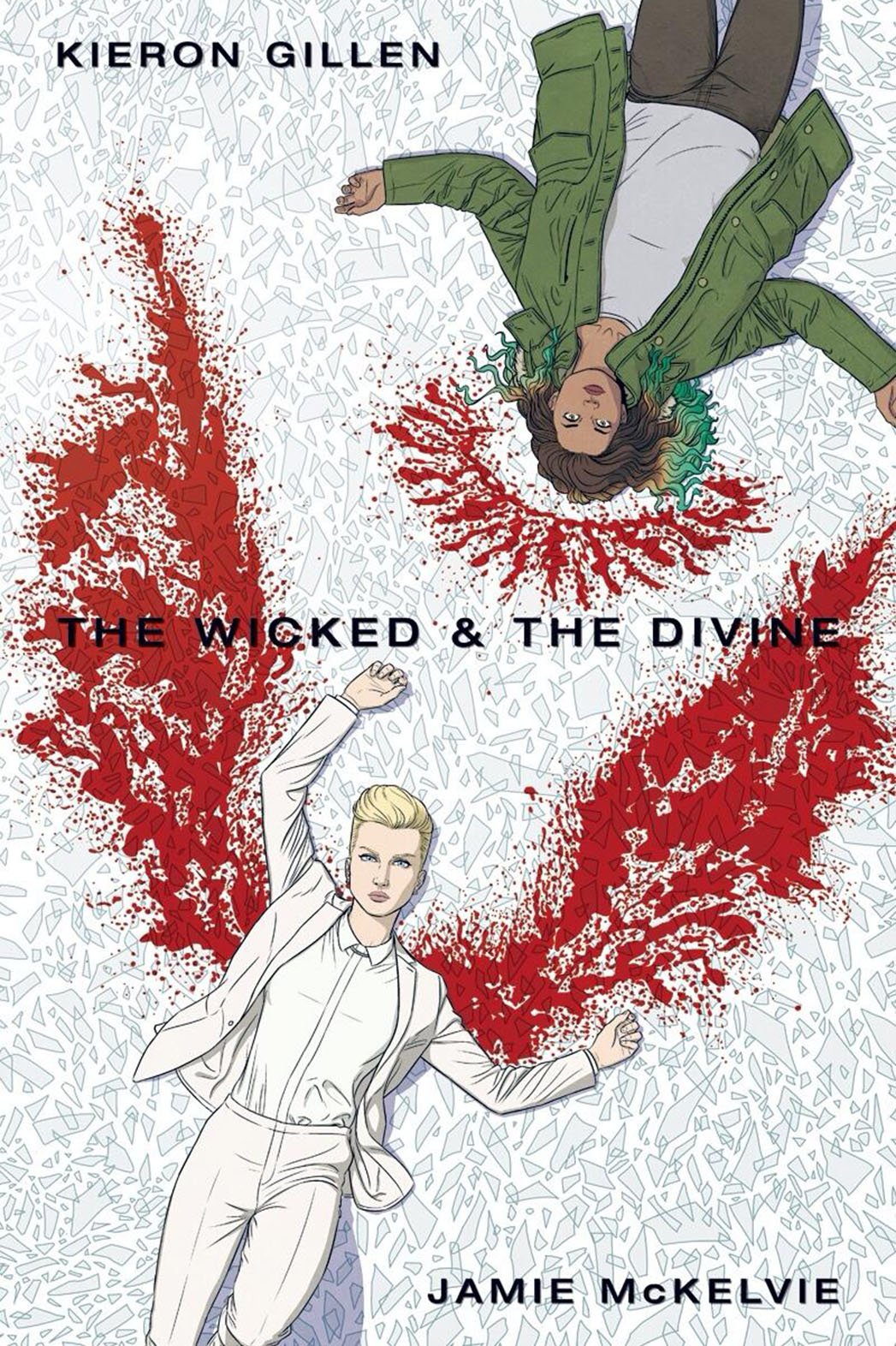
The Wicked and the Divine, volume one — Kieron Gillen & Jamie McKelvie

The_Wicked_and_The_Divine_Promotional_Picture_from_January_2014

It seems like having a great premise is everything when it comes to new comics, nowadays. In the case of this one — possibly the most acclaimed comic of the year — it’s “gods getting reincarnated as young pop stars.”

Again, that premise ought to sell this outright. If not, I’ll elaborate: one of the pop stars is Kate Bush (well, basically). Go forth and buy this trade collection.

For the time being, Sex Criminals is my favourite ongoing comic. But, I feel like this has the potential to become a major work on the level of The Sandman or Alan Moore’s Swamp Thing.

Run the Jewels 2 — Run the Jewels

I have very little to say about this album that everybody else hasn’t already observed. Suffice it to say that I love it as much as everybody else seems to.

Animism — Tanya Tagaq

My favourite non-classical album of the year. The lion’s share of the attention that’s been devoted to Animism since its well-deserved Polaris win has focussed on Tagaq herself. Which, fair enough. She’s probably the most extraordinary musician in Canada, right now. The breadth of unexpected sounds she can conjure from her throat is shocking. Plus, she’s got a lot of important things to say.

But, to me, this album succeeds the same way that great jazz albums succeed: as a collaboration between musicians who know how to make fascinating sounds at the spur of the moment. The album’s core trio consists of Tagaq, violinist/producer Jesse Zubot, and drummer Jean Martin — who gives one of the great instrumental performances of the year. Listening to the telepathy happening between those three provides moments of joy on an album that deliberately resists being loved.

Well, I love it anyway. Animism is difficult, alienating, troubling and spiky. I wish more music were like it.

Note: The Pixies cover above is emphatically not the best track on the album (that would be “Damp Animal Spirits”), but it deserves to go down in history as one of the most revelatory covers ever.

Gone Girl

At the Parsons Oscars, David Fincher would have been nominated for best director, Gillian Flynn would have been nominated for best adapted screenplay, Ben Affleck would have been nominated for best actor, Jeff Cronenweth would have been nominated for best cinematography, and Trent Reznor and Atticus Ross would have been nominated for best score. (Sure, they’re not as good as Mica Levi, but they’re still great.)

Oh, and Rosamund Pike would still be nominated for best actress.

99% Invisible

Before Serial, the biggest podcasting success story of 2014 was 99% Invisible. This was their first full year of weekly episodes — a feat made possible by a pretty impressive Kickstarter campaign. We got a new, surprising, audio-rich story every week; we were introduced to a new regular producer in Katie Mingle; and host Roman Mars’s warm bonhomie got even warmer for the gratitude he evidently feels for his generous listeners.

And then, as a result of an even more impressive Kickstarter campaign, we got Radiotopia: a constellation of other intricately-produced podcasts that share funding and cross-promote. Before podcasts were suddenly a thing, these people were working really hard at making podcasts a thing.

99pi is still the highlight of the bunch, though. It’s a show about design, in the broadest sense possible. The entire human-constructed world is grist for the mill. This year, they tackled everything from Ouija boards to Penn Station to tunnels for cows. They made me laugh; they made me cry. They reinvigorated my love for audio storytelling once a week. This, for me, was the podcast of the year.

Orange is the New Black, season two

So, remember what I said about Interstellar and how I love stories that I’ve never seen before? Orange is the New Black does that exact thing, one episode after another — probably in a more profound way than Interstellar.

I’ve never seen a show with so many fully-realized characters. From Vee (*grr) to Red (*punches the air) to Miss Rosa (*sobs), I became massively invested in all of their stories, this season. Taylor Schilling’s performance continued to be wonderful — and continued to be not even the highlight of the show.

Side note: that Zombies song I linked to at the beginning (this one) is totally going to close out this show’s series finale. I’m absurdly confident in this.

Become Ocean — John Luther Adams

John Luther Adams’s Pulitzer win for Become Ocean seemed a long time coming. I fell in love with Adams’s mesmerizing, textural compositions after reading Alex Ross’s profile of him in his book Listen to This. But, Become Ocean really does feel like a new peak for this composer. A 42-minute sound tapestry of gradually rising and falling tension, this piece uses the massive sonic palate of a symphony orchestra more completely than anything I’ve heard in a long time.

Adams sums up the piece’s thematic premise in a short, beautifully crafted statement in the CDs liner notes: “Life on this earth first emerged from the sea. Today, as the polar ice melts and sea level rises, we humans face the prospect that we may once again, quite literally, become ocean.”

The statement reminds me of another strangely moving pronouncement of doom, accompanied by arhythmic droning: the tape that precedes the rendition of Peter Gabriel’s “Here Comes the Flood” on Robert Fripp’s Exposure album. Both pieces of music deal — however obliquely — with ecological disaster, and both of them remind us that we will never have enough power over the natural world to keep it from killing us all when things get bad enough.

Become Ocean, to me, is the album of the year. No matter what you normally listen to, you should hear this.

The Grand Budapest Hotel

It’s like Buster Keaton, Alfred Hitchcock, Stanley Kubrick and Terry Gilliam made a movie together. And that movie is my favourite of 2014. It’s a tough pick between this and Birdman, but ultimately, I’ll go for the one that I could not keep myself from seeing in theatres a second time.

This is the movie that once-and-for-all puts the lie to the notion that Wes Anderson’s artificiality gets in the way of the feels. It’s true: everything in this movie is ostentatiously crafted and adjusted by Anderson, from the highly choreographed jaunts through the titular hotel to the aesthetically pleasing single tear that was carefully applied to F. Murray Abraham’s face in the dining room scene. But none of this prevents the movie from having the intended effect, be it laughter or a bit of a twinge, at every turn. Because it’s not a filmmaker’s job to feel things. It’s the audience’s. And I don’t see why a movie presided over by an aloof, aesthete’s eye should affect me less directly than one produced with a more improvisatory approach. As I said on Twitter at the time, sincerity be damned. Give me craftsmanship any day.

Also, nothing in movies or on TV made me laugh harder this year than “She’s been murdered. And you think I did it.” *runs*

Doctor Who, series eight

This second year of my Doctor Who obsession was slightly more sedate than the first. The frenzy of discovery that led me to gulp down the first seven series of the rebooted show and a pretty significant chunk of the classic one in a matter of months seems to have abated, now. So, it is with a rational and balanced mind that I can proclaim OMG TWELVE IS TOTALLY MY DOCTOR.

This series has certainly been the most consistent one since Doctor Who rebooted. Its highlights (“Listen,” “Dark Water/Death in Heaven,” “Kill the Moon”) don’t quite reach the heights of previous series (there’s no “Human Nature/The Family of Blood” or “The Pandorica Opens/The Big Bang”), but “Listen” comes awfully close.

And, more crucially, there are no clunkers here. Every episode feels like it’s building to the themes that showrunner Steven Moffat would pay off in his spectacular two-part finale. But every episode is still allowed to be its own self-contained story — which is really important, because what’s the point of a show about a magical box that can take you anywhere if all of the stories are the same?

We saw a different, more ruthless and conflicted Doctor in Peter Capaldi. We saw new dimensions in Jenna-Louise Coleman’s performance as Clara (although, as blogger Caitlin Smith convincingly argues, they were probably there before and we just didn’t notice). We saw Nick Frost as Santa Claus.

We are waiting in agony for more.

Blood and Laurels — Emily Short

Since the storied elder times of Zork, text-based gaming has been on something of a low simmer. Plenty of fantastic hobbyists have been making absolutely stellar works of interactive fiction in that tradition — the one where you type commands and the computer responds, when it understands — for more than twenty years, now. But, it was a niche community, to say the least.

Now, with games like Device 6 and A Dark Room making a stir in mobile gaming, it seems like the world may be ready for more word games. After all, what do we spend all of our time doing, nowadays? We spend it reading text on screens.

2014 saw the release of one of the most promising platforms for interactive fiction, going forward. Versu is a massively more flexible new version of the Choose Your Own Adventure. Basically, you read text and make choices at critical points (or, for that matter, whenever you’d rather intervene than stand idly by). Choices can be as simple as making one gesture instead of another, or as sweeping as siding with one character in an argument over another. Versu’s artificially intelligent non-player characters react in kind.

The platform’s launch title, Blood and Laurels is by one of the most acclaimed authors of interactive fiction in recent years: Emily Short. It’s a story of intrigue in Ancient Rome. I don’t even want to think about how many endings it probably has. It’s a fantastic story, but what’s most exciting is the potential of this format. My prediction for 2015: this will be big, soon.

Honourable mentions: Salad Days — Mac DeMarco; The Ambassador — Gabriel Kahane; Stella di Napoli — Joyce DiDonato; Lamento — Romina Basso; Mad Men, season seven, part one; Last Week Tonight, season one; Game of Thrones, season four; Serial; Radiolab; Philip Sandifer’s blog; Boyhood.