Cracked 30 for the first time in a while! Only by one, though. Here are this week’s 31 reviews.
Movies
Looper — I watched this during a rare case of “oh, I’ll just put on whatever’s on Netflix,” and it led me into a weekend-long Rian Johnson binge. Looper unexpectedly scratched the itch that Arrival left me with, for thinky science fiction with all of the filmmaking basics in high gear. This is a brilliantly written, brilliantly shot, brilliantly acted movie based on a brilliant premise that it knows not to take too seriously. It’s a time travel movie where the mechanics of the time travel are both important and deeply inconsistent, but which is constructed expertly enough that the story never stops making sense. Everything else about the movie is meticulous — from the comparative advantages of the characters’ various firearms to Joseph Gordon-Levitt’s prosthetic nose. Like Arrival, Looper uses its sci-fi premise to achieve its emotional payoff. But also like Arrival, it would all be for nought without performances that invest the characters with our sympathies. In this regard, Emily Blunt is particularly excellent, as is the extremely promising Pierce Gagnon, who plays her precocious 10-year-old son with magnificent superciliousness. Of the main duo, Gordon-Levitt and Bruce Willis as the former’s older self, Willis stands out for his ability to convey a similar ruthlessness to Gordon-Levitt, but with the world-weariness of 30 extra years. To be honest, I’ve never really been that excited for a new Star Wars movie. But after seeing this, I’m extremely psyched to see what Rian Johnson does in that universe. Because Looper is at least twice as good as The Empire Strikes Back. That’s a quantifiable thing. I measured it, and it’s definitely true. Pick of the week.
Brick — An astonishing debut from Rian Johnson, with some of the tendencies that make Looper great already in place. Like Looper, this is a movie built on deep awareness of genre tropes — from action/sci-fi movies in Looper’s case, and from hard-boiled crime and noir in Brick’s. But both of those movies cast the tropes of their respective genres in slightly new and different lights, without actually crossing the line into parody. Brick comes closer, given that it’s a proper crime movie about drug dealers with actual life-and-death stakes, and it also takes place in a high school. But Johnson almost elides that last part entirely, only pointing out the absurdity of his own premise in the few scenes that have adults in them. Aside from that, this is played almost entirely straight and the high school setting is basically aesthetic. It’s kind of great to see so many of these classically noirish scenes play out in broad daylight. And speaking of classical noirishness, this movie goes a step or five beyond it in its writing. The dialogue in Brick is entirely its own beast and it’s beautiful. A young Joseph Gordon-Levitt delivers the movie’s best lines with total commitment. I really enjoyed this, and it makes me hope that Johnson doesn’t rule out doing smaller budget movies in the post-Star Wars period of his career.
The Brothers Bloom — Without a doubt the weakest film in Rian Johnson’s oeuvre so far, but still worthwhile for the wonderful performances by Adrien Brody, Rachel Weisz, Mark Ruffalo and Rinko Kikuchi. All four bring a totally different energy to the movie: Brody is romantic and brooding, Weisz childlike, Ruffalo charming, and Kikuchi brings the snark while hardly saying a word. It’s the kind of comedy I’d like to see more of but there are times when it feels like a slightly less committed film by Wes Anderson. (Maybe it’s just the presence of Brody.) The movie is at its best when it’s at its least subtle: it’s a movie about storytelling, with its themes applied to con men. Ruffalo’s character writes elaborate cons for his younger brother (Brody) to play the lead role in. The key tension is that Brody’s character is afraid that he won’t be able to tell fact from fiction much longer. The ideas of lies that tell the truth, or cons where everybody gets what they want are everywhere in this movie, to an almost Steven Moffat level of obsessiveness. Particularly striking is a sequence in which Weisz’s character demonstrates her pinhole camera to Brody’s, explaining how it distorts images in interesting ways that show you things not as they are, but as they could be. More compelling is the extent to which she doesn’t know why this resonates with the person she’s talking to. As with Brick, the writing is where this movie shines. Everybody constantly means two things at once, both being equally true. But it all feels a bit less than the sum of its parts. Still worth a watch. But I can see this being considered the Hudsucker Proxy of Johnson’s catalogue a little bit farther down the line.
Television
Last Week Tonight: March 12, 2017 — Best episode in a very long time. Just watching Oliver get upset about Trump’s whole “who knew healthcare was this complicated?” thing is worth the time.
Ways of Seeing: Episodes 3 & 4 — What a marvellous series. These latter two episodes focus on the ways in which oil painting was primarily a tool for the self-aggrandizement of the wealthy and the ways in which modern (read as: 1970s) advertising uses the same techniques to reflect a fantasy of wealth at a population that does not, but might be persuaded that they can enjoy it. I understand now why a segment of my social media circle was so saddened by his death. His television programmes are the sorts of things that simply aren’t being made anymore: no frills, non-pandering, direct intellectual arguments accompanied by clever and knowledgeable juxtapositions of images. Well actually, I suppose there’s Adam Curtis. Still, this would be focus-grouped out of pre-production today.
Literature, etc.
Alex Ross: “The Fate of the Critic in the Clickbait Age” — Oh man, it’s nice to see that the writer who made me want to go to journalism school still thinks the same way as me about everything, except better. Ross argues cogently that slavish devotion to analytics is unconscionable: “The trouble is, once you accept the proposition that popularity corresponds to value, the game is over for the performing arts. There is no longer any justification for giving space to classical music, jazz, dance, or any other artistic activity that fails to ignite mass enthusiasm. In a cultural-Darwinist world where only the buzziest survive, the arts section would consist solely of superhero-movie reviews, TV-show recaps, and instant-reaction think pieces about pop superstars. Never mind that such entities hardly need the publicity, having achieved market saturation through social media. It’s the intellectual equivalent of a tax cut for the super-rich.” Brilliant. But if you’re really going to champion the little guy, Alex, is the New Yorker really the place to do it??? I mean, wouldn’t it be more consistent with your argument to, I dunno, express the same outlook in the form of obscure essays about Jethro Tull on Tumblr? Or something? It’s a minor quibble though. All I’m saying is I’m coming for your job. Don’t worry about it, just let it happen. You’ll land on your feet.
Louis Menand: “Karl Marx, Yesterday and Today” — Super interesting. Manand contends that while biographical efforts to put Marx back in his 19th-century context are noble enough, we ought to push back against the notion that a figure from the increasingly distant past can’t have any practical use in the modern world. It’s got some biographical info on Marx that’s new to me, but then most things to do with Marx are relatively new to me. One of these days I’ll get off my ass and read Capital. Just lemme get through this stack of comics first.
“25 Songs That Tell Us Where Music Is Going” (2017) — I do hope this becomes an annual thing for the NYT Mag, because both editions have featured some top-shelf music writing. The short-form podcast version of this feature is even better, but this is worth reading for a few of the longer segments. Amos Barshad’s feature on the ever-elusive Future and Jenny Zhang’s heartbreaking essay on “Your Best American Girl” by Mitski are particularly worth reading.
Ta-Nehisi Coates & Brian Stelfreeze: Black Panther vol. 1: “A Nation Under Our Feet” — I wanted to like this so much more. Obviously, Coates is a brilliant prose writer, but his first foray into comics relies much too heavily on the repeated juxtapositions of portentous inner monologues with straightforward fight scenes. There are only a handful of scenes in these first four issues where I really got a sense of character, and it suffers from the perpetual superhero comic problem that the worldbuilding is basically taken as read — when for most of the people who’ll probably pick this up, it’s definitely not read. Did anybody read this book before Coates took over??? Anyway, I’m happy that Marvel was interested in working with Coates. That bodes well for the future. But this book just isn’t that good.
J. Kenji Lopez-Alt: The Food Lab — I picked this up a month or so ago and I’ve been picking through it gradually, rather than reading it cover to cover. Mind you, it definitely is the kind of cookbook that you can read cover to cover, and ultimately I think I’ll do that. Because Lopez-Alt’s entire focus is to make you pay attention to the small details in technique and process that affect the end result of the food you prepare. Reading the lengthy preambles to each recipe and his accounts of his rigorous applications of the scientific method to cooking is ultimately what helps you avoid the mistakes that make your food sub-par. It also helps to clarify why Lopez-Alt is so specific in his directions in the recipes. An example: one of the first recipes that I tried from the book was Lopez-Alt’s buttermilk biscuits. Altogether, they turned out much better than any of my previous, tepid attempts at this seemingly simple American staple. Lopez-Alt’s method of folding and rolling the dough multiple times as you would in a French pastry helps form stacks of flaky layers, and his advice to pulse the butter and dry ingredients in a food processor before adding the buttermilk leaves just enough big chunks of butter in the dough that the layers are separated from each other during baking. But the one instruction that I failed to follow was to place the raw biscuits on parchment paper over the baking sheet. I didn’t have any, so I substituted aluminum foil and thought nothing of it. In retrospect, it should have been obvious that this would cause the bottoms to burn. But I thought of that too late. Later, upon reading a bit more of Lopez-Alt’s introduction, I learned the science words to frame what went wrong. The bottoms of my biscuits cooked by way of heat conduction: they were in direct contact with the hot aluminum foil, and that was the primary source of the energy transfer that caused them to cook. By contrast, the tops and edges of my biscuits cooked by way of heat radiation from the elements of the oven. This is a less efficient way of transferring energy to food, so those parts of my biscuits didn’t overcook. So, the purpose of the parchment paper in Lopez-Alt’s recipe was to reduce the efficiency of the heat conduction onto the bottoms of the biscuits, ensuring a more consistent outer texture. Now I know. I think it says something about the kind of book this is that the most impressed I’ve been with any recipe has been a recipe for scrambled eggs. Yes, The Food Lab contains an actual recipe for the most basic undergraduate food you can prepare from scratch. Actually, it contains two: one light and fluffy and one creamy and custard-like. I’m a light and fluffy eggs kind of guy, so that’s the one I’ve been using. The key revelation is an astonishingly simple thing: if you salt your whisked eggs and let them sit for 10 or 15 minutes before cooking, rather than whisking, salting and then cooking them immediately, the eggs retain their moisture and don’t weep onto the plate. The difference completely blew me away. I will never not do this when I make eggs, now. Those are just two examples of how my initial explorations of this book have improved my cooking already. Other recipes have introduced useful new techniques to me, even if Lopez-Alt is not especially innovative or bold with flavours. Yotam Ottolenghi he is not. But he clearly has no interest in being Yotam Ottolenghi, and it takes all types. The Food Lab and my two editions of The Flavour Bible (vegetarian and not) have made me a measurably better home cook over the last few months, and I’d encourage anybody with a passion for food and a bit of time on their hands to check them out.
Music
Sxip Shirey: A Bottle of Whiskey and a Handful of Bees — The title is a line seemingly taken straight from the Tom Waits playbook, and this whole album by electroacoustic new music dude Sxip Shirey is brimming with the sort of scuzzy Americana that is the near-exclusive province of Waits and his imitators. Much in the same way as it’s fun to hear roots music collide with glam on Kyle Craft’s debut, it’s fun to hear a New York composer’s take on folk in the O Brother, Where Art Thou? vein. (It’s even got a genderswapped adaptation of “I Am a Man of Constant Sorrow” with Rhiannon Giddens singing.) The other strand running through the album is a sort of avant-garde electronica, which is generally more successful when Shirey steers clear of dance music conventions. In general, I’ve found that people who get called “composers” aren’t great dance music producers. The album would have been better if it wasn’t so gigantically long. But then, there’s virtue in throwing everything at the wall. If you’re willing to skip (pun?) tracks that don’t take your fancy, this may yield more fascination. Many tracks are worth seeking out: the fantastically freaky harmonica jam “Grandpa Charlie” is great. Also, the electronic thing “The Land Whale Choir Sinks the Albert Hall” lives up to its title, if such a thing is possible. And the Neil Gaiman-inspired “Palms” is the closest Shirey gets to a really good pop song, with a touch of Belle and Sebastian to it. It’s better still when sung by Puddles Pity Party, as in the music video. These are not the only good tracks, to be clear. But I will definitely not listen to the album straight through again.
The Flaming Lips: Yoshimi Battles the Pink Robots — After all of the Jethro Tull I listened to last week, I needed to find a new favourite. I’ve always meant to check out the Flaming Lips. I don’t know why it took me so long. Honestly I’m… not overwhelmed. I liked this enough to probably check out at least one more Flaming Lips album, but I generally find myself wishing that the fun spacey sounds and weird beats would occasionally also yield to a nice melody or a good lyric? But I do love that cut up acoustic guitar at the beginning of the title track. I’m not giving up. It’s just not quite as easy a sell as I thought it would be.
Beyoncé: Beyoncé — Man, I love this album, and I don’t think I’ve listened to it start to finish since it first came out. It’s far less cohesive than Lemonade, and maybe a bit less ambitious. But it’s every bit as perfectly crafted. It feels like Revolver to Lemonade’s Sgt. Pepper. So basically, I’m expecting a White Album from Beyoncé within the next couple of years: something sprawling and weird and awesome.
Podcasts
Love and Radio: “Understood as to Understand” — A classic sort of episode of Love and Radio where a person who is likely to be controversial to different people for different reasons is allowed to state their case. It’s not the best of the season, or anything, but this show hasn’t set a foot wrong in a long time.
The Memory Palace: “Amok” — Nate DiMeo tackles fake news. That’s almost a spoiler, except that if you believe the story in the opening of this episode, you are concerningly credulous — as was, apparently, most of New York City.
99% Invisible: “Sanctuary, Parts 1 & 2” — This isn’t a design story in any way that I can detect, but it’s a good one, about the movement among churches to harbour migrants who the government was turning away. If this is 99pi doing a legal story, maybe they should spin off like Radiolab did with More Perfect. I’d listen to that.
Code Switch: “Safety-Pin Solidarity: With Allies, Who Benefits?” — This is the most essential Code Switch episode for privileged people to listen to. That means everybody should hear it, because as argued in the episode, almost everybody has some form of privilege they ought to recognize. Consider me edified and a little chastened.
Reply All: “Matt Lieber Goes to Dinner” — I can’t wait to learn what P.J. finds out from hacking Alex’s phone. Also, I’m 100% on board with Cory Doctorow’s concern about this new black box DRM bullshit. That’s end of days nonsense, there.
Pop Culture Happy Hour: “Get Out and The Americans” — More than anything, I’m glad that nobody disapproved of the final act of Get Out. I don’t know why, but I had a strong suspicion that someone would do a “the movie could have just kept doing what it was doing!” thing. And I’m still in the frame of mind where I can’t acknowledge anything wrong with Get Out. I’m probably not going to catch up with The Americans. I’m intrigued, but not intrigued enough to watch four seasons.
Code Switch: “In Search of Puerto Rican Identity In Small-Town America” — Here we have an honest-to-god reporting trip, tape-driven story about the complicated attitudes of the Puerto Rican diaspora. I’ve always liked Shereen Marisol Meraji as a host, but I love hearing her work as a reporter. The school shutdown story was fantastic, and so is this. The tape is really compelling, and takes you right inside the conflicts occurring in each character’s head. It’s for sure one of the strongest episodes of this podcast in terms of narrative and emotional punch.
Pop Culture Happy Hour: “Big Little Lies and Feud” — Won’t be watching either of these, but I’ll certainly be trawling through Stephen Thompson’s Austin 100 again. That was awesome last year. And I appreciate his only mentioning it this once, as opposed to at every opportunity last time around.
The EP — 45 minutes of fantastic audio-rich music criticism from the New York Times. It’s drawn from conversations with the writers of their second gigantic music feature about 25 current songs. And while it clearly lacks the amount of detail and analysis of the written feature, these thirteen tiny snippets do what every music podcaster should be doing, which is to use the techniques of radio editing to unspool the various meanings of the songs in question, and to illustrate points made by the interviewees. It sounds absolutely great, and it’s definitely a sort of thing I want to hear more of. Pick of the week.
All Songs Considered: “SXSW Late-Night Dispatch: Tuesday” — Think I’ll sit the rest of these out. I’ve got a lot of podcasts to get through and while I’m always happy to let these folks be my proxies at a festival that sounds to me like a panic attack waiting to happen, I just can’t justify the time expenditure if they’re not going to play the music. Still, it’s really gratifying to hear that Let’s Eat Grandma were popular in Austin. I still think they’re the most promising new act in ages.
Love and Radio: “La Retirada, Parts 1-2” — A fascinating start to a three-part series about how a family got into and out of the drug trafficking business. I’ll reserve final judgements until the conclusion next week.
Crimetown: Episodes 11 & 12 — I’m ready for this season of Crimetown to be over now. It started off pretty focussed on a couple of key stories, but it’s been meandering for a while. Still, the episode about Raymond Patriarca’s doctor is the best standalone story that this show has done so far. I do think that in future seasons, though, these guys will need to figure out whether they want to be serialized or episodic. Because mixing and matching doesn’t work.
You Must Remember This: “Marilyn Monroe (Dead Blondes Parts 6 & 7)” — The highlight of this season so far, by far. The first episode of this is a repeat, and a good one, but the second part does something a little different from what Karina Longworth has done before on this show, which is: it focusses specifically on Monroe’s persona and public perception and the decisions that went into it. It’s less narrative than it is analytical. I like this. I’m very much looking forward to next week’s conclusion.
Imaginary Worlds: “The Spirit of Will Eisner” — A live show from Eric Molinsky, on the comic writer who represents the greatest gap in my comics reading career. This is a fascinating look at Eisner’s relationship with later generations of comics creators. Maybe it’ll inspire me to finally pick up A Contract With God.
Theory of Everything: “Nothing to Hide” — Benjamen Walker’s surveillance series gets a shaggy dog ending, but it does confirm that he and I share a favourite apocalyptic movie: Brazil. This series has been intermittently among the best of what Walker’s done on this show. But I’m still left uncertain about what to do about any of this.
Fresh Air: “‘Get Out’ Director Jordan Peele” — Peele is funny and thoughtful, but that’s no surprise. The best parts of this are hearing him talk about horror movies. Guess I should watch The Stepford Wives.
Arts and Ideas: “Thinking – Neil Jordan, Flat Time House, Teletubbies” — This begins with an insufferable debate over whether Teletubbies is any good as children’s programming, continues with a Neil Jordan interview that I had higher hopes for than I probably should have (The Company of Wolves is one of my favourite movies, but I don’t know his work outside of that) and finishes with an out piece on John Latham, a conceptual artist who I’d never heard of. I came for Neil Jordan, but this Latham thing is ultimately what saved an otherwise deeply underwhelming show. I do like the fact that this podcast pairs pop culture with art that isn’t “pop.”
Serial: “Preview of S-Town, Our New Show” — Oh, this is exciting. If Sarah Koenig says it’s weird, I’m in. I love this preview. I love how it starts with an account of clock repair that’s obviously a metaphor, but then the penny doesn’t drop. I won’t spoil it. Just listen to this. I’m much more psyched about S-Town than about season three of Serial.
If things seem a bit scant this week, well, I’ve been busy with my annual wrap-up, which I posted yesterday, and from which some of this is repurposed. 21 reviews.
Movies
Arrival — I came out of this genuinely feeling that it’s the best movie of the year. One gradual process I’ve been through this year is that I’ve come to see how spoilers are an actual thing that’s worth avoiding. And it’s really hard to talk about Arrival without dealing with the twist. This is one of those movies that becomes an entirely different film from start to finish once you know the whole of the story. I suspect that’s probably why everything I’ve seen written about it seems more effusively positive than it can actually back up with analysis. To talk about what makes this movie extraordinary as opposed to great is to spoil it. This movie’s ending is a narrative rug pull of Steven Moffat proportions. Still, for the bulk of Arrival’s running time, we don’t know the big secret, and it’s still an excellent movie. Amy Adams gives one of the best performances of the year (again, a performance that is elevated by knowledge of the ending) as the person that the military brings in to help them communicate. Specifically, with aliens. Couching a first contact story in terms of understanding language is a winning premise, especially when the story introduces the idea (a real idea in linguistics) that language actually fundamentally affects the way that a person thinks. That makes it critical to any understanding of another culture, yet alone another species. As far as I can tell all of this comes straight from the Ted Chiang story that Arrival’s excellent screenplay is based on. But if the movie were only a brute force expression of some clever ideas, it wouldn’t be my favourite of the year. Director Denis Villeneuve imparts an element of profound lyricism to the story by allowing us to see small moments, and letting our eyes linger on images that one assumes the citizens of this movie’s world are being fed through a much more frenetic TV news approach. Villeneuve is a director that I’ve been aware of since he made Incendies in 2010, but this is the first of his movies that I’ve seen. It’s clear that he’s a major talent, and one hopes that he’ll continue making movies like this, even after he’s made his franchise juggernaut debut later this year with the new Blade Runner. Pick of the week.
Mad Max — I saw Fury Road when it was in theatres, because it was essential viewing. And oh my god am I ever glad I did. But I hadn’t seen any of the previous Mad Max movies. Now I’m rectifying that. This is astonishing for having been made for $2.3 million, adjusted for inflation. So much is communicated by implication here, with cuts made in opportune places so that major events are left to the imagination. It’s both dramatically effective, and a great way to cut expenses. Considering how far off from Fury Road this movie is — in terms of time, budget and the series not having yet built its cultural legacy — it’s incredible how many of the ingredients are already in place. The deranged gang of predatory biker dudes in this are so over the top that they don’t even need makeup. But, when you throw a bit of magic character design juice over that same basic formula, you get Fury Road’s war boys. And of course, their leader is the same guy, just younger and with more of his face visible. Neither of the Mad Max movies I’ve seen have especially involved stories, but of course this isn’t a problem. It’s more of a problem in Mad Max, though. Because, in Fury Road, the chase scenes are so detailed that plot can occur at a micro level: every chase and fight scene has dozens of tiny plot events. A character gets plucked from a friendly vehicle into an unfriendly one; a man being pursued spies the promise of sunlight through a grate; the unconscious guy chained to Max as he’s fighting wakes up. That’s what $150 million well-spent buys you. In the 1979 rendition, you have to be content with a slightly blunter instrument. Still, well worth the hour and a half.
Television
Downton Abbey: Season 3, episodes 6-9 — At its best, this season is like a less thoughtful, more conservative, British Horace and Pete. More than either of the previous seasons of Downton Abbey, it foregrounds the series’ central tension, which is that things can’t remain as they are. Lord Grantham is the most interesting character, at least symbolically, because he is the primary representative of the old guard, and we see him undermined again and again: regarding how his estate is to be run, the church in which his granddaughter will be Christened, whether his middle daughter should be allowed to write a newspaper column, and most compellingly which doctor to listen to when there’s a life at risk. The fact that he makes his every decision based on a crumbling value system that will only lead to his own ruin is a tremendously interesting throughline that also serves to explain at a granular level why the big houses like Downton fell, historically. It really comes down to people like Grantham being entirely out of touch with any traditions and ways of life save their own. (A personal favourite moment: Grantham’s valet is released from prison and his chummy advice for how to spend his first day of freedom is: “Stay in bed! Read books!” Honest to god.) However, that’s where the positives stop. This is the first season where the upstairs plotline has struck me as substantially more interesting than the downstairs plot, which in this season is completely insufferable. It revolves around O’Brien trying to take brutal revenge on Thomas for something I don’t remember, and a messy, dull love pentagon between Thomas, two new footmen, Daisy and the kitchenmaid. Good lord, kill me now. And then, off in their own tangentially connected world, are Matthew and Mary, who have been highlights of previous seasons, but who are actually worse in this season than the love pentagon. Even if the huge twist at the end of the season is incredibly contrived (and Jesus Christ, the writing around it could not be more hamfisted), I’m quite happy that it’s removed a relationship from this show that has become a source of aggravation. Actually, the entire final episode of this, a Christmas special, is awful. The worst episode of the show so far. At some point during its running time, Lord Grantham bids his fellow toffs “good hunting,” which only reminded me of that other show I’m much more enthusiastic about getting back to.
Literature, etc.
Emily Nussbaum: “How Jokes Won the Election” — This feature is a good corollary to HyperNormalisation. It argues that the rapidly thinning line between “joke” and “not a joke” is a clear contributor to Trump’s victory. It also contains an excellent assessment of Trump, Obama and Clinton as varying comedic personalities.
Michiko Kakutani: “Why ‘1984’ Is a 2017 Must-Read” — Here is a confession. I have never read 1984. Here is another confession. I have been lying about having read 1984 for years. In fact, I think I’ve been lying about having read 1984 for so long that this isn’t the first time I’ve gone public about not having read 1984. It may actually be the third. But nonetheless I feel another confession is necessary, because it’s a lie I’ve repeated as recently as a couple of weeks ago. And it’s such an easy one to keep up, given how familiar the central tenets of 1984 are in our culture. But perhaps I should take this opportunity, while this whole American fascism thing is going on, to see for myself why it is so enduring. I’ll add it to the list.
Olivia Laing: “The Lonely City” — The very act of writing a book about one’s own loneliness is an act of bravery. If this book were simply Olivia Laing’s account of the period in her own life when she felt the most alienated, it would still be worth reading, and not at all self-indulgent. Nothing could be less self-indulgent than proclaiming loneliness, because we all intuitively know that such a proclamation will have the counterintuitive effect of worsening one’s own isolation. But Laing only uses her own narrative as a spine: a framing device that she uses to string together her readings of the lives and works of several definitively lonely American artists. Though it is often conflated with depression, Laing considers loneliness as a unique affliction: an undesirable one by definition, but one without which the human experience is incomplete and possibly less inspired. The chapter that focuses on Andy Warhol’s outsiderness, his alienation through not having a firm grasp of language, is shattering and actually makes Warhol’s famous repeated images take on a bittersweet quality that I had never detected in them before. Laing is sensitive to the alienating tendencies of patriarchy and heteronormativity, and offers compelling portraits of people who lived lonely lives due to a society-wide lack of understanding. A substantial amount of the chapter that begins by focussing on Warhol veers off to consider Valerie Solanas, an early radical feminist of some genius who has since become known for only one thing: shooting Andy Warhol. The Lonely City is a beautiful book: equal parts sad and validating. It made me want to jump on a plane to New York to go look at art. By myself.
Music
The Tragically Hip: Live Between Us — I’ve been into live albums lately, and it occurred to me that maybe I could start to understand the Hip a little better if I heard a full live show from them in their prime. I think it worked. Gord Downie has always been the part of the band that I liked: his lyrics, his whimsical character as a frontman, his conscience. It’s the rest of them, with their almost aggressively generic sound that always posed a problem. But live, that sound is almost a virtue, because there’s no more semiotically rich sound than two guitars, a bass, drums and a screaming crowd. This is straightforward rock and roll, with a very non-straightforward frontman. I’m sold.
Podcasts
Reply All: “Man of the People” — This is another story from the annals of American demagoguery — and one that played out on a similarly massive scale to the current one, relative to its time. It’s about John Brinkley: a fake doctor who patented a raft of fake medicines and marketed them to a nation of credulous customers on a radio station that he owned. (This was the earliest days of commercial radio, and it already sucked.) It’s gratifying to hear that flimflam was always a thing. It’s depressing that it’s still just as much of a thing in an era where we’re each equipped with far more of the facts than we were in the 20s.
99% Invisible: “Tom Swift and His Electric Rifle” — The story of the taser is as fraught as you’d think it would be. Framing this as a design story is a great idea, because then it becomes the story of whether the design of the taser is a fitting design or a catastrophic one — and that depends, of course, on whether you’re talking to a police officer.
Crimetown: “Power Street” — Ohhhh, it’s back. This show is catnip to me. It’s basically everything that Criminal isn’t, which isn’t a slight to either of them. Criminal is a show that demonstrates the multifacetedness of criminality, and thrives on telling stories of all sorts of different characters. Crimetown is True Crime, note the capitals. It’s got charismatic gangsters, fisticuffs, mob hits, and corruption that goes right up to the top. It’s a yarn that you can just get lost in the grisly details of. It’s the best. I’m just as much looking forward to hearing what city their next season will focus on as I am to how they deal with the rest of this one.
Welcome to Night Vale: “[Best Of?]” — This basically proves that it’s the structure of Night Vale that annoys me most. Every time they break from the structure, I love it. This episode responds to Cecil taking a bit of time off by installing a mysterious new host in his seat. It features a clip from Cecil’s early career (but not as early as you’d think, considering) where he reports on the invention of radio, which of course begs the question… how was he reporting it? This is clearly one of the classics, and has an absolutely haunting twist at the end. If I can expect periodic episodes like this one, I’ll happily groan my way through a few potboilers. Pick of the week.
Chapo Trap House: “Mr. Chapo Goes To Washington” — An incredibly edifying hour of the Chapos and their guests bitching about the inauguration, which is clearly the worst thing that ever happened. Just as good: general bitching about Washington, D.C., which is clearly the worst place that ever happened.
On the Media: “Future Tense” — This is an hour on the future of the White House press corps in the Donald Trump administration. The usefulness of that institution isn’t universally agreed upon, even in the media. So this is a contentious hour with no easy answers. But easy answers are not what you come to On the Media for in the age of Donald Trump. You come to it for the BIG WIDE 70MM SUPER CINEMASCOPE view of how fucked we are.
The Gist: “Don’t Mind Us, We’re Just Collapsing” — Ahhh, lovely. This features an interview with an archeologist who’s actually calling from the jungle to talk about the warning signs before the fall of a civilization. I love that they thought to talk to somebody like this. Pesca’s spiel about reconsidering #oscarssowhite is less convincing to me — last year’s Oscars were so white.
Twenty Thousand Hertz: “What Makes up a Movie Soundtrack?” — This isn’t that interesting, story-wise. A big segment of it is given to the great sound designer Ann Kroeber. She’s a good talker, but the stories she tells about getting animal sounds for movies don’t really go anywhere. (This is something that 99% Invisible does too — where it just throws stuff at you rather than telling a linear story. But I think you’ve really got to be a radio grandmaster to pull that off.) The most interesting bit is where they take apart the layers of sound in a movie explosion. I could have listened to more like that: an entire episode of deconstructing sound effects would have been great. (Explosion Exploder?) Anyway, this show has mostly been really good in its short life so far. It’s allowed an off week here and there.
The Gist: “Deregulation Nation” — I think I need to read this guy’s book. Jacob Hacker argues that it was the effective use of government that made America prosper in the first place, and that Republicans have fundamentally misunderstood the history of policy-making. Really interesting.
The Gist: “Yeah, We’re Scared Too” — Oh, good. Here’s an interview with a Bush appointee about how establishment Republicans are still as terrified of Trump as during the primaries. Excellent. Flippancy aside, Eliot Cohen is a reasonable person, and it’s good to know they exist in Trump’s party, even if they have no hope in hell of actually swaying him to the centre.
On the Media: “New Reality” — Bob Garfield visits the flailing White House press corps, and commiserates and berates in equal measure. That’s something we needed. Also, there’s an interview with Jay Rosen, who’s always great to hear on this show, on the question of why the hell anybody would even bother interviewing Kellyanne Conway.
99% Invisible: “The Revolutionary Post” — The post office invented America. That’s a hell of a premise, and with evidence found at the bottom of the Grand Canyon and in the life story of Benjamin Franklin, it doesn’t seem absurd.
On the Media: “Week One” — Sean Spicer is a piece of shit. Honest to god, there are no decent people among Trump’s staff at all. The most powerful country in the world is being run by goblins. The only thing that makes him seem a little less noxious is that Steve fucking Bannon is even worse.
Imaginary Worlds: “Winning the Larp” — I love the idea of LARPing. I just love it. The part of me that used to do improv and also the part of me that admires Wagner for fusing a bunch of art forms together are both complicit in this. But I don’t think I’ll ever do it, because there are lines that even I won’t cross.
It has become customary for me to post my best-of list for any given year at the end of the following January. I do this partly to give myself a bit more time to digest everything, including albums or movies that might have come out in December, and books I haven’t finished. But mostly I do it as a perverse act of protest against modern “EVERYTHING NOW” culture. I won’t have that. I think we can afford to take a bit more time.
But this year, I’ve put myself at a disadvantage. Faced with the task of belatedly summing up the most recently completed planetary rotation period, I find myself with little to say — since there simply are no more clichés available to describe it. The media, social and otherwise, exhausted them all. With no clichés to rely on, how is one to describe 2016? We’re in uncharted territory.
So, I’ll simply introduce this list by telling one of my own personal 2016 stories. It is not an especially consequential story, nor does it necessarily define the year in any profound way. But it’s a story that I’m fairly confident didn’t happen to anybody else. At least, not in the details.
I was working late the night of the American election. I’d been tasked with writing a short piece on Leonard Cohen for a year-end feature. Cohen, as far as I knew, was still alive. So, I wrote a piece that tried to reconcile the morbidity and resignation of his recent album You Want It Darker with the inherent triumph of creating a great work of art in a state of unwellness.
I was just about through it when Trump won Florida. I watched the New York Times’ probability meter zoom up into the red. The ground slipped, etc. I finished off the last few sentences of my Cohen piece. They went like this: “2016 has saddled us with the deaths and diagnoses of many artists we hold dear. Leonard Cohen persists. That is a straw to clutch at.”
The next day, Hillary Clinton conceded the election to Donald Trump. Two days after that, news broke that Leonard Cohen had died. And moreover, that he had died on Monday. Little did I know while I was writing those final, celebratory lines that Leonard Cohen was already dead. Probably he died regretting that he wouldn’t get to see the seemingly inevitable victory of the first female president.
I edited the Cohen piece. I managed to keep the last sentence, but it wasn’t as good in the new context.
You Want It Darker isn’t on this list. Neither is Chance the Rapper’s Colouring Book, which was the album I reached for to ring in 2017 on New Year’s Eve (specifically “Finish Line”). Both of those albums seem to have a lot to say about this past year, but so does everything. That’s because we let 2016 get under our skin, even though it was just a year — a semi-arbitrary way of measuring reasonably-sized blocks of time.
All the same, I can’t help but think that this list reflects the extent to which I let 2016 get under my skin as well. Many of its entries are here because they seem to resonate intensely in the here and now. For the first time, this seems to be a more important criterion for me than whether or not I can see myself revisiting a particular entry in the future. The world has become dangerously interesting of late.
Oh, and another thing: the list is ranked. I find the exercise of comparing apples to oranges to beach balls to crows to Chevrolets to be inconceivably satisfying, so that is what I’ve done here. Take it for what it’s worth.
Honourable mention: 887
It seemed weird to include a piece of theatre in the proper list, given that there is currently no way for most people to see it, and that the cities that saw it this year may not ever see it again. But Robert Lepage’s one-man show about memory would be very close to the top of this list if it didn’t seem so perverse to do that. Any footage or promo text that you’re likely to find about this show online will likely make it seem like a spectacle: a technical marvel. And it is that, to be sure. But it’s spectacle on an incredibly intimate scale. Most of the show is composed of Robert Lepage simply talking to the audience, directly, casually and out of character. It’s a testament to the strength of the material that even with its rotating set, video screens, live cameras, and various tricks of light, 887 would still work as a radio drama, and it would be only marginally less awesome. It’s like a TED Talk inside of a magical realist diorama. The subject is memory, in nearly every sense of the word: the neurological phenomenon of memory, Lepage’s own childhood memories of his family and of major national events, the process of memorization. Along the way, he explores the origins of theatre, he remembers his father, and he reflects on Quebec nationalism and the FLQ. These are themes that may not seem on the surface like they should connect. But Lepage keeps the balls in the air seemingly effortlessly, and never makes a forced attempt to draw an unnatural thematic link. It’s a deft, haunting and cathartic experience, and if you find yourself able to see it, I could not urge you to see it in strong enough terms.
No. 30: The Nice Guys
This is the year’s most inevitably underrated movie. It’s a big, rompy action comedy that just allows itself to just be that thing. Like all halfway convincing modern comedy, it is trope aware. But unlike most modern comedy, the humour in this mostly doesn’t come from undercutting the tropes: it comes from great, great iterations of those tropes. There’s a bit near the end with a luxury car on one of those rotating drums you see at big fancy car shows, and it is such a perfectly intuitive physical comedy setpiece that you wonder why you’ve never seen it done before. Speaking of physical comedy, it says something about both director Shane Black and leading man Ryan Gosling that the movie can get laughs from pratfalls in 2016. The Nice Guys relies on that kind of humour more than any contemporary movie not made by Wes Anderson, and it gets away with it without being compulsively stylized. At various points during this list, it may seem like I don’t actually consume media for fun, but for some other misguided, principled reason. The Nice Guys is pure fun. No other movie entertained me so uncomplicatedly this year. But since everything is political, it’s worth noting that this movie corrected a problem that’s always bothered me in movies: mostly Coen Brothers movies. It’s got dumb comedy liberals in it, who stage vacuous protests about social ills they don’t adequately understand — but it also has comedy conservatives who monologue villainously about American exceptionalism. Politically, this movie traffics exclusively in caricature, and can thus be read as essentially disinterested in politics altogether. If this were a Coen Brothers movie, the monologuing villain would have been subbed out for some variant of the plainspoken cowboy, who espouses moderate views and good old-fashioned common sense — as if that’s what the liberals are fighting against. If it were South Park, the script would have attempted to make a sincere reading of its own caricatures, and come out with some sort of false equivalency that suggests there’s right and wrong on both sides of every issue. The Nice Guys does none of this: rather, it explicitly invites us to completely ignore the politics that may or may not underpin the film. I, for one, was happy to do so.
No. 29: The Lonely City
The very act of writing a book about one’s own loneliness is an act of bravery. If this book were simply Olivia Laing’s account of the period in her own life when she felt the most alienated, it would still be worth reading, and not at all self-indulgent. Nothing could be less self-indulgent than proclaiming loneliness, because we all intuitively know that such a proclamation will have the counterintuitive effect of worsening one’s own isolation. But Laing only uses her own narrative as a spine: a framing device that she uses to string together her readings of the lives and works of several definitively lonely American artists. Though it is often conflated with depression, Laing considers loneliness as a unique affliction: an undesirable one by definition, but one without which the human experience is incomplete and possibly less inspired. The chapter that focuses on Andy Warhol’s outsiderness, his alienation through not having a firm grasp of language, is shattering and actually makes Warhol’s famous repeated images take on a bittersweet quality that I had never detected in them before. Laing is sensitive to the alienating tendencies of patriarchy and heteronormativity, and offers compelling portraits of people who lived lonely lives due to a society-wide lack of understanding. A substantial amount of the chapter that begins by focussing on Warhol veers off to consider Valerie Solanas, an early radical feminist of some genius who has since become known for only one thing: shooting Andy Warhol. The Lonely City is a beautiful book: equal parts sad and validating. It made me want to jump on a plane to New York to go look at art. By myself.
No. 28: We Are The Halluci Nation
This is the album that finds A Tribe Called Red well past the proof-of-concept phase: the brilliance of their fusion of powwow music and EDM has already been established and accepted. As of this year, ATCR is as much an albums band as a live act, and they have thus secured their legacy. We Are The Halluci Nation is a mind movie. It uses a rich sonic palette of synths, beats, hand drums and throat singing. It layers that palette with the words of some like-minded collaborators including Saul Williams, Yasiin Bey and Leonard Sumner. And from that alchemy emerges a story, impressionistically told, of oppression and resistance. It is the most forceful music on this list by miles. And when it isn’t, it’s tense, coiled up and ready to do battle. It naturally feels like music of the present moment, but of course it is more than that: it’s music of a brutal historical moment that is ongoing and five centuries old. (“500 years and still drumming,” says the album cover.) I saw ATCR live this year as well, and they’re magnificent in that setting. But given a full album’s length to work with plus your undivided, sober attention, they are both infectiously righteous and some of today’s finest musical architects.
No. 27: Love and Radio
After the election, Nick van der Kolk did what many people in the media did, i.e. he had a muted existential flail in public. He expressed his doubts that anything he could do on his show would have any impact on the world at all, and asked the audience for feedback as to what they’d like to hear on the show. I sent him an email to this approximate effect: listening to Love and Radio, it’s always struck me that the show feels like it belongs to somebody different every episode. I don’t know that there’s any other show that’s so willing to surrender the story to its guest. It requires an active investment of empathy from the listener. I believe that people can come away from art and media compelled to act differently in the world. And if that’s true, then this is among the most important work that anybody’s currently doing on a podcast — even and especially after this past election. It seems likely that we could be entering an era that’s even more defined by fear and hatred of the ‘other’ than the present one. This is a podcast that starts from the contention that it’s better to listen to people than not to. I can’t imagine anything more powerful.
No. 26: Love Streams
I’ve spent more time listening to ambient music this year than any other. It has come to serve a particular purpose in my life: to quiet and focus me, and occasionally to provide a sustained moment of catharsis. I don’t tend to think of Tim Hecker’s recent music as ambient, for the very specific and personal reason that it doesn’t serve that purpose for me. Since 2013, Hecker has been making bracing, heterogenous electronic music that is not content to simply drift: it very nearly seems to be trying to speak. On Love Streams, this becomes almost literal, as Hecker bases the entire project on recordings of choirs, processed and warped into unrecognizable shapes and semblances. The presence of voices and the absence of words combine to offer the impression of direct, emotional communion: bypassing logic and reasoning. It was another esteemed instrumental musician who bid Goodbye to Language this year, but it’s Love Streams that best demonstrates how music can be disquieting and moving for reasons that exist beyond the reach of words. There’s a sweetness in this album that is new to Hecker, and is basically the polar opposite of the music on his acclaimed previous record Virgins, which remains the darkest and strangest album of Hecker’s career — and thus also, the best received. But the fact that Love Streams hasn’t been a mainstay of the music press’s year-end lists is unfortunate evidence that he’s not the sort of musician who gets to become a “major artist.” He can have his one watershed album, but no more. And that is a shame, because Tim Hecker is only now demonstrating his tremendous capacity to surprise. This album is every bit Virgins’ equal, and thus among the very greatest abstract electronic musical works.
No. 25: Captain America: Civil War
It’s safe to say this is the first superhero movie that reminded me of The Rules of the Game. That movie details the foibles of pre-war French aristocrats rather than quippy costumed vigilantes, true. But Captain America: Civil War is one of very few movies that shares one crucial element with it: everybody does what they think is right. Consequences arise regardless. Unlike in The Rules of the Game, there is a bad guy in Civil War. This is a Marvel movie, after all: not a French drama from 1939. But, the villain here is essentially a MacGuffin. He even conceives of himself as a MacGuffin: he’s just trying to start a process that he himself will not have much to do with. That structural decision makes this the closest thing I’ve seen to a juggernaut franchise blockbuster that doesn’t rely on the idea of evil. It’s almost immaterial whether you align yourself with “Team Cap” or “Team Stark”: the important thing is that they both think they’re doing what’s right, and violence ensues regardless. Even after all that’s happened this year, I’m still fairly convinced that this isn’t misguided. Evil’s not the enemy. Ignorance is. In any case, a lack of evil is almost unprecedented in this kind of movie, and marks it as something really special in contemporary genre fiction. The fact that it won me over in spite of my prejudices marks it as a miracle.
No. 24: Dolls of Highland
I listened to “Lady of the Ark” more times than any other song this year. There’s something about it that is more purely cathartic than anything else I heard in 2016, and it’s all in the performance. Craft’s lyrics are a blend of non-specific mysticism and a sense of romance seemingly derived mostly from Blood on the Tracks. And for the most part, I’m not entirely certain what he means by any of it. But most of my favourite lyricists are similarly obtuse, and the secret to it all is this: some words and phrases just sound great coming out of certain throats. It’s really that simple. When Craft sings “Swing low, low sweet heathen / Swing for the wretch and the rock and roll kids / Who roam this earth repeating / All this sin until this wicked world makes sense in time,” it sounds like a sermon delivered by a fire alarm. Surely, he’s got one of the most bracing voices to emerge so far this decade. And musically, welcome to the concept of glam country. He’s halfway between the Band and the Spiders from Mars, and the fact that it was all recorded in a laundry room just makes it sound bigger. I have been obsessed with every song on this album at some point during the year. That’s an auspicious debut.
No. 23: More Perfect
I wouldn’t have thought that a Radiolab spinoff about the Supreme Court was a good idea before I heard it. But in the second episode, “The Political Thicket,” I realized why it makes sense: Jad Abumrad is better than almost anybody at breaking down byzantine concepts and processes. “The Political Thicket” is about how a decision about something seemingly mundane — redistricting — led to a precedent that completely changed the way the Supreme Court works in the U.S., and subsequently to a raft of social changes. It was a decision that broke one of the justices at the time. It was a decision that allowed the Supreme Court to wade into what were previously thought of as “political” questions, or legislative affairs. It’s the decision that, decades later, allowed the Supreme Court to determine the outcome of the 2000 presidential election. And most crucially, it’s a decision that will likely have staggering effects in the near future, depending on how many justices Donald Trump gets to appoint during his administration. “The Political Thicket” is just my personal favourite episode of More Perfect. The entire series is among the best journalism of the year. It is the best argument for long-view journalism that I’ve heard in a long time. The world today will make more sense once you listen to this, even though many of its stories happened decades ago.
No. 22: I, Gemini
I have a soft spot for very deranged music. And since I didn’t listen to Danny Brown’s Atrocity Exhibition until late in the year and haven’t quite come around to it, my deranged record of choice for 2016 comes courtesy of a pair of teenagers. Perhaps that shouldn’t be surprising. There’s nobody more deranged than teenagers. Let’s Eat Grandma’s debut record is a worthy application to join the annals of England’s great musical eccentrics, from Brian Eno to Genesis P-Orridge. But it is also fabulously self-assured. There’s an almost shocking sense of self-knowledge in this record, as if Jenny Hollingworth and Rosa Walton are five times their age and have long since stopped giving a shit what anybody thinks. It’s sludgy psychedelia that doesn’t sound like anything else, and whose basic ethos seems to be, “why not?” Recorder solo? Why not? Rap verse? Why not? Glockenspiel recorded too hot on a super-close mic? Why not? There are a few tracks that stand out as comparatively immediate (“Deep Six Textbook,” “Eat Shiitake Mushrooms,” and especially “Rapunzel”), but it’s the kind of album whose deep cuts creep up on you until you’ve had a half-dozen or more favourite tracks at various times. I’m partial to “Chocolate Sludge Cake,” these days. This is one of a few debut albums included on this list, and it’s not the highest-placed one. But it’s probably the one that leaves me most curious about what the second record will sound like.
No. 21: Kentucky Route Zero: Act IV
When the fifth and final act of Kentucky Route Zero finally comes out and we have the whole thing in front of us for evaluation, it may well be the single most profound computer game ever made. The developers at Cardboard Computer are taking the simple story of an old man making his last delivery of antiques and crafting it into a complex exploration of post-recession anxieties. It ties together more thematic strands than any other currently ongoing serialized narrative in any medium. What other game/show/film series/comic can you think of that deals with the history of computers, the malignancy of debt, the process of creating art, the reasons behind the impulse to travel, and the pull of addiction, all while establishing three-dimensional characters and dreaming up beautiful, impossible spaces for them to inhabit? The series as a whole is a modern creative miracle. Judging this year’s fourth act as a thing in itself is a bit more challenging. Certainly, it’s a different beast than any of the three prior acts, being substantially more linear and less exploratory in terms of gameplay, and being substantially more bittersweet and elegiac in tone. Rather than presenting the player with a map to explore at their leisure and a variety of mysterious locales to uncover and explore, Cardboard Computer gave us a set of discrete vignettes this year: an excursion to a tacky bar on an underground beach; breakfast at a fish shop that serves catches from the deepest most mysterious depths of a secret river; a theremin recital on the bow of a tugboat. Most astonishingly, it allows the player to control a character in security footage, with events narrated in past tense. It almost reminds me of The Animatrix, in the sense that it consists of a bunch of small stories that take place in a world with bigger stories. But each of these vignettes is so resonant that it’s impossible to object to the relative lack of control. It’s an even more lovely choice, when you consider that our protagonist, Conway, is at the turning point of his story here. We know there’s something tragic happening to him, but our focus is turned elsewhere, on these little stories of unusual lives going on regardless, until it actually happens. And when it does, it’s shattering. It’ll likely be a long wait until we get to see how the story ends. But that’s fine, because the world of Kentucky Route Zero is rich enough that no amount of playthroughs can really serve to fully reveal it.
No. 20: Blackstar
We’ve finally reached the first item on the list that might be too ubiquitous to write meaningfully about anymore. Bowie has found himself at the centre of far too many Grand Unified Theories of 2016 Celebrity Deaths already, so I’ll just offer a couple of thoughts about this album, which still hits me just as hard as when it came out. David Bowie died less than a week apart from the great French avant-garde composer/conductor Pierre Boulez. To attempt to draw general connections between the two of them would be facile (though it didn’t stop many from trying), but there’s a line on Blackstar that haunted me from the beginning, especially given that when I first heard it, I’d been thinking about Boulez for a few days: “Something happened on the day he died / Spirit rose a meter, then stepped aside / Somebody else took his place and bravely cried / I’m a blackstar.” Since Bowie is first and foremost rock and roll’s greatest purveyor of riddles and enigmas, we can and should speculate wildly about what (or who) he meant by “blackstar.” But even without knowing, the sentiment here is clear. On a track that’s demonstrably about Bowie’s death, he’s not singing about his legacy: he’s singing about the artists who will replace him — the artists he’s stepping aside for. Those lines are positioned almost like a thesis statement. They recur throughout the opening song, with different musical settings. I think I know what this is: Bowie is using his last musical breath to admonish future generations who may revere him above the artists of their own time. This, by a wonderful coincidence, was the cornerstone of Boulez’s artistic philosophy. Boulez considered music history a “great burden,” and claimed that “we must get rid of it once and for all” in favour of the art of the present day. Whatever Boulez might have thought about Bowie, there’s no doubt that he helped to build popular music into an idiom that values innovation and novelty more than traditions and dubious notions of timelessness. So, if you occasionally hear somebody make that well-meaning claim that one day we’ll remember David Bowie (or, conceivably, Pierre Boulez) the way we now remember Mozart, take a moment to consider that he might not have wanted us to. Not that he can help it.
No. 19: Swiss Army Man
Known on the internet primarily as “The Daniel Radcliffe Farting Corpse Movie,” this is a movie that was exactly as bonkers as I thought it would be, but also much much better. In spite, or more likely because of its relentless devotion to its own ridiculous premise, Swiss Army Man is never less than riveting for a single second. It is essentially a feature-length two-hander, with Paul Dano and Radcliffe together in almost every frame of the movie. The fact that the whole thing doesn’t come crashing down under the weight of its own childishness is largely due to the fact that Dano and Radcliffe both offer grounded, emotionally realistic performances within an absurd context. Even Radcliffe, who plays a talking (farting) corpse, gives his character a believable emotional arc. To the credit of directors Dan Kwan and Daniel Scheinert, the movie never gets bogged down in the mechanics of what’s real and what isn’t. Instead, the Daniels just allow the story to be a visual fantasia that proceeds entirely according to the logic of pacing and character. They bring their expertise as music video directors to bear, allowing the score to interact freely with the story — at times reflecting what’s going on in the character’s heads, and at times actually being sung by the characters themselves. Swiss Army Man’s hallucinatory dream sequences also double as Rube Goldberg machines, with sets built largely of found objects. It’s dazzling, in a jerry-rigged sort of way. It’s hard to say what, if anything, the themes of this movie are. But that seems almost beside the point. It is realistic character drama that takes place within a high-concept, gross-out, borderline trolling indie comedy that gets laughs out of subjecting a corpse to untold indignities. It almost seems like a deliberate response to assholes like me who complain ad nauseum about how there are no new ideas in the movies. But honest to god, I would take an endless stream of movies like this to inevitable Christmas Star Wars forever.
No. 18: Jerusalem: The Burroughs
Yes, technically, this is only a ranking of book one of Alan Moore’s magnificent brick of a novel. Because that’s as far as I’ve gotten. Nonetheless, Jerusalem isn’t the kind of book that you need to be finished to know whether you like it. It was quite clear from the very beginning that I did. He’s every bit as engaging as a novelist as he is in his comics. I daresay that in some cases there’s not much difference between the two experiences, given how verbose he is as a comics writer as well. But on the other hand, there’s intrinsic merit to reading a novel by Alan Moore, because it allows him to really occupy the insides of his characters’ heads more than he often can in comics. This is very much a novel in the English modernist tradition of Mrs. Dalloway and Ulysses, where characters’ inner selves are revealed by way of their responses to the city streets that they walk through. If you’re a fan of books about people thinking as they walk — and how could you not be? — you will love this. Each chapter in “The Burroughs” focusses on a different character’s inner monologue — every one of them as fully realized and vibrant as Watchmen’s Rorschach or From Hell’s Sir William Gull, but without their seductive danger. This is, after all, a novel about Moore’s home: Northampton, the town where he’s lived for his whole life. And though there is a general, pervading sense of squalor, dilapidation and desperation throughout, Jerusalem is thus far proving to be a remarkably warm novel. Moore’s obsessively detailed descriptions of tiny local landmarks (often seen at different points in history) are obviously acts of love — and acts of preservation. Jerusalem opens with an artist proclaiming that she’ll save Northampton from complete gentrification with a magical ritual involving paintings. That’s transparently Moore’s goal as well. And in transcribing the sights and stories of his beloved surroundings, he’s done a service to his community, as well as to those of us who love his fiction. I’m convinced that the remaining two books will be better still.
No. 17: let me tell you
Let’s start broad and work towards the specifics. Classical recordings like let me tell you offer a fundamentally different value proposition to classical recordings of familiar repertoire: Beethoven; Liszt; whatever. let me tell you contains a single work: the title work, by the Danish composer Hans Abrahamsen. It is a new work, and it has never been recorded before. It was written specifically for the soprano Barbara Hannigan, who performs it here. So, this recording will be the first time that most people will have heard this music. And those for whom it isn’t would have heard it in concert, performed by this same singer — Hannigan is, to my knowledge, the only person who has performed it as of yet. So, this album is offering brand new music, performed by an artist with real ownership over it. It is the music itself that is being offered. This is the same value proposition offered by pop albums. By contrast, a recital disc from a singer doing Verdi and Puccini arias, or Schubert lieder, is specifically offering a performance. The music itself cannot be the primary driving factor of such a recording, since it’s been recorded hundreds of other times, and what would be the point. I’ll be more strident, because who’s going to stop me: what is the point? Unless your recording reaches Glenn Gould levels of idiosyncrasy, isn’t it redundant upon arrival? (I should mention that the one classical musician recording standard rep nowadays who I do feel reaches those heights is the violinist Patricia Kopatchinskaja, who made my second and third-favourite classical recordings of the year.) This is why I’m so glad to see this recording gracing so many of the 2016 classical lists (including one I helped compile). Abrahamsen’s piece is so beautiful and so directly expressive that I feel it can serve as proof-of-concept for modern classical music. My hope would be that listeners would hear this and realize that there isn’t such a fundamental divide between classical music and pop. Not in the sense that this sounds like pop music. It doesn’t, and that’s never the answer. Rather, it bridges the divide in the sense that it offers the same value proposition as pop music, and is also self-evidently brilliant. As for the specifics, which are what’s ultimately important, the Bavarian Radio Symphony Orchestra is a truly great ensemble. Conductor Andris Nelsons leads them through this challenging new work like it’s Mozart 40. Barbara Hannigan is quite simply the best singer alive.
No. 16: The Heart
This is the podcast that customarily makes me too bashful to say anything meaningful in my weekly reviews. However, I’m certain that the producers of this show would be extremely disappointed in me for that, so let’s give it a go. The Heart is a show that explores love and sexuality without self-censorship, and with an emphasis on the perspectives of women and queer people. Like Criminal, Reply All, or 99% Invisible, it has the capacity to tell an infinitude of stories through the lens it chooses to focus it. Also, like those shows, it has a house style that tames its variety into a semblance of order. That style is best described by the show’s former title: Audio Smut. 2016 saw the release of three uniquely focussed seasons of episodes. “Ghost,” the first of them, is a series of stories about being haunted by past relationships. It’s possibly their most poetic season so far, with the routinely brilliant mixing often simulating the sensation of having an intimate conversation with yourself in your head. This is likely one of the two or three outright best sounding podcasts being made today, and not in a flashy way. It’s subtle, but always perfect. The second season of the year is the real flagship: “Silent Evidence” tells the rather difficult-to-hear but important story of a woman who decides to confront her childhood sexual abuser years later. It’s brave, it’s beautifully written, and it is very much its protagonist’s own story. The next full season, “Diaries,” is simpler, less ambitious, and does essentially what it says on the tin. But somewhere in the midst of all this was a standalone episode that ranks as maybe the most gutwrenching, affecting single podcast episode of the year. “Mariya” is the first-person story of a woman dealing with the fallout from female genital mutilation. It is heavy listening, but I’m not sure I’ve heard a more nuanced exploration of trauma before. The Heart expanded what it’s capable of this year, and it was already one of the best shows being made.
No. 15: Firewatch
The thing that initially impressed me most about Firewatch is that it solves the problems with two kinds of games by just stacking them on top of each other. This game is a walking simulator of the Dear Esther or Gone Home persuasion, with a branching narrative à la the Telltale Walking Dead games worked into it. That offers all of the freedom to explore that the walking sims offer, but tempers the aimlessness of some of those games by forcing you to make choices consistently. And, it offers the narrative propulsion of Telltale’s method, but combats the sense that you’re being driven through the game on linear tracks. I could see this exact set of mechanics working brilliantly for just about any story, and I imagine we will see that happen in the coming years. But none of this would have impressed if the story hadn’t been up to snuff. I slightly resent that this game has occasionally been characterized as a perverse attempt to make being a fire lookout fun (a whiff of Papers, Please, perhaps). This isn’t that. Nobody would bat an eye about a movie being made about a fire lookout, so why not a game? Besides, the idea that a guy takes a job as a fire lookout after a damaging experience in his personal life is an obvious setup for a proper adventure story. And it’s also a perfect setup for a great character drama. The best part of playing Firewatch is in hearing the interactions of its two main characters: Harry, the player character (voiced brilliantly by Mad Men’s Rich Sommer), and Delilah, his boss in another lookout tower who is available only by radio (voiced equally brilliantly by Cissy Jones). You get to shape their relationship through the dialogue choices that you make, which would be a game enough in itself. And wandering around in a beautifully-rendered forest would be nearly enough in itself as well. But again, it’s the combination of the two that makes this game unique. Firewatch is a rare thing: a fun, straightforward, not especially arty video game that nonetheless feels like it’s for grown-ups. Hopefully it’s a harbinger of more.
No. 14: Planet Earth II
The best that can be said of Planet Earth II is that it lives up to Planet Earth I. These two series both feature the most beautiful and virtuosic cinematography that’s ever been done, and it is beautiful in spite of the fact that the events it documents are as unscripted as it’s possible to be. Komodo dragons don’t take direction well. Mind you, I’m sure that the editing proved equally virtuosic: you don’t get sequences this perfect without a bit of fakery. There’s a sequence in the grasslands episode that keeps coming back to mind: a mouse climbs to the top of a blade of tall grass, has to dodge an approaching barn owl, and falls off of the blade of grass, into the frame of another shot. The whole thing is seen from several different angles. Who’s to say if all of those shots are even of the same mouse? But even if there is a certain amount of fudging going on, it’s hard to think of this as cheating. The amount of (quality, beautiful) footage that they must have had to shoot to tell complete, engaging stories must be gigantic. The BBC Natural History Unit’s secret weapon is the “personal narrative”: rather than showing us the generalities of things that happen in nature, the filmmakers introduce us to one specific sloth, or a particular pair of snow leopards, and show us their story. David Attenborough’s voiceover is as beautifully written and delivered as ever (contrived segues aside), but it’s also an infinitesimally small part of the undertaking of Planet Earth II. Credit belongs to the camera operators and producers who went out into the field and managed the most impossible of logistics to obtain the most stupefying footage ever seen. As ever, the behind-the-scenes segments at the end of each episode are as compelling as the footage itself. The season finale, which focusses anomalously on cities and the animals who have adapted to thrive there, is different from anything that this show has done before. But it’s also the unquestionable highlight. A rooftop conflict between monkeys results in a fight scene straight from a Jackie Chan movie; leopards stalk the streets of Mumbai; Catfish hunt pigeons on the shores of Rome; and birds perform elaborate mating rituals using colourful man-made trinkets. It’s as entertaining and surprising as any episode before, and also serves as a reminder that the boundary between the natural world and the built world is permeable. One hopes that the world is still in a place where Attenborough’s warnings about our responsibility to the rest of the planet don’t fall entirely on deaf ears.
No. 13: Pretentiousness: Why It Matters
If I had the money for grandiose acts of largesse, I would buy a whole case of Dan Fox’s latest and send them out to all of my friends and relatives, my member of parliament, Canada’s minister of heritage, every arts administrator and broadcaster I’m acquainted with, and as many heads of state as I think would actually read it. This monograph is a stunning defense of thinking and behaving in ways that contravene convention — a deeply necessary defence to make in our time. Fox isn’t attempting a whole-hog refutation of populism. Rather, he has composed an eloquent love letter to broad-mindedness. Fox notes the obvious point that the word “pretentious” is generally used in a derogatory fashion: to put somebody back in their place when they’re perceived to have overstepped a social boundary. But he argues persuasively that the act of overstepping social boundaries — which necessitates a certain amount of pretense or pretending (to the throne, even) — is inherently praiseworthy. And he has some choice words for those who prefer the epithet “elitist,” too. He cites a Guardian columnist who literally professed hatred — hatred — for a pair of flashily-dressed young people he saw randomly at a contemporary art exhibit. He tears that columnist apart for what he rightly calls “cheap, them-versus-us populism.” He continues: “It speaks to an ugly intolerance for difference, to an expectation that people must share the same aesthetic tastes and appearances and that if they don’t they must be complicit members of an elitist racket hell-bent on excluding ‘ordinary’ people from its world. Those ‘ordinary’ people, it is assumed, could not possibly be interested in complex ideas and conversant in different forms of visual literacy.” Boom. That quote alone is reason enough for everybody involved in art in any capacity to read this book. There’s a quote near the end that I now consider words to live by: “To fear being accused of pretension is to police oneself out of curiosity about the world.” Open-mindedness is an ideal among ideals. If more people were devoted to the cultivation of a broad base of knowledge, as opposed to fearing or resenting those qualities in others, societies would be stronger, less divided, and make better decisions as an electorate. Pretentiousness is not the enemy. Quite the opposite. This is a short and powerful book that everybody who cares about the legacy of human thought should read immediately, lest that legacy come to an end in the miasma of anti-intellectualism that the Trump administration is already promising to perpetuate.
No. 12: BoJack Horseman
There’s a promo graphic for this year’s season of BoJack Horseman that says “Soprano, Draper, Underwood, Horseman.” It would be easy to construe the point of that graphic as being something to the effect of: “Don’t let the fact that it’s a funny cartoon fool you! BoJack Horseman is a Serious Anti-Hero Television Programme!” If that actually is what the graphic is trying to say, it is a facile misreading of the show that it’s promoting. The third, and so far, best season of the show finds BoJack (a role in which Will Arnett just gets better and better) realizing that success doesn’t fill the emptiness. On its surface, that’s the premise of a standard “difficult man” show of the sort that has defined the last decade or so of prestige television. But BoJack Horseman differs from those sorts of shows in the sense that it focuses relentlessly on the malignant impact that its difficult protagonist has on the characters around him — particularly the women. The twin emotional spines of this season are BoJack’s relationship with his longsuffering, hypercompetent agent Princess Carolyn (Amy Sedaris keeps getting better, too) and with his former co-star and surrogate daughter Sarah Lynn (likewise for Kristen Schaal). In Princess Carolyn’s case, we see how she has helped BoJack out of countless situations where he’s made terrible errors, but she is not permitted a single mistake. With Sarah Lynn, we see how BoJack’s self-destructive tendencies are not only self-destructive, but also harmful to the most vulnerable people around him. In this sense, BoJack Horseman is the most realistic anti-hero show that’s been made so far. Because in real life, these sorts of people aren’t redeemed by their wit or charisma: they’re just bad. They’re bad for the world. BoJack is a great character because he realizes this and wants to change. But the fact that he doesn’t change means that he continues to cause pain and misfortune to those around him, and the show has no compunction about emphasizing this. In general, I’m not sure there’s another comedy out there that quite so willing to assume that the viewer is passingly conversant in feminist discourse. It’s gratifying to see that in a show that’s also full of silly animal jokes and has a whole episode of sight gags with almost no dialogue.
No. 11: Theory of Everything
Benjamen Walker is more committed than any other public radio refugee in podcasting to making a show that could never work on public radio. Theory of Everything deals with big, difficult, abstract subjects like the mathematics of coincidence. It dives head-on into anxieties about the future of information and labour. It fearlessly dances over the line between fiction and nonfiction. And it does not hold your hand. It trusts you to be smart enough to parse it. This year saw the beginning of a lengthy project exploring surveillance, which has taken Walker in all sorts of directions, and which plays into his anxieties beautifully. (He’s at his best when he’s getting anxious about something.) It also addressed the moment when the CIA weaponized abstract expressionism during the Cold War, and the gentrification of Paris. But the defining moment of Theory of Everything this year came from the episode “Useful Idiots,” in which a guest connects Vladimir Putin to Jeremy Bentham by way of Vladislav Surkov and Grigory Potemkin. That is the kind of thing that regular listeners know to expect from Benjamen Walker. And as the Trump era gets underway, I’m certain that his series on surveillance will only become more relevant and essential.
No. 10: Phonogram vol. 3: The Immaterial Girl
Kieron Gillen and Jamie McKelvie had a big year, amping up the action in their blockbuster comic The Wicked and the Divine, but it’s this beautiful conclusion to their longstanding passion project Phonogram that best demonstrates what I love about them. For one thing, it accidentally prefigured the year of celebrity deaths that we’ve had, which is just one example of the crazy synchronicity that surrounds Gillen and McKelvie’s work. The premise of Phonogram is that music is magic: it isn’t only the most useful index of human culture that we possess, but it also exerts force on the world and has the capacity to change it by changing people’s minds. “The Immaterial Girl” finds the characters that we’ve known since way back in the first issue of Phonogram struggling with the consequences of having too thoroughly mediated their interface with the world through music. This arc’s protagonist, Emily, has literally cut her personality in half by surrendering to the seductive pull of a musical icon. It’s a curiously relatable story. But the most affecting moment in this, or any Gillen/McKelvie comic so far, comes courtesy of David Kohl, a protagonist from a bygone story arc. When confronted head-on with the concerns of somebody else’s real life, he has a small epiphany: “I realized that the most important things in the story — the things which really matter — aren’t in this story.” For maybe the first time ever, Kohl finds himself face-to-face with somebody else’s reality: a reality that isn’t mediated entirely by pop records. Music is magic: we know it is because it has the capacity to frame the world and affect the way that we act upon it. But Kohl’s realization provides a profound addendum to that: the world still exists outside of that frame. To a certain extent, “The Immaterial Girl” is about breaking the spells that bind you to a certain way of thinking. For those of us who are single-mindedly pop culture-obsessed enough to be into Phonogram, it’s a hard pill to swallow. But that’s why I love it.
No. 9: HyperNormalisation
Adam Curtis’s latest completely uncompromising, non-hand holding, fearlessly complex, nuanced and lucid documentary came out exclusively on the BBC iPlayer. It’s refreshing to see a public broadcaster look at the internet and say “I suppose this is where we put the stuff that’s too ambitious for broadcast television” instead of “I guess this is where the memes go.” Curtis’s stated aim seems ludicrously grandiose at first: he’s going to demonstrate that we’ve come to live in a world that’s fake. But once you realize what he means by that, you come to realize that his thesis isn’t only demonstrable in theory, it’s almost inarguably true. HyperNormalization begins with stories in New York and Damascus, and continues symmetrically mapping the gradual dissolution of politics into a false narrative-making machine through America and the Middle East. There are quick asides to the U.K. and Russia, but this is mostly a story about the U.S., Syria, and most compellingly, Libya. The figure who is the lynchpin of Curtis’s entire sprawling argument is Muammar Gaddafi: a cartoonish lunatic who wasn’t responsible for much that the U.S. (knowingly wrongly) accused him of, but who was deranged enough to take responsibility anyway. Curtis traces Gaddafi’s transformation from America’s handmade bogeyman that let them conveniently remain allied with Syria through the Gulf War, into a political intellectual and friend of the West after 9/11, and subsequently into an enemy again when the U.S. allied itself with the Libyan rebels. This strand of Curtis’s narrative alone makes it clear that reality hasn’t been tremendously important in American politics for a long time. Throw the internet into the mix and things get really spooky. Curtis demonstrates how some of the most notable revolutionary movements of recent times, the Arab Spring and the Occupy movement, fomented on social media — a reductive, simplified simulacrum of reality. Social media is really good at letting people organize and do things, but it’s really bad at fostering the kinds of discourses that produce viable ideas for how to run a country. So, after Occupy and after Tahrir Square, nothing really changed. Because you can’t build a real revolution in a fake version of the world. The documentary was released before the election of Trump, let alone the mainstreaming of the term “alternative facts.” But HyperNormalisation makes our inconceivably confusing and appalling contemporary world look like the inevitable consequence of a gradual, global, decades-long withdrawal from reality.
No. 8: Lemonade
I default to resenting juggernauts. It’s not a matter of principle, and in fact I’d rather approach music, movies, etc. with a more open mind than I do. But there are cases where this natural bias that I have against the ludicrously successful cannot find the slightest toehold. Lemonade, the most talked-about and obsessed over artwork of the year, is also virtually perfect: in both of its forms. The HBO special was the source of the initial buzz more so than the record, but they are equal accomplishments, each complete artworks in themselves. The record is the version that ultimately insinuated its way into my life, soundtracking my year in a way that might have been surprising, given how personal and specific an album Lemonade is. But it is also a demonstration of how the personal is political, as the motto goes. And, it’s a demonstration of how to make an intensely personal work of art within the context of expensive, shiny, commercial, heavily-resourced music. This must be what it felt like when Sgt. Pepper came out. Like that record, Lemonade was made by a massively popular artist. Like Sgt. Pepper, this record is following on the heels of a previous one that had massively intensified its creator’s critical acclaim. And like Sgt. Pepper, Lemonade surpassed virtually all of its near contemporaries in terms of ambition, depth of human understanding, and sheer studio perfection. Lemonade contains the best R&B, rock, hip-hop and country music of the year. A sonically flawless, intensely poetic celebration of black womanhood from Beyoncé was something that needed to happen, and it needed to happen specifically when it did. Thank the goddamn lord.
No. 7: You Must Remember This
Karina Longworth’s podcast about Hollywood’s first century is the best cultural history lesson you can experience on a weekly basis. The world’s podcast obsessives really started to take notice of You Must Remember This during last year’s “Charles Manson’s Hollywood” series. But 2016 found Longworth doing her most ambitious — and timeliest — project so far: a 16-part (21-part, if you count the completely essential re-runs of prior episodes sprinkled throughout for context) series about the Hollywood blacklist. These stories of how some of an era’s most creative people were forced out of their industry and into hard times because of their politics (and just as often, their race) would be fascinating in itself. But during a period where the pendulum has swung decisively back towards the fearmongering and hatred of the other that defined the HUAC era, it takes on the tenor of a warning. A meticulously-researched, hyper-detailed warning. (Remember the scary moment when it looked like Newt Gingrich might get a cabinet post and he said he wanted to reinstate HUAC? The fact that it didn’t happen with Gingrich doesn’t mean it couldn’t ever happen.) And yes, this is a podcast about celebrities and movie moguls. That might make it seem a bit distant from the concerns of the majority of the American electorate. But in focussing on cultural icons, Longworth doesn’t only impart glamour to her history lessons (though she does do that). She also emphasizes how government has always courted celebrity — at the very least, as a source of scandal. These are stories of resistance, cowardice, fear and persecution. They are stories of how governments can influence the culture industry and vice versa. And they will also probably introduce you to some colourful characters from American movie history that you might not know about. (The episode about Dorothy Parker is my personal favourite.) Longworth has even begun incorporating more archival tape into her show, so that it feels less like an audiobook with musical accompaniment. But her writing is still the be-all-and-end-all of the show, demonstrating that research and synthesis are potentially the equals of reporting and interviewing as working methods for making good nonfiction podcasts.
No. 6: Manchester by the Sea
This movie made me have every feeling I’m capable of. I’m not sure that I’ve ever been so pulled in by a movie with so little artifice. This is very much one of those movies that feels like dropping in on a period in somebody’s actual life. There’s nothing stylized about it. I usually like movies that announce their movie-ness as loudly as they can. (Recall that Swiss Army Man is on this list.) So why did Manchester make me respond like this? I think it might be because of the complete absence of emotional manipulation. Short of a bit of maudlin Albinoni music during the climactic scene, this movie declines to be openly expressive, opting instead to just be sad. In that, it is taking a cue from its protagonist. Manchester is basically a character study of Casey Affleck’s Lee. Still, I wonder why a movie so focussed on its main character should be titled after its setting instead? You might think that a film called Manchester by the Sea would focus more on the community around him. But aside from Lee’s nephew and a short but shattering performance from Michelle Williams as his wife, it really doesn’t. Here are my thoughts: I believe that Manchester by the Sea receives its title because this is first and foremost the story of what happens to a man when he’s forced to revisit a place that’s haunted by a past trauma. Manchester-by-the-Sea is the place where an unthinkable thing happened to Lee. The name of the town is as much a metonym for Lee’s personal tragedy as Wall Street is for high finance. So, Manchester by the Sea isn’t titled for its setting, so much as for its central horror: less Philidelphia than Poltergeist. There’s an alternate universe where Manchester is a horror movie: a haunted house story about what happens when you force a person to live in a place that’s full of ghosts. This is a profound film: a paradigm-shifting dissertation on what hides behind the facades of difficult, impenetrable people.
No. 5: Until the Horror Goes
This is the item on this list that I debated and deliberated about the most. I swung from one extreme to the other on this album throughout the course of 2016. When I first heard the singles, and then the full album, I thought it was without a doubt the best music I’d heard in years. Congleton writes huge cathartic anthems in the vein of Arcade Fire, or even U2. Then he twists them into warped shapes, with abrasive dissonances making a near-mockery of the basic material’s natural beauty. And he pairs the music with some of the bleakest lyrics you’re likely to hear outside of metal. The profoundest appeal of Until the Horror Goes is the fact that the latent beauty of Congleton’s anthems still shines through the muck, which to me makes them more poignant than anything on Funeral or The Joshua Tree. That is, when it hits me. Because this album — the one I’m currently proclaiming is my favourite of the year — doesn’t always work for me. It can get particularly dodgy when I pay close attention to the lyrics. In the right mood, Congleton’s nihilism is actually kind of satisfying. But the same part of me that doesn’t understand True Detective season one occasionally recoils at this. At the worst of times, John Congleton comes off like a 14-year-old goth: “If a tree falls in the woods… it doesn’t matter.” These are things you begin to get concerned about when an album captures your attention as completely as this captured mine. I feel more than ever that nihilism (as opposed to existentialism, which isn’t what this is) is an irresponsible philosophy and that the connections that we see and make in the world are actually meaningful. But I’ll confess to finding Congleton’s assurances that everything is meaningless and we might as well make the best of it more comforting these days than I did before November. If there’s a sentiment in music that’s defined 2016 for me, it’s surely “stay with me, stay with me, stay with me, stay with me… until the horror goes.”
No. 4: On the Media
If there’s one podcast episode from 2016 that I’m likely to remember for the rest of my life, it’s the short segment that On the Media put out in its feed the morning after the election. It starts off as the sound of the two most incisive media critics working in America realizing “oh my god, even we were wrong.” And it spirals from there. At the risk of infantilizing myself, the most contentious moments of this episode felt exactly like being a kid and overhearing my parents fighting. Two people I had come to trust almost implicitly were disagreeing about things I trusted them to inform me about. This, for me, was the moment when it really sunk in how destabilizing this election result actually was. Brooke Gladstone — by my usual estimation, “the smart one” — was most disturbed by the fact that the elements in the media and the political system that they’d been reluctant to engage with had effectively chosen the president. She argued that this might be the time to start broadening the types of people they’re willing to give a platform to, though certainly not to let them get away with saying what they want. Her co-host Bob Garfield, who had spent the year proving his usefulness with a series of beautifully written and argued segments on why the media should cover Trump as an existential threat to democracy rather that as a normal politician. He was more audibly shaken by the election, and wanted to talk about whether or not it’s time to start using Hitler comparisons. It’s almost physically painful to listen to. However, the worst that can be said about On the Media this year is that they missed what everybody missed. In a media criticism show, that may seem like a substantial problem. But the fact remains that every assertion that Gladstone and Garfield made about Trump’s false narratives, media hustling and ongoing normalisation was correct. They’re still correct. And it’s not like it was all Trump all the time: the season’s highlight was Gladstone’s series on America’s poverty myths, and how they affect policy. It’s possible that this show is in the midst of an existential flail at the moment. But I’m confident that it will only become more important as we move into an era with a media-hostile president.
No. 3: Horace and Pete
This was the year when Louis C.K. got to the point where he could do whatever he wanted. Before we even get into the actual content of Horace and Pete, my favourite scripted show of the year, let’s note that it’s a self-financed, independently distributed web series, written and filmed largely on a week-by-week basis — and it has Steve Buscemi, Alan Alda, Edie Falco and Jessica Lange in it, alongside some of the best comedians around… and a theme song by Paul Simon. Oh, to be a person who can make this happen. It’s possible that Louis C.K.’s imperial phase has only just started. But that leads us to what exactly Horace and Pete is, which is to say, political drama. It’s a critique of American values, with characters being split into camps that wish to either maintain traditional power structures or acknowledge that the world is changing. This manifests through the story of a generations-old bar that’s been run by the same family since its inception — always managed by two men named Horace and Pete. Obviously, given the presence of women in the family who are not entitled to the same role in the business as the generations of Horaces and Petes, this raises some questions that need addressing. And thus begins the drama. For the most part, Horace and Pete isn’t openly polemical. The first episode introduces a useful division of labour: supporting characters are allowed to sit at the bar and talk politics explicitly, but the main contest of old values vs. new values takes place symbolically in the A plot, with no explicit references to, for instance, the primaries, which were ongoing at the time. Nothing in this show is a straightforward allegory, thank god. But it captures American anxieties in the year before the election of Donald Trump better than any other work of fiction this year. It is also a simple testament to the power of good writing and good acting presented straightforwardly. The show’s standout episode is its third, which begins with a ten-minute monologue in a single close-up shot of a character who we’ve never seen before. She just tells a story. We don’t even know who she’s telling the story to, or why, because the first reaction shot is ten minutes into the episode. It is electrifying, and the kind of gutsy move that I want more of in television. I haven’t gone back and watched any of this since the election, but I’m curious how the ending would read now in light of Trump’s win. Without spoiling too much, C.K. opted to end his show twice. A happy ending is immediately undercut by staggering bleakness, with an undercurrent of muted hope for change. I’m curious now: clearly the ending we got was a horrifying one, but was the alternative really that happy? Horace and Pete is an audacious and flawed show, with some unnecessary fat in the middle episodes, but I can’t help feeling that its imperfections only enrich it. We’ve always known that Louis C.K. is one of the great contemporary comics, but this reveals him to be the reincarnation of Eugene O’Neill as well.
No. 2: Arrival
It’s possible that recency bias is a factor in this high placement, since I saw Arrival this past week. But I came out of it genuinely feeling that it’s the best movie of the year. One gradual process I’ve been through this year is that I’ve come to see how spoilers are an actual thing that’s worth avoiding. And it’s really hard to talk about Arrival without dealing with the twist. This is one of those movies that becomes an entirely different film from start to finish once you know the whole of the story. I suspect that’s probably why everything I’ve seen written about it seems more effusively positive than it can actually back up with analysis. To talk about what makes this movie extraordinary as opposed to great is to spoil it. This movie’s ending is a narrative rug pull of Steven Moffat proportions. Still, for the bulk of Arrival’s running time, we don’t know the big secret, and it’s still an excellent movie. Amy Adams gives one of the best performances of the year (again, a performance that is elevated by knowledge of the ending) as the person that the military brings in to help them communicate. Specifically, with aliens. Couching a first contact story in terms of understanding language is a winning premise, especially when the story introduces the idea (a real idea in linguistics) that language actually fundamentally affects the way that a person thinks. That makes it critical to any understanding of another culture, yet alone another species. As far as I can tell all of this comes straight from the Ted Chiang story that Arrival’s excellent screenplay is based on. But if the movie were only a brute force expression of some clever ideas, it wouldn’t be my favourite of the year. Director Denis Villeneuve imparts an element of profound lyricism to the story by allowing us to see small moments, and letting our eyes linger on images that one assumes the citizens of this movie’s world are being fed through a much more frenetic TV news approach. Villeneuve is a director that I’ve been aware of since he made Incendies in 2010, but this is the first of his movies that I’ve seen. It’s clear that he’s a major talent, and one hopes that he’ll continue making movies like this, even after he’s made his franchise juggernaut debut later this year with the new Blade Runner.
No. 1: O.J.: Made in America
This is the best documentary I’ve ever seen. I don’t think I’ve ever seen anything that’s quite this good at telling the big story and the little story at the same time. This is not just the story of the O.J. Simpson trial. And thank god for that: I would have little to no interest in watching eight hours on a trial so well-known that I’ve become intimately familiar with its finer details simply through osmosis. (I was four when it actually happened.) But director Ezra Edelman takes advantage of the story’s basic familiarity to use it as an illustration of a much larger story. The story starts with a pre-infamy O.J. Simpson making the conscious attempt to distance himself from his race. (“I’m not black; I’m O.J.”) Edelman allows long stretches of the series to unfold with very little mention of Simpson at all, in order to establish the context of race relations in late 20th-century Los Angeles. The story continues through Simpson’s abusive relationship with his wife, Nicole Brown, who is finally afforded the space in this narrative that she always should have had. Only then, a few episodes in, does Edelman get to the trial of the century. This would be a key storytelling challenge in a lesser documentary, because how does one tell this story, again? But, having laid the groundwork, Edelman deconstructs the Simpson trial by mapping the convergence of two narratives: the increasing awareness and preponderance of police violence against black people, and O.J. Simpson’s attempt at a “post-racial” public persona. Edelman deftly demonstrates how Simpson’s defence team commandeered one of the most important cultural discourses of the late 20th (and early 21st) century in defence of a man who had openly worked against that discourse in his prior career. These are the broad strokes, but there are more individual moments in this that will chill your spine than I could possibly enumerate. O.J.: Made in America is nonfiction storytelling of the very highest order. It is the ultimate synthesis of complex ideas by way of narrative. It is modern America, photographed from a helicopter.
***
Well, that was an exertion, wasn’t it? In case you’re interested, here are the lists that I drew from, broken down by genre with several runners-up in each category. You’ll note the preponderance of auditory entertainments, because those are the things I can consume while running or doing the dishes. There were simply more of them in my life last year, and this reflects that. Entries that made the top 30 are in bold.
Television
O.J.: Made in America
Horace and Pete
BoJack Horseman
Planet Earth II
Better Call Saul
Stranger Things
Fleabag
Orange is the New Black
Movies
Arrival
Manchester By The Sea
HyperNormalisation
Swiss Army Man
Captain America: Civil War
The Nice Guys
High Rise
I Am The Pretty Thing That Lives In The House
Moonlight
Doctor Strange
Music
John Congleton and the Nighty Nite: Until the Horror Goes
Beyoncé: Lemonade
Hans Abrahamsen/Barbara Hannigan et al.: let me tell you
David Bowie: Blackstar
Let’s Eat Grandma: I, Gemini
Kyle Craft: Dolls of Highland
Tim Hecker: Love Streams
A Tribe Called Red: We Are The Halluci Nation
Justice: Woman
Chance the Rapper: Colouring Book
Bon Iver: 22, A Million
Patricia Kopatchinskaja, Teodor Currentzis, MusicAeterna, et al.: Tchaikovsky Violin Concerto & Stravinsky Les Noces
Big week! 31 reviews! I’m working part-time and it feels GREAT. Also, I have some magical new running pants that allow me to run in the cold. So, podcasts! But first, everything else.
Literature, etc.
Ken Doctor: “The Newsonomics of Podcasting” — Doctor’s analysis of the current state of podcasting is probably the most in-depth bespoke piece of journalism out there on the matter at the moment. (I say “bespoke” because the best way to stay informed about the podcast biz remains a subscription to Nick Quah’s weekly newsletter Hot Pod.) There is much here for podcast producers and enthusiasts to be scared about — especially in the fourth of the five parts in this series, which details how dynamic advertising (something that contributed to the web’s current state of dilapidation and skeeziness) will soon be implemented into podcasting at the cost of its current, open RSS-based model of distribution. However, the fifth and final section offers some reasons to be optimistic, as it seems that the people at the heads of the companies responsible for many of the most popular podcasts don’t want to see this industry go the way of commercial radio, or of digital publishing. As long as there are people in powerful positions at big podcasting companies who believe in the primacy of good programming over all other concerns, we’ll be fine. Right? Right??
Jed Gottlieb: “Curtains fall on arts critics at newspapers” — Well, this is intensely discouraging. Still, it’s gratifying to read a quote from a formerly full-time critic that calls the situation for what it is: “It’s all for kids. The papers, the movies and music. There is nowhere to go for smart analysis, beautiful features. Social media means everyone has a voice but what’s lost in the cacophony is that intelligent voice commenting on intelligent art.” Welcome to the abyss.
Olivia Laing: The Lonely City — Another 2016 notable book I’m hurrying through before my end-of-January list. This is unexpectedly cathartic: a study of urban loneliness in American art, and an examination of how that art can help ease loneliness. Halfway between straight art criticism and memoir, Laing’s book sets out exactly the headspace she found herself in when she became obsessed with the art of loneliness. The first chapter focusses on the work of Edward Hopper, whose paintings I have apparently seen plenty of without actually ever knowing who he was. But it also focusses on the way that the experience of loneliness of the acute sort that Laing has experienced, and that I can sympathise with in a much more muted form, has a tendency to further isolate you from the people that you want in your life. Moreover, Laing notes that there’s social science research that details how, once the loneliness subsides, we tend to forget the sensation altogether and fail to recognize and sympathize with it in others. So, for anybody who has experienced what Laing describes and has come out the other side, this is a useful read because it contains a description of the sensation that you may have forced yourself to forget. The appeal of this book lies in the intersection between Laing’s ability to articulate the experience of loneliness and her ability to look at and interpret pictures in interesting ways based on that experience. Familiar Hopper paintings like Nighthawks take on more beauty when seen through the lens that Laing offers. The next chapter’s on Warhol. No idea where she’ll go with that, but I’m looking forward to finding out.
Games
Steve Jackson’s Sorcery!: Part 4 — Not finished yet, but I’m happy to report that this is everything I’d hoped it would be. It incorporates the mechanical improvements of the third instalment into a setting that has more of what appealed to me in the second part: I’ll always prefer a text-based game that takes place in a city to one that takes place in a vast wilderness. Even a vast wilderness with nifty time beacons. So much of what makes me like interactive fiction is getting to interact with NPCs from fictional civilizations. Or fictionalized versions of real civilizations. The other advantage in this game is that the rewind feature is disabled at a crucial point, so that your decisions aren’t reversible and you can’t be tempted to try all of the routes through any given situation: a big part of what sunk the last instalment for me. That said, I’m only just getting to a situation where I wish I could rewind my choices, because I think I might have actually trapped myself somewhere I can’t get out of without rewinding back past the point where the rewind was disabled. My final assessment of this will likely depend on my level of frustration in getting out of this situation. But let’s just bequeath something on this pre-emptively, in case I decide I hate it later for unfair reasons, namely that I’m a terrible and idiosyncratic gamer. Pick of the week.
Television
Battlestar Galactica: Season 1, episodes 5-13 — Okay, so I powered through the rest of this season faster than I’ve watched any show since before I entered the workforce. Here’s a thick slurry of thoughts. There’s something marvellously David Cronenberg about the way that the Cylon spacecraft are semi-organic. I don’t think I’ve seen spaceships that bleed in any other bit of science fiction. Also, those ships’ capacities feel refreshingly analogue: if the humans destroy a fleet of eight Cylon scouts, they’re safe. They haven’t been discovered. For 2004, this feels really pre-internet. What does it say about 2017 that Battlestar Galactica feels like a retreat into a world with less sophisticated surveillance? On the other hand, it’s clear now that Commander Adama has an extremely selective code of ethics. He has previously advocated for leaving behind huge swathes of the remaining human race for the safety of even bigger swathes. But when one of his pilots is stranded on an inhospitable moon, he risks the lives of his entire fleet to save her. It’s a clever decision on the show’s part to make Starbuck that pilot, because she’s far and away the most sympathetic character the show has. It’s the only thing that could make us support Adama in what is increasingly obviously a series of horrible decisions. (Also, it’s telling that Adama gets his way with this in the end — and he also comes damn close to getting his way when the president starts making seemingly awful decisions of her own in the two-part finale. The power of the presidency is dependent on the goodwill of the military.) However, putting Starbuck in that scenario specifically is also a bit of a cop out, because we know that she’s smart enough to find her way out of this situation without Adama’s help. We aren’t genuinely ever faced with a potential consequence, because Starbuck’s survival is never really in serious doubt. Still, “You Can’t Go Home Again” is one of my favourite episodes so far. Ditto for “Six Degrees of Separation,” in which Six appears to have superpowers. I’m generally less invested in worldbuilding and mythology than I am for the actual plotline of a series, but I confess to being fascinated by Cylon spirituality, and I wonder if this will end up being a Game of Thrones situation where one of the religions turns out to be correct and allows its worshippers to do seemingly impossible things. The seemingly prescient nature of President Roslin’s visions only makes the question: which one? Both? Also, intriguingly, given the show’s much vaunted willingness to engage with the ongoing war on terror, the human religion is founded on the belief that time repeats itself. “All of this has happened before and will happen again.” Perhaps the show’s metaphors are meant to be literal recurrences of the early 21st-century sociopolitical events they’re critiquing? (When you consider that there’s a line in “Colonial Day” about how the largest point of speculation at the start of an event regards whether or not two political figures will shake hands, the show seems oddly prescient — and thus backs up its own point.) “Tigh Me Up, Tigh Me Down” is by miles the stupidest episode in the show thus far. It is only redeemed by Mary McDonnell’s performance of intense suspicion and strained tolerance of Tigh’s wife — about whom, oh my god get this character off of the screen. I think that’s just about all of my thoughts. In any case, it seems like enough. Also, much as I enjoyed Todd VanDerWerff’s Deadwood recaps on the A.V. Club, I halfway think that Sonia Saraiya’s BSG recaps are even better — specifically the one on the Starbuck two-parter. Check that out for sure.
Sherlock: “The Lying Detective” — Bizarrely, I think I liked Mark Gatiss’s episode last week better than this one by Steven Moffat. It’s not that it’s bad, certainly. It’s just that the tension of this episode rests largely on whether Culverton Smith (Toby Jones, at his leering creepiest) is actually a serial killer or if Sherlock is just finally too off his head on drugs to know up from down. That’s not a particularly interesting tension, and it isn’t resolved in an especially interesting way. The huge twist at the end is indeed a huge twist, but it doesn’t have much to do with the actual story of this episode: it’s just laying groundwork for the next one. On the plus side, Amanda Abbington is still in the show, as we all knew she would be. On the down side, Mary is still dead, and seemingly for no good reason.
Music
Hans Abrahamsen/Ensemble MidtVest: Works for Wind Quintet — Abrahamsen is responsible for my favourite newly-recorded classical work of the year, let me tell you, a song cycle for the magnificent Barbara Hannigan. I don’t generally write about the stuff I listen to for work on this blog, to avoid cannibalizing myself. But you can find my remarks about that recording at the top of this list for CBC Music. This recording is the only other music of Abrahamsen’s that I’ve heard. Being wind quintet music, it’ll be of limited accessibility to lots of listeners, I’m sure. But I’ve always loved the explicit heterogeneity of wind music, probably because I grew up playing in wind bands. Abrahamsen uses this format to its greatest possible advantage, allowing the instruments to play independent lines that are meant to diverge as much as they’re meant to blend. It’s interesting to note that the two original pieces featured here predate let me tell you by nearly 40 years, because they sound identifiably like they’re by the same person, even if let me tell you is a lot more satisfying. Abrahamsen took a ten-year hiatus in his compositional career, which the history books will look at as a dividing line the same way as they do with Bob Dylan’s motorcycle crash. But as with Dylan, the two sides of that line aren’t as distinct as all that. The latter half of the disc is devoted to Abrahamsen’s transcriptions of Schumann and Ravel, which if they were by anybody else would be derided as curiosities, or mere necessities to pad the limited repertoire of the wind quintet. That’s unfair, of course. But these transcriptions are genius of the same sort as Schoenberg’s orchestration of Brahms’s G minor piano quartet. Schumann has always been my very least favourite of the major composers, and I confess that I enjoy Kinderszenen more in this formation than the original piano version. At least there’s timbral variety in a wind quintet. Abrahamsen’s transcription of Ravel’s Le Tombeau de Couperin is less surprising on account of Ravel’s familiar orchestration, but it is lovely and intimate. The wind players of Ensemble MidtVest comport themselves ably. Nothing’s perfect: especially not wind quintet playing. But this comes acceptably close. I will certainly not be returning to this as often as let me tell you, but it leaves me assured that Hans Abrahamsen is a voice in classical music that I ought to be keeping track of.
Brian Eno: Reflection — This is an excellent alternative to silence. Perhaps that sounds like faint praise, but for anybody who admires John Cage as much as Brian Eno does (and indeed as much as I do), it is among the highest compliments to offer a piece of music. Eno’s ambient music projects fall into two camps. There are the sublime ones like Music for Airports and On Land, which in the midst of their drones and textures contain memorable musical material, spread out judiciously. These records are deeply unobtrusive, as Eno intended, but they still announce their presence in the gentlest ways possible. The melodies on Music for Airports are like supportive friends. Along with Brahms’s German Requiem, it is the most profound musical expression of human compassion that I’ve ever heard. Loving these records so much can tend to make you underestimate the power of the ambient records that fall into Eno’s other camp: records like Thursday Morning and this new one. These records are built differently. They feel like audible spaces as opposed to audible objects. As such, they’re unlikely to be perceived as something so specific as “compassionate,” because they’re seemingly conceived to be neutral. Music for Airports is a record you turn to to lower your heart rate and quiet your mind. Reflection is a record you turn to as an alternative to silence, to bring us back to where we started. Any attempt at finding true silence will inevitably fail. Cage taught us that. But we can substitute what passes for silence for music like this: music that proceeds nearly invisibly, whose musical events possess the seeming uniformity of randomness. Reflection will allow your mind to remain a bit noisy. It can help you get things done. It can help you think in a straight line. It is perhaps a less profound gift than some of Eno’s more intentionally beautiful music, but it is a gift nonetheless.
Daniel Lanois: Goodbye to Language — This construction of ambient sounds with pedal steel is the kind of ambient music that has presence. It feels like a person making sounds with an object, and then making decisions about what to do with those sounds. It isn’t ethereal at all; it’s physical. There are times when this feels like an intentional attempt to bend time. It’s like there’s an early version of Goodbye to Language sitting somewhere that’s a straight line, but the one that got released is full of knots, and swerves and loops. Of the numerous ambient albums from 2016 that I’ve heard, I like this one the best — with the proviso that I don’t consider Tim Hecker’s Love Streams to be ambient.
Esperanza Spalding: Emily’s D+Evolution — Oh, I like this. I really like this. I have nothing against virtuosity. I’m for it. And I do think that it’s a viable end in itself. But personally, I’m more attracted to music with a big plan, these days: an idea. And Emily’s D+Evolution has a plan, and ideas o’plenty. This is virtuosity placed at the service of poetry. And equally, it’s poetry placed at the service of virtuosity. Spalding’s singing and bass playing are both astonishing here, and the lines she writes for herself to deliver with both instruments are worthy of her abilities. That’s not something you come across a lot. This is socially conscious music, delivered through a Bowie/Janelle Monaé-esque constructed persona. And it’s also a record you can listen to for the sheer joy of hearing people play instruments really freaking well. It is equally strong in concept and execution. I’m hard pressed to isolate favourite tracks, because the whole thing is so strong, but I’ll suggest “Good Lava” for its unison lines, “Ebony and Ivy” for its killer lyrics and awesome a capella opening, and also the extended cut of “Unconditional Love” for Matthew Stevens’ shit-hot guitar solo. Truly awesome.
Mitski: Puberty 2 — A good album, but I tend to prefer this kind of messy, grungy indie rock in song-length doses. All the same, there’s plenty of variety here, and the best tracks on the album (“Happy,” “Fireworks,” and especially “Your Best American Girl,” which is staggeringly good) are intensely repeatable. Mitski is a good songwriter and a committed enough rock ‘n roller that she doesn’t let her songwriting skill get in the way of making a gigantic loud noise. I’ll inevitably revisit my favourite tracks more than I’ll revisit the album as a whole, but that’s fine. Not everybody has to be an album artist.
Childish Gambino: Awaken, My Love! — A lovely little divertisment, with some truly impressive range from Donald Glover as a singer. He’s doing something different on nearly every track. The songwriting is a bit whatever, but that’s hardly the point. The point is this beautiful production that’s at once modern and a throwback to the 70s. Miles Davis and Teo Macero would have loved this. I haven’t heard either of the previous Childish Gambino records in their entirety, but what I have heard doesn’t leave me feeling entirely convinced about Glover as a rapper. I can definitely get into him as a person who does weird creative projects like this alongside big things like Atlanta, which I will certainly try to get to eventually. Nice.
Podcasts
All Songs Considered: “Viking’s Choice 2016” — Bob Boilen references Tales from Topographic Oceans! Never thought that would happen. I am so excited for more Lars Gotrich on All Songs in 2017. This guy has the most interesting taste at NPR. For every bit of hardcore that doesn’t connect, there’s a piece of weird synth music that I need in my life. He’s not as articulate as Ann Powers or Stephen Thompson, but he’s got such a depth of knowledge about music on what’s generally considered to be “the fringes” that it makes him essential to this operation. This is a great episode. The tracks by Oathbreaker and Zao were the standouts to me. I’ll at least check out the complete tracks, if not the complete albums.
Song Exploder: “Oathbreaker – 10:56 / Second Son of R.” — I actually like this song less upon hearing it in its entirety. I love the juxtaposition between quiet acoustic music and hardcore, but it doesn’t coalesce structurally in the way that I like. Maybe it would be a grower, but I think I’m past the point where I can listen obsessively to heavy music. Ah, well.
Chapo Trap House: “We Live in The Zone Now” — This show hits me where I live. This is their post-election episode, and it is the second-most indicative podcast episode I’ve heard of that destabilizing moment (the first being the On The Media post-election story meeting tape). I do think that in their (justified) zeal to tear down the DNC and the mainstream media for allowing Trump’s rise, the Chapos downplayed the material role of racism in the election, i.e. a segment of America either doesn’t recognize racist attitudes in themselves and their candidates or openly supports those attitudes. And either way, they were profoundly unprepared to prevent overt racism from overtaking the white house. In a decent world, rule number one ought to be “Don’t vote for a racist. Every other quality is secondary.” (You could also easily replace “racist” with “sexual abuser.” That is an equally valid rule number one.) But regardless, the red hot rage that these guys can articulate against the DNC is refreshing. I have been of many minds about the kind of comedy I want in a post-Trump world. And in spite of what I’ve written in the past, it’s not Samantha Bee. This is closer, at least.
Welcome to Night Vale: Episodes 63-65 — “There Is No Part 1: Part 2” is a single joke stretched too thin. But the following two episodes are excellent, and I’m very much enjoying the plot arc about Cecil periodically losing consciousness only to find upon awaking that he’s saved the mayor yet again. I have a suspicion about who purchased Cecil as lot 37 at that auction, which is verifiably either right or wrong, considering how behind I am on this. Nonetheless, here it is: I think Cecil purchased himself. I think he got tired of only reporting on the struggles of his loyal friend and former intern Dana, and decided that he could only get involved if he could do so under the pretense of unconsciousness. This will preserve his journalistic integrity, and also allow him an extra measure of bravery. I’m not clear on the mechanism by which he purchased himself. Maybe it has something to do with time travel. Maybe he’ll go visit Carlos in his desert otherworld, and time will turn out to work differently there in such a way that future Cecil can purchase past Cecil at a bygone auction. Just a guess. Anyway, I’m backed up on podcasts again, so who knows when I’ll actually get back to this and discover whether I’m right.
Pop Culture Happy Hour: “Small Batch: The Golden Globes” — This appears to be all of the Golden Globes 2017 that I could possibly need, i.e. eleven minutes of recap on a podcast, plus Meryl Streep’s speech on YouTube. Jimmy Fallon is the worst host on late night, so it stands to reason that he’d be awful here as well. I couldn’t care less about who won or lost, save that I’m disappointed Kenneth Lonergan didn’t win in one of his two categories. But WHATEVER.
The Gist: “The Secret to Meaningful Work” — Not Pesca’s most revelatory interview, but it’s nice to know that there are people doing research on how work does and doesn’t relate to personal self-worth.
Longform: “Terry Gross” — The most revealing moment in this great interview with America’s interviewer-in-chief is the bit where she talks about how she gradually became more willing to do media herself. As recently as a year ago, when she went onstage with Marc Maron, she seemed deeply uncomfortable with the idea of talking about herself. To be fair, that was in front of a live audience, whereas this is an intimate conversation in her Philadelphia office. But there’s something reassuring about hearing Gross talk about her own process and why she does what she does. It makes it clear that she’s not just a disembodied consciousness with above average levels of empathy. I also admire her approach to interviewing politicians. They’re the only group of people who don’t get the option to take back something they say or to refuse to answer a personal question. And hearing that clip from her Hillary Clinton interview again made me remember just why she sets my teeth on edge.
Twenty Thousand Hertz: “From Analogue to Digital” — If Twenty Thousand Hertz’s episodes thus far were compiled into an album, this would be filler. It doesn’t really have much to say about the value of analogue sound technology other than that it’s different from digital sound technology in ways that everybody is entirely aware of: i.e. there are rituals associated with analogue music that have died off. No matter, this show’s batting average is still high.
NPR Politics Podcast: “Obama’s Farewell, Russian Intel Reports, Senate Hearings” — Oh my god there is so much news right now. The real value of podcasts like this is that sometimes you only have time to catch the headlines of things that happen. On days when you’re not inclined to trawl through news articles, you can turn to this show instead and they’ll shove context and analysis directly into your head. It’s nice! It’s a good feeling. Makes things make sense. Well, no it doesn’t. But it allows me to be aware of the nonsensical, inexplicable things that are happening in the world, and also sometimes the reasons for them.
99% Invisible: “Mini-Stories: Volume 2” — I’ve enjoyed these two episodes because it’s nice to hear unscripted conversation on this show. Not as a usual thing, but every so often it’s nice to hear the facade drop away.
The Gist: “How the Onion Remade Joe Biden” — Joe Biden has been the best character on the Onion for a while now. It’s interesting to hear the editor talk about how the character came together, and particularly how they handled the death of Biden’s son. Lovely stuff.
The Heart: “Twirl” — A very promising start to the new season, which I suppose is going to be about femininity in male-identified people? Anyway, this particular episode where Kaitlin Prest interviews her exes (and her current boyfriend) about their feminine aspects is as thoughtful and intimate as the show always is. The high point is the conflict between Prest and her current boyfriend about whether his aversion to being thought of as having feminine traits is masked misogyny or not. It’s much deeper than “yes it is,” “no it isn’t.” Pick of the week.
Imaginary Worlds: “Atari vs. The Imagination Gap” — I had no idea that the culture at Atari was so intense. I suppose the madness of the videogames industry goes back right to the start. That aside, the most interesting thing about this is the notion that the packaging and promotional materials surrounding janky old Atari games served a purpose beyond marketing: it helped to fill in the gaps left open by the games’ primitive graphics. I happened to flip through the book mentioned in this, The Art Of Atari when I found it at my comics shop the day I listened to this, and it really is some fantastic stuff. Worth checking out.
Fresh Air: “Why More Americans Are Giving Up On Banks” — I came to this thinking that it would be about credit unions and all that: people who are leaving their banks as a protest against their investment in fossil fuels, etc. It’s not that. It’s actually about people who use cheque cashing services and payday lenders. Which is interesting in its own way, but I should have read the description more carefully. Still, one thing about podcasts as opposed to actual radio is that you don’t often hear something by accident. This isn’t the sort of interview I’d normally listen to, and I learned something. Maybe I should institute a further element of randomness to my listening practices.
NPR Politics Podcast: “Trump’s Press Conference, Tillerson’s Hearing” — Once again, there is too much news. Also, has anybody else noticed how dangerously interesting the world is these days? Would I be paying attention to senate approval hearings if Clinton had won? No, I wouldn’t, because they’d be dull. Which, to be clear, I’d definitely prefer. And also, I don’t deny that this speaks to my insufficiency as a citizen. Though I do have an ironclad excuse where American politics is concerned: I’m Canadian. In any case, this is good. I don’t so much recommend this episode as I recommend that you definitely listen to whatever episode of this show is most recent when there’s a lot happening in American politics and you feel the need to make sense of it.
On The Media: “January Surprise” — Brooke Gladstone breaks down the ethics of Buzzfeed’s publishing the unverified Trump dossier with a Slate writer. It is what it is, and what it is is intensely valuable.
Code Switch: “Obama’s Legacy: Callouts and Fallouts” — Part two of maybe Code Switch’s best project yet: their wrapup of the Obama presidency. This one is about the various ways in which he failed people of colour during his administration. Especially interesting is the final interview with the immigration advocate who called him the “deporter-in-chief.” This offers a bit of necessary context to that remark, i.e. she was responding to allegations that Obama wasn’t enforcing the current policies. There’s more. You should listen to this.
Reply All: “The Reversal” — When I heard that Reply All had an ALS-related story, I assumed it would be about the ice bucket challenge, but it is mercifully not. It is actually about a doctor who set up a site by which he found that every so often, there’s a person who seems to recover from ALS. And by the providence of the internet, he may yet be able to find enough people to do a study on why it happens and whether it can be used as a treatment. Fascinating.
Pop Culture Happy Hour: “Hidden Figures and One Day at a Time” — I love Brittany Luse on this podcast. I hope they bring her back again before she’s utterly consumed by whatever her big new secret Gimlet project is. I never liked Sampler, but that’s because the premise was dumb. She was great on it, and I’m confident that whatever is replacing it will be better. Also, this show is about two broadly admirable things that I don’t have a lot of interest in. Maybe Hidden Figures. We’ll see. But I’ll definitely go to Hell or High Water, given Stephen Thompson’s intense enthusiasm and the fact that Glen Weldon agrees with him. I wouldn’t have thought it would be something that either of them would like. Good sign.
In case you’re one of the people who I don’t actually know who wanders through here from time to time, here is a link to my new, other, much more specific blog that you might like to check out. It is about Pink Floyd, progressive rock, and the way that societies make collective decisions about art.
For everybody else: 23 reviews.
Literature
Kurt Vonnegut: Slapstick — I think this may be Vonnegut’s most misunderstood book. This isn’t a broad satire of anything specific, though Vonnegut does snipe at his favourite targets from time to time: war, American exceptionalism, etc. This begs to be read not as a story but as a sort of self-therapy on Vonnegut’s part. It’s a way for him to express his grief about his sister’s death and his despair at the resulting loneliness. When you read it semi-psychoanalytically, it’s maybe the saddest book of Vonnegut’s career. If you try and read it only for its content, it doesn’t make a whole lot of sense. (Though, considering how direct Vonnegut is about the autobiographical nature of the story in the prologue, I’m not sure how anybody reads this any other way.) This is exceptionally companionable book during a sleepless night, and the most underappreciated thing that Vonnegut ever wrote.
Eric Lipton, David E. Sanger & Scott Shane: “The Perfect Weapon: How Russian Cyberpower invaded the U.S.” — I don’t usually include news pieces in this thing, but this New York Times feature is magnificent journalism. Its content is extremely disquieting, especially where the D.N.C.’s response to the initial discovery of its security vulnerabilities is concerned. But the construction of the piece is a thing to be marvelled at. Without sacrificing fairness or veering out of the somewhat austere voice that news should be presented in, the authors make careful note of the quiet poetry in certain elements of this story: the fact that the infamous filing cabinet from the Watergate burglary is sitting in the D.N.C.’s basement, or that the Russians sent a phishing email in which the bad link was to a fake Harvard paper called “Why American Elections Are Flawed.” The investigation is thorough, and the story is presented in a way that makes linear sense in spite of the many moving parts and their various aliases. I would likely not have taken the time to read this if I hadn’t subscribed to the Times. I am already glad that I did. This is top shelf.
Shirley Wu: “An Interactive Visualization of Every Line in Hamilton” — I confess that I find Wu’s actual analysis a little bit obvious throughout this feature, but having the data broken down in this interactive format is endlessly fascinating, and maybe my new favourite piece of Hamilton’s fan-made paratext. This allows you not only to look at visualizations of characters’ lines throughout the musical, but also to see where they are addressing each other directly, and when they make use of particular lyrical leitmotifs like “that would be enough” or “who lives, who dies, who tells your story.” It makes certain observations simple, like the fact that Aaron Burr’s role is actually not much smaller than Hamilton’s, and also that Lin-Manuel Miranda almost never makes two characters sing together in duets. This is the lord’s work.
Gideon Lewis-Kraus: “The Great A.I. Awakening” — This is the best magazine feature I’ve read in a long time. It is impressive mostly because it has so much business to attend to throughout its length. It has to juggle a huge cast of characters, mostly computer scientists at Google. It has to touch on decades of history that are relevant to its story. It has to deal with the complexities of institutions, such that a relatively small service (Google Translate) can be at the forefront of innovation for a company. And, perhaps most dauntingly it has to explain complicated computer science concepts to a lay audience. Lewis-Kraus pulls it all off while also being funny. He is also neither alarmist nor boosterist where Silicon Valley is concerned, though he’s closer to the latter than the former. Also interesting is that I read this on the same day I started watching Battlestar Galactica. And in spite of Lewis-Kraus’s reassurances that A.I. in its current state is only here to help, there were many moments here where I found myself interjecting: “But Cylons.” Nonetheless, a fascinating read. Provided that Google doesn’t bring about the apocalypse in the next few years, I’d suggest that Lin-Manuel Miranda should learn to rap in about 100 more languages and consider this as the subject for his next musical. Look back at that list of all the business that Lewis-Kraus has to deal with in this feature and tell me it doesn’t play to LMM’s strengths.
Television
Planet Earth II: “Cities” — I had not expected this somewhat tangential finale to be the highlight of the series, but it absolutely was. The opening sequence features monkeys fighting over turf on rooftops, and it’s like something out of a Jackie Chan movie. Throw in adorable Torontonian raccoons and catfish who have learned to hunt pigeons, and you’ve got an incredible episode of television that also makes a compelling argument: the natural world is powerful enough to coexist with us in our modern environments if we only allow it to. This whole series has been some of the year’s best television, and this single episode is the one that makes this new instalment of Planet Earth the most distinct from its esteemed predecessor. Pick of the week.
QI: “Kinetic” & “Knowledge” — The “Knowledge” episode is one of the funniest of all, partially on account of its premise, which is that most facts turn out not to be true — and that therefore QI’s history is packed with falsehoods. Makes it disquieting to watch back episodes on YouTube. But what am I going to do, stop?
Battlestar Galactica: The Miniseries — Ooh, this is exciting. It’s been a long time since I binged a show, and I can feel a bender coming on with this one. This two-part backdoor pilot for the show that followed is mostly stunning television. Specifically, part one is outstanding throughout. The efficiency with which it introduces its world, setting and characters (that long take!) is really impressive, and the opening exposition sequence is genius. Let’s think about that for a second. If you haven’t seen it, just go watch the first five minutes of this. And note how much labour is done simply through the set design. The détante between the humans and the Cylons is explained through onscreen captions, but the interior set for the armistice station tells you exactly how the meetings between the two factions are supposed to work. There’s a long hallway with a big metal door on each side. The hallway widens a bit in the middle, and there’s a desk there, with a chair on each side. When a man walks through one of the doors and sits down at the chair on his side of the hallway, we know that the same thing is supposed to happen on the other side because of the symmetry of the set. This is brilliant. And the entire first episode, jumping as it does from character to character, is buoyant and propulsive, even when it turns into a war movie. The second part doesn’t fare quite as well. The first half hour introduces a moppetty child whose only function is to make a standard trolley problem a bit more emotionally wrenching, but it doesn’t work because the strings are so visible. It also introduces a sort of ostentatious philosophizing that I would like to go away, please. Mind you, the character most responsible for that becomes more interesting very quickly. So, a fabulous bit of television that flies off the rails halfway through. Sure hope this isn’t foreshadowing of anything.
Music
Donnie Trumpet & the Social Experiment: Surf — This is just pure joy. I’ve never quite heard this particular genre fusion: rap meets jazz and gospel in a mix that would rather relax then be aggressive. It’s super fun, and “Sunday Candy” is a masterclass in why everybody should love Chance the Rapper.
John Cale: Paris 1919 — I guess it was about time to give John Cale another shot. Years and years ago, I bought the set called The Island Years, which collected his albums Fear, Slow Dazzle, and Helen of Troy, plus some bonus material. I had high expectations for Fear, at least, given that it was one of his most acclaimed albums and featured notable contributions from Brian Eno. But I was thoroughly underwhelmed by all three records. They seemed to me like songwriter records, except that they were made by somebody who is definitely more of an experimental musician than a pop songwriter. Based on my recollection, the songs aren’t that interesting, either in their lyrics or their structures. So, I was never particularly inclined to check out the one John Cale album that most fans would recommend. How much better could it be? Well, as it turns out, a lot better. This is still not quite my thing, but it’s drastically different from the albums that came after in that it is a huge symphonic record rather than a stripped back art pop record. And that broader sonic palette (reminiscent of Procol Harum, but with a sense of irony) makes Cale’s pedestrian lyrics and taste for extremely basic chord progressions and song structures less important. If that seems like faint praise, it is. I don’t love this album. I think it’s fine. But by and large, John Cale’s solo career is one of those bodies of work that music nerds love for reasons I will never understand.
The Velvet Underground: The Velvet Underground — The first time I reviewed this album, I said this: “I’ve loved the first two Velvet Underground albums for years, but never got around to checking out this or Loaded. Apparently, Eno loves this album so much that he’s never owned a copy for fear of becoming overfamiliar. I do see the appeal, though I definitely prefer the debut. I love the first album as much for its noisy sonic adventures as for its songwriting, and that element sort of left the band with John Cale. Still good.” Reading that now, I’m reminded of the value of repeat listening. There was a time when listening obsessively to full albums was my default, but that gradually fell away as I stopped buying physical CDs. These days, the temptation is huge to just listen again and again to the one or two tracks on a given album that capture me initially. And the temptation is even bigger to dismiss albums like this one, that don’t make an immediate strong impression. But I’m glad I took it in mind to hear this again, because the second listen was astronomically more meaningful than the first. Now, I think that “I’m Set Free” might be Lou Reed’s most beautiful song, “The Murder Mystery” might be their most compelling extended experimental track, and the entire album is full of subtle gems. It’s an introverted record, unlike its two predecessors. Nothing here has the epic sweep of “All Tomorrow’s Parties” or “Venus in Furs.” But it’s the kind of thing that’s designed to sink in gradually. I think I need to consider whether writing this ridiculous blog encourages me to listen more broadly and less deeply. I like writing this blog, so occasionally I find myself listening to new stuff and things I haven’t heard before just to have something to write about. That takes away from the time I spend getting to really know an album. In any case, I’ll be listening to much more of this.
Podcasts
Pop Culture Happy Hour: “This Is Us and Speechless” — Maybe it’s just because my personal pop culture experience of 2016 has revolved around music a lot more than around TV and movies, which remain the primary focus of this show, but I’m not getting as much out of PCHH as I used to. I have no intention of stopping, obviously. But I wouldn’t mind if this panel did tackle music once in awhile. Because All Songs Considered isn’t ultimately about discussion. It’s about playing music, usually. Anyway, this is fine.
A Point of View: “Holes in Clothes” — Presumably, right now Adam Gopnik is thinking “I was clearly so insightful about Trump… I wonder if I can get people to listen to me talk about jeans with holes in them?” And the answer is obviously yes. And his take is neither stodgy or vapid. This is a slight thing, but proof that Gopnik is a worthwhile voice, even when he’s tackling current affairs from an oblique angle.
Homecoming: “PINEAPPLE” — This continues to be dark and beautiful, but I’m not feeling myself pulled in by the suspense in the same way that I did with, for instance, Limetown. Possibly it’s in part because the story comes in such small bits, and possibly it has something to do with the MANDATORY documentary segments at the ends of the episodes. But this feels slight to me. I imagine it’ll grow on me. Maybe I’ll try a few episodes at a time, next I listen. I am behind, after all.
On the Media: “Imagine That” — OTM’s public existential crisis continues apace, but they’re still doing great work on topics like digital security. If the segment on Pizzagate is somewhat underwhelming, that’s only because OTM’s former reporter Alex Goldman has already covered the hell out of it elsewhere.
Too Much Information: “On Four Lions, Comedy, Radio and Idiots” — Firstly, it’s weird to hear Benjamen Walker do a straight interview. He’s in a strangely good mood here, grunting affirmatively at most of what Chris Morris says. But then, Benjamen Walker is clearly a huge fan of Chris Morris. And with good reason: Chris Morris is the comedian equivalent of Benjamen Walker. Everything is tediously researched. Nothing is sacred. Most of what’s called “progress” isn’t. They’re two peas in a pod. Interesting.
Theory of Everything: “Useful Idiots” — Holy bonkers. The final segment of this episode connects Jeremy Bentham to Putin’s key advisor by way of Grigory Potemkin. And after some cursory verification, I don’t think I’m being fucked with. This show is valuable as much for its tendency to breed scepticism as anything. I have often felt compelled to make sure that something on this show that seems fake is actually fake, and vice versa, because I fear being made a credulous fool. But that final interview here (starts at 16:50) seems like the real thing. And it is earthshaking. Pick of the week.
Bullseye: “John Cale & TJ and Dave” — This is really why I listened to Paris 1919 this week: the live version of the title track that Jesse Thorn plays a snippet from here is infectious. The interview is great, though it does hue rather closely to the best-known elements of Cale’s career: meeting Lou Reed, getting kicked out of the Velvet Underground, producing the Stooges, etc. The TJ and Dave segment isn’t as funny as you’d like, but it’s vulnerable. Bullseye is a pop culture interview show done mostly right, in that the focus never really moves too far away from the sensibility of its host. It’s not trying to be for everyone. But also, it’s just so cool, sometimes. And I find that offputting, frankly. That’s why I listen so seldom. On the other hand, I can wholeheartedly recommend the one segment from the episode after this one that I did listen to: Jesse Thorn’s love letter to 19th-century paintings of cows. Magnificent.
Code Switch: “Audie and the Not-So-Magic School Bus” — Nice to hear Audie Cornish on Code Switch finally. This is a bit odd in the sense that it’s a behind-the-scenes look at a story that Cornish did on All Things Considered, but they don’t play the actual story. I suppose I could go find it, but it would have been nice if they could have played at least a little bit more than the one tiny clip that they used. Still, this is a really interesting trip through the history of busing and school segregation.
99% Invisible: “Plat of Zion” — The best 99pi in ages. (I think I probably say that a lot. But I honestly don’t remember another episode this year that’s as good as this one.) This is a discussion of the urban planning of Salt Lake City, Utah, which is seen by Mormons as having been divinely revealed. This is maybe the single greatest urban planning story in American history, on account of simply being so crazy. I love it.
Crimetown: Episodes 4-5 — This turned out to be really bingeable. This show is built around incredible interviews with charismatic mobsters, of various degrees of regretfulness. It is so fun to listen to these complicated people talk. Gimlet doesn’t hit it out of the part every time, these days. But this one is destined to be one of the crown jewels in their stable.
Imaginary Worlds: “Working On the Death Star” — I guess now this podcast is also doing Star Wars every year? Whatever. This is fun. Hearing serious people talk about non-serious things is always fun. And in this episode, a prosecutor and a judge argue about the legality of the Galactic Empire’s labour practices, and an economist argues that the Rebel Alliance might have been wrong to blow up the Death Star, because it would throw the galaxy into economic disarray, which would have dire consequences even for those with no enthusiasm for the Empire itself.
StartUp: “Anger” — This is a fairly elegant solution to the problem that Dov Charney won’t talk on the record about the shit he did that got him fired. Lots of other people will. This is a details-heavy episode with lots of contractual talk, but the drama never flags. I’ve actually really warmed to this season of StartUp since I started hating Charney. Lisa Chow has always been more of a reporter and less of a personality than some of her fellow Gimlet hosts, which is greatly to her credit. Even when she’s stretched to her limit by an extremely complicated subject such as Charney, who is occasionally openly hostile to her, she doesn’t make the story about her for more than a couple of minutes. It’s kind of amazing. This season is a real return to form for this show.
Pop Culture Happy Hour: “Rogue One: A Star Wars Story and La La Land” — I think I’ll actually sit Rogue One out. Maybe I’ll watch it when it’s on Netflix. But I’m not giving money to Disney for a bad Star Wars movie. I’ll give them money for the good ones. I was more enthusiastic about La La Land before I listened to this, but the panel kind of threw cold water on that as well. What can you do.
Okay, I’ve given up on links, by and large. If you want the multimedia experience, go to the Tumblr. I’ve beefed that up a bit in terms of embedding things. These posts, on the other hand, will remain austere walls of text. Because there needs to be a place for austere walls of text.
Literature, etc.
Alex Ross: “The Frankfurt School Knew Trump Was Coming” — How amazing a magazine do you have to be when your classical music columnist writes this piece? That is, of course, almost cruelly reductive: Ross is as much an expert on Theodor Adorno and Thomas Mann as he is on Gustav Mahler and Alban Berg — at least partially because you can’t be that much of an expert on Mahler and Berg without being an expert on Adorno and Mann (he says, and slumps shamefully in his chair). Ross gets closer to a key element of Trump’s election than any other commentator I’ve read: how our contemporary media (social and otherwise) is essentially designed to make Trump happen. Adorno saw this coming from more than half a century away. Fascinating.
Anne Midgette: “Martha Argerich is a legend of the classical music world. But she doesn’t act like one.” — This WashPo profile of Argerich reveals her to be exactly the sort of person you’d expect to play like that. She’s always been one of my favourite pianists, with her debut recording being a particular classic. (Check out that Prokofiev. Seriously.) Her ferocious, spontaneous style of playing is more exciting than anybody else in the classical piano world, and it seems that she has led her life in the same way. It’s strangely gratifying to learn that. So many classical musicians today are dull careerists whose playing you couldn’t pick out of a crowd. This is the real thing.
Kurt Vonnegut: Slapstick — Yeah, I was planning on devoting my fiction time for the rest of the year to Jerusalem, but I occasionally get a hankering for Vonnegut. It’s best to heed these hankerings, or I spend the rest of my reading time wishing I was reading Vonnegut. I only started this a couple hours ago, so I’m only about a quarter through (one thing I love about Vonnegut is how quickly I can get through his books) but I’m already sinking into the familiar rhythms. It’s similar to Hocus Pocus, and Galápagos, the last two Vonnegut novels I read, in that it’s narrated in first person from the aftermath of a disaster of some kind. Already, the strange details about how the world is now, in this aftermath, are starting to be explained. I imagine the penny will continue to drop slowly. I know how this game works. The thing that is intriguing me more than anything is Vonnegut’s promise in the (extraordinary) introduction that this is the closest thing he’ll ever write to an autobiography. And considering that this comes right after Breakfast of Champions (my favourite) in his corpus, maybe he’s got a few unexpected tricks in store for the final act of this one.
Music
Steve Hackett: Voyage of the Acolyte — This album didn’t connect with me during my most prog-obsessed phase, so it’s a bit odd that it’s hitting me now. It’s a subtle thing, to be fair. (Except for the bits where it’s not.) But it is as typical a prog album as you’re likely to find. The comparative focus on Hackett’s virtuosity as a guitarist makes it almost proggier than the later Peter Gabriel-fronted Genesis albums. It isn’t entirely consistent, but “Ace of Wands” is a classic prog instrumental and “Shadow of the Hierophant” is actually beautiful, and I don’t use that word lightly. The melody is sublime, Sally Oldfield’s voice is perfect for the material, the way the flute comes in and restates the secondary melody of “Ace of Wands” ties everything up in a nice bow, and the album ends with a huge crescendo. Everything you could want. It’s amazing that Tony Banks doesn’t like this album. It’s also amazing that Banks tried to keep Hackett’s “After the Ordeal” off of Selling England. It’s appalling that Banks would slag either of those things off in interviews. No wonder Hackett left the band.
Solange: A Seat at the Table — A subtle, righteous album that I won’t pretend I didn’t constantly compare with her sister’s record from earlier this year. Which is a terrible thing to do. Asking A Seat at the Table to be Lemonade is like asking Led Zeppelin IV to be Madvillainy. But truth be told, I’m not dying to hear this a bunch more times the way that I have been with certain other albums. Still, very very good.
Television
Last Chance To See: Episodes 5 & 6 — This is a magnificent series. Mark Carwardine’s genuine excitement and affection for the endangered animals that he and Stephen Fry go looking for is absolutely contagious. And if Fry in his voiceover is a less profound and slightly less witty companion than his predecessor Douglas Adams, he’s nonetheless an extremely companionable screen presence. This show does as much to convey the wonders of the animal kingdom as Planet Earth or Life from the BBC Natural History Unit, but with a more elegiac tone and a focus on human threats and conservation efforts. I completely enjoyed it, and it has inspired me to add the BBC Radio version of the Adams/Carwardine original to my list of things to check out. This is on Netflix, at least in Canada. Watch it. It’s wonderful.
Planet Earth II: Episodes 1-5 — It’s got all the stuff that became familiar by the end of the first Planet Earth. Same storytelling, same incredible footage. David Attenborough still does that thing where he figures if his sentences are pretty enough I won’t notice he’s doing an awkward transition. Attenborough still hilariously talks about the film crew in the behind the scenes segments the exact same way he talks about animals. Glibness aside: this is outstanding, and it’s making me slightly regret writing so effusively about Last Chance to See. That series is truly excellent and worth your time, but Planet Earth — both instalments of it — is among the most virtuosic filmmaking ever done. There are events captured here that are so momentary, so hidden, and so infrequent that it’s astonishing it even makes sense. There’s a sequence in the grasslands episode where a mouse climbs to the top of a blade of tall grass, has to dodge an approaching barn owl, and falls off of the blade of grass, into the frame of another shot. The whole thing is seen from several different angles. Surely there’s a certain amount of fakery at play here, but the amount of (quality, beautiful) footage that they must have had to shoot to tell complete, engaging stories must be gigantic. Will wonders never cease? No. No they won’t. That’s why people still make nature documentaries. It’s still got one more chance to be pick of the week. It would be, this week. But…
Movies
Manchester by the Sea — This made me have every feeling I am capable of. I’m not sure that I have ever in my life been so pulled in by a movie with so little artifice. This is very much one of those movies that feels like dropping in on a period in somebody’s actual life. There’s nothing stylized about it. The framing of every shot is beautiful, but understated. The music is ever-present, but never ostentatious. Casey Affleck gives an Oscar-worthy performance as the protagonist, Lee, yet it’s the very opposite of the “big” performances that have seized the Academy’s attention in recent years. Even the jokes (which exist) are timed in the way that real people with good timing time their jokes in conversation, rather than like actors who have studied the script. It is, in other words, the opposite of nearly every movie I like. So why did it make me respond like this? I think it’s because it tells a story that is genuinely gutting without a smidgen of what we’d often call “emotional manipulation.” (Okay, maybe the Albinoni is a bit manipulative, but it’s in the saddest scene, so…) It’s the story of a naturally aloof person who has had something so horrifying happen to him that his only response is to completely cut himself off from the world he’s known. The movie itself takes a hint from its protagonist and declines to be openly expressive, opting instead to just be sad. It’s telling, I think, that a movie so focussed on its main character should be titled after its setting instead: you might think that a film called Manchester by the Sea would focus more on the community around him. But aside from Lee’s nephew and a short but shattering performance from Michelle Williams as his wife, it really doesn’t. As far as I can tell, it’s called that because Manchester-by-the-Sea is the place from which Lee can’t escape. Why is Lee miserable? Manchester-by-the-Sea. The name of the town is as much a metonym for Lee’s personal tragedy as Wall Street is for high finance. There’s an alternate universe where Manchester by the Sea is a horror movie: a haunted house story about what happens when you force a person to live in a place that’s full of ghosts. And to make matters worse, he’s saddled with the care of a nephew who is just in the process of becoming the person that Lee wishes he could still be. This is a profound film. It’s a paradigm-shifting dissertation on what hides behind the facades of difficult, impenetrable people. And while half of me will be rooting against it come Oscar season in favour of Moonlight, which is the nobler picture and the one whose victory has the greater potential to cause positive change in the film industry, I really think this is one of the best movies in recent years. Looking back briefly through my favourite movies of 2014 and 2015, only Mad Max: Fury Road, Carol, and The Grand Budapest Hotel can compete. I would have watched five more hours of this. Pick of the week.
Podcasts
In The Dark: “Update: A Sentencing, A Demand, No Closure” — This epilogue to In The Dark doesn’t especially further the investigation’s key findings so much as put a final button on the personal side of the story, which is that many people’s lives were ruined by Jacob Wetterling’s murderer, and that said murderer is as much of a cold monster as you would expect him to be. It’s not especially enlightening, but it is compassionate, and that’s just as important in investigative journalism.
The Memory Palace: “Peregrinar” — The hundredth episode of The Memory Palace! It’s hard to imagine how much work could go into a show like this: the time spent researching so that there can be details to colour the story, and the time spent finessing the prose so it sticks in your head. And all for a show that’s much shorter on average than most podcasts. But it’s a counterintuitive process that results in a profoundly worthwhile product. This episode is a firmly middle-of-the-pack instalment about Cesar Chavez’s campaign for worker’s rights. Which means it’s still going to be one of the best things I hear this week.
Radiolab: “Alpha Gal” — Welcome back to ye olde Radiolab. It’s been awhile since I felt like all of the old gears were working this well in tandem: This is a personal story about a person who loves food. (The interview that most of this is drawn from was done by Dan Pashman, which is a good start.) But it’s also a science story about how an extremely unlikely instigator started making people allergic to red meat. Everything you want from this show. Except for a multi-story format, which I still miss.
All Songs Considered: “Run the Jewels, Flaming Lips, John Prine, More” — This is an old as balls episode of All Songs but I still hadn’t heard this RTJ single, so I’ve kept it in my feed while I catch up. This is one of the good ones, and not just because of the three eminent artists in the title. There’s also a great track by Laura Burhenn.
Love and Radio: “Upper Left” — Like so many stories on this show, this starts off seeming like it’s going in one direction and then abruptly goes in another. It’s the story of a woman who tries to explore her sexuality and ends up a member of a Scientology-like organization that tries to silence dissent and bilk women out of their money. Only on Love and Radio would that be a “lighthearted” episode.
Love and Radio: “Doing the No No” — This is one of the best episodes of Love and Radio. It’s not the emotional rollercoaster of “The Living Room” or “Greetings From Coney Island.” And it’s not the intensely controversial sort of thing that they did with “A Red Dot.” But it features a character who is dealing with something that will horrify people at least until they hear him talk: making transgenic organisms as art. He is wilfully transgressive, but also extremely thoughtful and not entirely unsympathetic. Which makes it all the more compelling when the story takes a typically Love and Radio-style turn more than halfway through its duration.
Census: “talking about sex on facebook” — This guy contacted me on Twitter to listen to his podcast, and months later when I finally get to it, he seems to still have only made one episode. Well, anyway, it’s fine. It’s alternately funny and intense and it’s frank. But it doesn’t seem to fill much of a gap in my podcast feed. There’s nothing here that some combination of The Heart and Love and Radio doesn’t do better.
Pop Culture Happy Hour: “Small Batch: Younger” — Linda Holmes talks to a millennial! I have no interest in Younger. But I am always happy to hear people talk about why the tropes associated with millennials are dumb.
The Gist: “It’s Much Bigger Than O.J.” — The whole reason to listen to The Gist is that Mike Pesca almost never has the same angle on a story or interview as anybody else. I’ve heard a couple of interviews with Ezra Edelman about his masterful O.J. Simpson documentary series, but none of them were recorded after the election and focussed on the parallels between O.J. supporters and Trump voters. Super interesting.
99% Invisible: “Guano Island” — This is one of those episodes of 99pi that really makes me think about how it relates to the show’s design-oriented premise. But it’s a great story about how the United States gradually stuck its toe into the murky swamp of imperialism (the European kind, where you claim new territories, as opposed to the kind that the actual foundation of America was based on). Who knew it had anything to do with bird shit?
Homecoming: “MANDATORY” — An intriguing start to a series that promises to be at least one of the best produced fiction podcasts ever. And certainly the most ostentatiously prestigious. I mean, Catherine Keener. David Cross. Amy Sedaris. Ross from Friends. Tadd Dameron. The story hasn’t really got rolling yet, so it’s most interesting to focus on the format, which relies heavily on scenarios that diegetically justify the presence of microphones — though not exclusively. Eli Horowitz is careful to point out in the interview after the show that they didn’t tie themselves in knots to justify the very existence of the story in this format. Which is wise. But about that aftershow. I get that it’s a big advertising opportunity to partner with Apple. But I fear that eventually putting an interview segment after every episode — in the actual episode, mind you; packaged together with it — will feel like too many peeks behind the curtain for a show that is trying to be suspenseful. I may turn out to be wrong. Anyway, this is really promising. I’ve got the next few episodes cued up in my feed for pretty soon.
Crimetown: Episodes 1-3 — If Homecoming demonstrated instant promise, then its Gimlet stablemate Crimetown forced me to start binging immediately. This is my favourite of the new slate of Gimlet shows that came out in the last month, by miles. And that’s in spite of it being part of the slightly overcrowded genre of true crime. I’ve read comparisons to The Wire already, and those are indeed more apt comparisons than that more obvious Serial ones would be. This is a story about a corrupt mayor, sure. But it’s also a story about how crime becomes a defining element of a city’s culture. And with a promise to cover a different city in every season, it’s got an endlessly renewable premise that makes it one of the most exciting new podcasts of the year.
Undone: “Disco Demolition Night” — The clear underdog of Gimlet’s fall season. This story in itself is quite good, and would be a highlight in any given episode of This American Life. But the premise of the show seems to lack focus, and I can’t muster up the enthusiasm to listen to more of this until there’s another topic I’m especially interested in. Not one of those podcasts that sells itself by simply existing.
Reply All: “Voyage Into Pizzagate” — Is it possible that this is the most ludicrous of all of the lunatic fringe’s conspiracy theories? The fact that it’s not a question I can immediately answer is distressing in itself. This is Alex Goldman in On the Media mode, trying to figure out how the internet, and specifically Reddit, made it possible for a shockingly large number of people to believe something patently ridiculous in the absence of any evidence at all. Really, really good. Angry-making, but good.
Fresh Air: “NYT Exec. Editor On The New Terrain Of Covering Trump” — A fantastic interview with the editor of the paper that Donald Trump has essentially declared his mortal enemy. I like him. He clearly thinks a lot about what words mean. I’ve recently gotten myself a digital subscription to the Times and it was a very very good decision, and you should do that too. Or whatever other newspaper. But the Times, though.
All Songs Considered: “The Year In Music 2016” — First off, I’d halfway like to hear Stephen Thompson and Ann Powers take over as hosts on this show. It’s not that I don’t love the dynamic between Bob Boilen and Robin Hilton, but these two just have more to say. They represent the really insightful side of NPR Music, as opposed to just having their ear to the ground and having great taste, which is what makes Boilen and Hilton effective on this show, at least in terms of selecting music to feature. Secondly, there is a lot of great music in this episode, and it is as good a wrap-up for the painful, confusing year that was 2016 as you’re likely to find. It really does exemplify my feeling that music, more than maybe any other art form, is the means by which we take our own temperature. The music of 2016 is going to be super meaningful in the future, just like the music of 1967 or ‘77 is now. I’m really happy that Boilen closed it all out with Let’s Eat Grandma. They’re one of the most promising new acts of the year, and they are one of relatively few who managed to be brilliant in a way that doesn’t constantly remind you of the shitty historical context in which the art was made. Which, I mean, is definitely a thing that art should do. But it’s nice that there’s at least something out there that’s weird and awesome and totally from its own world. I love Let’s Eat Grandma. And I wouldn’t have heard them if not for this show, which is one of my favourite personal discoveries of the year. Pick of the week.
StartUp: “Suits” — Yeah, I have no sympathy left for Dov Charney. I mean, I hope that somebody learns from his better decisions and incorporates certain of his ethical principles into their own businesses. But I couldn’t care less if Charney gets back on his feet at the end of this story.
Do you ever listen to podcasts at 1.5X speed? Pro-tip: do that. You can listen to more podcasts that way.
27 reviews.
Television
QI: “Keys,” “Jumpers” & “Jobs” — If I am not mistaken, I have watched three episodes (in a random batch of six) of QI in the past two weeks that all reference bungee jumping.
Fleabag: Episodes 1-3 — Watched on the recommendation of the panel on Pop Culture Happy Hour. I’m really enjoying this, even if my snootiest, least charitable self wants to believe that I had it pegged as a Louie-esque-difficult-person-dramedy-with-an-occasionally-cloying-indie-sensibility right from the start. The important thing is not that it happens to fall into an increasingly identifiable box, but that it’s brilliantly executed and succeeds at being both sensitive and hilarious at the same time. Also, it’s always nice to see a show that succeeds without having a big, pitchable marquee concept (“women’s prison show” or “washed-up cartoon horse”). How would you summarize Fleabag? “A young woman deals with grief?” Yawn. Yet, I’d love to see more of this sort of thing. Television producers take note: “show with ordinary, real-life story, interesting characters, and good jokes” might actually be an elevator pitch worth paying attention to.
Movies
Fantastic Beasts and Where to Find Them — Well, I went to a movie theatre and was pleasantly diverted for a couple of hours, so I guess that’s a win. But this is not a very good movie. Aside from just being sort of superfluous in general (also, five movies!?!? that’s far too many movies), it has some problems even when taken entirely on its own terms. The plotline suffers from the sense that groundwork is constantly being laid for later things. Jon Voight shows up pointlessly about three times, and will presumably be important later. Also, in the end, the focus turns to a thing called the Obscurus, which is a big evil repression monster, but the bulk of the movie is just people running around chasing other, unrelated escaped monsters. Those plotlines don’t sit easily together, and I think Rowling should have just picked a thing. Story concerns aside, there are also character concerns. Namely, the two main characters are both ill-conceived ciphers. Eddie Redmayne’s Newt Scamander is fun to watch in the way that Eddie Redmayne is usually fun to watch, but he has to state outright that he has the tendency to annoy people because he is never seen to do that thing. Anyway, this is genuinely weak in most respects, but also strangely hard to dislike. It’s nice to be back in the wizarding world, even though the absence of Great British Character Actors A through Z makes this feel like a drastically different thing, tonally. (The cast here is fine, but the thing that makes the Harry Potter movies occasionally more than workmanlike is that particular species of British acting proffered by Alan Rickman, Maggie Smith, Richard Harris, Michael Gambon, Robbie Coltrane, Helena-Bonham Carter, and tons more. Nothing of the sort here — by design, clearly. But I do miss that.) If there’s one silver lining to an American-set wizarding world franchise, it’s that modern fantasy’s least subtle left-wing allegorist has been unleashed on a country that just elected Donald Trump. This is not necessarily a winning formula, but I’ll hold out hope that future instalments could be interesting. Also thievery platypus.
I Am The Pretty Thing That Lives In The House — This is my kind of horror. The premise is classic pulp fodder: a young hospice nurse moves into a house to care for a senile author who used to write horror novels, and the house turns out to be haunted. But this film takes a dramatically more ambitious approach to this material than you might expect. It is slow and contemplative, with deliberately artificial performances and artfully framed static shots. The bulk of the script is delivered in voiceover, pairing enigmatic images with obtuse, circuitous discussions of themes rather than exposition. It’s a movie that actively challenges you to figure out what it’s really about, given that its story is so basic and told at such a slow, deliberate pace. I’m not entirely sure what the answer to that is. There’s lots in there about the act of looking, but I’m not quite sure what to make of that. Seems like something I might be able to parse on a second viewing, when I’m not preoccupied with the curry I’m eating. And there will be a second viewing. This is that kind of movie.
Literature
Dan Fox: Pretentiousness: Why It Matters — I can’t remember the last time I read a book that felt this much like it was written specifically to connect with me. This monograph by Dan Fox is a stunning defense of thinking and behaving in ways that contravene convention. It is by no means a refutation of populism, but rather a love letter to broad-mindedness. Fox notes the obvious point that the word “pretentious” is generally used in a derogatory fashion: to put somebody back in their place when they’re perceived to have overstepped a social boundary. But he argues persuasively that the act of overstepping social boundaries — which necessitates a certain amount of pretense or pretending (to the throne, even) — is inherently praiseworthy. And he has some choice words for those who prefer the epithet “elitist,” too. He cites a Guardian columnist who literally professed hatred — hatred — for a pair of flashily-dressed young people he saw randomly at a contemporary art exhibit. And he tears that columnist apart for what he rightly calls “cheap, them-versus-us populism.” He continues: “It speaks to an ugly intolerance for difference, to an expectation that people must share the same aesthetic tastes and appearances and that if they don’t they must be complicit members of an elitist racket hell-bent on excluding ‘ordinary’ people from its world. Those ‘ordinary’ people, it is assumed, could not possibly be interested in complex ideas and conversant in different forms of visual literacy.” Boom. That quote alone is reason enough for everybody in the media to read this book. There’s a personal anecdote in the postscript about how Fox grew up in a time and place when a young person could be introduced to the films of Kenneth Anger and the music of John Cage by way of the public broadcaster. Makes one wistful, frankly. There’s a quote near the end of the book that I consider words to live by: “To fear being accused of pretension is to police oneself out of curiosity about the world.” Open-mindedness is an ideal among ideals. Fox doesn’t quite go there in his book but I think if more people were devoted to the cultivation of a broad base of knowledge, as opposed to fearing or resenting the same in others, societies would be stronger, less divided, and make better decisions as an electorate. Pretentiousness is not the enemy. Quite the opposite. Pick of the week.
Alanna Bennett: “The Harry Potter Fandom Is At A Crossroads” — This is a fascinating portrait of a fandom growing up. The really interesting thing about the Harry Potter fandom right now is that they (we? I would include myself, if I weren’t so obviously less invested than the superfans referred to here) learned about social justice in part from Harry Potter, and now they find themselves butting heads with J.K. Rowling herself when she does boneheaded, offensive things like trying to fictionalize Native American culture. This is fascinating. About halfway through, I stopped to reread the first chapter of The Philosopher’s Stone. (It’s all I could get on iBooks; my own copies have been packed away in boxes in my hometown for years.) And I suddenly understood the fans in this story even more. It sort of all came rushing back: even at that early stage, writing for young children and nowhere close to the height of her powers, J.K. Rowling wrote the most compelling characters in modern children’s literature and was brilliant at conveying a sense of place. As soon as Albus Dumbledore appears for the first time, sucking the light from the streetlamps of Privet Drive, you’re forced to think of modern Britain as a hiding place for another whole, glorious world. It’s a magical book. With that in mind, it’s easy to see how so many fans have had more trouble than I have accepting the mediocrity of Rowling’s post-Deathly Hallows Potter projects. I’ll reread these books just as soon as I can get into those boxes.
Music
Kate Bush: The Dreaming — I think I’ve returned to considering this my favourite Kate Bush album. I gave it a listen this week in anticipation of her new live album, which has nothing from this on it. And holy smokes, this is the most intricate songwriting, maybe ever. There’s a tempting narrative about Kate Bush that suggests that the directness she embraced on Hounds of Love was the result of lessons learned from the critical and commercial failure of The Dreaming. But that’s ridiculous — why on earth would she care? I think that a better reading is simply that The Dreaming represented the furthest possible extension of this kind of songwriting. There’s no out-dreaming The Dreaming, so Bush took a different approach. Both albums are masterpieces. But this is the more virtuosic by far.
Pink Floyd: Cre/Ation: The Early Years 1967-1972 — God, I want that 27-disc box set so bad I could curl up in a ball. This paltry two-disc sampler only makes me lust after it more, because so much of it is exactly what I’ve been wishing for from Pink Floyd for ages. It is only the very nerdy among us who are interested in hearing an early version of “Echoes” that consists almost entirely of the triple-time bit that comes right before the final reprise on the album version, but I am extremely nerdy. I want to hear every miniscule step in the evolution of this band. I suppose I’ll have to wait for it to gradually find its way onto streaming services. Because I do not have the wealth to indulge this obsession. Still though, for a two-disc sampler, this is really a lot of fun.
Podcasts
All Songs Considered: “Guest DJ: The Politics and Passions of Roger Waters” — “I know I sound like a crazy person, but I’m not. I’m actually a wise man.” He’s not wrong, on either count. Bob Boilen and Robin Hilton are simply not the people to interview Roger Waters. He is far too given to extraordinary statements and long rants for a pair of music broadcasters to handle. Marc Maron managed, somehow. But this is a mess.
Benjamen Walker’s Theory of Everything: “Targeted” — I can’t quite tell if Walker’s story about giving his son a stuffed Pepe is true. If so, that was a dumb move. The segment about facial recognition software is as disquieting as anything in this series so far.
All Songs Considered: “What Was It Like To See Pink Floyd In 1966? Joe Boyd Knows” — This is the highlight of the three parts of this show’s Pink Floyd week. Joe Boyd has a unique perspective on the band, given that he was right there in the early days, but his recollections aren’t necessarily coloured by having been involved beyond that. I will say that I think he gives Rob Chapman’s argument in the book A Very Irregular Head a bit too much credence. Chapman is probably right to argue that the narrative about Barrett declining because he took too much acid is too simple. But considering the extremity of his post-Floyd condition, Chapman’s assertion that his behaviour was part of a grand conceptual art project is patently ridiculous, and clearly born from an impulse towards hagiography. That aside, this is a nice interview. I do wish that Boilen had chosen to play some of the previously unreleased stuff from the box set instead of just returning to the iconic songs. That’s what the box is for, after all. Ah, well.
99% Invisible: “Space Trash, Space Treasure” — A fascinating look at the necessity of cleaning up the junk we keep leaving in space. But the really fascinating part is an interview with a professor who responds to the moniker “Dr. Space Junk” about why we should also consider leaving some of it there for anthropological reasons.
Code Switch: “Everyone Is Talking To Barry Jenkins But Our Interview Is The Best” — I need to see Midnight so bad. This is one of Gene Demby’s best interviews, partially because of how much he obviously loves the movie, but also because of how much he openly identifies with elements of the story and the filmmaker’s perspective. I think this show is really successfully walking a tonal tightrope where it acknowledges some of the tropes of thinkpiece journalism — but still does it, because the alternative is being dumb.
Reply All: “Flash!” — One of the most lacklustre episodes of Reply All in a while. The Yes Yes No segment is as funny as usual, but the story of a lost tortoise ad on Craigslist ends up being exactly as boring as it sounds.
Science Vs: “Antidepressants” — The subject matter of this is fascinating, but there is a recurring Hamilton reference that defines what I find grating about this show. There’s a thing in mental health research called the Hamilton scale, and every time but one that it is referenced here, a sample from Hamilton is used. A reference. Is not. A joke. And I know it may be a little much to expect top-notch humour from a science podcast, but this kind of thing is so much a part of its aesthetic that I think I’m out at this point. That was the last straw. Never thought it would be Hamilton.
A Point of View: “In Praise of Prophets of Doom” — A wonderfully curmudgeonly defence of dissatisfaction from Howard Jacobson. I tend to be a rather optimistic sort, though I have my particular doomy moments. It’s vindicating to hear something like this in a world that often feels full of mindless boosters for things that aren’t making our lives better.
NPR Politics Podcast: “Musicals and Politics” — This almost made me feel better about politics. What’s most incredible about this rundown of political musicals (aside from the regrettable absence of any Kander and Ebb) is not so much that there’s such a preponderance of them, long before Hamilton. It’s that Hamilton still stands head and shoulders above them all. It’s not just that there are no other musicals that have engaged so thoroughly in the political process, it’s that there are barely any other works of art that have done that. Save a few by Aaron Sorkin.
99% Invisible: “The Shift” — I’ll listen to sports stories when they’re on 99pi. That said, this is really the same story as the earlier one about basketball: innovations in the game make it less exciting and provoke a backlash. Still, fun.
On the Media: “Debunking the AIDS ‘Patient Zero’ Myth” — A quick story about how horribly Gaëtan Dugas was treated by the media: he did not give the world AIDS. That’s the Coles Notes version.
StartUp: Season 4, episodes 4-6 — Dov Charney is a compelling character, but this isn’t popping out of the headphones for me. I appreciate the return to serialized storytelling (I remain one of the few staunch defenders of StartUp season two) but I can’t help but think that this show is now suffering by comparison to its more consistent Gimlet stablemates. (I have not been reviewing Heavyweight because of an upcoming thing I’m doing, but informally: it is one of my favourite new shows of the year.) We’ll see how this ends.
Pop Culture Happy Hour: “Doctor Strange and Moonlight” — I wish the rest of the panel had given Kat Chow a bit more space to say her piece on Doctor Strange. It does sound like a fun movie that I’d like to see, but the whitewashing is some serious bullshit. Moonlight on the other hand sounds like something I am going to love unreservedly. Can’t wait.
99% Invisible: “Reverb” — Ooh, this is some great 99pi. I was aware of Wallace Sabine before, because the story of his minuscule acoustic measurements is incredible, but I was unaware that his formula has become obsolete in our increasingly quiet world. There’s also apparently a technology that simulates different reverbs in the same sized room using microphones and speakers distributed around the walls and ceiling. I would love to experience that.
Reply All: “Hello?” — The premise “P.J. and Alex open their phone lines to anybody for 48 hours” was bound to result in something bonkers, but this is far longer and more bonkers than you could possibly expect. A meandering, borderline pointless, destined classic of this amazing podcast. Pick of the week.
Code Switch: “Want Some Gravy With Those Grievances?” — The Code Switch team plays phone messages from people who are dreading Thanksgiving dinner because they have family members who voted for Trump. It is what it is.
Theory of Everything: “Nolite te bastardes carborundorum” — Benjamen Walker’s speculative story behind the appalling image (which I missed on election day) of Trump spying on Melania’s vote is a brilliant way of working Trump into his surveillance season. I mean, there are other more obvious ways. But why go the obvious route? I love the approach Walker is taking right now, of just continuing to do his show and respond to current events, but through the lens of surveillance. This series is going to get awesome eventually. It’s already great.
Pop Culture Happy Hour: “ Romantic Comedies With Kumail Nanjiani” — Nanjiani and Linda Holmes talking about rom coms is great. Throw in a markedly less enthusiastic Steven Thompson and a MUCH less enthusiastic Glen Weldon, and you’ve got… almost gold. Yellow-tinged silver.
99% Invisible — “Dollar Store Town” — Audibly a shorter version of a longer, more visual documentary. Still, the fact that there is a town in China where they manufacture nearly all of the worthless tchotchkes sold in American dollar stores is amazing.
So, I was just sitting in a restaurant next to what seemed like a second or third date. And the guy was trying to come off as being way less into video games than he obviously was. Like, the conversation about how he’s not really much of a gamer went on for a lot longer than it would have needed to if he actually wasn’t one.
Anyway, here are 20 reviews of things that are not video games and one comparatively long review of a video game that I didn’t even really think about all that much, honestly. Didn’t really even register.
Live events
A Tribe Called Red: Live at the Commodore — I’m not much of a dancer. Fortunately, in Vancouver you can go to a show like this and not worry too much about it. I wasn’t the only one. A Tribe Called Red is a phenomenon. And it seems to me that their live show is a better illustration of their basic musical thesis — that First Nations chanting and drumming works really well as an element of EDM — than their recordings. We Are the Halluci Nation is still one of my favourite records of the year, but it strikes me that genre fusion is easier when you are ostentatiously making a Work Of Art. Whereas, when you’re in front of a dance floor, on which people are dancing (or not, as the case may be), there’s another set of expectations at play. It’s perhaps a more workmanlike task, and the result was for me still less effective than listening to We Are the Halluci Nation (this was inevitable). But the fact that A Tribe Called Red can do as good a live set as this and get people moving is the ultimate proof-of-concept. And while they can’t just have Joseph Boyden show up from time to time in a live show to read about Chanie Wenjack, their social message remains intact through a clever video accompaniment composed entirely of culturally appropriative images. There were also kickass dancers onstage. A Tribe Called Red is one of the most inventive and skilled acts in the country. Saul Williams was a hell of an opener, too. Pick of the week.
Music
Depeche Mode: Speak and Spell — I found myself unexpectedly in the mood for some plinky synthpop after hearing Yazoo’s “Only You” on an episode of This American Life. After discovering that the writer of that song was the creative force in early Depeche Mode, I decided on this as my poison. “Just Can’t Get Enough” isn’t a strong enough song to survive its overexposure, but everything else on this album is viscerally satisfying. Hits you right in the lizard brain. Plus, it’s so dated that it sounds exactly like modern music. It sounds a little bit like what I’d imagine a collaboration between Brian Eno and Tangerine Dream would sound like, provided Eno had his pop songwriter hat on. Really enjoyed this. I understand it’s drastically different from the music that Depeche Mode would become more esteemed for in the late eighties and nineties, so I’ll go on to check that out too. But this is definitely worthwhile in itself. “New Life” is endlessly repeatable.
Depeche Mode: Violator — This is objectively a better album than Speak and Spell, but it’s less what I was looking for at this very moment. This is a gritty, rock’n’roll electronica record. If I hadn’t come to Depeche Mode specifically for really 80s-sounding synthpop, I think I would have loved this immediately. I’ll probably listen again real soon. “Policy of Truth” and “Personal Jesus” strike me as the real highlights.
Justice: Woman — I’m tempted to say it’s Justice’s best album. Being more a fan of their second album than their first, this is probably going to be an easier opinion for me to arrive at than many. But this has the initial effect of making me want to listen to nearly all of its tracks on repeat. The three singles they released in advance are all album highlights, particularly “Safe and Sound,” which may be their most infectious track ever. Of the album tracks we’re now hearing for the first time, the highlights for me are “Chorus” (the least rock and roll track on an otherwise very rock and roll album), and “Heavy Metal” (which takes its gothic vibe from a tiny Bach paraphrase: very metal, indeed). This is up there with Coloring Book as one of the most purely joyful releases of 2016.
Patricia Kopatchinskaja & the Saint Paul Chamber Orchestra: Death and the Maiden — This is the second time this year that Patricia Kopatchinskaja has sold me on a piece of music that I hadn’t previously cared much about. Schubert’s Death and the Maiden is obviously a masterpiece, but it’s never been one that I’m actually compelled to listen to. But Kopachinskaja’s imagination in interweaving the movements with adaptations of early music by Dowland and Gesualdo as well as the contemporary composer György Kurtág, emphasizes the most dramatic and existentially terrifying dimensions of Schubert’s piece, which has otherwise been rendered a bit tame by way of canonization. If there’s a downside, it’s simply that Kopatchinskaja’s playing is less prevalent here than on her excellent duets album or her wonderfully cracked recording of the Tchaikovsky concerto. But as a record in general, it is marvellous, and suffused with the particular idiosyncratic intelligence of an artist who is quickly becoming my favourite person in classical music.
Movies
O Brother, Where Art Thou? — I’m not sure this isn’t my favourite Coen brothers movie. Usually, I’ll cite Fargo. But this film’s sheer verbosity makes it a bit more fun. There are lines in this movie that could only be from this movie. Lines like: “Say, uh, any a you boys smithies? Or, if not smithies per se, were you otherwise trained in the metallurgic arts before straitened circumstances forced you into a life of aimless wanderin’?” Or: “Well, Pete, I just figured it should be the one with capacity for abstract thought. But if that ain’t the consensus view, hell, let’s put her to a vote!” Or: “I’ll press your flesh, you dimwitted sonofabitch! You don’t tell your pappy how to court the elect ‘rate!” And speaking of Pappy O’Daniels, this is one of those movies with two stories: one about a group of protagonists, and one larger narrative that they find themselves unexpectedly crossing paths with. These days, the state election between O’Daniels and Homer Stokes almost reads as a cruel inversion of the recent catastrophe: an outsider candidate who claims to represent “the little man” but who is actually just a virulent racist loses the election to an uninspiring establishment figure. There’s a decisive moment in the middle of the film where Stokes seems to go from being a Bernie Sanders analogue to a Donald Trump analogue, so this film is in a sense a forecast of Hillary Clinton’s entire campaign — which gets most everything except the ending correct. But if we may put aside these comparisons for a moment, the election storyline in O Brother is one of the most classically absurdist Coen brothers plotlines ever to not be Burn After Reading. It shows a fictional electorate blindly stumbling into the better decision because of how much they love the music of an integrated folk band whose very existence is part of a harebrained scam. And the decision that they make is still clearly not a very good option: O’Daniels is comically insincere and probably corrupt. (Again, we’ve put aside the comparisons at this point. Lest anybody misunderstand.) But there’s a major difference between this and many other Coen comedies. To a certain extent it shares the nothing-happens-for-a-reason-and-the-universe-is-indifferent mentality of other films. (“Ve believe in nossing.”) But this movie goes out of its way to sow doubt in that. It essentially sympathizes with its rationalist protagonist, and assumes that we will as well. But even after all of the proto-Burn After Reading meaningless bullshit that’s happened by the end of the movie, it still goes out of its way to leave a supernatural interpretation open. The sight of the prophesied cow atop the cottonhouse is the most obvious tactic, but it’s also there in the implication that the old man on the railroad might be God and that the sheriff might be the Devil. (“The law. Well, the law is a human institution.”) Given that things do work out, relatively, for the best at the end of the movie, this suggestion that there may indeed be a benevolent force at work makes O Brother, Where Art Thou? maybe the Coens’ most optimistic movie.
Television
Last Week Tonight: November 13, 2016 — Well, after all of those shit opening jokes characterizing the 2016 election as various species of can’t-it-be-over-yet, Oliver gets a punchline. Because yeah, this is worse. And, for all of the crap I’ve said about Oliver over the past few weeks (which I stand by) I feel the need to defend him against those who have written him off for failing to prevent Trump’s rise. Because that’s obviously not the point. The point is to write good, prescient jokes — which is something that you can rightly critique him for not always doing. But Oliver was one of the first to treat Trump as a threat worth joking about rather than implicitly a joke. And now that the worst has happened, Oliver is goal-oriented. Rather than encouraging the sharing of the episode, which he can usually pass off as a sort of righteous-minded quasi-activism (only last week, for instance), Oliver basically acknowledged that such minuscule acts are empty virtue signalling and only play into the echo chamber problem that got us here. Instead, he highlighted a number of organizations that you can donate actual money to which will work to mitigate some of Trump’s inevitable atrocities. And in terms of messaging, Oliver hits a home run by imploring his viewers to remember that this is not normal. The worst thing that can possibly happen at this point is for Donald Trump to be viewed as an ordinary political figure. The season’s end fell in an appropriate place, given Oliver’s ongoing rhetorical war with the man who has just become the most powerful person in the world. The outro montage is a bit damp, though. You can’t just say “Fuck 2016” over and over and expect it to be funny or cathartic. You need to write jokes. At the beginning of Oliver’s third season, I thought Last Week Tonight was the best thing on TV. Now it frustrates me immensely. But I still think that it’s valuable on balance and I’ll keep tuning in next year.
Full Frontal with Samantha Bee: November 14, 2016 — Even on the most high-minded comedy shows, it’s sometimes the dumb jokes that work best. “Eerie R.N.C. Pubis,” indeed.
QI: “Danger,” “Jeopardy” & “Jumble” — I was planning on doing some work this Saturday evening. Even made sure I had no plans because, important things to do. Instead, I mainlined three episodes of QI. I have no regrets.
Literature, etc.
Dan Fox: Pretentiousness: Why It Matters — Yeah, I’m reading a book about why it’s not bad to be pretentious. Laugh it up, folks. It’s very short and I’m almost finished it, so expect a report back soon. For now, I’ll just say that the central argument — that pretentiousness need not be dismissed as a symptom of elitism when it can just as easily be a side-effect of a healthy, open mind — is only about a quarter of what’s going on here. There is historical context o’plenty, including a short history of notions of authenticity in acting — professional pretentiousness. It’s well worth reading, as I think Fox’s arguments tie into some of what’s wrong in contemporary politics, and certainly what’s wrong with the media. It’s also well worth checking out Steven Poole’s Guardian review of the book, which takes its argument in a couple of new directions. More when I’m done.
Alan Moore: Jerusalem — Speaking of things I’ve just started reading, but not of things that I am likely to finish any time soon, there’s this. I am eleven pages into Alan Moore’s 1200-page literary epic and already thinking “what have I done.” It is entirely readable thus far, but its sheer bricklikeness is causing me inertia. Perhaps I’ll really put some time into it over Christmas. Until then, I foresee progress being slooooowwwww.
Games
Pony Island — I’ve always thought that there’s nothing scarier than metafiction. Borges speculated (pretty sure it’s Borges, though I can’t place the citation off the top of my head) that the reason for this is that when we see the characters in a story becoming aware of their unreality, it attunes us to the idea that we may also be unreal and thus trapped in an infinite regress of fictions all the way down. (It’s notable that this idea can be seen as either horrifying or absurdly hilarious, accounting for metafiction’s twin strong suits of horror and comedy.) But I’m not entirely sure that it works quite the same way in metafictional games. In fact, the anxiety that the most effective metafictional horror games play off of is almost the inverse of what Borges suggests. Rather than beginning to suspect one’s own unreality as the reader of a metafictional story does, the player of a metafictional game may begin to suspect that the characters in the game are more real than they initially seemed. (Spoilers ahead for both Pony Island and Undertale. But, you should really mostly be concerned about the Undertale ones, because Pony Island is far less effective and very derivative — at least in its themes.) If Pony Island is disquieting, it is so primarily because it shows you a basic arcade game interface that gradually reveals itself to be able to do things it shouldn’t be able to do. It takes advantage of the fact that our PCs are astronomically more advanced than arcade games to portray an arcade game that’s uncanny and occult. What’s that Asimov aphorism? Any sufficiently advanced science is indistinguishable from magic? Then, what’s a modern PC but a magic (and/or haunted) arcade cabinet? I digress: the thing that makes Pony Island’s scariest moments scary is that the characters inside the arcade game (e.g. literally the Devil) gradually appear to have greater capacities than they should, given that they’re in an arcade game. They begin to appear real. The opposite of Borges’ anxiety about self-aware literature. Conceptually, it is genuinely horrifying. And the reason I’ve gone into this much detail about how I think it works is that this sort of thing in games generally has a shattering impact on me. Metafictional horror in video games is one of very few sets of tropes in media that can actually keep me up at night. And if I’m tuned into this on such a fundamental level, you might expect that any iteration of those tropes should prove preoccupying for me, almost without regard for everything else in the game. But it didn’t work in Pony Island. And I think it didn’t work because I’ve seen all of these tricks before. So, I’ve learned something about myself: these tropes need to be employed in a surprising way if I’m going to be affected. For reference, there are two older games which, when combined, account for everything that should be scary in Pony Island. Obviously, there’s Undertale, the most frightening moment of which is recreated nearly verbatim here. More on that in a second. But there’s also The Uncle Who Works For Nintendo, the monster of which manifests as glitches in the game’s interface — moments where the game appears to be able to do more than it had initially seemed it could. (And aside from merely coming first, that game also has some social commentary going on that Pony Island doesn’t remotely attempt. Which is fine. I’m just saying: TUWWFN has more plates spinning.) Anyway, the most frightening moment in Undertale is also probably one of my top five most frightening moments in all fiction. And that’s the moment at the end of the standard, neutral story that you’re most likely to get on your first time through where the primary antagonist shuts down the game. That moment nearly coincides with the game’s most clever reveal, which is that “saving” is an in-universe superpower possessed by your character, and not a mere administrative task you perform as a player. The thing that’s horrifying here is that the game’s final boss is becoming aware of the organizational infrastructure that exists just outside of the story. He knows about saving, and that it’s possible to shut down the game — and he’s learned to do those things, in order to turn the tables on you. For a moment, he appears terrifyingly real. (Would this be a weird place to quote Hamlet? Nah, couldn’t be bothered, anyway.) There’s nothing nearly this sophisticated going on in Pony Island. There are moments where the game appears to have the capacity to shut itself down. And there’s a sort of internal consistency to the logic of this, much like in Undertale. But I didn’t detect any further twist on the trick. So, I wasn’t discomfited in the least. Which is actually really disappointing. Anyway, as reviews go, I feel like this has been a very idiosyncratically negative one. I’m sure than most of these concerns are of absolutely zero consequence to most of the people who will play this game. So, aside from all this, Pony Island is good. I do think that the premise of “video game haunted by literally the Devil” is a bit limp. But the gameplay is completely fantastic, both in its action sequences and its puzzles. Both are challenging, but never unfair. And at six bucks, it’s a hell of a deal. So, if you happen to have read this far without having played Pony Island, I guess I… recommend it???
Podcasts
The Gist: “The Autopsy” — Okay, I guess I’m still listening to election wrap-ups. I said I’d stop, but it’s what all of my favourite news-hooked podcasts are talking about, so I guess I’ll just cede a portion of my sanity and continue. This is terrifying, because it doesn’t focus on why Trump won like everything else, but on what his early presidency will actually be like. Sample horror: Newt Gingrich could be in the cabinet, and he’s expressed interest in reinstating HUAC. Smile into the abyss.
Code Switch: “Apocalypse Or Racial Kumbaya? America After Nov. 8” — Good lord, were we ever so optimistic as to even ask the question? These panelists, speaking before the election, express the thought that America will inevitably be in a better place in four years after having been forced to reckon with the racism of this campaign. I wonder if they took the possibility of a Trump win into account at all???
This American Life: “The Sun Comes Up” — A basic, bare-bones series of interviews with Americans from various backgrounds reacting to the news of Trump’s election. It’s the best thing TAL could have done this week. The highlights are the saddest segments, alas: a Mormon woman petitions for gender equality within her religion, supports Hillary Clinton, and gets ostracized; and a black British TAL producer phones his mom to talk about their immigration status. It’s not an earthshaking hour of radio, but it’s exactly what you want This American Life to be the week after Donald Trump’s election.
WTF with Marc Maron: “Lin-Manuel Miranda” — If anybody can get Marc Maron singing, it was always going to be Lin-Manuel Miranda. This is a great chat, with both of them seeming at-ease. Must help that they’re fans of each other, and they know they’re fans of each other. It’s especially great to hear Miranda’s stories of finding himself in the school play. And it’s gratifying to see that somebody who was obviously so precocious has turned out so normal.
The Gist: “The Liberal Hegemony of Pop Culture” — Mike Pesca has a knack for finding reasonable voices on the right. And honestly, listening to reasonable voices on the right is probably important right now. Because as much as I think that voting for Trump was a morally wrong thing to do — no grey area there — it’s probably not right to write off all of those voters as people. Which is what Ross Douthat is accusing virtually all of pop culture of doing. I definitely don’t agree with that, but I can muster a certain amount of sympathy for his case in the abstract. That’s about as much as I’m willing to budge at this very moment.
Radiolab: “One Vote” — This is a fantastic episode, with three great stories (multiple stories per episode has always been my preferred mode of Radiolab) about the extent to which a single vote counts. And it survives the election (which hadn’t happened yet) right up to the point where Robert Krulwich talks about how decisive the difference between male and female voters is. And certain metrics would now seem to undermine the point he’s subtly trying to make. It’s a quibble, and it’s not even really his fault. This is good Radiolab.
All Songs Considered: “Guest DJ Nick Mason On Pink Floyd’s Early Years” — Inevitable nitpick: Bob Boilen mistakes an actual flute for a Mellotron in this episode. But at least he has the forethought to play “The Grand Vizier’s Garden Party” while he’s actually got Nick Mason in the studio. Admirably, Mason doesn’t even seem that embarrassed.
Code Switch: “Another Black President Says Goodbye To Washington” — Chris Jackson is a wise fellow. The way that he’s chosen to think about Washington’s resignation gives him a legitimately unique perspective on how we ought to respond to the election result. And as for Hamilton, I’m sure whoever plays Washington next will be at the top of their profession but Chris Jackson was the perfect choice for the role and his interpretation is one of the strongest in a strong bunch.
Imaginary Worlds: “Dumbledore’s Army” — This mini-season about Harry Potter is maybe the best thing Eric Molinsky has ever done. (Except that semi-fictional Cthulhu thing. That was amazing.) Between this series and The Cursed Child, I’ve recently come to realize exactly how much Potter nostalgia I have. We all kind of marinade in shit-talk about J.K. Rowling, and her various indiscretions in storytelling (the house elves being “happy slaves”; the probably-accidental-but-still-regrettable anti-Semitic caricatures who work at Gringotts). But hearing about people who have used Harry Potter as a springboard for various causes, and as a way to deal with trauma has brought back all of the warm feelings I once had for these stories. I may even re-read a couple favourites within the next year. I haven’t read any of the original seven novels since they came out. Easily rectified. Pick of the week.
Here’s a fun game! Guess which reviews I wrote before armageddon, and which I wrote after!
22 reviews.
Television
Last Week Tonight: November 6, 2016 — Well, it survives the election by not being primarily about the election. But interestingly, it also announces itself as a “web video” in spite of the fact that it’s on television. Which is interesting, and demonstrates that Oliver has entirely embraced his role as the most viral comedian.
Full Frontal with Samantha Bee: “Post-Election” — First off, getting Lizzo to perform at the end of the episode where Samantha Bee’s natural enemy became the most powerful person in the country was a masterstroke. When everything is shitty, Lizzo. I dunno if she would have been there regardless, but it worked well as an ending to the episode. I admire Bee’s optimism in the face of the worst possible outcome. She closes the episode by echoing the most worthwhile sentiment in Clinton’s concession speech: “there is more work to do.” During the Bush administration, Jon Stewart was the comedic voice that held the right’s feet to the fire and kept progressive people sane. Of the available heirs to the throne, my money’s on Samantha Bee to do the same during the Trump administration.
Doctor Who: “The Dalek Invasion of Earth” — This is a mess. The story is boilerplate adventure serial nonsense and there are too many moments where an attempt at a heartstring-tugging catharsis falls totally flat because of bad acting or obvious manipulation. But there are positives. Firstly, the on-location shooting makes this one of the most visually distinctive early serials, and there are actually some really great shots in there. You know, between all of the crap edits that obscure cause and effect. Also, William Hartnell has thoroughly figured out his role at this point. He’s completely charming in this. He’ll never be one of my favourite Doctors, but he’s adorable when he gets to be a hero. For the first time, you can start to see the universal characteristics of the Doctor that would be expanded on in iterations I like better (Patrick Troughton, Tom Baker, Sylvester McCoy, David Tennant, Matt Smith, Peter Capaldi). In this, you see the Doctor as a humanist, an ingenious man of action and a loveable weirdo. The one thing Hartnell doesn’t pull off is the scene where he bids Susan farewell, and that’s not his fault. That is quite simply one of the most completely bungled emotional beats in this show. It would have been so simple to just have Susan decide for herself to stay behind with David. Then, the Doctor could be forced to say goodbye in his way. And that is something you could see Hartnell pulling off brilliantly: trying to stay aloof while the emotions well up. As it stands, it looks like what it is: a presumptuous old man stranding his granddaughter on a foreign planet. A fitting end to a really not very good serial at all.
Movies
Mean Girls — It transpires that almost all of my Vancouver guy friends have moved away, and I now find myself in a social circle of almost entirely women. And, apart from occasionally feeling like the fly in the ointment, this is fine. It also means that I occasionally find myself in a room where a movie is playing that I didn’t necessarily feel like I’d ever watch. But when that movie is Mean Girls, there are no protests to be raised. Mean Girls is singularly brilliant. It’s astonishing the extent to which Tina Fey’s writing has maintained its aesthetic through this film, 30 Rock and Unbreakable Kimmy Schmidt. This movie is joke dense to a level that would not become standard for at least another several years. (30 Rock premiered in 2006, but Fey was clearly ahead of the curve. On the other hand, Archer premiered in 2009.) The acting is uniformly fantastic, with the titular mean girls stealing the show. Rachel McAdams offers an uncanny performance as the queen bee we can all remember as part of our high school experience. And it’s hilarious to see Amanda Seyfried playing dumb when she’s been taking totally different roles since then. Also: I’m pretty sure I’ve never actually seen Lindsay Lohan in a movie before. She’s always just been a pop culture reference point — and specifically, one relating to drug abuse and lost innocence. So, to see her offering an actually very sympathetic performance in this movie was something of a welcome shock. Amy Poehler does that thing she does where she’s funny every time she’s in the frame, even if she’s not saying anything. But what’s really remarkable about this film is that it manages to conform to a standard comedic plotline while remaining honest to the realities of high school: Lohan’s character gradually becomes the very thing she detests, which is both narratively ripe and truthful to the experiences of adolescence. And if Tina Fey has a tendency to put the moral of the story in her own character’s mouth, at least that character is something of a feminist role model — and not at all a drug pusher. I completely enjoyed watching this, and I’m happy to have seen it in the company of a number of people for whom it appears to be a formative text: a quotable and relatable film that maintains its power twelve years on.
Music
Leonard Cohen: New Skin for the Old Ceremony — If there’s an upside to great artists dying (and let’s be fair, Cohen’s death is less sad than Bowie’s or Prince’s because he was 82), it’s that they get to be back in the conversation for a while. And that means I can listen to his music and talk to people about it with the benefit of a news hook, which is basically necessary. I’ve learned that I can’t just talk at people about Jethro Tull for no reason other than being obsessed. (Though nothing will, and nothing should, stop me from doing essentially that on this blog. You can opt out. And the fact that you haven’t is frankly bizarre.) So, I figured I’d give a spin to one of the classic Cohen albums that I hadn’t actually heard. New Skin for the Old Ceremony is firstly one of the best album titles ever. Think about it for a second. Good. Also, it seems to me on first listen to be essentially the equal of Songs of Leonard Cohen in terms of consistency (high, but not 100%), although it is more the stylistic cousin of the somewhat better Songs of Love and Hate. What I’m saying is it’s better than its “lesser classic” reputation would suggest. Also, this is the album on which Cohen seems to most embody Joni Mitchell’s characteristically dismissive description of Cohen as a “boudoir poet.” But that’s not a strike against the album. He puts aside some of his more existential questions here, but they’re replaced with compelling, intimate pictures of specific relationships. “Chelsea Hotel No. 2” is the obvious highlight in this sense. I reckon it’s not merely the most romantic song to have a blowjob reference in the third line, but possibly the most romantic song ever to be written about a one-night stand. Famously, it’s about Janis Joplin, and famously Cohen regrets having revealed that. But putting that indiscretion aside, “Chelsea Hotel” is one of many reasons I feel that Leonard Cohen is an effective model of non-toxic masculinity. There’s no sense of self-congratulation in this story, and Cohen emphasizes the value that he places on his lover’s entire self. That sort of thoughtfulness is rare enough in songs about long-time romantic partnerships, let along hookups. (If anybody reading this disagrees with me, I’d be interested to hear. Because I’ve been wrong about these sorts of things before.) The rest of the album stays the course. It’s not entirely about love and loss, but enough of it is that you come away from it feeling like those are the key themes. I’d say this is Cohen’s Blood on the Tracks, but frankly just about any Leonard Cohen album could be his Blood on the Tracks. Blood on the Tracks is Bob Dylan nicking Cohen’s schtick (and doing it better, but that’s not the point). Leonard Cohen was awesome. I hope the rest of the world is also spending some time with his records right now. Pick of the week.
Literature, etc.
David Remnick: “Leonard Cohen Makes it Darker” — I read this just before Cohen died, so I kind of assumed that he was exaggerating the extent of his illness. He did, after all, say that he was. But regardless of any of that, this is a really fascinating portrait of Cohen at the end of his life. He seems happy, fulfilled and resigned. And he’s completely in possession of his faculties. It really highlights how Cohen’s lyrics are darker than his personality. This is a lovely companion piece to You Want it Darker, if only to add a touch of levity to Cohen’s final chapter.
Sala Suleri: “Meatless Days” — Suleri’s prose is truly wonderful, and her descriptions of food are worthy of the best authors in the “food writing” genre. Which is definitely not what this is. This is a memoir about childhood, and how food plays into how we see the world as we grow up. Lovely.
Philip Sandifer: TARDIS Eruditorum Volume 1: William Hartnell — I bought this ages ago and it’s taking me a ludicrously long time to get through, for reasons that have nothing to do with Sandifer. I just find it hard to dredge up the will to actually watch these dull old stories from the earliest days of Doctor Who. My enthusiasm for Sandifer’s writing is such that I’ll put myself through the dull-as-shit experience of watching a story written by Terry Nation, just so that I’ll be equipped to read Sandifer’s essay on that story. In this period at least, Sandifer’s TARDIS Eruditorum entries are often superior works of art to the television that they critique. I just read the book version of one of my favourite posts on Sandifer’s blog, which is on “The Rescue.” His observation of how clever it is to have a man in a rubber suit actually turn out to be a man in a rubber suit as opposed to being a monster is brilliant, makes watching “The Rescue” more fun, and is exactly the reason why I like reading Sandifer’s criticism. But, since the next Doctor Who story that I haven’t seen is “The Romans,” for which I have exactly no enthusiasm, it’ll probably be another several months before I get any farther in this book.
Podcasts, etc.
Slate Election Day Special — This is the reason for the “etc.” in the heading. Slate did a clever thing here, by putting out updated editions of the same podcast (sort of) periodically throughout election day, adding and updating stories as they become relevant. It’s like a newscast, except more polished, more discretely packaged, and without the need for an anchor who can fill time, which has always been a stupid idea and is part of the reason why traditional broadcasting is largely so stupid. This is definitely a format I could see working in other situations in the future. As for the content itself, Alison Stewart and Zoe Chace are both brilliant and covered the stories they chose with rigor and fairness. It was nice to hear Mike Pesca show up from time to time, since he’s got the fastest brain in the business. He was made for this sort of thing.
Fresh Air: “Trump And The White Working Class” — George Packer’s take on this election is hugely informed by his work on The Unwinding, which I haven’t read, but which sounds fascinating. He comes down mostly on the side that views Trump’s voters as disaffected, but his position is more nuanced than many who claim this, and he’s well aware of the extent to which the white working class does not actually make up Trump’s base.
A Point of View: “America Votes” — Adam Gopnik has been, along with Bob Garfield, one of my most treasured voices of reason in this election. This is possibly his most succinct summation of why Trump is awful. It’s ten minutes. Just listen to it.
On the Media: “Poor Judgement” — The final instalment of Brooke Gladstone’s poverty myths series takes the form of an OTM news consumer guide, which is a really good idea, because the media apparently cannot portray poverty in anything close to an accurate semblance. This series has been among the best radio of the year.
This American Life: “Master of Her Domain… Name” — I listened to this on November 8th. It has a story about how Hillary Clinton does not know how to use a computer. Then it has a story about a man making cat puns. Then it has a story about a police officer who was bested by a squirrel. Then the United States elected Donald Trump as their president.
On the Media: “Now What?” — This was the first podcast I listened to after the election of Donald Trump. It is the most difficult 17 minutes of radio I’ve listened to all year. On the Media has been one of my favourites, and possibly my very favourite show of 2016. Bob Garfield is a big part of that. His call to arms, where he implored reporters not to settle into familiar routines as Trump’s campaign went on — to acknowledge that he is a totally unique candidate and highlight his obvious unfitness for office at every opportunity — was one of very few moments in this election season where somebody said something that I thought made sense. His closing line was a killer: “The voters will do what the voters will do, but it must not be, cannot be because the press did not do enough.” And Brooke Gladstone has always been one of the most valuable people on the radio, because she’s one of the few who can explain to people how they’re processing information, so that they can then examine their own interface with the media and arrive at something closer to the truth. This was massively evident in the poverty myths series that just wrapped. So, hearing Garfield and Gladstone disagree so vehemently in this taped conversation with Katya Rogers about the future of the show is extremely disquieting. At the risk of infantilizing myself, there’s an element of “mom and dad are fighting” to this. It’s two people you’ve come to deeply trust, and who you take for granted will present a united front, not seeing eye to eye. At no point during this episode did I know whose side I was on. I kept listening, but I wanted it to stop. I think these next four years are going to be very bad. And when even the most reliably sane and measured source of analysis is existentially spiralling in the wake of the election, it seems like an indication that things might be worse than I thought. Pick of the week, if only because it’s the most preoccupying thing on the list.
Pop Culture Happy Hour: “Small Batch: The Election and Political Comedy” — This is either the last, second-last, or third-last pre-election, election-related podcast I will listen to. It’s just too painful to listen to missives from that more innocent time. *sniff. Also Glen Weldon doesn’t understand that John Oliver’s show doesn’t have any jokes on it, and that’s distressing.
The Heart: “Love, Harry” — One day I will go back through the entire archive of The Heart and Audiosmut. Because it is such engrossing radio. This extremely gutsy and vulnerable piece details the near-romantic relationship between the show’s host and one of its early producers. It feels like listening to something you’re not supposed to be listening to. I love it. And, as always, it has some of the best, most subtle, least ostentatious sound design in all of radio. I think it’s Kaitlin Prest who does the mixing? I don’t really know. But it is top shelf, always.
99% Invisible: “Ten Letters for the President” — Listening to this post-election is distressing. Because, it’s clear that President Obama’s dedication to reading a sample of the citizenry’s correspondence will not be continued by President Trump. Ruined my listening experience.
Code Switch: “A Muslim and Mexican Walk Into A Bar…” — It’s as good as you could expect from a clearly shell-shocked Code Switch team. It’s funny, for much of its duration. But I would have been just as satisfied, or more, if Gene Demby had just unloaded all of his fears and doubts into the microphone for 25 minutes.
On the Media: “Wrong Number” — A deeply unsatisfying post-election hour. But, to be fair, Brooke Gladstone knows that and directs listeners to the existentially terrifying podcast extra from earlier this week. Part of me feels like Nate Silver ought to have been made to sweat a bit more, but the rational part of my brain knows that he’s justified to say that Five Thirty-Eight’s predictions were within the margin of error. But frankly, if the margin of error can encompass such drastically different outcomes as American fascism vs. no American fascism, then my faith in data remains slightly shaken. Call me a plebe. Go ahead.
The Bugle: “Tony The Tiger: RIP” — This has its moments, but there are long stretches of laughlessness. I’m confident that Andy Zaltzman will reach equilibrium eventually, but the key is going to be finding collaborators that think he’s funny, as opposed to just a weird old dude who’s good at puns. Also, it is legitimately weird that this is a Radiotopia podcast now. Zaltzman doesn’t even seem to have a clue what that means. Or maybe he’s just being funny. Who can tell?
The Bugle: “ZERO DT” — It must be a good sign that I went on to listen to another episode of The Bugle right away after listening to the season premiere. However, it was mostly just because I needed to hear how these same two people reacted to Trump’s election. Short answer: not well. Longer answer: this is a better episode than the other one I listened to, even if Hari Kondabolu sounds like he’s been severely beaten in the interim. Which he sort of has. We all have.
NPR Politics Podcast: “The Election of Donald Trump” — This is about all I need in terms of election wrapup, I think. Gonna try to not think about this too much until Trump takes office. For my own sanity.
Ooh, some good stuff this week. Also a few pans. Pans! Imagine. 26 reviews.
Games
Thomas Was Alone — After watching Charlie Brooker’s video games special, I was reminded of the occasional joys of a game where you mostly just jump. But I need my jumping to be mediated through several layers of metacritique and accompanied by a cast of colourful characters with actual personalities, because I am me. I had deleted this from my iPad for space, but I downloaded it again, not intending to reply the full game, but then I remembered how the puzzle mechanics pull you in, and how the gradual, minimalistic storyline eventually ends in staggering, sad catharsis, and I just had to play to the end. It’s marvellous, obviously. It’s one of the most seamless integrations of mechanics and story that I’ve seen in a non-IF context. Braid comes to mind as another, but Thomas Was Alone didn’t inherit Braid’s smugness. This game’s masterstroke is how it uses basic platformer mechanics to enrich characterization. When you need to use two different characters’ unique abilities in tandem to help them both reach their destinations, it doesn’t just feel like solving a clever puzzle (though it is that), it feels like you’re watching relationships form. That’s remarkable. This second time through, I had some minor quibbles. Occasionally the narration can be a bit overbearing. The spoken text in this has a delicate balance to strike: it can’t be so twee that it’s annoying, yet it also needs to be whimsical enough to mark a contrast with the rather terse written text that appears at the beginnings of certain levels to tell the larger story of what’s going on outside the narrative we’re seeing. Usually, the narration strikes that balance pretty well. But occasionally it veers into too-twee territory. Most of the time, I felt like a slightly different read of the same script might have done the trick. It’s such a minor thing. The larger issue is that the emotional climax of the story happens quite some time before the end of the game. Without spoiling anything, there’s a story event about 80% of the way through that paves the way for a really cool new mechanic that defines the late stages of gameplay. But from that point on, the story can’t match up with what came before. It would have been an easy storytelling problem to overcome: just a couple of strategically-placed evocations of the characters from early in the game might well have done the trick. But I also think it would have been wise to minimize the narration in those late phases, so that the game can accelerate to a close rather than drift into one. Altogether, I still love this game, though. Any game that’s mostly jumping that can compel me to play through to the end, twice, is a very good game.
Sunless Sea: Zubmariner — This arrived at just the right time. Sunless Sea is the only vast sandbox game that I’ve ever gotten into. I do like a game that lets me explore, but preferably in the service of a linear story. (Firewatch has kind of become my ideal in this sense.) This game is pretty much as close as I get to Skyrim. And while I haven’t actually played Skyrim, I’ll wager that Sunless Sea is even vaster, on account of the fact that it is so dominated by text: the densest medium. So, this is probably the only game that I’ve poured more than a half-dozen-or-so hours into since childhood. Clearly, it’s much too big and deep for me to have turned over every rock and scrutinized every crevice for searing enigmas and extraordinary implications (gosh, this game’s jargon is so infectious). But, I had put enough time into it that I’d seen the entire map and I had a general sense of what each locale is like. There’s still plenty to uncover after you’ve reached that point, but without the thrill of exploration the game does lose something. Zubmariner is a godsend because it not only introduces several new ports with new premises, characters and stories; it introduces an entirely new and mysterious map to explore. Sure, it’s an addition grafted onto the old map, but it still feels new. And the new ports that I’ve discovered so far (less than half of them, I think) are all among the most interesting in the game. I should specifically mention the underwater settlement of Scrimshander, my current favourite. Scrimshander is a settlement made of bones, where they are so obsessed with the recording, archiving and interpretation of history that they demand that nobody may leave Scrimshander without leaving something behind for posterity: a memory, a bit of your personality, a body part… It seems that the larger story in Scrimshander, which I’ve barely scratched the surface of, will turn out to be a purposeful interrogation of the Great Man model of history, in which you can choose to search the archives for either great heroes or telling patterns. That’s a whole level wonkier and more specific (and also more directly satirical) than anything on the surface of the Unterzee. (Well, except for Pigmote Isle, perhaps. That one was always a tad unsubtle.) One thing that’s great about this game being text-based is that it can actually go to places like this: where archiving and scholarship are as much part of your adventure as fighting and smuggling. And since it all happens in an imaginary world made of well-placed words, one type of adventure is just as vibrant and exciting as the next. This expansion is just what I needed to get pulled back into Sunless Sea’s warped magnificence.
Movies
Harry Potter and the Deathly Hallows Parts 1 & 2 — I honestly can’t even remember which Harry Potter movies I’ve seen and which I haven’t, but I was sure I hadn’t seen these two. And, thrown into a fit of nostalgia by The Cursed Child, I figured I’d check them out. After all, even if they sucked, at least there’s Alan Rickman. Part 1 is massively slow, and a bit superfluous. One of the most egregious downsides of massive franchises is that studios can make as many movies as they like and people will dutifully turn up. Still, Part 1 has some really excellent moments. The animated segment telling the parable of the three brothers is brilliant. Also, if there’s one good reason why the seventh book should have been split into two films, it’s to offer the three leads — all of whom, remember, were small children when the franchise began — a chance to do a proper three-hander, without being bolstered by the staggeringly prestigious supporting cast who has been there since the start. Daniel Radcliffe, Rupert Grint, and especially Emma Watson all acquit themselves quite well, here. Plus, Rickman’s not the only late icon who makes an appearance: it’s nice to see Richard Griffiths as well, if only for a few frames. The second film is the better one by miles, obviously. There are still problems, like Professor McGonagall locking the entirety of Slytherin house in the dungeons. Seems like a civil liberties infraction. But then, Slytherin has always been one of the biggest problems with the Harry Potter canon. As has been frequently observed, it’s a house for evil children. That will tend to cause storytelling issues. There are moments of moviemaking nonsense, like Malfoy grabbing Harry’s hand as he flies above on a broomstick, to suddenly being on his back in the next shot. But all of this is more than compensated for by the magnificent handling of Snape’s memories in the pensieve, and Harry’s final encounter with Dumbledore, in the bright white King’s Cross Station in his head. I have only just realized that both here and in the book, Dumbledore is essentially Alan Moore in this scene. First off, there’s his famous quote (and also J.K. Rowling’s most powerful benediction at the end of the series) “Words are, in my not-so-humble opinion, our most inexhaustible source of magic. Capable of both inflicting injury and remedying it.” That’s pure Alan Moore. And then, when Harry asks him directly the question that the audience is already thinking (this sort of thing happens a lot in these movies), namely whether what’s happening is actually real or only in his head, Dumbledore rejects his premise: certainly, it’s in his head, but that doesn’t mean it’s not real. That’s also pure Alan Moore. I doubt somehow that Moore would have time for the Harry Potter books, but that’s his loss. The movies are certainly the lesser iteration of the story, but it’s nice they exist for a quick trip back into that world now and then. And they do boast the most staggering array of overqualified supporting actors this side of Game of Thrones.
Lo and Behold: Reveries of the Connected World — I expected more from this. First off, there are a couple of segments where I think Werner Herzog is labouring under a totally misguided premise. The whole bit about internet addiction has a slight tinge of daytime television about it. Herzog seems to be implying, by putting this chapter alongside other stories of how the internet has changed the world, that this is a new phenomenon, when it’s quite obvious from the interviews that it’s really no different from any other addiction. Gambling addiction in particular comes to mind. Addiction is age-old. Implying that this is a new human grievance brought on by the internet seems almost willfully ignorant. Plus, when Herzog talks about gamers wearing diapers so they can “avoid losing points by going to the bathroom,” it’s clear that he believes all video games are Pong. The other segment I thought was an odd choice is one about a family who were forced to confront disturbing images of their deceased daughter, who had been decapitated in a car accident, by emails from random malicious strangers. This is awful, certainly. But it’s a bizarre way to approach the cruelty of anonymous strangers on the internet. Saying “the internet can sometimes be bad, like in this one extreme example!” is not super effective when we’re constantly bombarded by horrifying stories of the online abuse suffered by women and people of colour as a matter of routine. What Herzog has put forth here isn’t the exception: it’s the sad, sad rule. But there’s much to love, here. The film opens with incredible panache. One plausible origin story of the internet is related to us by Computer-Science-Regis-Philbin (Leonard Kleinrock) accompanied by the Rheingold overture. Really, putting the Rheingold overture at the beginning of anything tends to make it feel momentous, but the combination of Kleinrock’s incredible charisma and Herzog’s sense of what details will pop out make it a really great opening scene. The segment featuring Ted Nelson is quite wonderful. He’s a computer scientist who conceived of a version of the internet before there was such a thing and is struggling even now to make it work, in spite of the World Wide Web’s indomitable presence. (Popular guy, lately. He cropped up in Kentucky Route Zero as well. Sort of.) But this scene is too short. Nelson gets to outline his vision in extremely broad strokes, and then we never hear from him again. I could have done with more of this kind of stuff — visions of internets past and future and possible and improbable — and less of the sort of stuff where Herzog asks people if the internet dreams of itself. That’s a question that sounds interesting until you think about it, and then it doesn’t sound that interesting. It definitely sounds very Herzog, which leads me to wonder if he’s just playing into the schtick at this point. Of the responses to that question that were included, exactly one of them is interesting, because it’s grounded in computer science, and offers a compelling argument that the World Wide Web is the internet dreaming of itself. But the fact that Herzog got that response seems like random good fortune considering that the rest of his interview subjects treat the question like the imprecise thought that it is. I think the biggest problem with this movie is that Herzog insists on looking at the internet as A Thing That’s Here Now, and it’s Doing Stuff To Us, as opposed to something that we made and continue to make. Herzog is good at thinking about the stuff that exists outside of us and in spite of us and that we can’t control. But the internet is not a grizzly bear. And as much as we probably can’t control it, we do shape it because we are it. “What is the internet doing to us” is a less interesting question than “what should the internet be?” And Herzog doesn’t seem plugged in enough to realize that this is a question that’s even possible to ask.
The Girl on the Train — I didn’t hate it. But it’s not very good. For a thriller, it’s pretty dull for the bulk of its running time. It really only picks up once the penny drops and the events that the movie has been obscuring become clear. That’s an odd thing: to be more engaged once you know everything. The acting’s hit and miss. Emily Blunt alone is hit and miss. She’s made to look extremely rough, like you’d expect such an extreme alcoholic to, but the performance feels mannered, and the moments where she really cuts loose don’t hit home like they should. They’re more pathetic than sad. Haley Bennett ranges from quite good to “Did Jennifer Lawrence forget how to act??” And Justin Theroux gives a reasonable performance, only to throw it away at the end with some deeply unconvincing, erm, twitching. I don’t think that’s a spoiler. Honestly, the best part of this movie is watching consummate professional Allison Janney do marvellous things with extremely limited material. She plays the detective. You know, the detective. That role. And she can make implications and cast aspersions without even saying anything. I’m always happy when she shows up in stuff. I wish somebody would give her a lead role in something I want to watch. (Though, after this I may go and watch Tallulah, just for the acting.)
Literature, etc.
Karen Page & Andrew Dornenburg: The Flavor Bible — Yeah, I bought the meaty one. And I immediately made a delicious meal of ginger-glazed salmon with fresh tarragon and broiled grapefruit. Both Flavor Bibles have proven themselves to be spectacular reference books that make cooking more fun, and in a few cases easier. I’ve never felt this confident in just selecting a couple of vegetables and a few spices and serving them together, uncomplicatedly. I haven’t looked at the intro yet. I’ll do that when I finish slogging through the one in the vegetarian edition, which is useful but quite dull — unlike the vegetarian meals I’ve made using that book, which were not dull at all. For vegetable-inclined omnivores such as myself, it really is worth having both.
Natalia Ginzburg: “He and I” — An essay anthologized in Phillip Lopate’s The Art of the Personal Essay, a book that I love very much and would recommend to literally everybody. Ginzburg’s essay is a fascinating glimpse into a marriage — her marriage, to a man who seems like a bit of a condescending shit, but who must have something going for him, because Ginzberg seems to mostly like him. Basically, it’s about how people in relationships can be different from each other, which is both extremely obvious and an extremely huge concept to take on in a short essay. But Ginzberg manages, because she’s able to describe the differences between her and her husband with great specificity. I really enjoyed this. Go buy The Art of the Personal Essay. It’s got everything.
Wole Soyinka: “Why Do I Fast?” — Soyinka is a fascinating figure: a literary pioneer whose experiments took place while he was in solitary confinement during the Nigerian Civil War. This essay about a practice he would occasionally undertake during that period — fasting in protest — is staggeringly visceral. This is not the last of his work I’ll read.
Television
Last Week Tonight: October 23, 2016 — Another good week, with only a couple of jokes that didn’t land. The segment on the third debate is particularly good, which is a remarkable thing to say given how completely worn out I am from hearing the same horrible sound bites from that debate again and again. Also, I think this might be the first time that Oliver doesn’t introduce an interstitial with “And now, this.” Don’t know why I felt compelled to make that observation. But here we are.
Full Frontal with Samantha Bee: “United Nations” — Incredible. Bee’s segment on Catholic-run hospitals is as revealing as John Oliver’s best semi-investigative segments, but with the added touch of actually featuring original interview footage with women who have been denied medically necessary late-term abortions by Catholic hospitals. It’s harrowing. And then there’s an interview with Madeleine Albright. This is great.
Nathan Barley — I really wanted to like this. I would really love for it to be an ahead-of-its-time critique of vapid internet personalities and proto-tech bros (this is the concept of the show that was pitched to me in an excellent episode of Benjamen Walker’s Theory of Everything called “The Future,” which you should check out because it’s better than the actual show), but it’s actually really obvious, and doesn’t have much to say except that sometimes people who are seen as fashionable are also stupid. Big news. I’m having second thoughts about watching more Black Mirror, if this is what Charlie Brooker thinks constitutes satire. I think this show would have been better if it made the sceptic Dan Ashcroft (a wonderful, pre-Boosh Julian Barratt) a stronger, more present protagonist, and made the show’s titular fashion-conscious scenester idiot more of a thing that happens to him. Like with Nick Carraway and Jay Gatsby. The story of a well-meaning sceptic who becomes embroiled in the very world he’s trying to stave off in spite of his best efforts is a better story than the one told here. On the other hand, you do get to see a bunch of future stars in small roles, which is cool. Noel Fielding shows up to do the Noel Fielding thing. Ben Whishaw is hilarious in a role with almost no lines. And Benedict Cumberbatch himself shows up as a fully-formed, wonderful actor with obvious leading man potential, and he’s in two scenes. So that’s fun.
Music
Ghost: Meliora — This was exactly what I hoped for it to be: totally over-the-top, gothic, theatrical metal with an underlying pop sensibility. It has essentially hit the perfect formula to lure me back to a genre that I thought I was done with. It’s fun, trope-aware, and definitely taking the piss. But it’s also a really solid metal album with great riffs and good playing from the band of masked persons who stand alongside the face paint-wearing, self-styled Satanic pope who sings lead vocals. “Cirice” is the obvious highlight on first listen, with its suspenseful acoustic opening, and its well-deployed vocal hooks (yes, hooks), but I’m also already quite taken with “Majesty” and the final track, “Deus in Absentia.” Admittedly, that last one works better as a finale to the album than it does on its own. This is one of those cases where the band knew it was okay to go (even more) over the top at the very end, because what came before seems to call for it. (See also: Supertramp’s Crime of the Century, the Chemical Brothers’ Further, Mahler’s third symphony.) Maybe it’s just because it seems seasonal, but I’ve been really getting a charge out of Meliora this week. At this rate, it’s likely to end up one of my favourite albums of the year. Didn’t see that coming. Pick of the week.
Podcasts
WTF with Marc Maron: “Margo Price” — This is instantly classic WTF. Right at the start of the conversation, Maron says it directly: “I like you.” And Margo Price says it back: “I like you too.” That’s the key, on this show. And here are two people with some common hardships to talk about and a similar sense of the world. Price is a lot of fun, and she’s got great stories. Plus, listening to this made it clear that there really isn’t anything on Midwest Farmer’s Daughter that’s not based on Price’s own life experiences. Which is distressing. But at least she could channel it all into great songs. This is an engrossing conversation that could also act as proof-of-concept for WTF if you haven’t gotten into it. Listen to this. It’s super. Pick of the week.
In the Dark: “The Truth” — As a conclusion to In the Dark, this doesn’t hit quite as hard as last week’s episode, but it does manage to sink a few more nails into the coffin of the Stearns County sheriff’s office’s reputation. Which is all you can ask. This has been a pretty good podcast, based on a truly extraordinary investigation. I’m pretty excited about the future of APM Reports.
You Must Remember This: “The Blacklist,” parts 15 & 16, plus Sinatra rerun — It’s a really good thing that Longworth employs somebody to mix the audio now. Because, even if it is still just music playing underneath talking, at least the music isn’t edited in such a distracting, ostentatious way, like it is in the older episodes that have been replayed in this series. There’s a moment in the Sinatra rerun where the same brief segment of a very recognizable Gershwin piano piece plays again and again, and it is infuriating. This series has been incredible on average. At its best, and the final two episodes are among its best (along with the episodes on Dorothy Parker and Lena Horne), it is staggering. I’m undecided whether I prefer it to the Charles Manson season or not, but I did really love it.
Theory of Everything: “Honeypot” — This series on surveillance is already one of my favourite things that Benjamen Walker has done. It’ll be nice when he manages to get out in the world a bit more, for a bit of sonic variety. But I’m always on board for the episodes where Walker turns a critical eye towards the emerging future of the internet. His sharing economy series is the reigning champion, but considering how terrified I am about online surveillance, this could easily surpass it. And I’m really wondering what he’s working up to with that fake midroll ad spot. Funny that Andrew Calloway from the “Instaserfs” series showed up in this one: he’s got a new podcast out, and DMed me on Twitter to listen to it. I haven’t. I will. I wonder if it’s part of an elaborate fiction devised by Benjamen Walker…? Nah, that’s just paranoid.
In Our Time: “Plasma” — I think maybe I should steer clear of science on this show. Science researchers talking on the radio like they talk to each other has limited appeal compared to the same thing done by historians or English professors.
The Memory Palace: “In Line” — A short one, but affecting. It’s about the circumstances that led to the Voting Rights Act, and how familiar they still seem today. More interestingly, isn’t it notable how Radiotopia is putting its funding model front and centre in this pledge drive (nearly over, go support it) just when the wheels look like they’re coming off of Gimlet? (I don’t think they actually are, mind you, but they’ve had their trials front-and-centre, lately.) DiMeo even comments specifically on the lack of venture capital backing Radiotopia. Hmm.
The Bugle: “Buglemas Eve – a final preview” — The relaunch had already happened by the time I listened to this, but I’m glad I did, because these snippets make me more confident that it’ll go on being funny with these guest hosts. And Wyatt Cenac! Seriously, this is going to be an embarrassment of comedic riches.
This American Life: “Seriously?” — I had no idea that “patriotic correctness” was a thing. Also, this is most notable for its first act, produced by Ira himself, where he talks to his Republican uncle about the things he believes that are factually untrue. It is frustrating beyond compare, no doubt moreso for Ira himself, because it didn’t used to be like this. There was a time when the two sides of the political spectrum merely had a conflict of values. Now, there’s an entire side of the discourse (and it really is mostly just that one side) that contests even the demonstrable facts. This is one of those things that you can basically only listen to and despair.
The Heart: “Helen Breger’s Last Kiss” — A charming story about an elderly woman’s love and sex life. What better ode could there be to a recently-departed grandparent?
Pop Culture Happy Hour: “The Great Halloween Candy Debate with Mallory Ortberg” — PCHH live episodes are always great. They’re funnier in front of an audience. I have to say, I laughed harder at the segment on Halloween candy than I have at some actual comedy podcasts in recent weeks. The three core members are especially on their respective A-games here, with Glen Weldon providing some classic Weldonisms, including a description of Tootsie Rolls as Madame Tussauds’ elegant turds. I generally agree with their assessments, though I think I’m less enthusiastic about candy in general. There’s just something about listening to people talk about food, though. This honestly rivals The Sporkful at it’s most gleefully frivolous. Really fun.
Imaginary Worlds: “The Sorting Hat” — It’s possible that this hit me at exactly the right time, considering my current wave of Cursed Child-induced Potter nostalgia. But I think this is one of the best episodes of Imaginary Worlds. Hogwarts’ four houses are one of the most compelling elements of J.K. Rowling’s wizarding world, partially for the problems they pose. I’ve always felt that Ravenclaw and Hufflepuff were the only houses with properly specific, house-like identities, because Gryffindor and Slytherin are essentially narrative constructs: one is for protagonists, one is for antagonists. And that opens up the oft-stated issue of Slytherin being a house for evil people. However, listening to this, it was interesting to hear other fans’ take on this: people who self-identify as Slytherins, for instance. That demonstrates to me that I must be at least slightly wrong. Besides, Snape’s a Slytherin. (Sidenote: Slytherin and Gryffindor make up the same approximate yin-yang as Snape and Dumbledore, don’t they? The good within the bad; the bad within the good.) Plus, there’s a fan’s in-universe theory about why the Sorting Hat chooses to put Harry, Hermione and Ron in Gryffindor as opposed to Slytherin, Ravenclaw and Hufflepuff respectively. And that theory gets at a much deeper notion of the value of education than I expected to come into this at the beginning. Really nice.
New Yorker: Out Loud: “Beyond Citizen Kane” — Somehow, I came to the New Yorker’s defunct short-form podcast before I ever listened to their much-beloved New Yorker Radio Hour. I’ll get there. But this is about Orson Welles and it has Alex Ross on it, so how was I not going to listen? I’ve made a note to watch F for Fake. My Welles experience is too limited, it seems.
This American Life: “Will I Know Anyone at This Party?” — One of the most rage-inducing things I’ve heard during this rage-inducing election. The main attraction is a great story by Zoe Chace about St. Cloud, Minnesota, where conservative America’s racist panic over immigration (which, as Ira points out, doesn’t even make sense given the falling immigration rate) has been bubbling over for a few extra years. There’s tape in this of people saying things that are… hard to forgive. It’s not even the racism itself that’s so galling; it’s the fact that many of the people saying these things believe wholeheartedly that they aren’t racist. Even an elected representative who outspokenly opposed his own constituents’ call for a moratorium on Somali immigrants (honest to god) says things like “I know these people! They’re good people! They’re not racist, they’re just…” and then he tries to defend them. But they’re obviously, totally racist. They may be good people in many other respects, but they do not understand what constitutes racism, and why it’s wrong. That’s what’s really great about this story: it demonstrates specifically how these kinds of views made it into the mainstream of the Republican party from out of the fringes. I know plenty of people like this myself, coming from a conservative part of Canada (relatively speaking). Some of the most thoughtful, generous and kind-hearted people that I know are also pretty racist. And it doesn’t come out in their interactions with specific individuals of other races; but it does come out in the policies they support because they’ve been made to perceive a larger problem. One that doesn’t exist. This episode gets into all of this, and also has Neil Patrick Harris singing in character as Paul Ryan. It is great, important radio, but it is not my pick of the week because right now I feel like I don’t need this as much as I need Marc Maron shooting the shit with Margo Price. It’s November in the year of an American election. We’ve got to stay sane somehow.
99% Invisible: “McMansion Hell” — Primo 99pi. If you didn’t support the Radiotopia fundraiser, feel bad. Then listen to this hilarious episode about tacky, tasteless gigantic homes and feel worse. Then go to the blog that it was inspired by and laugh more.
 The very act of writing a book about one’s own loneliness is an act of bravery. If this book were simply Olivia Laing’s account of the period in her own life when she felt the most alienated, it would still be worth reading, and not at all self-indulgent. Nothing could be less self-indulgent than proclaiming loneliness, because we all intuitively know that such a proclamation will have the counterintuitive effect of worsening one’s own isolation. But Laing only uses her own narrative as a spine: a framing device that she uses to string together her readings of the lives and works of several definitively lonely American artists. Though it is often conflated with depression, Laing considers loneliness as a unique affliction: an undesirable one by definition, but one without which the human experience is incomplete and possibly less inspired. The chapter that focuses on Andy Warhol’s outsiderness, his alienation through not having a firm grasp of language, is shattering and actually makes Warhol’s famous repeated images take on a bittersweet quality that I had never detected in them before. Laing is sensitive to the alienating tendencies of patriarchy and heteronormativity, and offers compelling portraits of people who lived lonely lives due to a society-wide lack of understanding. A substantial amount of the chapter that begins by focussing on Warhol veers off to consider Valerie Solanas, an early radical feminist of some genius who has since become known for only one thing: shooting Andy Warhol.
  I wouldn’t have thought that a
  Yes, technically, this is only a ranking of book one of Alan Moore’s magnificent brick of a novel. Because that’s as far as I’ve gotten. Nonetheless,
 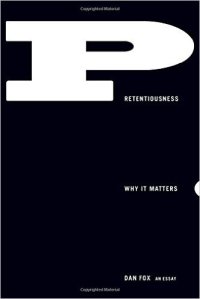 If I had the money for grandiose acts of largesse, I would buy a whole case of Dan Fox’s latest and send them out to all of my friends and relatives, my member of parliament, Canada’s minister of heritage, every arts administrator and broadcaster I’m acquainted with, and as many heads of state as I think would actually read it. This monograph is a stunning defense of thinking and behaving in ways that contravene convention — a deeply necessary defence to make in our time. Fox isn’t attempting a whole-hog refutation of populism. Rather, he has composed an eloquent love letter to broad-mindedness. Fox notes the obvious point that the word “pretentious” is generally used in a derogatory fashion: to put somebody back in their place when they’re perceived to have overstepped a social boundary. But he argues persuasively that the act of overstepping social boundaries — which necessitates a certain amount of pretense or pretending (to the throne, even) — is inherently praiseworthy. And he has some choice words for those who prefer the epithet “elitist,” too. He cites a Guardian columnist who literally professed hatred —
  Kieron Gillen and Jamie McKelvie had a big year, amping up the action in their blockbuster comic
  If there’s one podcast episode from 2016 that I’m likely to remember for the rest of my life, it’s the short segment that
  The great and shameful archive